CARIARYCAR · DIARY · PERSPECTIVE
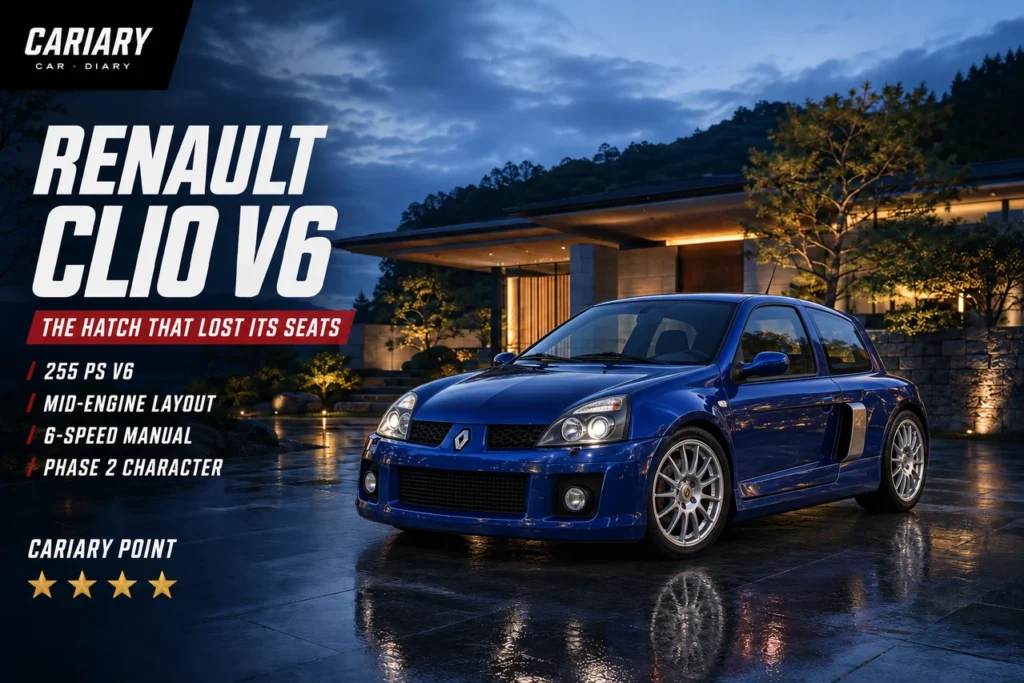
Cover: AI-generated Cariary editorial illustration, checked against the specified vehicle. It is not road-test photography.
This Renault Clio V6 review starts where an ordinary hatchback’s rear passengers would sit. Renault put an engine there instead. That single decision explains why this car is both fascinating and so easy to misunderstand. It resembles something familiar while asking you to accept a completely different set of priorities.
The temptation is to call it the ultimate hot hatch. Cariary thinks that misses its most interesting feature: it gave up much of the practical bargain that makes a hot hatch appealing in the first place. The result needs to be judged as a small, unusual sports car wearing a recognizable shape.
This research-based review covers the European Renault Clio V6 Phase 2 / 255, introduced in 2003 and built through 2005. It is not the earlier 230 PS Phase 1 or the Trophy competition car. Cariary has not driven it. Photographs show Phase 2 examples, including a Japan-market Lutécia and workshop views.
4/5: memorable proportions, a mid-engine identity and a six-speed manual make a compelling enthusiast proposition. Restricted practicality, unusual low-speed usability and the need to assess specialist support keep it from an unconditional five-star recommendation.
Renault Clio V6: Key Specifications
| Reference | European Phase 2 / V6 255, 2003–2005 |
|---|---|
| Engine | Naturally aspirated 3.0-liter V6, mounted transversely behind the seats |
| Output | 255 PS at 7,150 rpm; French ch denotes metric horsepower |
| Transmission / drive | Six-speed manual; rear-wheel drive |
| Seating | Two; the engine occupies the rear passenger area |
| Official acceleration | 0–100 km/h in 5.8 seconds, manufacturer claim |
| Source | Renault’s July 2003 launch release |
Renault Clio V6: When Familiar Proportions Turn Strange
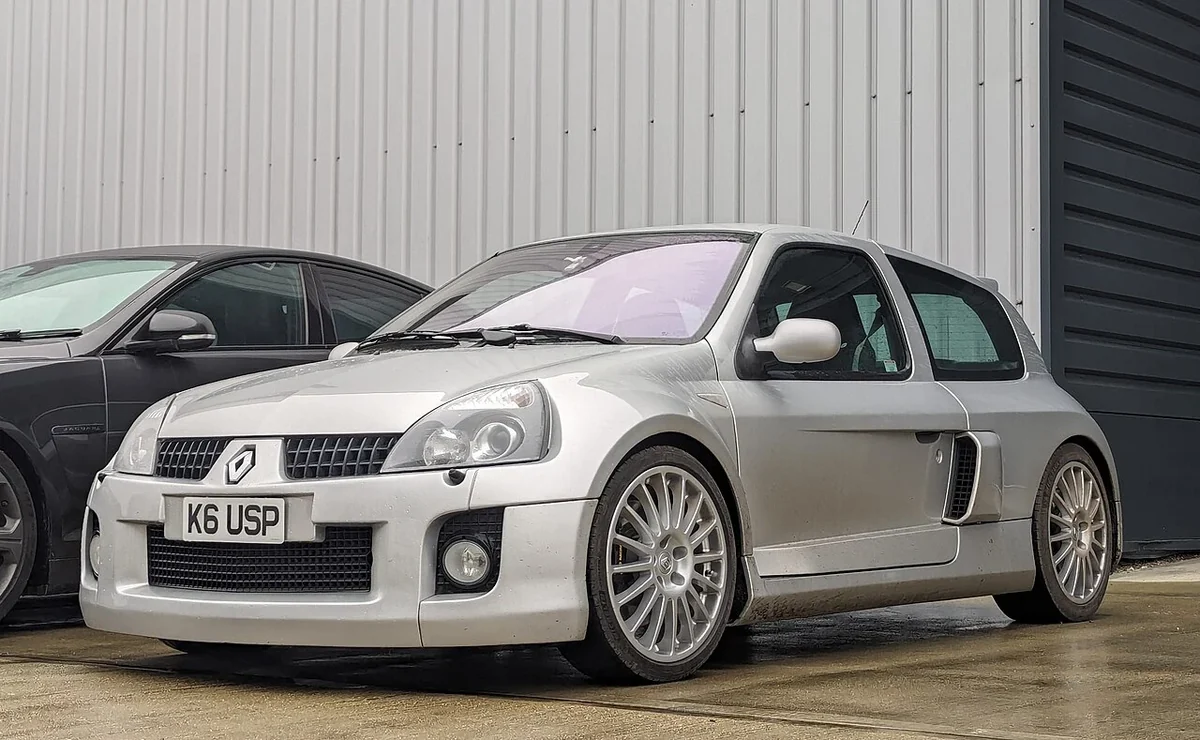
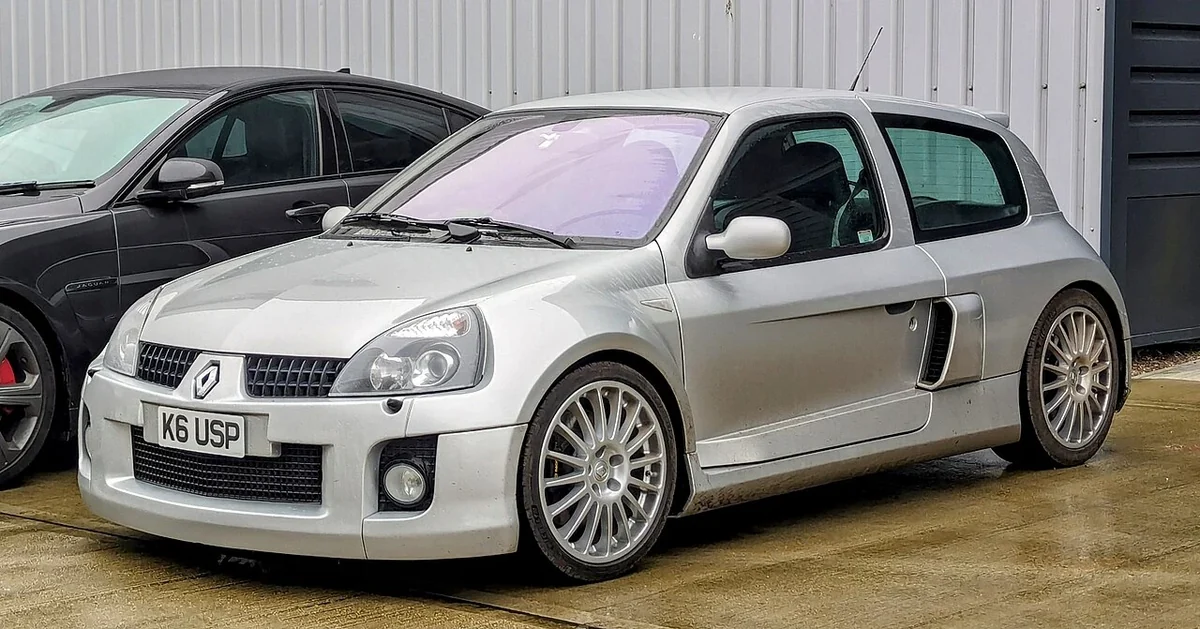
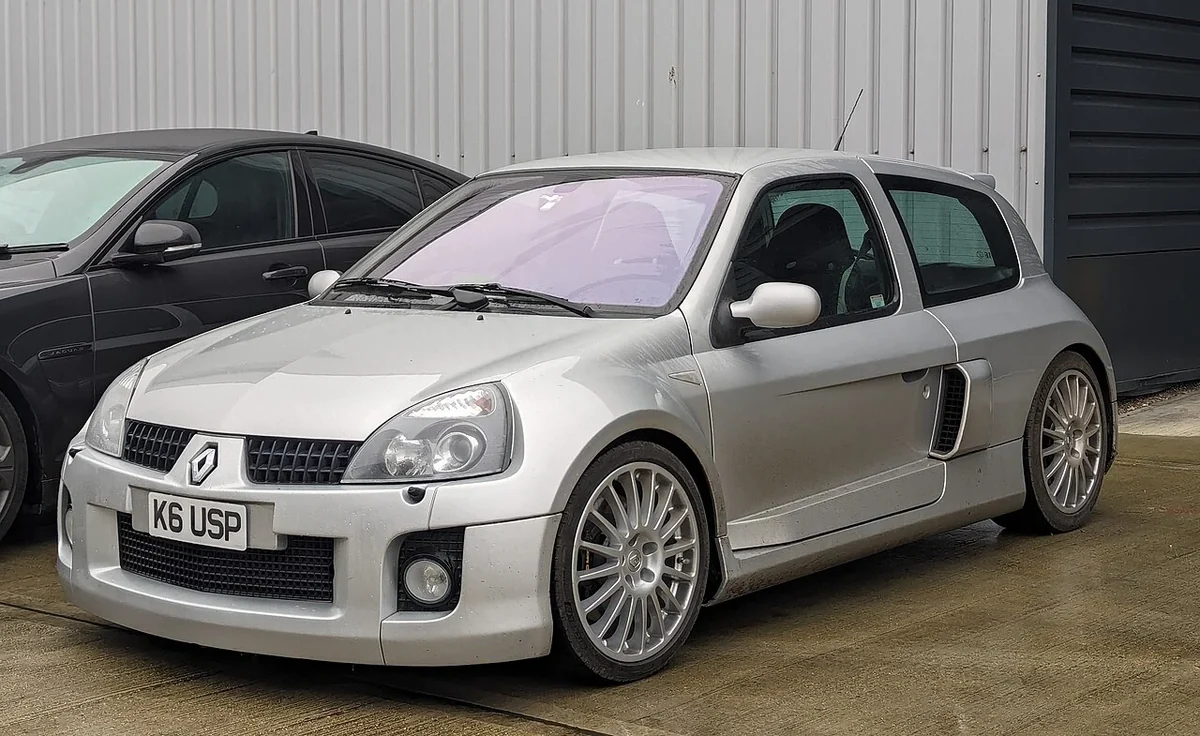
From the front, the Phase 2 headlights still connect it to an ordinary Clio. Move around the car and the widened arches, deep sills and side openings change the reading completely. The photograph makes the contrast more interesting than the simple claim that it looks aggressive.
Its appeal depends on recognition. A purpose-built exotic looks unusual because that is what you expect. The Renault Clio V6 feels unusual because your mind first reaches for an everyday hatchback, then has to revise the answer.
That does not make the bodywork merely a joke. It communicates that something fundamental has changed underneath. Cariary likes a design whose oddness leads to a mechanical explanation, rather than one that relies entirely on ornamental vents and a louder badge.
The Engine Replaced More Than the Rear Seats
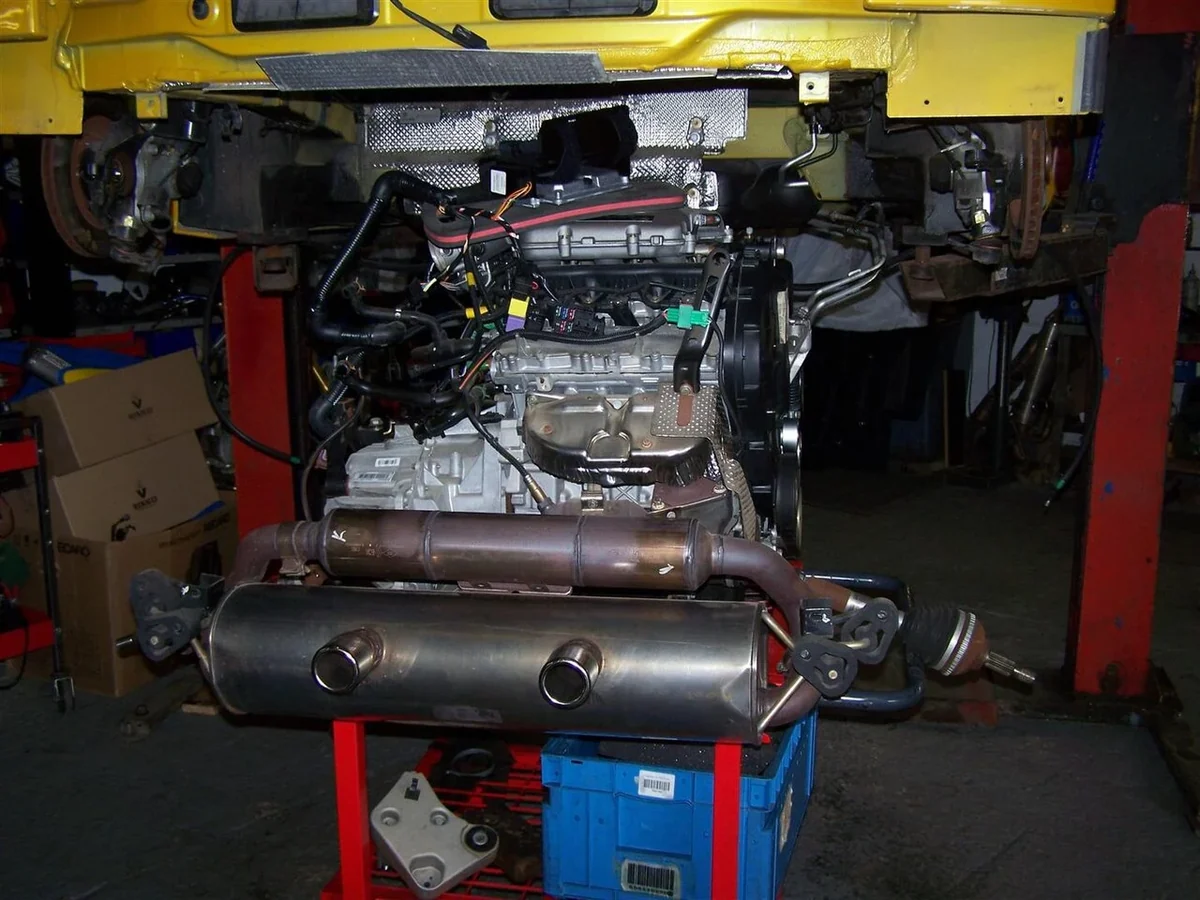
Renault’s July 2003 launch release specifies two seats and a transverse rear-mid-mounted V6. The important word is layout. Moving the engine into the former passenger area changes the car’s packaging and the location of a substantial part of its mass.
A normal hot hatch promises that the same car can carry friends or shopping and entertain its driver. The Clio V6 abandons that easy dual role. Its small exterior does not buy you ordinary hatchback flexibility.
The workshop photograph below shows the mechanical assembly with bodywork removed. It is a real vehicle photograph, not a generated cutaway or a repair guide. It helps explain why treating this as a normal Clio with a larger engine would be such a poor starting point for either ownership or servicing.
Phase 2 Was More Than a New Face
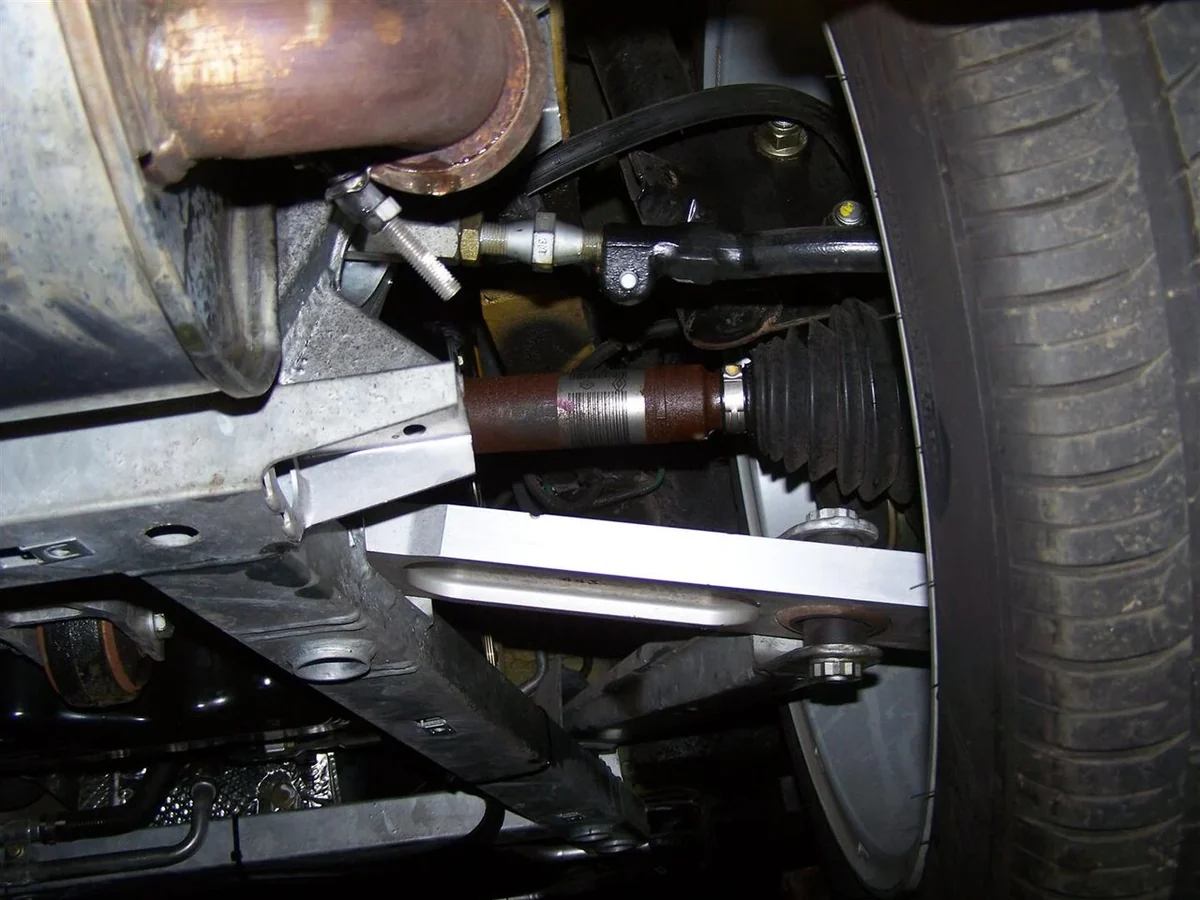
Renault’s Clio history describes a 33 mm increase in wheelbase and a 23 mm wider front track for Phase 2, alongside suspension and subframe changes. Production moved to Dieppe, where Renault records 1,309 examples of the 255 through 2005.
Those changes matter because the familiar shorthand—earlier car, later headlights—leaves out development beneath the skin. Renault was working on how the unusual package behaved, not simply how it looked in a showroom.
This does not mean a later badge makes the car immune to driver error or removes the importance of condition. It means the generation should be identified accurately before comparisons begin. A Phase 1 review can explain the origins of the idea, but it cannot substitute for evidence about the Phase 2 you intend to buy.
255 PS With the Engine Beside the Conversation
evo’s 2008 Clio V6 255 drive describes an engine that becomes more animated high in its rev range and a manual shift the writer found precise. It also notes a high seating position and steering that initially felt disconnected. These are attributed observations from that test, not a Cariary drive.
The useful conclusion is not that the Clio is simply thrilling or simply flawed. The same layout that creates theatre also asks the driver to learn an unfamiliar set of responses. An entertaining car does not have to deliver every sensation in the most immediately intuitive way.
For a prospective owner, a controlled test drive should answer whether that learning process appeals. The engine’s location may fascinate you in a photograph; living with its presence and the driving position is a separate decision. Choose the relationship you want with the car, not only the story you want to tell about it.
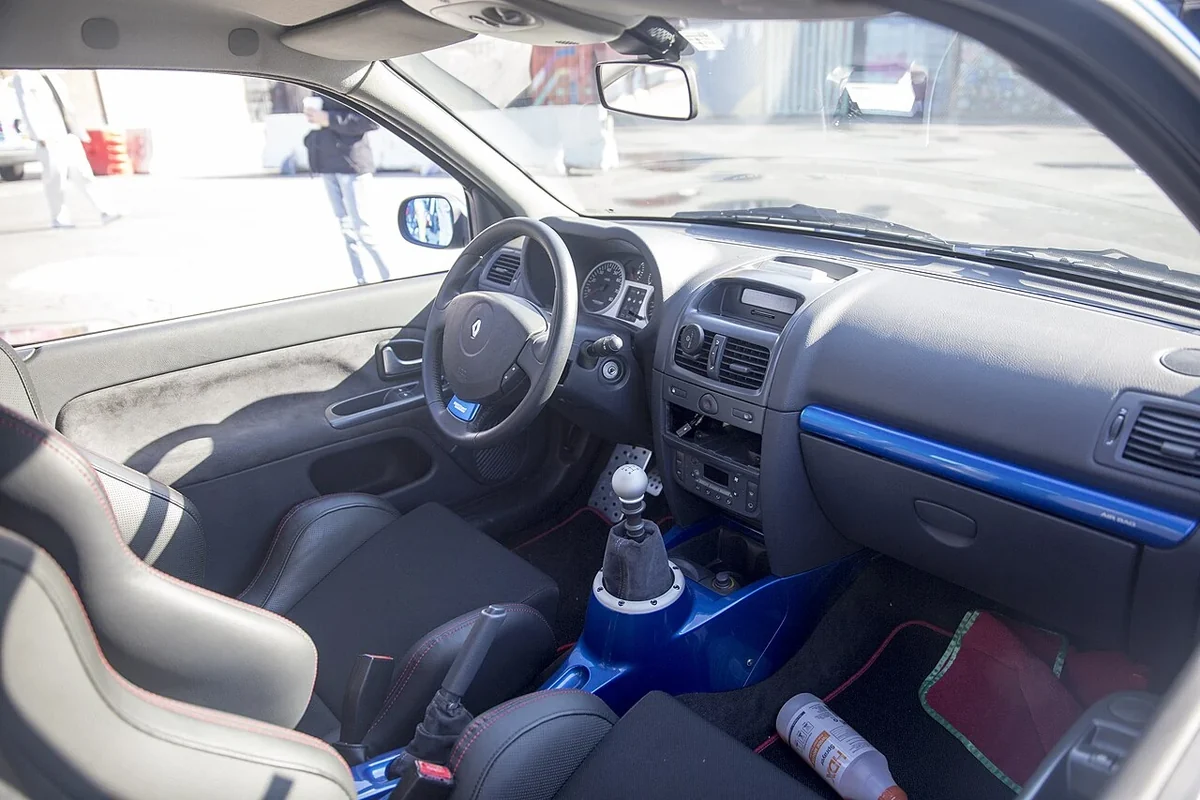
Inside the Renault Clio V6: Ordinary Pieces, Extraordinary Purpose
The Lutécia interior photograph shows the contradiction clearly: a recognizable small-car dashboard in a cabin devoted to something far less ordinary. The Japan-market name and the photographed trim should not be read as universal European equipment.
Cariary does not see a conventional dashboard as a fatal weakness. Its familiarity can make the mechanical absurdity around it more memorable. But an owner paying for rarity is entitled to separate that charm from material quality, wear and seat fit.
Try the wheel and pedal relationship, check whether the seat supports you comfortably, and consider a journey longer than the seller’s demonstration route. Distinctive engineering should enrich time in the car. It should not require you to pretend an uncomfortable position is comfortable because the vehicle is special.
Small Car, Large Practical Compromises
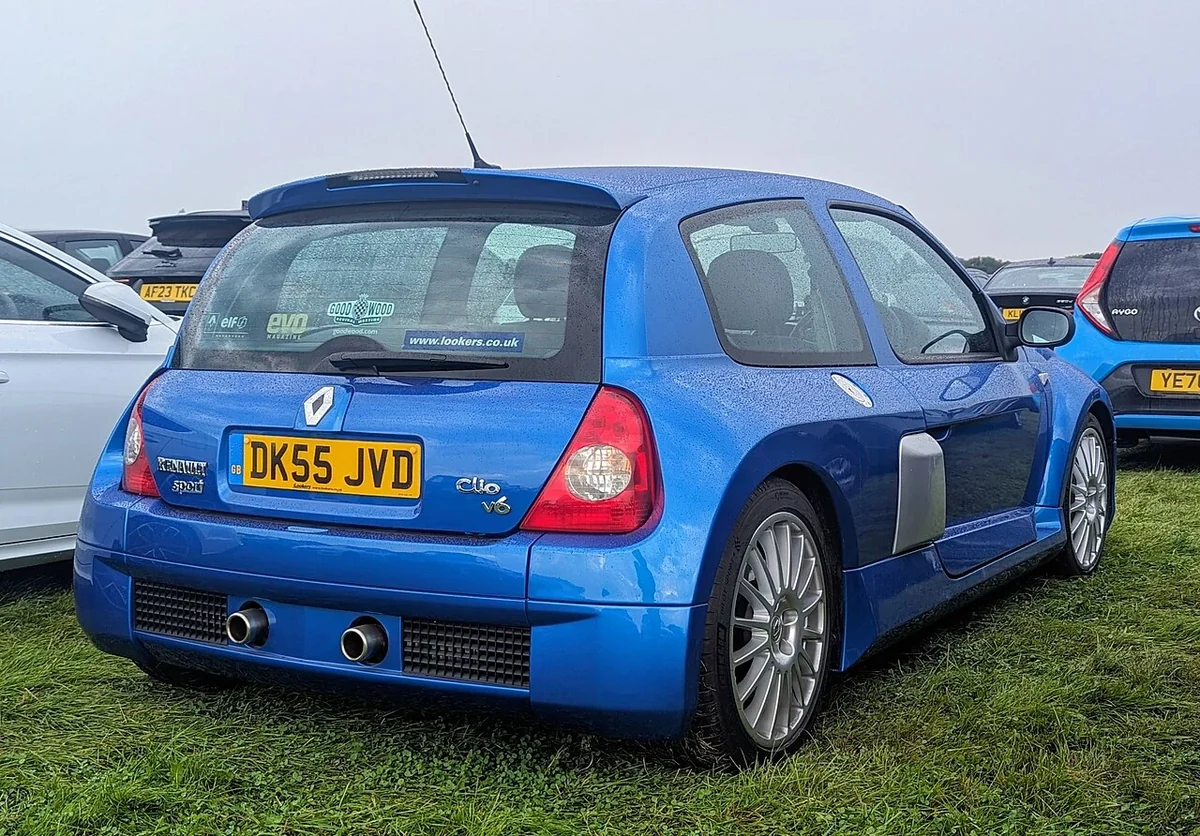
The rear view retains a hatchback outline, which is exactly why expectations need resetting. There are no rear passengers to collect. Any luggage plan needs to work around the real available storage rather than the useful-looking silhouette.
Before buying, try the low-speed movements your own parking place demands. The width across the bodywork, turning space and visibility matter more than the word Clio on an advertisement. An occasional car can tolerate compromises, but those compromises should be consciously accepted.
This is also a value question. If you want one vehicle to perform many ordinary tasks, paying for the V6’s uniqueness buys away some of the flexibility you need. If you already have daily transport, that same focus can become part of the attraction. The vehicle has not changed; the role has.
Used Buying: Rarity Is Not a Condition Report
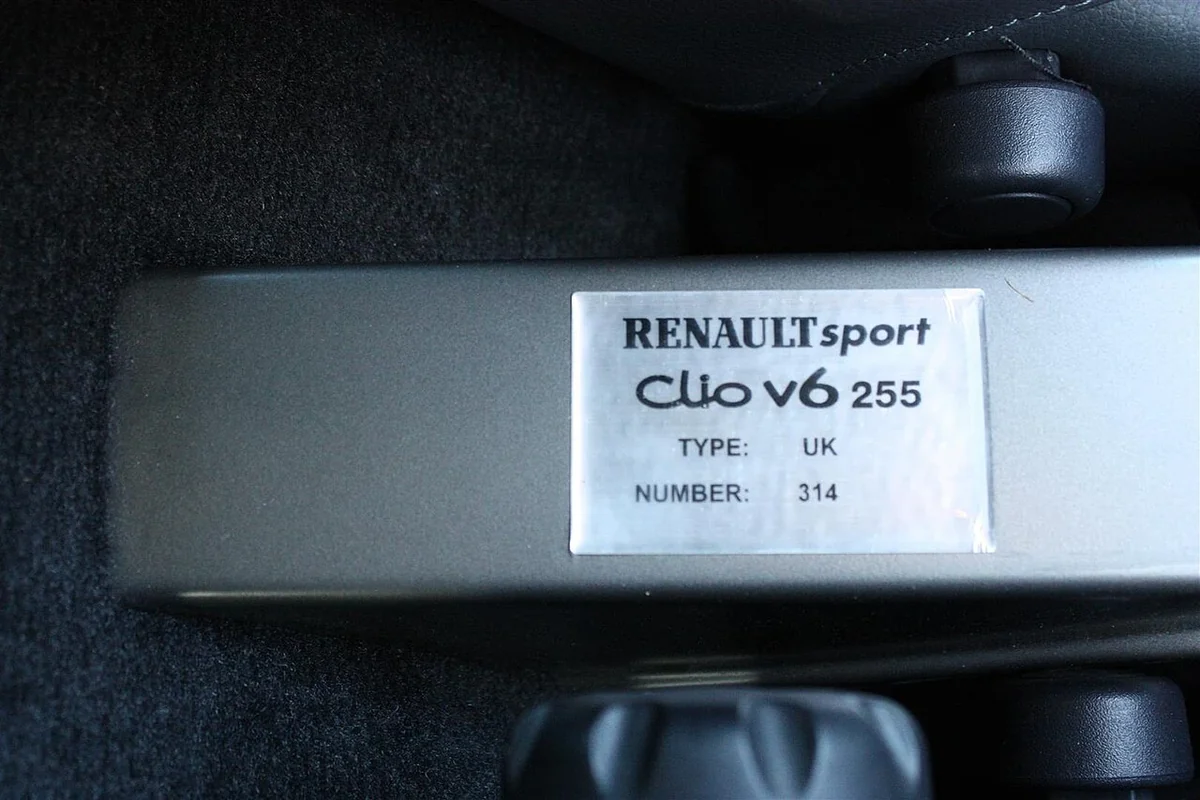
A numbered plaque is enjoyable evidence of the car’s identity, not evidence of mechanical health. Inspect the bodywork and repair history, establish the service work due on the actual example, and ask a Renault Sport specialist to assess it before committing.
Cariary would price needed maintenance and check the availability of model-specific components locally. The fact that familiar switches or a Renault badge appear in the cabin does not establish that all the important work will be priced like routine hatchback servicing. Equally, rarity alone does not prove that every part is unobtainable.
Avoid turning an old review’s used price into a current valuation. Compare documented cars in your own market and distinguish an asking price from a completed sale. The rational ownership case is not that the car must appreciate. It is that you can afford to maintain and enjoy the particular example you buy.
Cariary Perspective: Four Stars for a Car With a Point
The Alpine A110 provides a revealing French sports-car contrast. Its review centers on lightness and a purpose-built coupe. The Clio V6 draws fascination from transforming something familiar into a mid-engine two-seater. These are different routes to making a drive feel like an occasion.
The Renault earns four stars because the idea remains unusually clear. You do not need to win a horsepower comparison to understand why someone would want it. Its silhouette tells the setup; the engine’s location supplies the surprise.
The missing star reflects the narrowness of the recommendation. The Renault Clio V6 makes most sense for someone who actively wants its compromises as part of a distinctive second-car experience. It makes much less sense when bought as the fastest-looking version of a practical hatchback. Understand that difference, and the car becomes more interesting rather than less reasonable.
Who Should Buy It?
Recommended For
An enthusiast seeking a distinctive manual second car, who accepts two-seat packaging and can arrange specialist inspection and maintenance.
Not Recommended For
Someone expecting hot-hatch versatility, ordinary Clio running costs or immediately familiar handling without a period of careful acclimatization.
One-Line Verdict: The Clio V6 is memorable because Renault changed the purpose of a hatchback, not merely its engine size.
Frequently Asked Questions
Is the Renault Clio V6 front-wheel drive?
No. The V6 road car uses a mid-mounted engine and rear-wheel drive. It should not be confused with the ordinary front-drive Clio range.
Does it have rear seats?
No. The V6 occupies the rear passenger area; this is a two-seat sports car despite the familiar hatchback outline.
Why focus on Phase 2?
It combines the 255 PS engine with meaningful chassis revisions. It is a distinct buying proposition, not simply a Phase 1 with updated lights.
Is 255 PS the same as 255 U.S. horsepower?
No. PS and French ch are metric horsepower units. Unit differences should not be mistaken for a model upgrade or ignored in comparisons.
Should I buy one as an investment?
Cariary would buy it for the experience and only with a sustainable ownership budget. Rarity and past prices do not guarantee future value.
Further Reading and Data Reference
Data reference date: September 27, 2026. Official specifications and attributed test observations are linked where discussed. Cariary Point is an editorial buyer-fit assessment, not an owner road-test score or reliability rating.
Explore more Cariary car reviews and buyer perspectives.

