A designer draws a beautiful car, engineers make it work, and a factory builds it. That is how I used to picture the Car Design Process. The more interesting reality is that those jobs overlap: the shape keeps changing as people discover what the car needs to do.
Why build a life-size clay model when a computer can create a convincing image? Why does a slim headlight need so much space? And why can the car on a motor-show stand look different from the one that eventually reaches a showroom?
Let’s follow a new model through seven connected stages. They are a useful map, not a universal factory schedule: teams revisit earlier decisions, and interior, exterior and engineering work often run alongside one another.
Quick Summary
- A new car starts with a purpose, a customer and a package, not just an attractive outline.
- Proportions establish its basic character before details such as lamps and trim are settled.
- Sketches, digital models and physical models answer different questions; one does not automatically replace the others.
- Safety, aerodynamics, comfort, manufacturing and cost influence design throughout development.
- Design freeze means controlling changes, not declaring that no detail can ever change again.
- A clay styling model, a mechanical test vehicle and a production prototype are different things.
- The real achievement is preserving a clear idea in a car that works and can be built consistently.
Why Understanding Car Design Changes What We See
When a new car appears, we usually react to its face first. We like the lamps, dislike the grille, or wonder why the wheels look too small. Those reactions are real, but they tell us little about the decisions underneath.
A taller roof might make space for occupants above a battery. A thicker-looking pillar might accommodate several structural and packaging requirements. Neither observation proves that a particular design decision was inevitable; it simply gives us better questions to ask.
This is also why good design is not the same as adding more decoration. Our guide to how car design evolved looks at changing visual tastes. Here, we are opening the studio door to understand how an individual model takes shape.
1. The Car Design Process Starts With a Brief and a Package
Before deciding what the nose looks like, the team needs to know what kind of car it is creating. A compact city car and a long-distance luxury GT solve different problems, even if both need to look desirable.
The brief brings those questions together: who will use it, what will they carry, where will it be sold, what should it cost, and how should it express the brand? Research can inform those choices, but it does not produce a finished shape by itself.
Hyundai’s account of concept design connects customer aspirations and brand values with an initial design direction. That is a useful distinction: a brief sets an ambition; designers still have to interpret it. A concept-car project may explore possibilities that a production project must also justify commercially and technically.
What Does Vehicle Packaging Mean?
Packaging means arranging the things the vehicle must contain. Think seats, people, luggage, powertrain, battery, cooling equipment and the space needed for structures and moving components.
Wheelbase is the distance between the front and rear axle centers. It is not the same as overall length, which also includes the body beyond the wheels, or track width, which describes the lateral spacing of wheels on an axle.
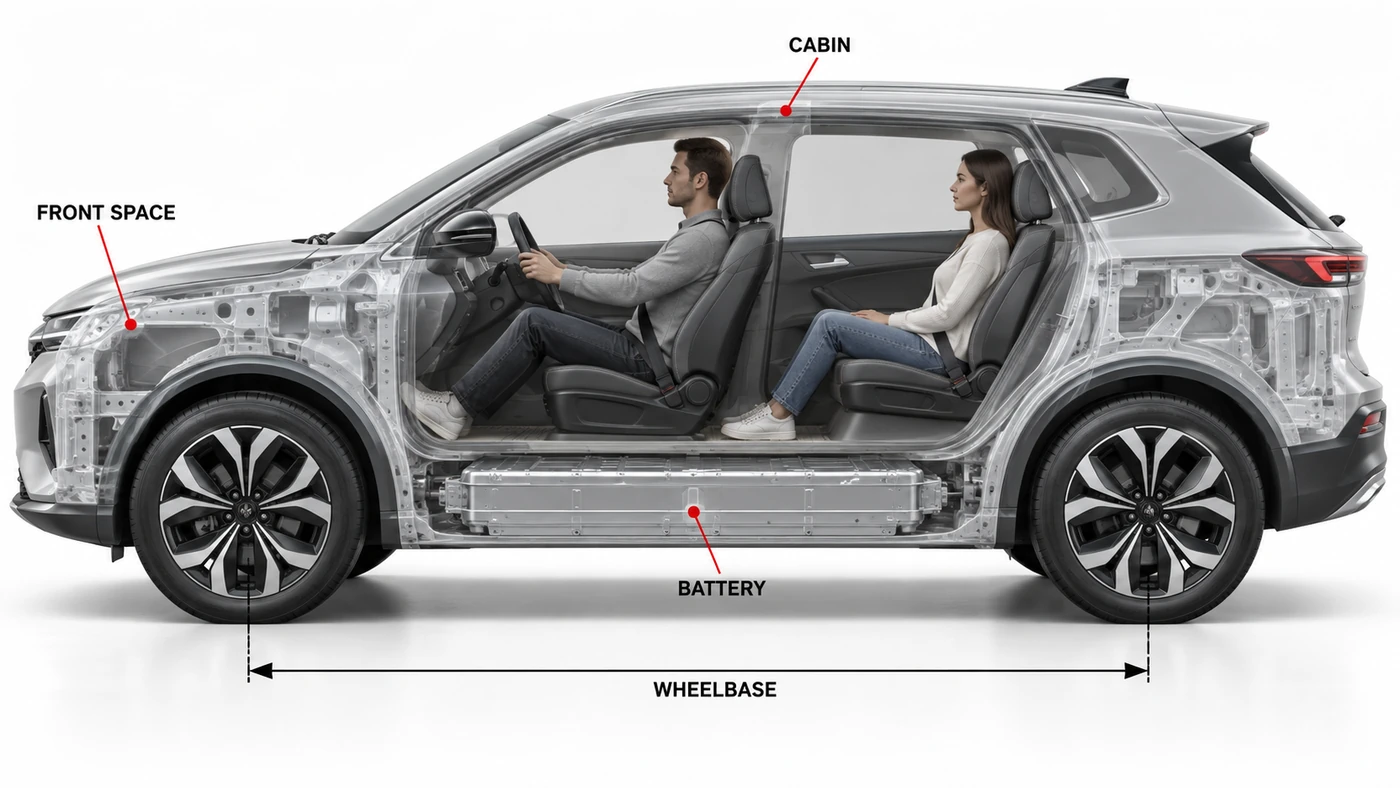
Imagine moving a front wheel forward while leaving the seats in place. The side view changes, but so can space around the footwell, steering system and front structure. One elegant line on paper can affect several systems.
An electric platform may allow a shorter nose, but it does not make the front of the car empty. Occupant protection, suspension, cooling and other equipment still need space. Likewise, a long hood can support a traditional front-engine sports-car identity without being a universal requirement for that category.
Some key locations, often called hard points, come from an existing platform. Others are negotiated as a new architecture develops. Packaging is therefore neither unlimited freedom nor a box engineers finish before designers are allowed to contribute. Our car structure basics guide adds context to the structure beneath these surfaces.
2. Proportions and Sketches Give the Idea a Personality
A car can be recognizable in silhouette before we see a badge. The relationship between wheels, roof, cabin and body ends already suggests whether it is upright, formal, compact or athletic.
This is why proportions matter so much. Details can strengthen an idea, but a dramatic grille cannot independently correct every awkward relationship in the side view. What counts as beautiful remains subjective; there is no single wheelbase-to-roof formula that makes every car successful.
Why Do Early Sketches Look So Exaggerated?
An exploratory sketch may have enormous wheels, an extremely low roof and very little visible cabin space. Its first job can be to communicate energy and direction, rather than document a buildable car.
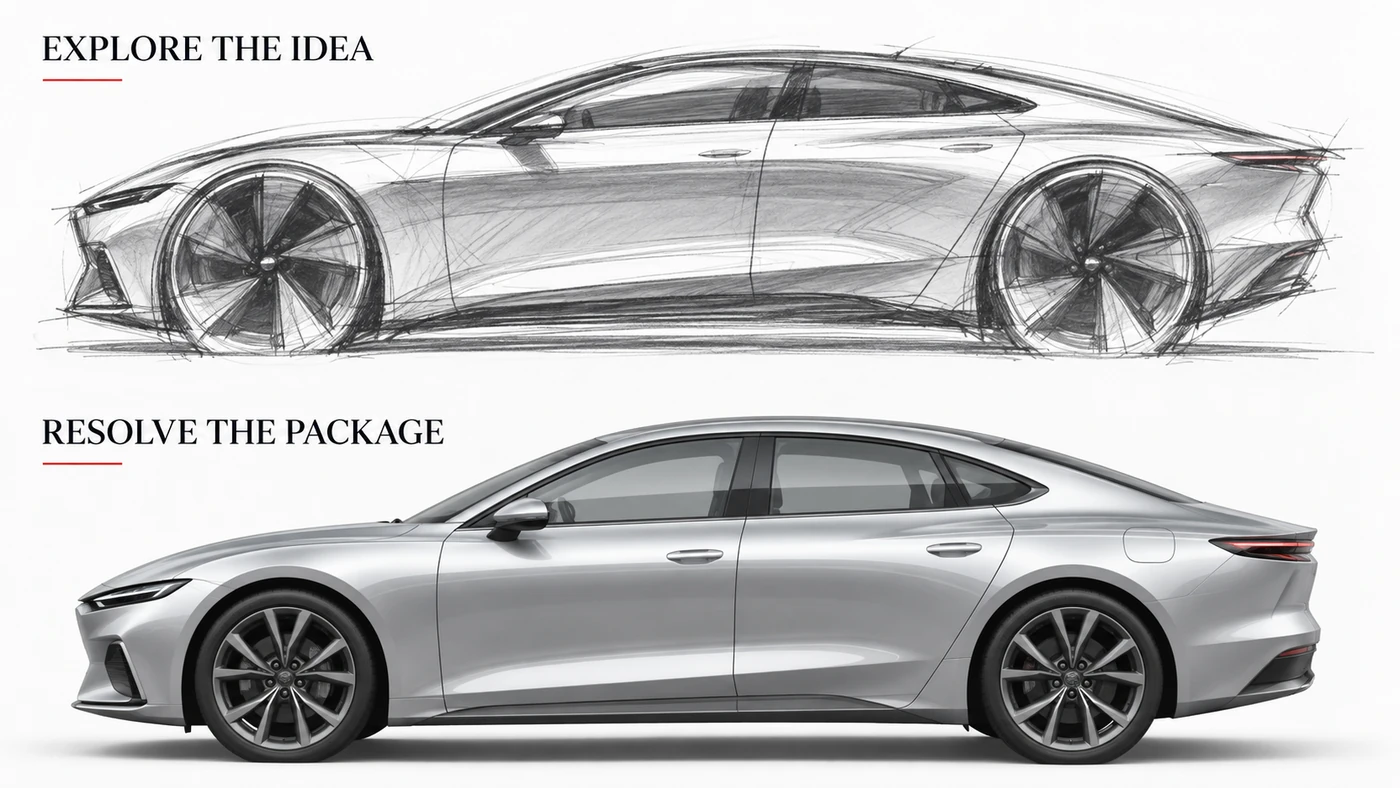
The useful question is not whether the sketch is already realistic. It is which qualities should survive when the package becomes more demanding. Perhaps the important idea is a strong rear shoulder, a low visual nose or one uninterrupted roof arc.
Studios develop multiple proposals rather than relying on a single inspired drawing. Reviewing alternatives makes the choice more explicit: which interpretation fits this vehicle and its brand, and which can mature into a coherent whole?
Tape drawing is another way to explore the relationship between an outline and a package. BMW’s documented process uses flexible tape over a full-size package plan. Moving a line makes its relationship with the underlying layout easier to discuss. That is a manufacturer example, not a requirement that every studio follows today.
3. Digital Models and Clay Make the Shape Answer Questions
A drawing gives us one chosen viewpoint. A three-dimensional model forces the surfaces to connect when we walk around the car, lower our viewpoint or change the light.
In automotive work, CAS usually means computer-aided styling, while CAD means computer-aided design. The terms and software overlap in practice. Broadly, styling tools help develop form, while engineering work must also define the detailed geometry and relationships needed for a functioning product.
Hyundai Motor Group’s digital-design explanation describes the movement between styling models, engineering data and repeated revisions. The important lesson is not a rigid software boundary. It is that an attractive surface must gradually become precise enough to work with the rest of the vehicle.
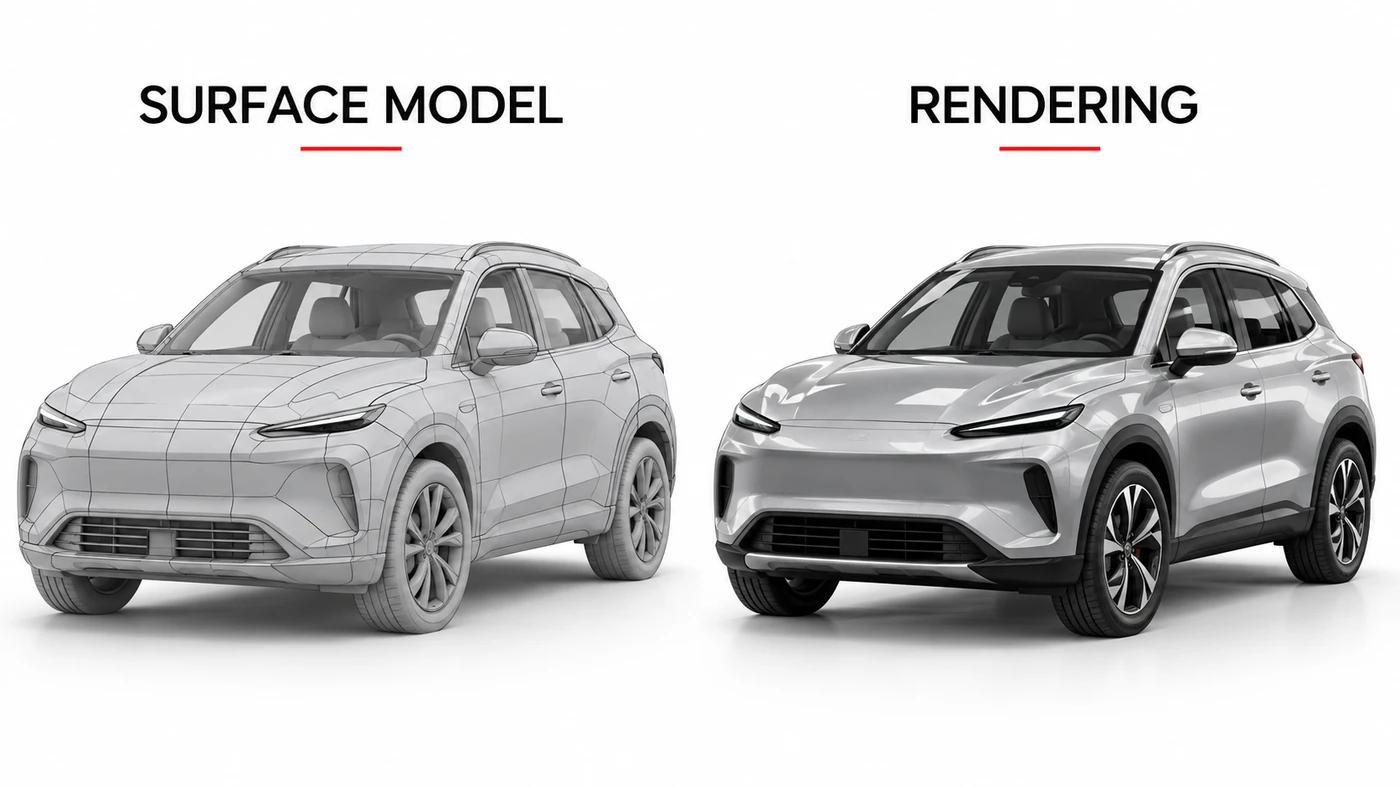
A rendering is a visual presentation of that imagined object, with materials, lighting and reflections. It can look photographic without proving that the car can be manufactured. VR adds another way to assess scale and viewpoints, but convincing immersion is not a safety certificate either.
Why Clay Still Has a Job
Full-size physical models let people judge a car together in real space. Walking around a surface, seeing its height against your body and watching a reflection move can raise questions that are less obvious on a monitor.
Mercedes-Benz describes a process involving smaller clay models, digital evaluation and full-size models. Scanning and milling connect physical and digital work; hand refinement can then feed back into the data. These are cooperating tools, not rival eras of design.
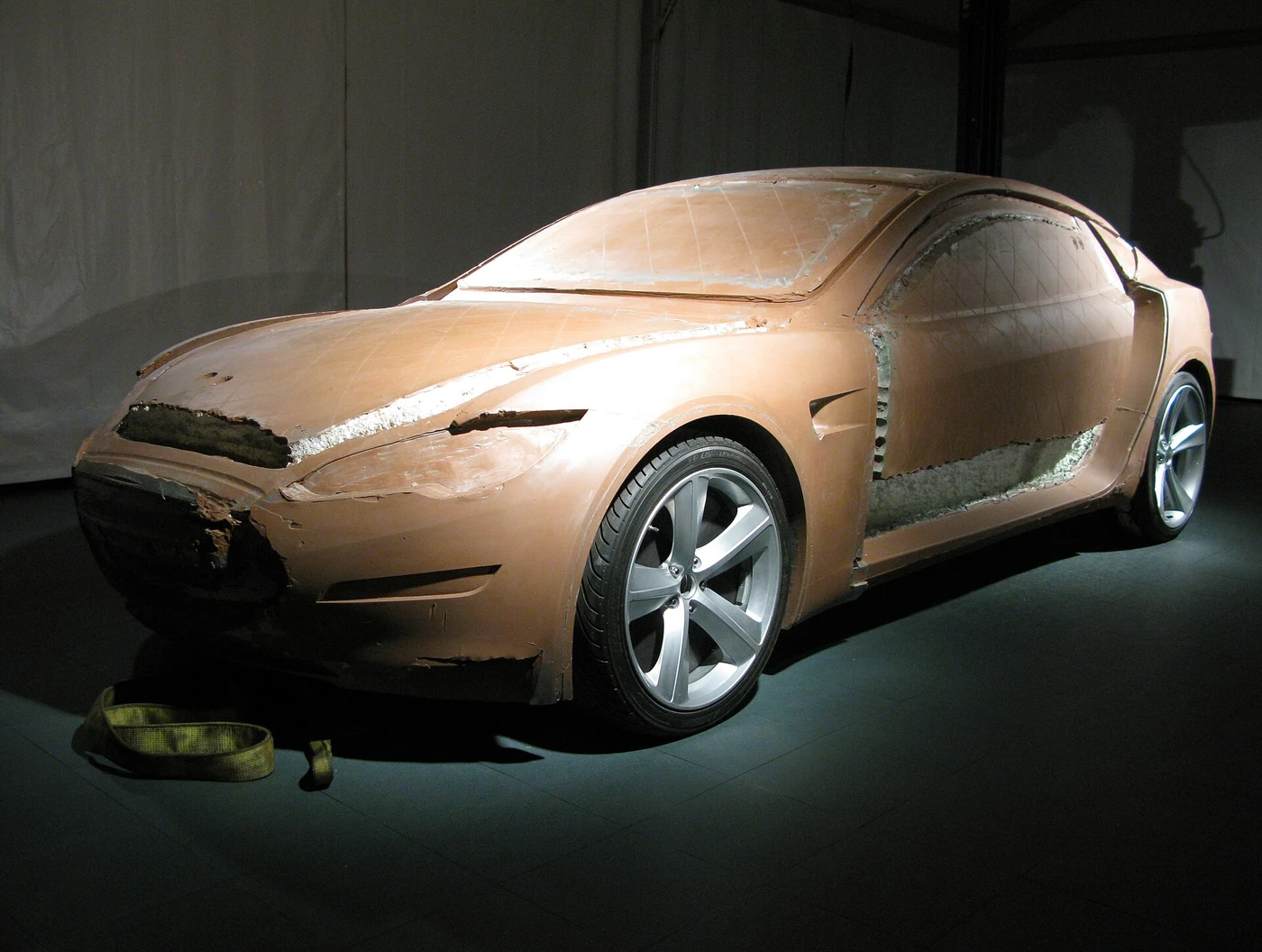
The material is specialist modeling clay, not a giant lump of pottery mud. A model may combine a supporting structure with applied clay and other components. A 1:1 model is full size; a 1:4 model has one-quarter of the corresponding linear dimensions, not one-quarter of the volume.
Reflective coverings can help designers read the surface without the clay’s color dominating the impression. A model with lamps, wheels or a convincing finish can nevertheless remain a styling object. It is not automatically driveable, and it is not the vehicle used to prove crash performance.
Moving the model into different lighting can change the judgment again. A reflection that looks clean beneath one studio lamp may break awkwardly from another viewpoint. Small local changes to curvature or an edge can matter, but there is no universal millimeter adjustment that fixes every surface.
4. Engineering Helps the Design Survive the Real World
It is tempting to imagine engineers arriving late to spoil the exciting drawing. A better picture is a continuous discussion: how can the team keep the intended character while making the car work?
Not every constraint has one inevitable answer. Changing an opening, a component location or the way a surface ends can produce several possible solutions. The quality of the result depends partly on how well those solutions belong together.
Air Does Not Judge a Car From One Photograph
Aerodynamics includes drag, lift, cooling flow and wind noise. CFD, or computational fluid dynamics, predicts aspects of airflow using computer simulation. Wind tunnels provide physical measurements under controlled conditions.
Porsche Engineering explains how simulation and wind-tunnel work remain complementary. Styling and airflow have to be considered together, rather than treating aerodynamic testing as a final pass-or-fail visit.
This does not mean making every edge round. A particular edge can help air separate where the team wants it to. Nor can we infer a car’s drag from one smooth-looking photograph: underbody details, wheel airflow and cooling requirements are also part of the system.
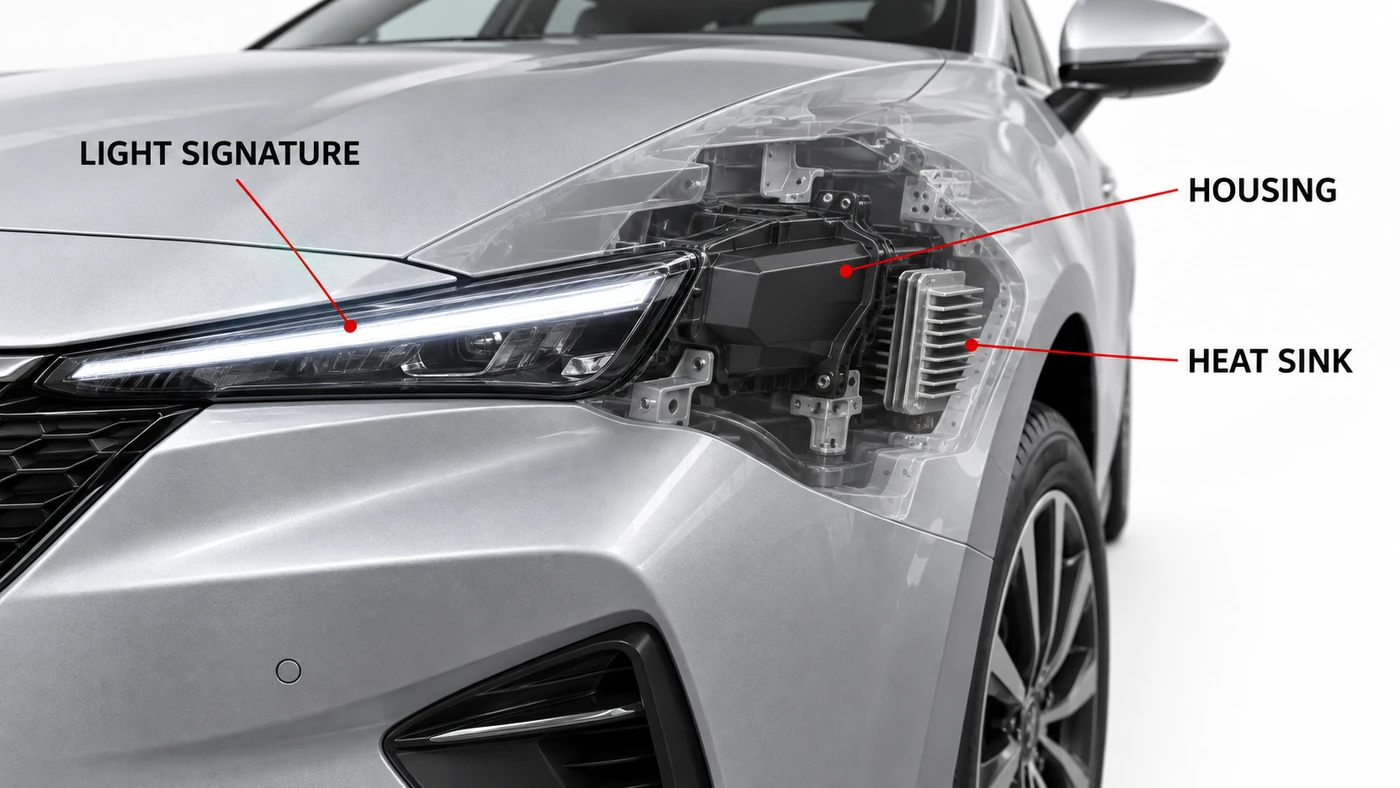
The Thin Headlight That Is Not Thin Behind the Lens
A visible light signature is only the front of a larger assembly. Optics must shape the beam, electronics need space, and heat must be managed. HELLA’s explanation of LED headlight technology shows why lighting design is about much more than drawing a bright strip.
The same reasoning applies to sensors. Some vehicles place radar behind a bumper or emblem, but not every badge hides radar and not every car uses the same sensor set. Materials and coatings in front of radar can affect its performance, which is why suppliers such as Rohde & Schwarz test radomes and bumpers.
Safety creates further interactions. For example, the relationship between a hood and hard components beneath it can matter to pedestrian protection. Euro NCAP’s assessment overview helps explain the people and impact scenarios being considered. Its consumer ratings are not themselves the same thing as a market’s legal approval requirements.
| Design ambition | Practical question | What the team is trying to preserve |
|---|---|---|
| Very low nose | Can the structures, equipment and protection requirements fit? | A low visual impression, not necessarily the lowest possible metal |
| Thin lamp signature | Where do optics, electronics and cooling go? | A recognizable light without sacrificing its function |
| Clean front surface | How do cooling and sensors work through or around it? | Simplicity that remains functional |
| Smooth body shape | What happens to airflow around the entire car? | A coherent form with suitable aerodynamic behavior |
5. Interior Design Starts With People, Not Just Screens
The cabin is not decoration added after the outside is finished. Seat position, roof height, sightlines and door openings connect the interior directly to the overall package.
Ergonomics means designing around human use. Can different occupants reach a control, see a display, enter the vehicle and sit comfortably? A screen that looks beautifully integrated in a photograph still needs to work in changing light and real driving conditions.
A full-size buck is a physical mock-up used to study aspects of the cabin. Different bucks serve different purposes; an appearance model does not necessarily reproduce every mechanism or structural property of the finished car.
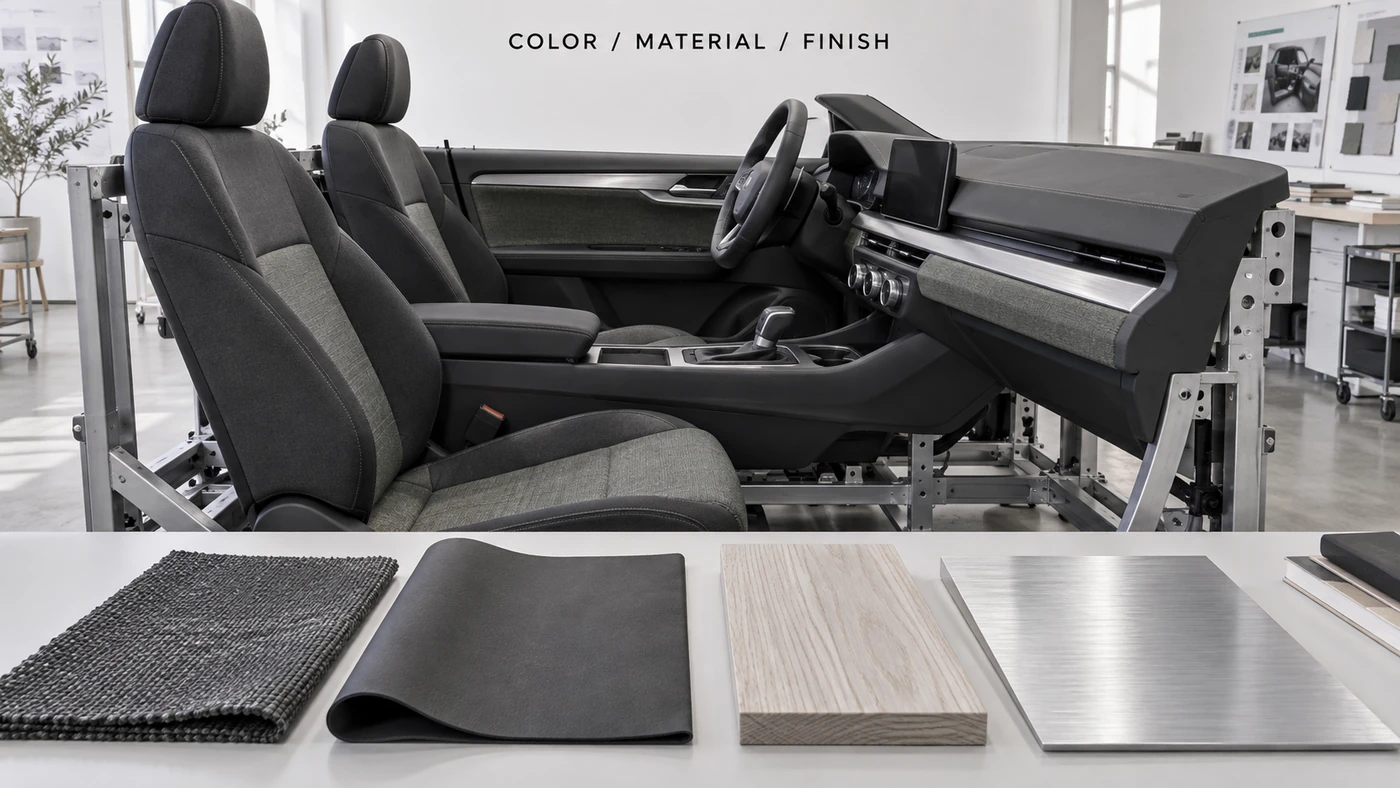
CMF: Color, Material and Finish
CMF is the part of design that considers these choices together. The same dashboard form can feel very different with woven fabric, wood, brushed metal or a glossy surface.
Mercedes-Benz describes evaluating material samples in realistic interior contexts. That matters because a small sample held under studio light is not the same experience as a complete seat or dashboard surrounding a person.
Appearance is only one question. Teams must also consider wear, cleaning, sunlight exposure, reflections, assembly and cost. A natural-looking material is not automatically sustainable, and real metal is not automatically the right answer everywhere. A material’s suitability depends on the application and evidence about its performance.
Wheels sit at a similar intersection of appearance and function. Diameter and spoke design contribute to the visual stance, but brake clearance, cooling, strength, weight and tire choice also matter. Our guide to whether bigger wheels are actually better explains why a more dramatic showroom appearance can involve trade-offs on the road.
6. Design Freeze Turns an Idea Into a Controlled Commitment
At some point, suppliers and production teams need stable information. They cannot prepare tools around a body surface that changes freely every week.
Design freeze is a commitment to an agreed design baseline. It does not mean that absolutely nothing can change afterward. Necessary changes are assessed for their consequences, and different systems can reach their decision points at different times.
What Is a Class-A Surface?
In this context, Class-A surfacing concerns the high-quality visible surfaces of a product: their precision, transitions and visual behavior. Autodesk’s automotive surfacing material places it within specialist surface-development work.
It is not a certificate saying that the whole car is ready for sale. The finished component also needs its thickness, attachments, inner geometry and relationships with neighboring parts resolved. A beautiful outer surface is one important part of that job, not the entire manufacturing definition.
Why Manufacturing Can Change a Beautiful Detail
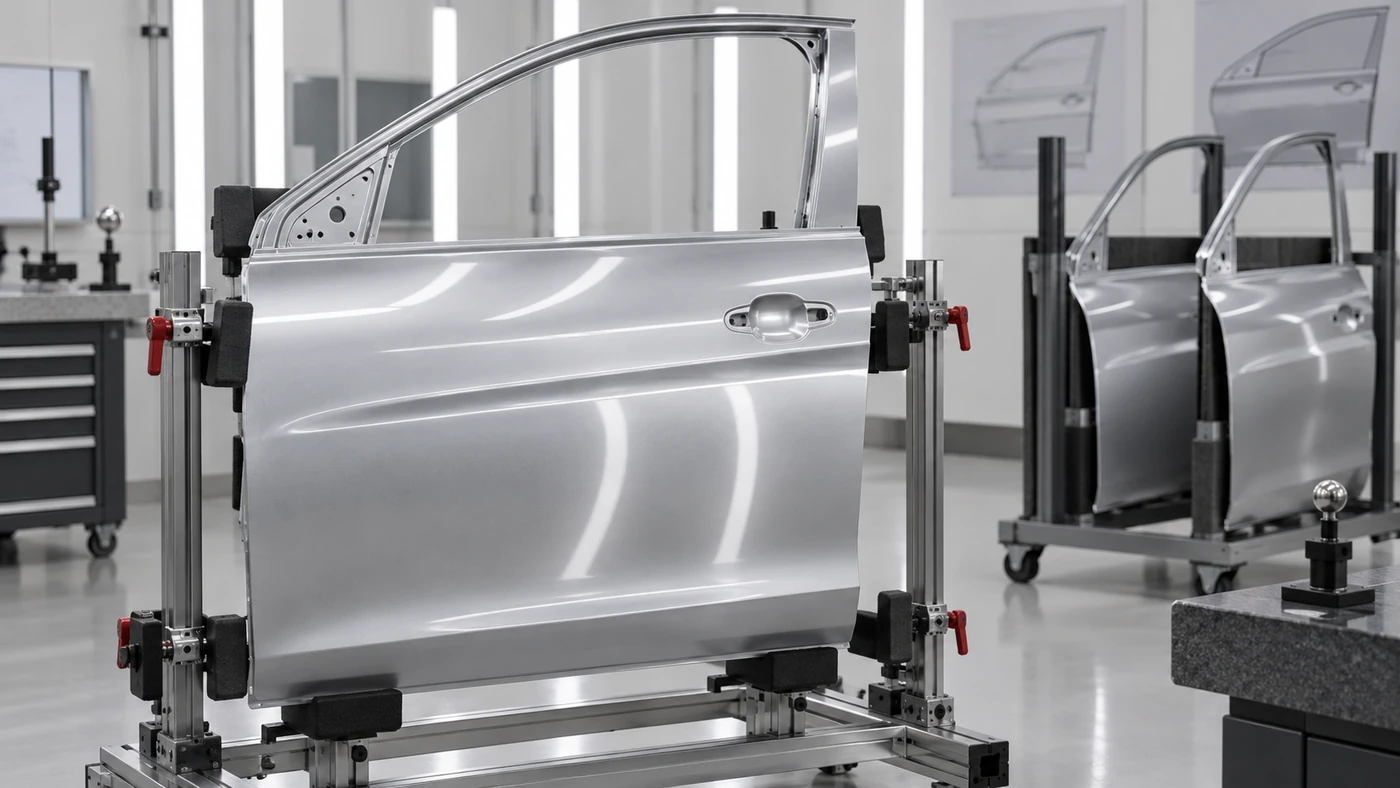
Sheet metal does not behave like a line on a screen. During forming it stretches, and after tools release it, some elastic recovery can change the shape. This is called springback. Tooling and process development must account for it; AutoForm explains the role of springback feasibility and compensation.
A crease that looks sharp in a render must work with the material and forming process. Other components have different constraints, including how molded parts release from tools and how assemblies fit together.
Panel gaps also need more thought than “smaller is always better.” Doors must open without touching neighboring parts, while manufacturing variation and changing conditions have to be accommodated. Consistent, well-controlled relationships matter; eliminating every visible gap is not the objective.
Cost belongs in these conversations throughout development. It is not simply a villain that appears at the end. A compelling design must be deliverable at its intended production volume and price, with enough consistency that the thousandth car still looks intentional.
7. Prototypes and Production Preparation Test the Promise
A camouflage-covered car on the road is exciting because it feels like a glimpse behind the curtain. But it may not tell us exactly how close the model is to launch.
Development vehicles have different jobs. A mule can test new components beneath an existing or adapted body. A prototype can combine more of the intended vehicle, while pre-production builds help teams evaluate the product and the processes that will make it. Terminology and maturity vary by manufacturer.
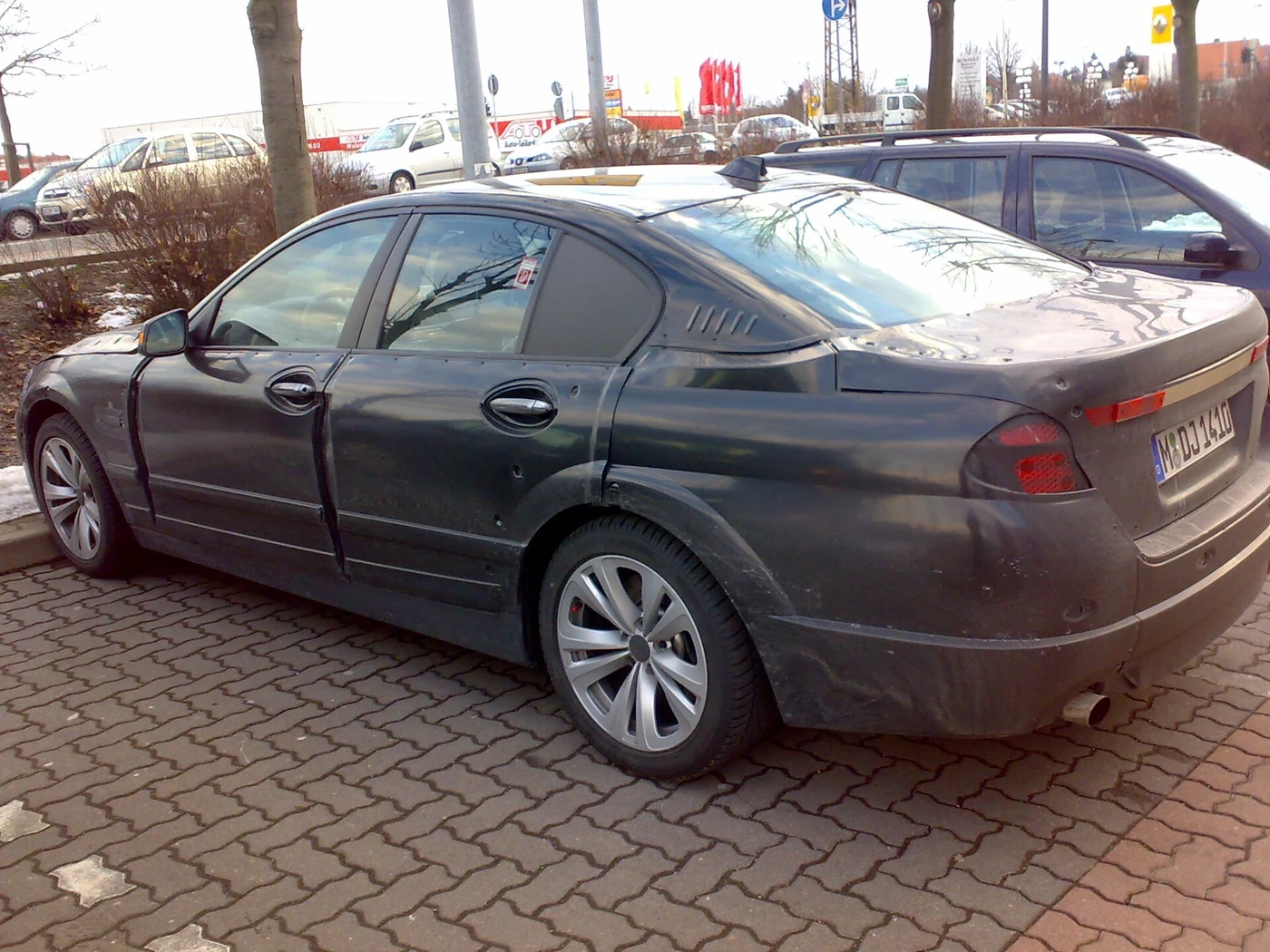
This is also why we should not treat a covered lamp or distorted body panel as a final styling choice. Camouflage deliberately makes the shape harder to read. Some testing takes place while design decisions are still evolving elsewhere.
As production approaches, the question expands from “Does this one look right?” to “Can the system deliver this result repeatedly?” Fit, finish, materials, supplier parts and assembly processes have to work together. Vehicle validation extends far beyond appearance into durability, safety and function.
How Long Does It Take to Design a New Car?
There is no reliable single number for every project. A facelift, a derivative using familiar hardware and an all-new vehicle architecture are different undertakings.
As a historical example, BMW’s 2012 process description described roughly five years for product development and selection of the final design around three years before production. Those figures describe that account, not a universal timetable for today’s industry.
Most importantly, five years of development does not mean five years spent drawing the body. Tooling, testing, supplier work, engineering integration and production preparation are substantial parts of the journey.
Recognizable, but Ready for What Comes Next
Brand identity remains part of the discussion throughout. Would the vehicle still belong to its family if the badge disappeared? The answer can involve proportions, lamps, surface treatment and interior details, not just one familiar grille.
Consistency does not require every model to repeat the same shape. A brand also needs room to evolve. The challenge is making a new direction understandable without reducing design to a collection of borrowed signatures.
Long lead times make that question harder: the customer will meet the car later, not on the day of the first sketch. Teams can already be considering a facelift or successor when a model launches. Exterior and interior need to make sense together now, while leaving the brand somewhere to go next.
Common Misconceptions About How Cars Are Designed
“The designer finishes the car, then engineers take over.” A useful mental picture is repeated exchange, not a one-way handover. Styling choices affect engineering, and engineering discoveries create new design questions.
“Clay is obsolete because computers are more accurate.” Accuracy is not the only question. Digital geometry and a physical object can reveal different things about the same proposal.
“A realistic render proves the car is feasible.” It proves that an image can be convincing. Buildability, occupant accommodation and compliance require other work.
“The production version is always a ruined concept car.” A show car can be exploring ideas rather than promising a finished product. Some production designs remain close to their concepts; others have a different brief or must resolve major practical issues.
“Expensive cars automatically have better design.” Budget creates possibilities, but it does not settle proportion, coherence or usability. Those still require judgment.
Cariary Thoughts
What surprised me most while studying this process was how misleading the sketch-to-factory storyline can be. It suggests that creativity happens first and reality arrives afterward. In practice, reality is one of the things designers are working with from the beginning.
That does not mean every awkward detail deserves an engineering excuse. We usually cannot know the exact internal debate behind a production car just by looking at it. Sometimes there may have been a better solution; sometimes the compromise becomes a clever part of the identity.
For me, the more useful way to look at a car now is to ask what the design is trying to achieve, what had to fit underneath, and whether the final result still communicates a clear idea. A successful design can make a complicated set of decisions feel surprisingly simple.
One-line Summary
The car design process turns an idea into a repeatable, usable product by developing appearance, people, engineering and manufacturing together.
FAQ
Do Car Designers Only Draw the Outside?
No. Automotive design includes exterior and interior work, materials, interfaces and specialist model development. Responsibilities differ between companies, and these teams work with engineering and production specialists.
Why Are Clay Models Still Used?
They allow physical evaluation of scale, surfaces and reflections. They can also be scanned and revised alongside digital models. They are not evidence that a studio has rejected modern software.
Can a Clay Car Be Driven?
A styling clay model should not be assumed to be driveable. Its job is usually to represent form. Running prototypes require the appropriate mechanical, electrical and structural systems.
What Is the Difference Between CAS and CAD?
CAS emphasizes computer-aided styling, while CAD is the broader term for computer-aided design. In practice, tools and tasks overlap; the distinction is not an absolute boundary between two separate stages.
Why Do Concept Cars Have Such Large Wheels?
Concepts and sketches can exaggerate stance to express a design direction. Production choices must also accommodate tires, comfort, clearance, strength, cost and other requirements. Not every concept uses unrealistic wheels.
Does Design Freeze Mean the Car Cannot Change?
No. It establishes a controlled baseline. Later changes can still be necessary, but their effects on engineering, suppliers, tools and timing need to be managed.
Does Every New Car Take Five Years to Develop?
No. Project scope and manufacturer processes differ. Historical examples help explain the scale of the work, but should not be treated as a fixed industry rule or as the time spent on styling alone.
Why Can’t Every Car Look Like a Supercar?
A family vehicle has different passenger, access, luggage and cost requirements. A low, dramatic shape is only useful when it suits the intended car. Different purposes deserve different design solutions.
Related Thoughts
- How car design evolved: the changing visual language behind today’s cars.
- Car structure basics: understanding what the visible body is built around.
- Are bigger wheels actually better?: where stance meets everyday function.
References
Data and source review date: October 2, 2026. Manufacturer descriptions illustrate particular processes; they are not universal schedules. Generated images are labeled conceptual illustrations, and real-photo credits and licenses appear beneath the photographs.
- BMW Group: documented design process, published in 2012.
- Hyundai: concept design and the project brief.
- Hyundai Motor Group: digital vehicle design.
- Mercedes-Benz: from sketches to physical and digital models.
- Porsche Engineering: wind tunnels and aerodynamic development.
- HELLA: LED headlight technology.
- Rohde & Schwarz: radar-transparent bumper and radome testing.
- Euro NCAP: vehicle safety assessment.
- Autodesk: Class-A surface modeling.
- AutoForm: springback feasibility and compensation.