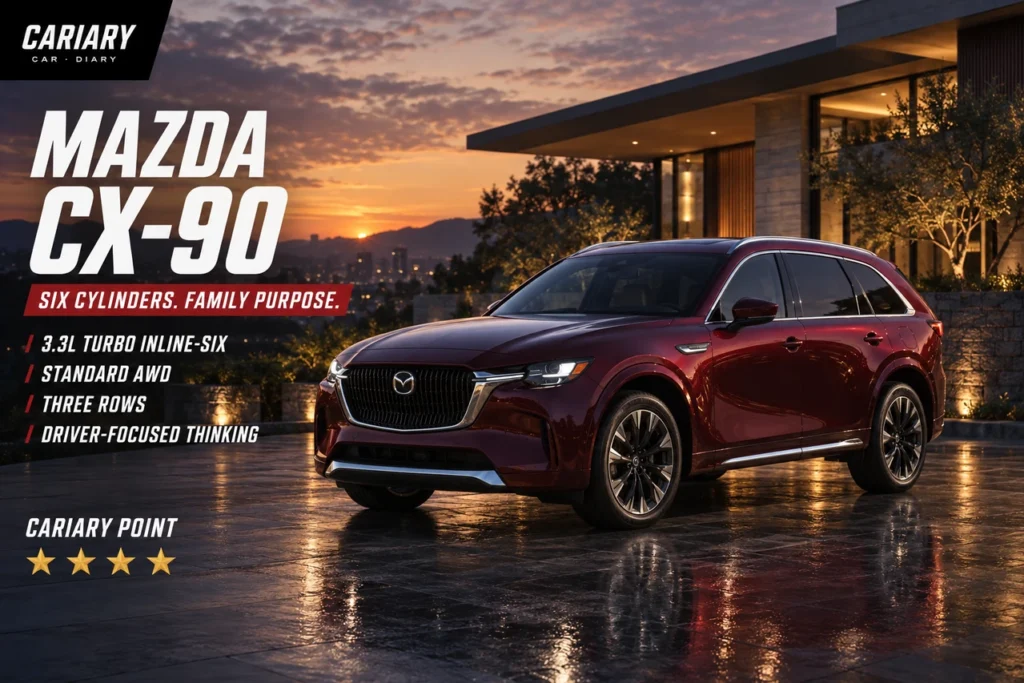
CARIARYCAR · DIARY · PERSPECTIVE
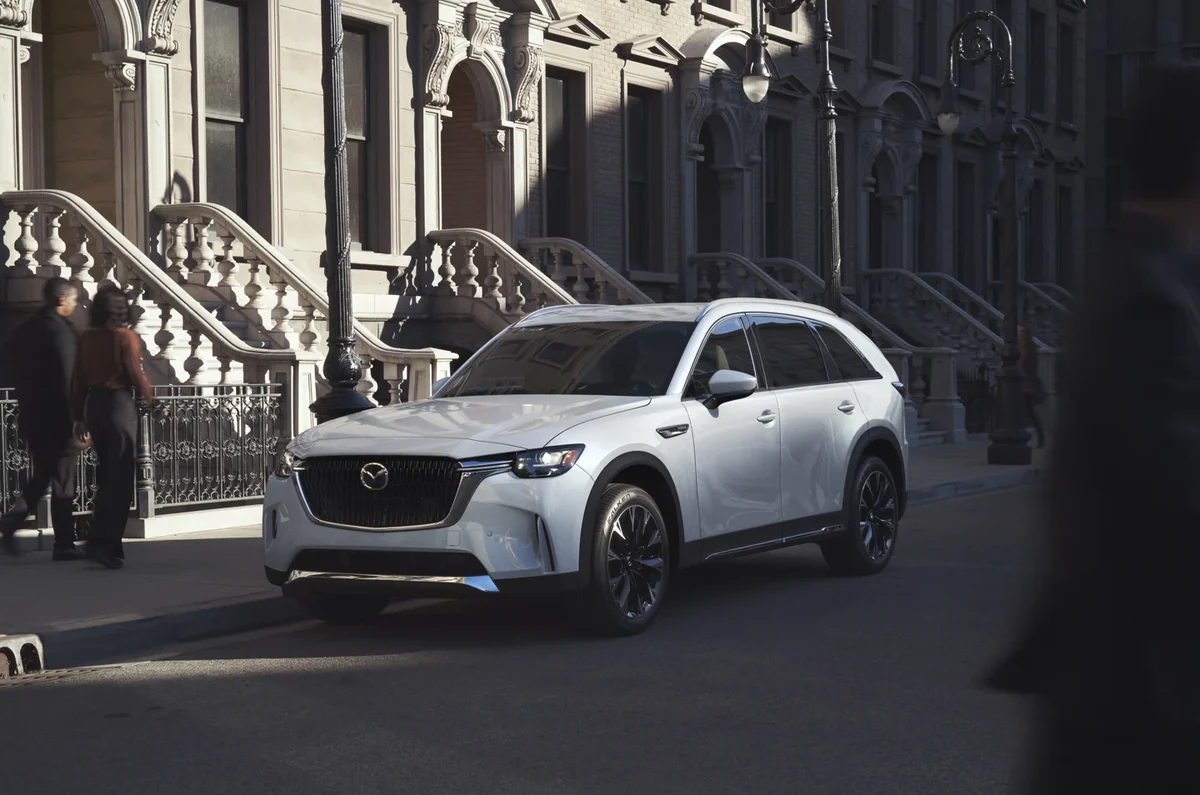
Cover: AI-generated Cariary editorial illustration, checked against the specified vehicle. It is not road-test photography.
This Mazda CX-90 review begins with an unusual choice: why put a longitudinal turbocharged inline-six into a family SUV when a four-cylinder would be easier to explain? Mazda has chosen to make the machinery part of the attraction, even for someone buying room for children and luggage.
The CX-90 is interesting because it asks the driver to want more than a useful box. That ambition can be attractive, but it has to survive the school run, a full holiday load and the monthly payment. The mechanical story matters only if the complete vehicle works for the people inside it.
This research-based review uses the 2026 U.S. Mazda CX-90 inline-six range as its specification reference. The plug-in hybrid is discussed only as an alternative. Cariary has not road-tested this vehicle; driving considerations are not firsthand observations.
Four stars for distinctive engineering and a credible premium-family proposition. Cabin packaging, trim complexity and the need to assess low-speed powertrain behavior keep this from being an unquestioned five-star recommendation.
Mazda CX-90: Key Specifications
| Reference | 2026 U.S. CX-90 inline-six range |
|---|---|
| Engine | 3.3-liter turbocharged inline-six with 48V mild-hybrid assistance |
| 3.3 Turbo | 280 hp / 332 lb-ft on regular 87-octane fuel |
| 3.3 Turbo S | Up to 340 hp / 369 lb-ft on recommended 91-octane premium; 319 hp on 87-octane |
| Transmission / drive | Eight-speed automatic / standard AWD |
| EPA estimate | 23 city / 28 highway / 25 combined mpg, inline-six models |
| Starting MSRP | Turbo Select $39,300 plus $1,645 destination; Alaska differs |
| Seating | Seven or eight, depending on inline-six trim and configuration |
Why the Mazda CX-90 Takes the Complicated Route
Most family-car decisions begin with seats, price and fuel. The CX-90 adds a question about mechanical character. Its long hood and rear-drive-based platform give it a different starting point from the transverse-engine layout common in this class. That does not make it automatically better. It means Mazda spent engineering effort on something beyond maximizing a rectangular cabin.
A straight-six has six cylinders arranged in one line. Its basic configuration offers favorable balance characteristics, although mounting, calibration and the surrounding structure still determine what occupants actually hear and feel. The layout also needs length. In a family SUV, the space devoted to the powertrain has to be judged alongside the space left for people.
This is the appeal and the tension of the CX-90. A parent can still care about the relationship between steering, body movement and acceleration. Yet the person paying for that interest should also sit in the last row before deciding it deserves priority.
280 HP or 340 HP: Choose the Character You Will Use
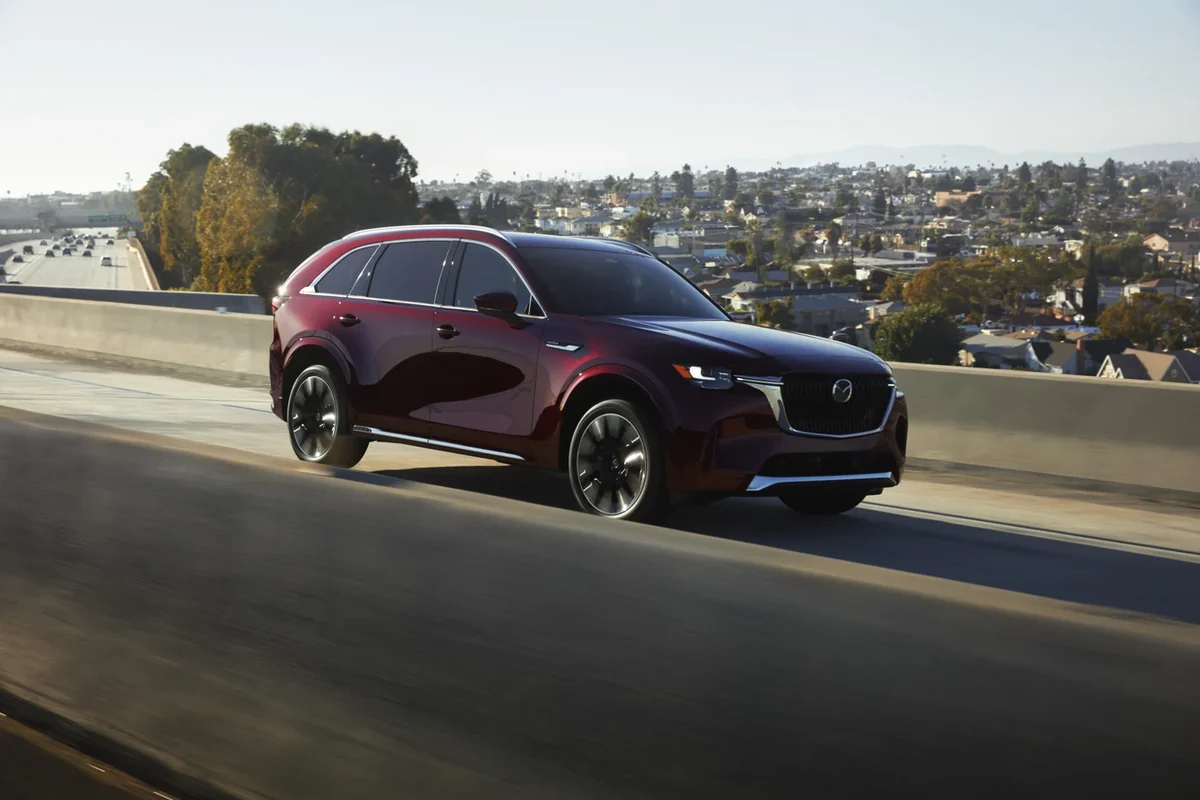
Mazda’s 2026 pricing and packaging release distinguishes the ordinary 3.3 Turbo from the Turbo S. The former supplies 280 hp and 332 lb-ft on regular gasoline. The latter reaches 340 hp and 369 lb-ft with the recommended premium fuel; Mazda quotes 319 hp when it uses regular. The fuel condition belongs beside the power figure.
More power can provide reserve for a loaded vehicle, but it is not the same as better everyday response. A driver who spends most of the week below highway speed should compare the two versions at modest throttle. How readily the car leaves a junction, settles into a gap and resumes speed after slowing will matter more often than the final part of the rev range.
The ordinary Turbo deserves to be the reference point, not the model you apologize for considering. It retains the basic inline-six arrangement. Move to the S because the additional performance and equipment improve your actual use, rather than because a smaller number feels wrong on a luxury-looking vehicle.
Mild Hybrid Does Not Mean Electric Commuting
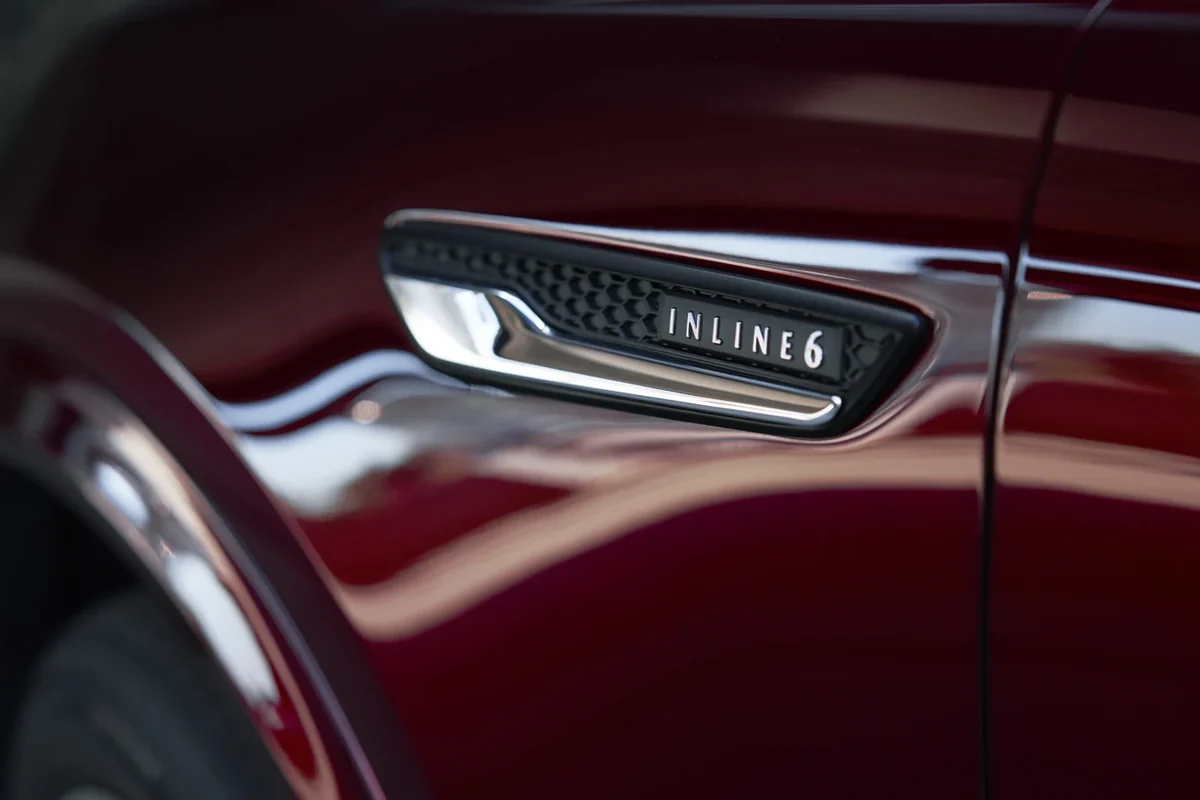
The 48-volt M-Hybrid Boost system supports the gasoline powertrain. It is not the same proposition as the separately offered CX-90 plug-in hybrid. You do not plug the inline-six version into the wall and expect a defined electric commute. Its electrification is an aid within a gasoline-powered routine.
The eight-speed automatic is another part of that routine. In a test drive, include parking, stop-start traffic, a gentle hill and a normal merge. Those situations ask the transmission and assistance system to coordinate repeatedly. A fast demonstration drive can hide the transitions that become familiar on a quiet weekday.
For a household with regular home charging, the plug-in version deserves a separate calculation. For someone without dependable charging, the inline-six avoids that dependency. Neither choice wins merely by carrying the word hybrid. The relevant distinction is how the car will receive energy during a normal week.
The Chassis Story Is More Than a Sport Button
The official CX-90 model materials describe double-wishbone front suspension, a multilink rear arrangement and standard i-Activ AWD. These are useful clues about the engineering brief, not a substitute for a ride assessment. Tires, damping, steering calibration and vehicle mass still shape the result.
Kinematic Posture Control is intended to help manage body posture in corners through brake control. It should not be interpreted as a system that erases weight or gives a tall SUV sports-car responses. The useful question is whether passengers remain settled while the driver makes ordinary corrections on a winding road.
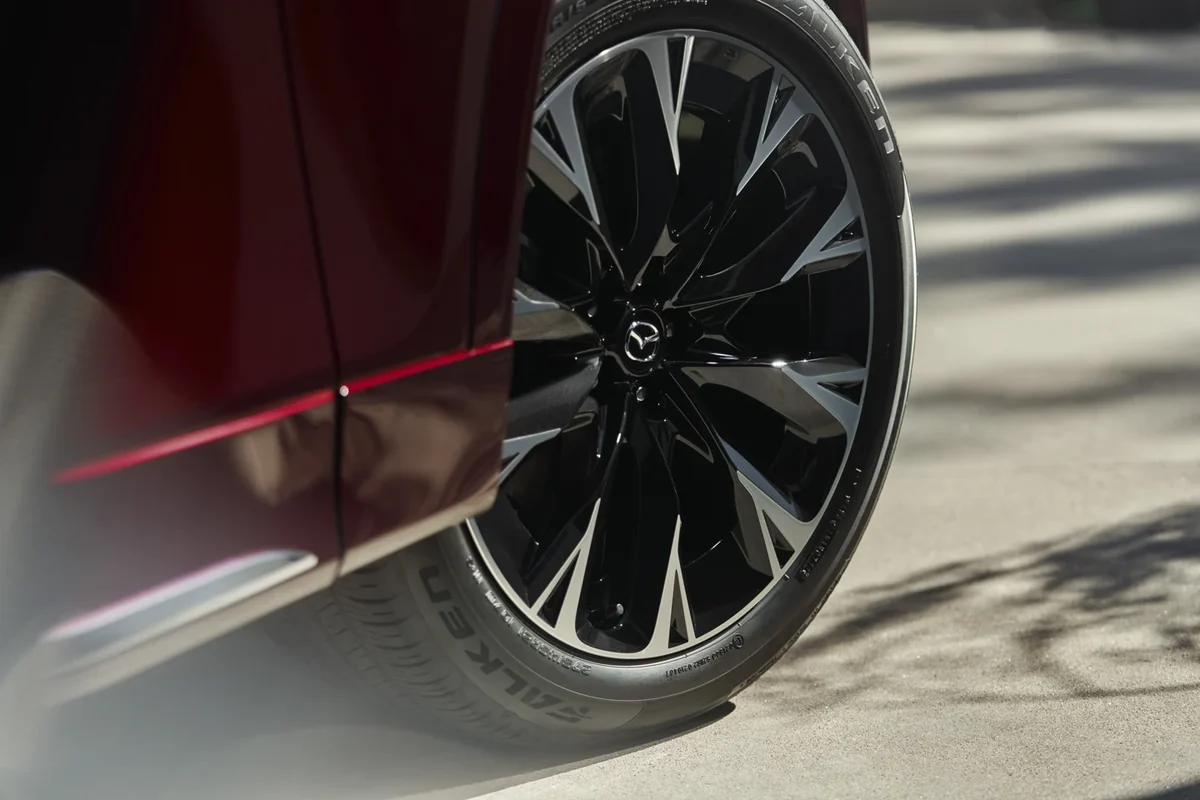
Try the wheel size fitted to the car you will buy. A more expensive trim can bring a larger wheel and a different tire package, so a higher price does not guarantee a softer ride. Our suspension discussion explains why one component or label rarely tells the whole comfort story.
Three Rows: Count the People, Then Bring the Bags
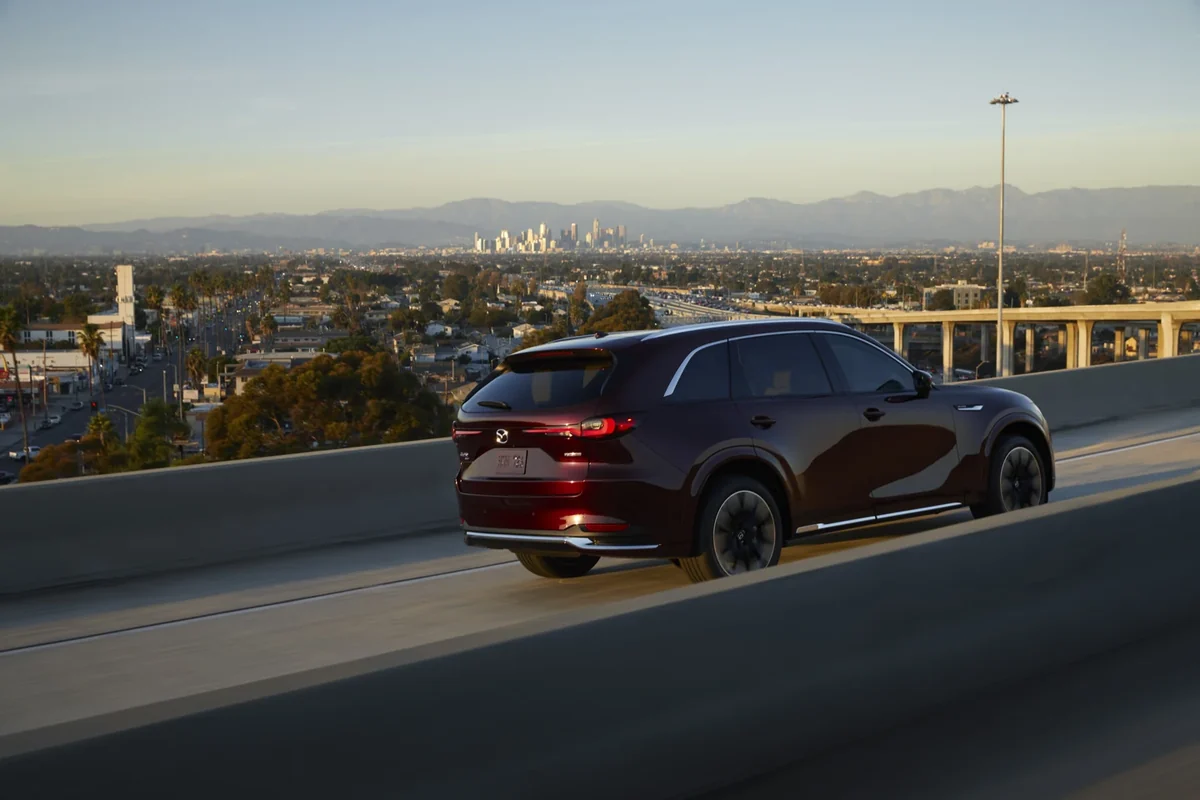
The inline-six range offers seven- or eight-seat configurations depending on trim. That variety is useful, but seat count is the beginning of the comparison. Set the front seat for the driver, place the second row where its regular occupant needs it, and only then assess the back. Moving every other seat out of the way is a showroom trick a family cannot repeat on a full trip.
Captain’s chairs can create separation and an access route. A bench can carry another person and suit a different child-seat arrangement. The best choice depends on who travels together, their ages and whether installed child seats block the path to the rear. Bring the actual seats if possible and follow their installation guidance.
Cargo deserves the same realism. Maximum space with rows folded is irrelevant on the day those seats are occupied. Load the stroller or suitcases you use, check the remaining view through the rear window, and consider a minivan if access dominates the problem. Appreciating Mazda’s engineering should not require pretending packaging compromises do not exist.
A Premium Cabin Should Work Without a Demonstration
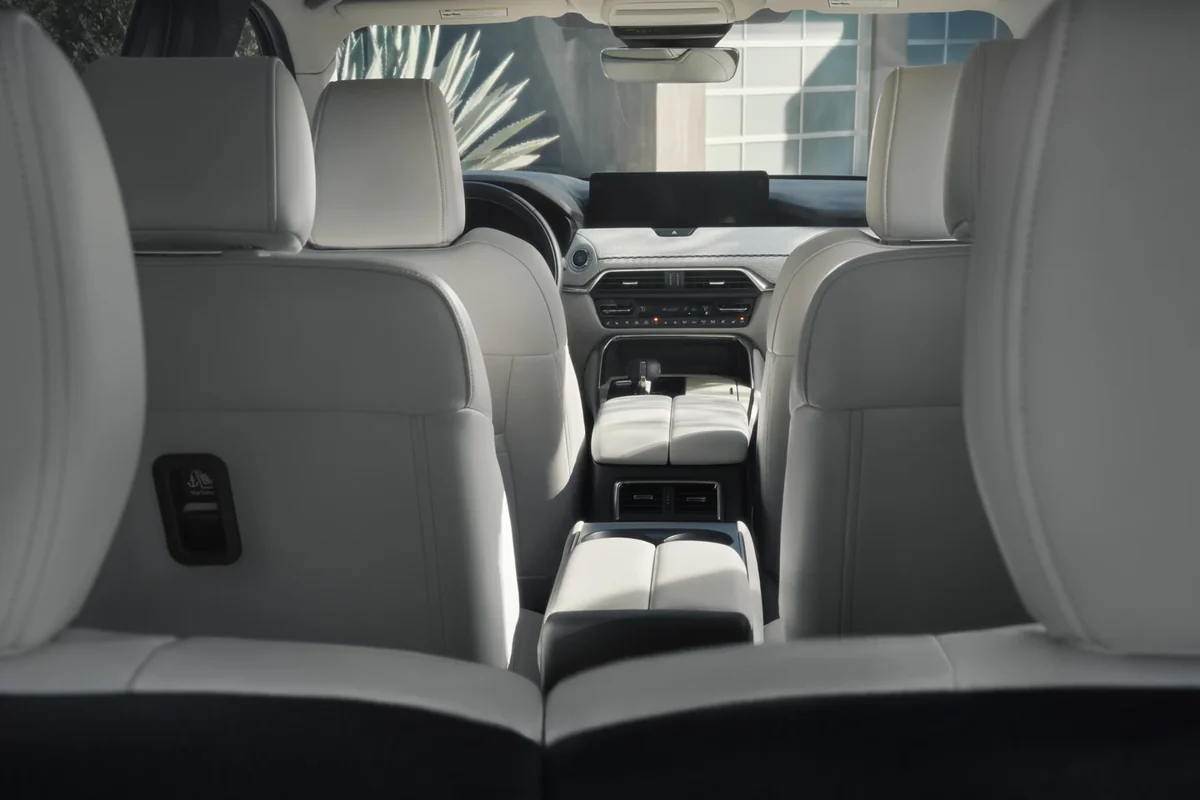
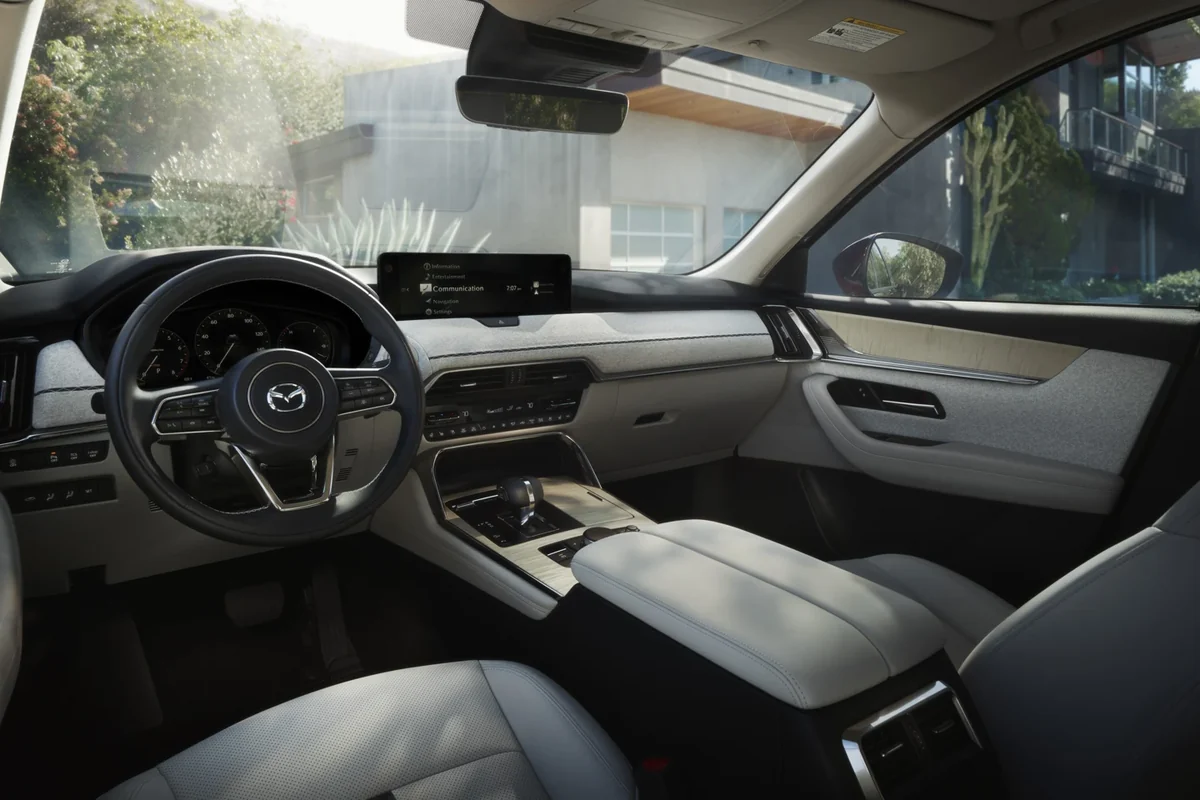
The CX-90 uses material contrast and a relatively restrained dashboard to support its move upmarket. Photographs can show the design, but not how naturally your hand finds a frequently used control. Check climate adjustments, audio, phone connection and navigation from your normal driving position while safely parked.
Equipment changes by trim. For 2026, Mazda adds useful comfort features to the Turbo Preferred and provides a larger display there than in the entry Select. The key is to distinguish a feature that saves effort every day from one that mainly improves the showroom impression. Ventilated seats may matter greatly in one climate and very little in another.
The accompanying original-generation official photographs illustrate the cabin architecture and design details. They are labeled as 2024 images and do not certify every 2026 color, switch or trim combination. Use the current order specification to decide what your particular car includes.
25 MPG Needs a Household Budget Around It
Mazda lists an EPA estimate of 25 mpg combined for the 2026 inline-six versions. That standardized figure is a comparison tool. A cold short commute, towing, a roof carrier or unusually heavy traffic can change the result, so it should not be converted into a personal guarantee.
An illustrative comparison shows why the fuel decision deserves attention. At 12,000 miles, 25 mpg requires 480 gallons; a hypothetical 35-mpg alternative requires about 343. At an assumed $3.50 per gallon, the difference is about $480 a year. This is arithmetic, not a measured comparison with another model. Premium fuel would also change the calculation.
Insurance, financing and depreciation can be larger than that difference. The CX-90 makes sense when its qualities justify the whole budget, not when a buyer finds one favorable number and stops adding. Obtain quotes for the exact trim and compare the cars you would genuinely consider buying.
Mazda CX-90 Price: The Middle Deserves Attention
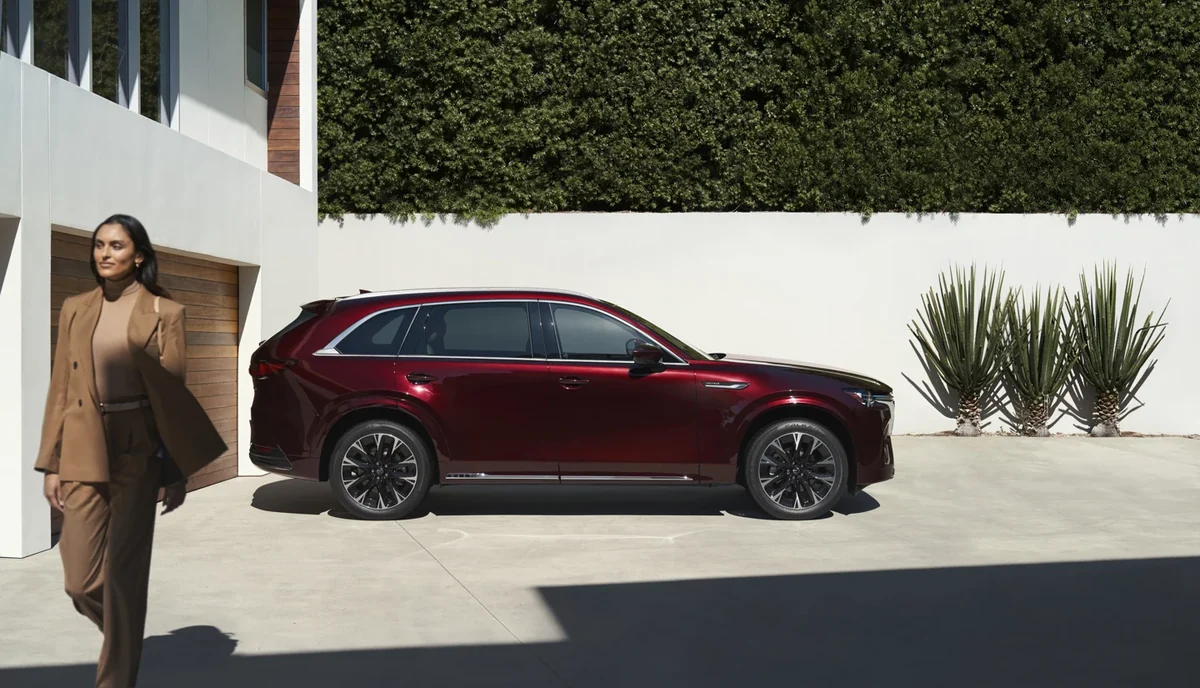
The official price list checked for this review starts the Turbo Select at $39,300 before destination. The listed destination charge is $1,645, or $1,690 in Alaska; taxes, options and dealer charges remain separate. Mazda’s release has been updated since launch, so an older article can show a different figure without describing today’s order.
The Turbo Preferred lists at $43,450, while Turbo S Premium Sport starts at $54,140, both before destination. That gap is large enough to change the type of rival on your shopping list. Build the comparison around equipment you need, then ask what the S adds for your driving.
Do not assume every CX-90 can tow 5,000 pounds. The stated capability depends on version and proper Mazda towing equipment; lower inline-six trims are listed at 3,500 pounds. Passengers, cargo and trailer tongue weight also matter. The exact vehicle documentation must settle the final towing decision.
Rivals Reveal What You Actually Want
A Toyota Grand Highlander or Kia Telluride belongs on the comparison list when cabin use dominates. Compare the precise powertrain and seating layout, not the most flattering headline from each lineup. A family may prefer the Mazda’s driving-oriented brief and still discover that another vehicle handles its weekly cargo better.
A premium-badge SUV introduces another question: are you buying equipment, a particular service experience or the meaning of the badge? The CX-90’s attractive interior does not automatically give it every attribute of a more expensive competitor. Equally, a familiar luxury emblem does not prove better seats or easier controls.
Use the same test route and the same passengers where possible. Start with a practical pass-or-fail list, then allow yourself to care about the car. The emotional choice becomes easier to defend when the essential jobs have already been checked.
Ownership: Engineering Interest Is Not Reliability Evidence
The combination of turbocharging, mild-hybrid assistance, AWD and an eight-speed transmission is technically interesting. None of those ingredients by itself proves long-term durability. Before buying, review the applicable maintenance schedule, warranty terms and service access, and check the specific VIN for outstanding recalls or campaigns.
For a used example, records matter more than an enthusiast’s general confidence in the engine layout. Confirm scheduled work, software updates where applicable, tire condition and the operation of every seat and electrical feature. A pre-purchase inspection should evaluate the actual vehicle, not simply repeat the model’s brochure strengths.
This is also why the Cariary score stops at four. The CX-90 has a coherent reason to exist and deserves attention, but its mechanical ambition cannot replace evidence about your particular car or your own assessment of daily behavior.
Cariary Perspective: A Family Car Can Still Have a Point of View
The Mazda CX-90 makes a better conversation than its seat count alone suggests. It argues that family transport can preserve an interest in machinery, proportions and the driver’s role. That is a valid ambition, even when a more packaging-focused rival is the more rational answer for some households.
The right buyer sees both sides. They use the cabin honestly, choose the engine deliberately and accept that an appealing straight-six does not excuse an awkward third row for their family. Four stars recognize a distinctive choice with a real purpose, rather than declaring it the universal winner of a crowded class.
Who Should Buy It?
Recommended For
Families that need three rows and still value the driver’s seat, with enough flexibility to compare seating layouts and trims carefully.
Not Recommended For
Buyers whose overriding priority is maximum rear-row access, those expecting plug-in commuting from the inline-six, or anyone buying an S solely for its headline output.
One-Line Verdict: The CX-90 makes family transport mechanically interesting, but the cabin still has to win its place in your life.
Frequently Asked Questions
Does every Mazda CX-90 have an inline-six?
No. This review covers the 3.3-liter inline-six versions. The separately offered plug-in hybrid uses a different powertrain.
Is AWD standard on the 2026 U.S. CX-90?
Yes. Mazda lists standard i-Activ AWD across the range.
How much power does the Turbo S make?
Up to 340 hp on recommended 91-octane premium fuel; Mazda lists 319 hp on regular 87-octane.
Does the mild hybrid need charging?
No. It does not require an external charging connection and should not be confused with the plug-in hybrid.
Can the CX-90 seat eight?
Some inline-six configurations can. Others seat seven, so check the exact trim and second-row arrangement.
Can every version tow 5,000 pounds?
No. Towing capacity depends on version and proper equipment. Consult the exact vehicle’s limits before choosing a trailer.
Which Mazda CX-90 should I consider first?
Use the ordinary Turbo as your baseline. Add equipment or Turbo S performance only when it improves a recurring need or a driving quality you actually value.
Further Reading and Data Reference
Data reference date: October 4, 2026. Official specifications and attributed test observations are linked where discussed. Cariary Point is an editorial buyer-fit assessment, not an owner road-test score or reliability rating.
Explore more Cariary car reviews and buyer perspectives.

