Quick Summary
- Modern F1 does not use huge V12 or V10 engines anymore. Since 2014, F1 has used a 1.6-liter V6 turbo hybrid power unit.
- The small displacement is not mainly about saving weight. It is mostly because the regulations define the engine layout, fuel-flow limits, energy recovery rules, and hybrid system.
- F1’s “boost” is real, but it is not a fantasy button. It comes from stored electrical energy, mainly through the MGU-K, which can add power to the drivetrain.
- F1 engine history moved from many different layouts to stricter formulas: V12, V10, V8, turbo eras, and now turbo hybrid power units.
- Some F1 ideas did reach road cars: turbocharging, downsized engines, hybrid energy recovery, advanced combustion, battery control, thermal efficiency thinking, and highly integrated powertrain management.
Why This Matters
When people hear “F1 engine,” it is easy to imagine a giant engine with many cylinders and a huge displacement. That image is not completely wrong historically. F1 once had screaming V12s, V10s, and V8s, and earlier rules allowed much more variety than today’s tightly defined formula.
But the modern F1 engine is almost the opposite of that old image.
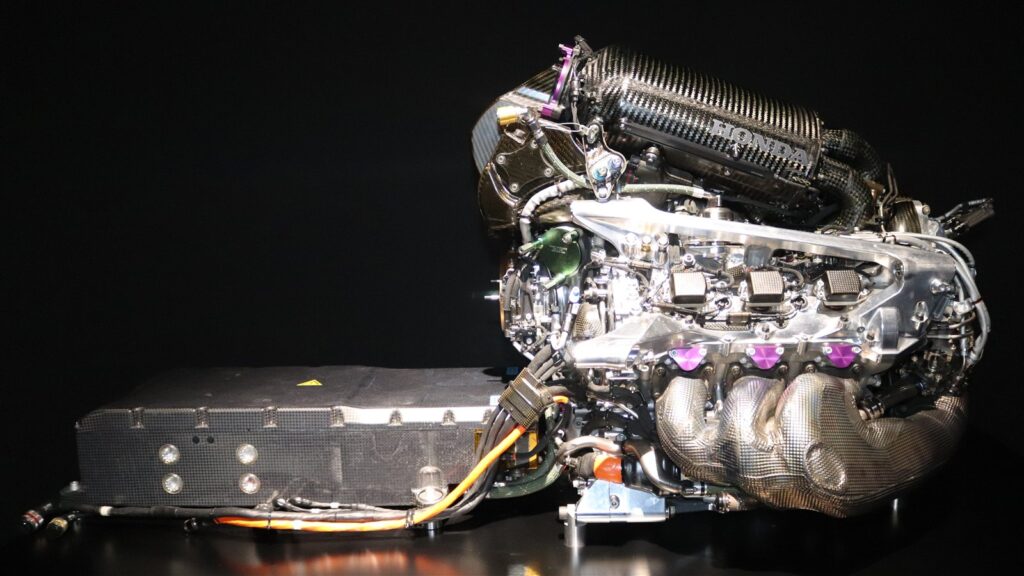
Today, the internal combustion part of an F1 power unit is a 1.6-liter V6 turbo engine. In normal road-car language, 1.6 liters sounds like something you might find in a compact car. The strange part is that an F1 power unit can produce enormous performance from that small engine because the combustion engine, turbocharger, electric motor-generator, battery, control electronics, fuel, and energy recovery strategy all work together.
So the better question is not only:
Why is the F1 engine so small?
It is:
Why did F1 choose to make small engines incredibly advanced?
The answer is a mixture of regulation, technology direction, manufacturer relevance, efficiency, and spectacle. Weight matters, but it is not the whole story.
Credit: Image: Liauzh, CC BY-SA 4.0, via Wikimedia Commons
How It Works
The modern F1 engine is really a power unit
Calling it only an “engine” is a little incomplete.
Modern F1 uses a power unit. That means the car is not powered only by the combustion engine. It uses a system made of several major parts:
- ICE: the internal combustion engine, a 1.6-liter V6 turbo.
- Turbocharger: uses exhaust gas to spin a turbine, which helps push more air into the engine.
- MGU-K: an electric motor-generator connected to the crankshaft. It can recover energy under braking and send power back to the drivetrain.
- Energy store: the battery system that stores recovered electrical energy.
- Control electronics: the brain that manages how energy is collected and deployed.
- MGU-H: used in the 2014-2025 generation to recover energy from the turbocharger shaft and help control turbo speed. For the 2026 rules, the FIA regulations move to a different architecture without the MGU-H.
The easiest way to think about it:
The gasoline engine makes power. The turbo helps it breathe. The hybrid system catches energy that would otherwise be wasted and uses it when the car needs extra acceleration.
Why is the engine so small?
It is not simply because a smaller engine is lighter.
Modern F1 engine size is primarily a rule-based choice. The FIA regulations define the engine architecture very tightly. For the 2026 technical regulations, the internal combustion engine must be a four-stroke reciprocating piston engine with six cylinders arranged in a 90-degree V configuration, with displacement limited to 1600cc. The FIA’s latest published Section C technical regulations available during this article’s research were Issue 18, dated May 7, 2026. The same rulebook also limits fuel flow and defines the electrical system’s role.
In other words, teams are not freely deciding, “Let’s use a tiny engine because it saves mass.” They are competing inside a formula that says, in effect:
Here is a small, highly efficient engine concept. Now show how much performance you can extract from it.
That is where the manufacturer technology showcase comes in.
Mercedes, Ferrari, Honda, Renault, Audi, and other F1 power-unit manufacturers are not trying to prove they can build the biggest engine. That would not match the modern automotive direction. They are trying to prove they can make a compact, fuel-limited, hybridized engine produce extreme power with extreme efficiency.
That is much closer to the engineering direction of modern road cars:
- Smaller engines with turbocharging
- Hybrid assistance
- Better thermal efficiency
- More precise combustion
- Energy recovery
- Software-controlled power delivery
So yes, the user’s intuition is right: F1 downsizing is partly about showing manufacturer capability. But it happens because the regulations create the battlefield.
How is the “boost” real?
F1 does have something that feels like a booster, but it is not like a movie rocket button.
The real system is electrical energy deployment.
The MGU-K can work in two directions:
- Recovery mode: under braking, it acts like a generator and converts some of the car’s kinetic energy into electrical energy.
- Deployment mode: during acceleration, it works like an electric motor and sends power back into the drivetrain.
This is similar in idea to regenerative braking in a hybrid road car, but the performance level and control strategy are much more extreme.
In 2014-2025 F1 power units, the MGU-H also played a special role around the turbocharger. It could recover energy from the turbo shaft and help keep the turbo spinning, reducing turbo lag. That is one reason modern F1 turbo engines do not behave like old turbo race engines that suddenly wake up with a huge delay.
For 2026, the FIA rules increase the importance of electrical power from the MGU-K. The regulation limit for ERS-K maximum power is 350kW, which is a massive electrical contribution. In simple terms, future F1 power units lean even harder into the idea that the car is fast because combustion and electricity cooperate.
So the “boost” is possible because:
- The car recovers energy while braking.
- The battery stores that energy.
- The MGU-K sends it back to the drivetrain.
- Software decides when and how to deploy it.
- The driver can influence deployment through mode selection and driving strategy.
It is not magic. It is energy that was captured earlier and released at the right moment.
A Short History of F1 Engines
F1 engine history is easier to understand if we think of it as a long argument between freedom and control.
Early F1 had more variety. Over time, the rules became stricter because the sport had to manage cost, safety, speed, reliability, manufacturer relevance, and environmental pressure.
1950s and early F1: many ideas at once
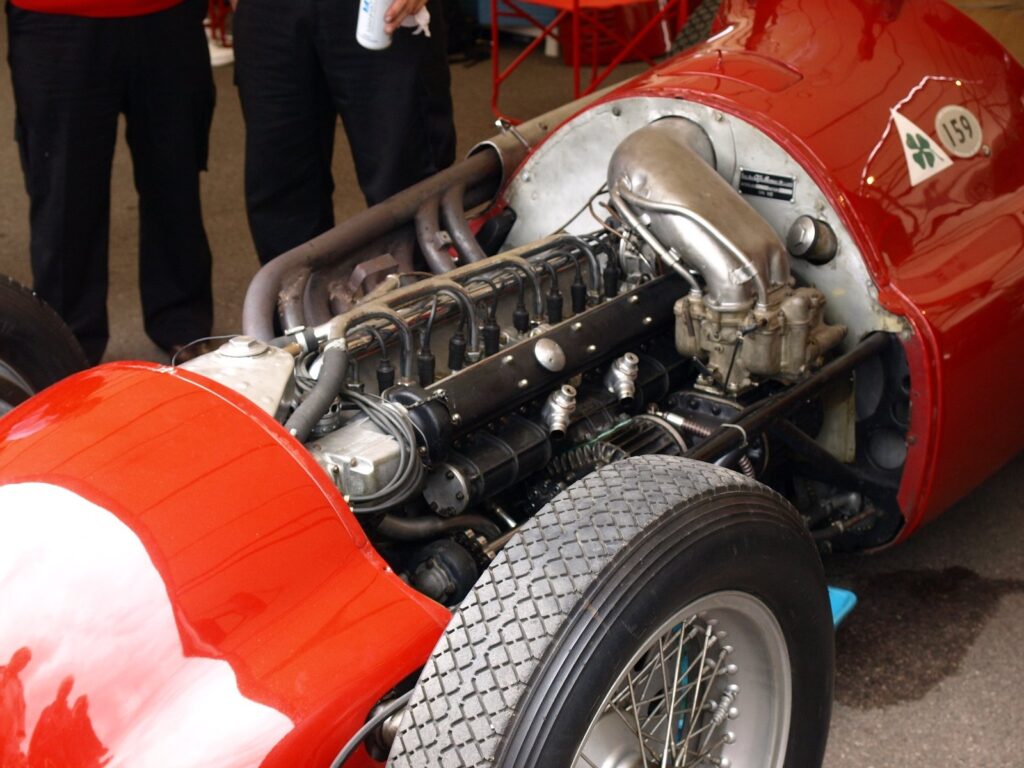
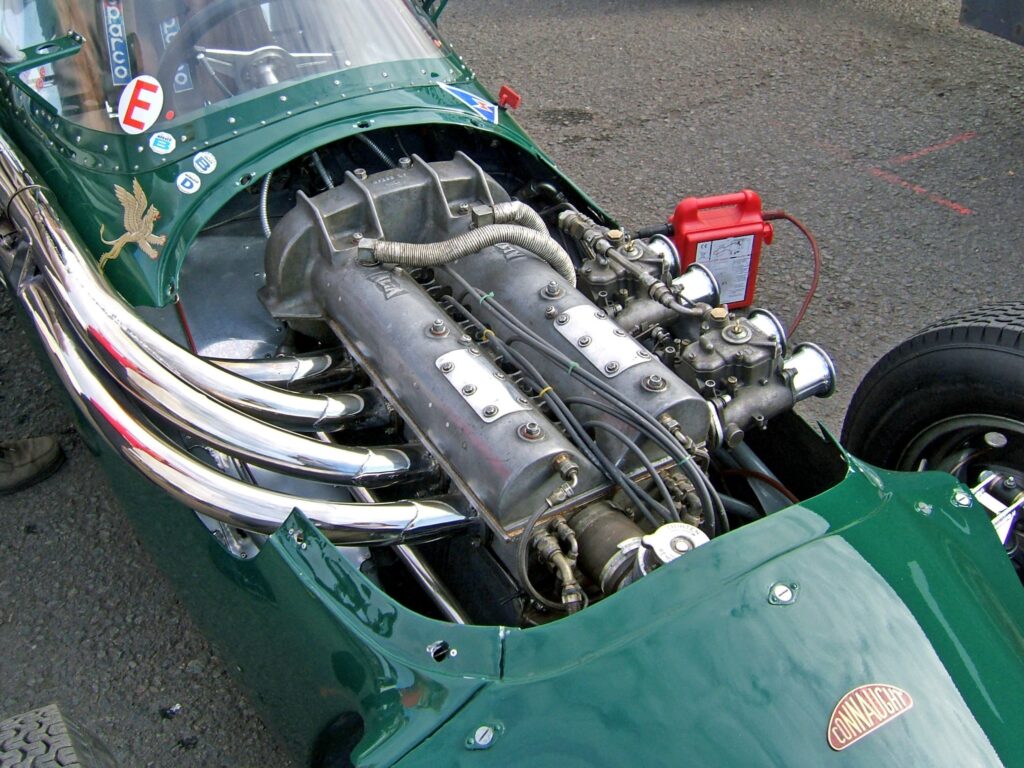
Early F1 was not one clean engine formula in the modern sense. The rules allowed different approaches, including naturally aspirated and supercharged engines in different periods. Manufacturers experimented because the sport was still discovering what the ideal Grand Prix engine should be.
Credit: Image: storem, CC BY-SA 2.0, via Wikimedia Commons
1960s-1980s: the classic engine personality era
This is the era many fans imagine when they think of old F1 engines. There were compact V8s, dramatic flat-12s, and later high-revving V12s. Engine sound and engine character were a huge part of brand identity.
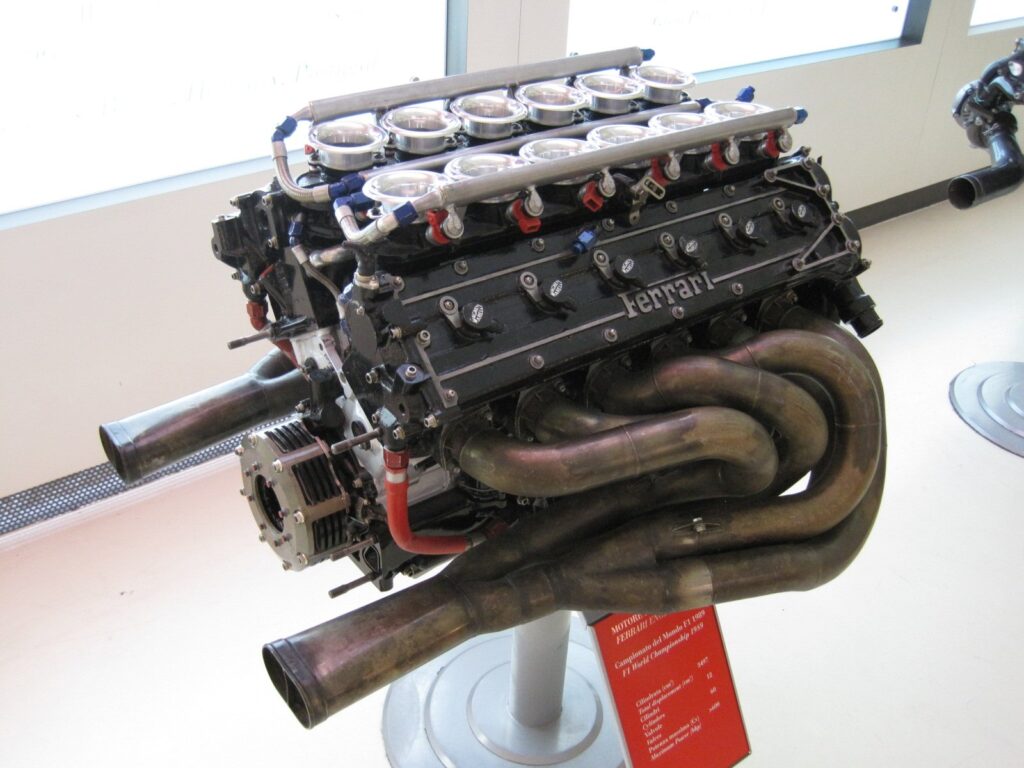
Credit: Image: Darren, CC BY 2.0, via Wikimedia Commons
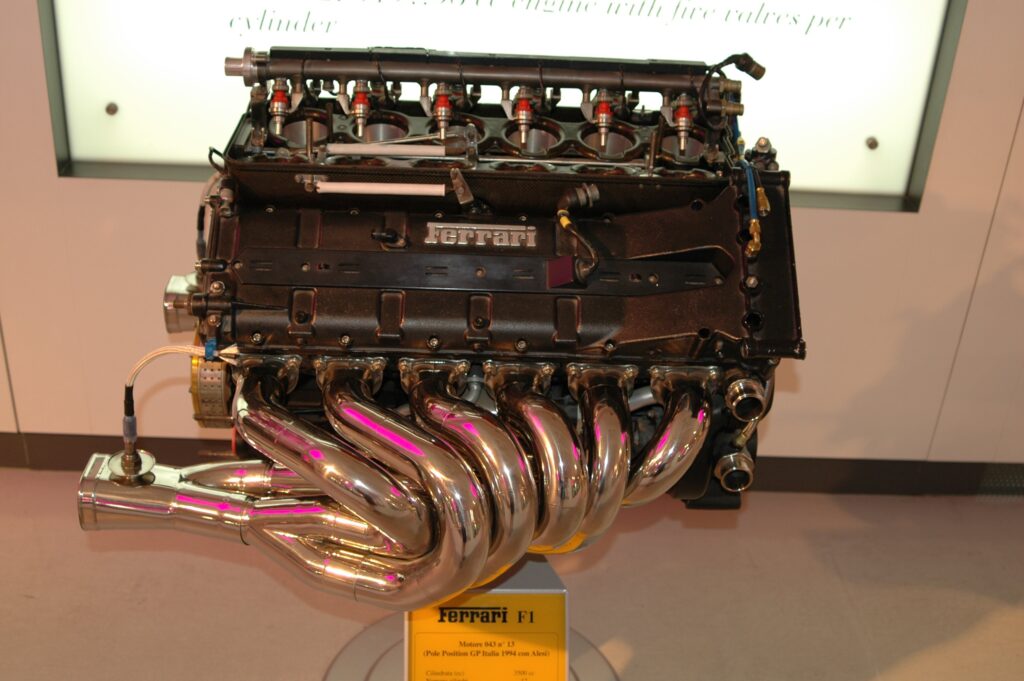
Credit: Image: Morio, CC BY-SA 3.0, via Wikimedia Commons
Some F1 engine stories also show how much experimentation happened around the sport, even when a project did not become a famous race-winning engine. The Isuzu P799WE V12 is useful here because it reminds us that F1 has often attracted manufacturers who wanted to prove what they could build at the very edge of engine design.
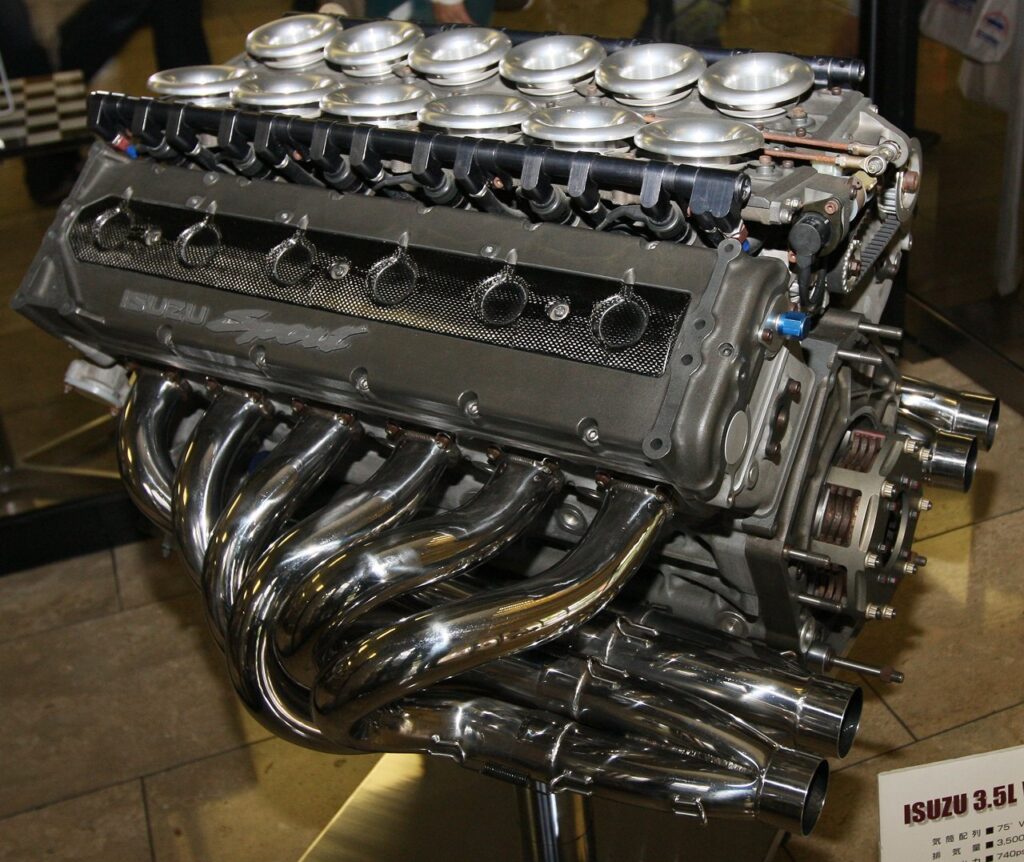
Credit: Image: Pex Cornel, cropped and retouched by Morio, CC BY 2.0, via Wikimedia Commons
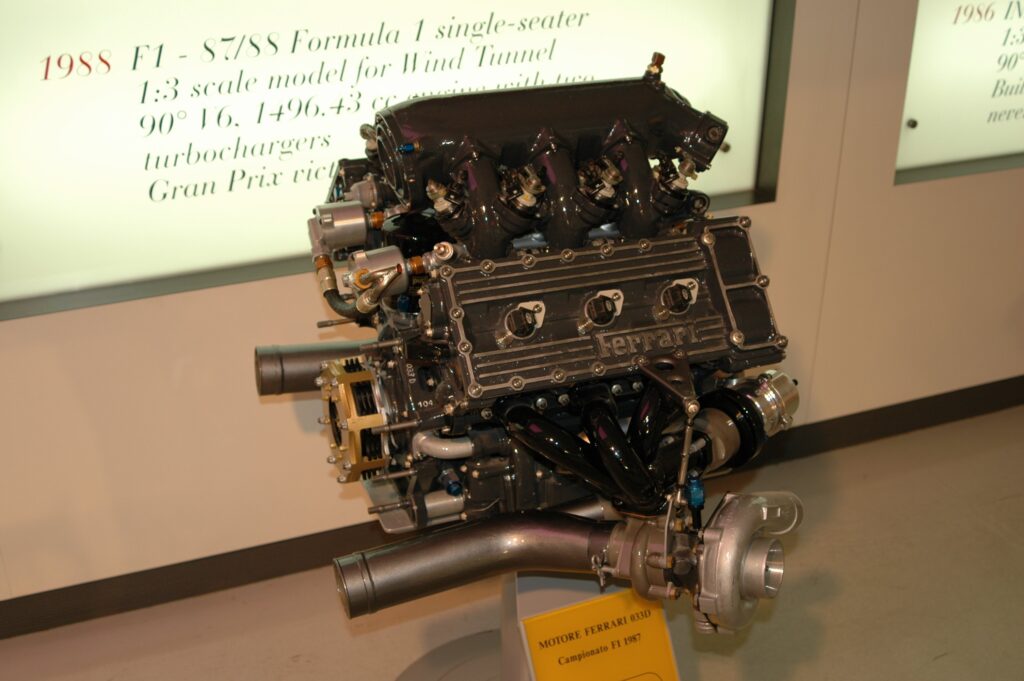
Late 1970s-1980s: the first turbo era
Turbocharging changed everything. Instead of only increasing displacement, teams could force more air into smaller engines and make huge power. The old turbo era became famous for extreme qualifying engines and violent power delivery.
But that also created cost and safety concerns. F1 eventually moved away from that level of turbo freedom.
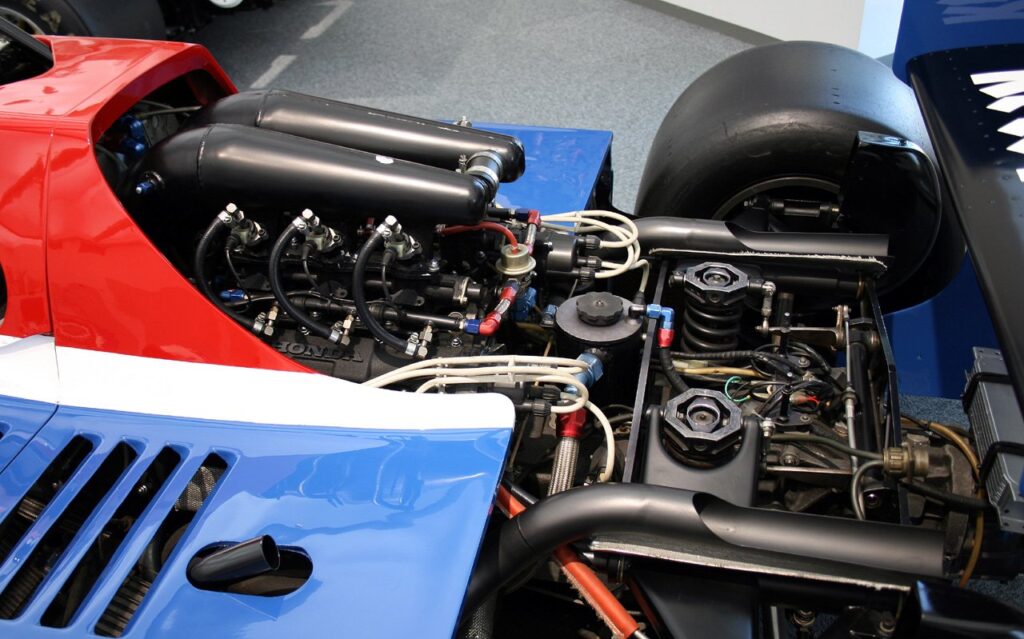
Credit: Image: storem, CC BY-SA 2.0, via Wikimedia Commons
Credit: Image: Arnaud 25, CC BY-SA 3.0, via Wikimedia Commons
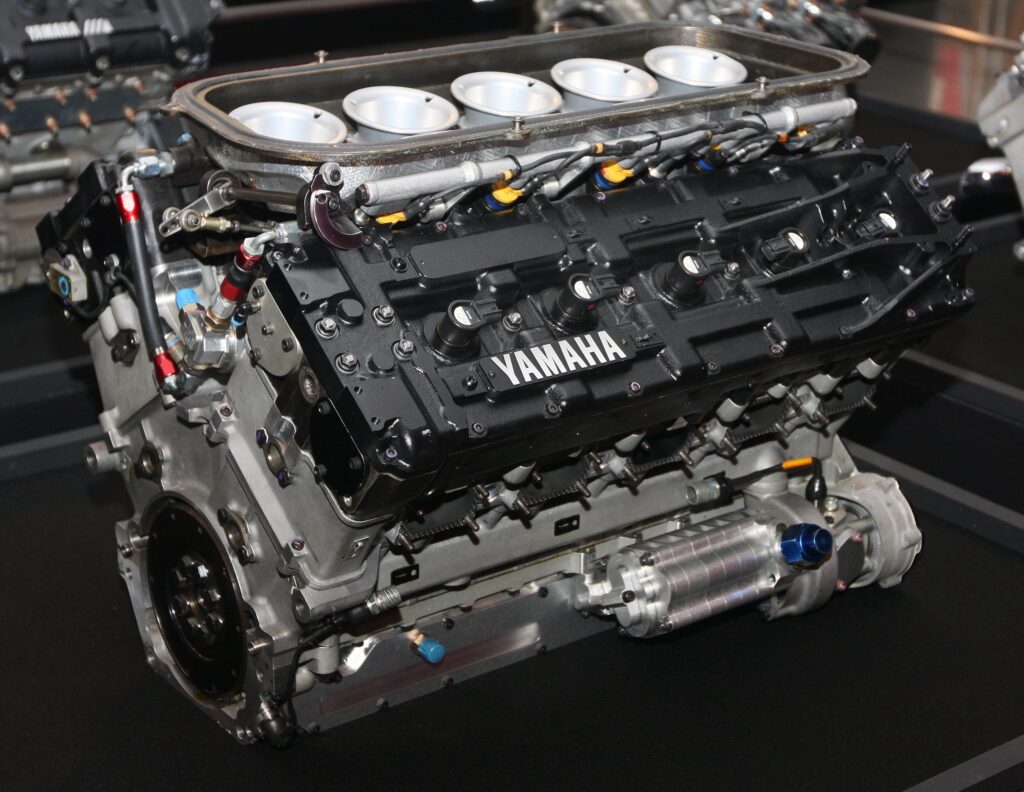
1990s-2005: the high-revving V10 era
For many fans, the V10 era is the emotional peak of F1 engine sound. These engines were naturally aspirated, very high-revving, and brutally responsive. They were not small in the current sense, and they were designed for peak racing performance rather than road-car efficiency relevance.
Credit: Image: Morio, CC BY-SA 3.0, via Wikimedia Commons
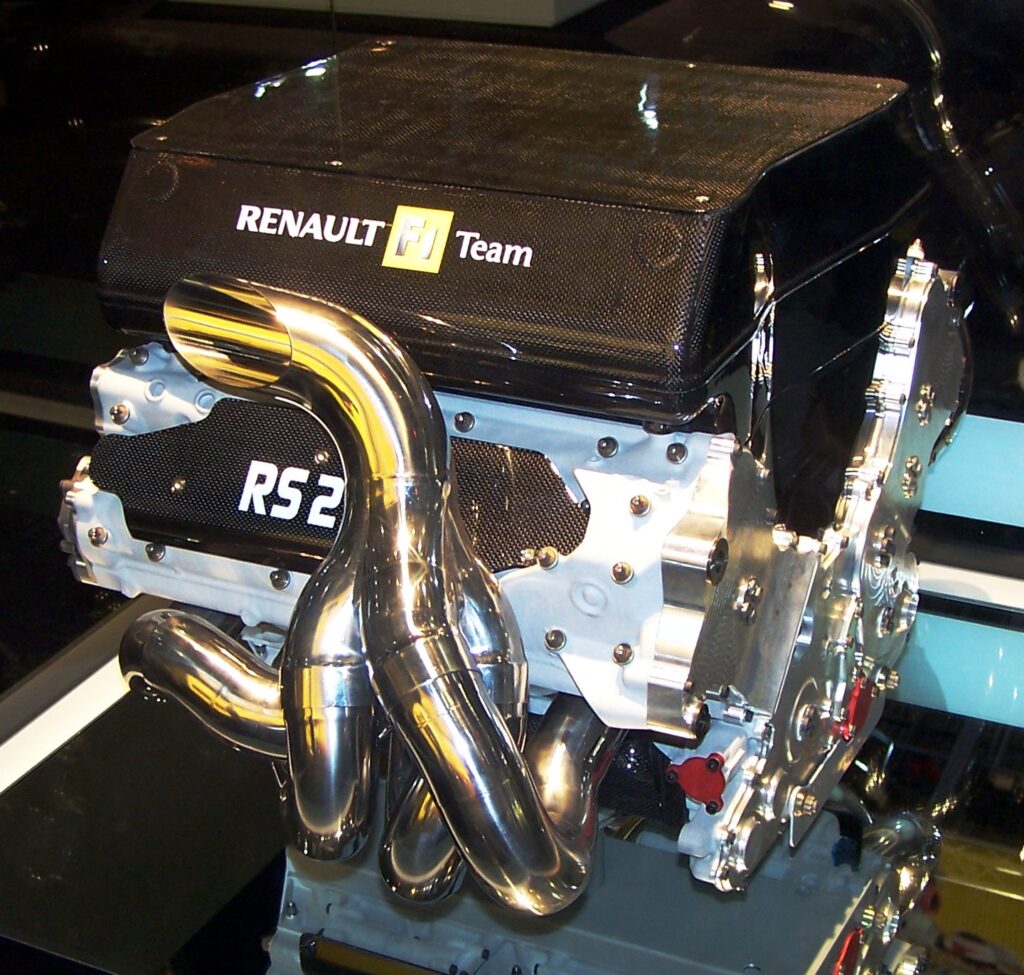
2006-2013: V8 engines and KERS
F1 moved to 2.4-liter V8 engines. Later, KERS appeared. KERS stands for Kinetic Energy Recovery System. It was an early step toward the hybrid thinking we see now: recover braking energy, store it, and use it for extra acceleration.
This was the bridge between classic engine racing and the hybrid era.
Credit: Image: John Chapman (Pyrope), CC BY-SA 3.0, via Wikimedia Commons
2014-2025: 1.6-liter V6 turbo hybrid
This is the era that changed the meaning of an F1 engine.
The engine became a power unit. The turbo returned, but now with hybrid energy recovery. Performance became less about displacement and more about efficiency, heat management, energy recovery, battery control, combustion quality, and software.
2026 onward: more electrical emphasis, sustainable fuel direction
The 2026 rules keep the 1.6-liter V6 concept but reshape the hybrid system. The FIA’s 2026 technical regulations specify a stronger electrical role, including a 350kW ERS-K maximum power limit, and F1’s broader direction emphasizes fully sustainable fuel.
That tells us where the sport wants the engineering fight to happen:
Not bigger engines, but smarter energy use.
Advantages
1. Small engines make efficiency a performance target
A large engine can make power by burning more fuel and moving more air. A small, fuel-limited engine has to be smarter.
That forces teams to study:
- Combustion speed
- Turbo efficiency
- Heat loss
- Friction
- Fuel flow
- Energy recovery
- Battery deployment
- Cooling drag
This is why modern F1 power units are often discussed in terms of thermal efficiency. Thermal efficiency simply means how much of the fuel’s energy becomes useful work instead of wasted heat.
2. Hybrid power creates strategy, not just speed
The driver and team must think about where to harvest energy and where to deploy it. That adds a second layer to performance.
Two cars may have similar peak power, but the faster one may be better at using energy at the right places on the lap.
3. The technology is more relevant to modern road cars
Road cars are not moving toward giant naturally aspirated racing engines. They are moving toward turbocharging, hybrids, EV assistance, advanced software, and energy management.
Modern F1 aligns better with that world.
4. Manufacturers can compete through intelligence
The rules limit size, layout, fuel flow, and energy systems. That means the advantage comes from details:
- Better combustion
- More efficient turbo design
- Better cooling
- Lower friction
- Smarter battery use
- Better control software
That is exactly the kind of work manufacturers want to show.
Disadvantages
1. The engines are harder to understand emotionally
Old F1 engines were simple to love. A V10 screamed. A V12 sounded special. A turbo car exploded forward.
Modern power units are more complex. The drama is partly hidden in software, energy flow, and thermal management. That is impressive, but harder for a casual fan to feel immediately.
2. Complexity increases cost
A hybrid turbo F1 power unit is not just an engine. It is a combustion engine, turbo system, battery, motor-generator system, cooling package, electronics, and software system.
That complexity is expensive.
3. Sound changed
This is subjective, but important. Modern F1 cars do not sound like the V10 or V12 cars many fans remember. The turbocharger and lower rev limits changed the sound character.
The current cars are still dramatic in person, but the engine note is no longer the whole emotional center of the sport.
4. Road relevance can make rules less romantic
The more F1 tries to stay relevant to road-car technology, the less it can be pure engine fantasy. That is not automatically bad. But it changes what the sport feels like.
Common Misconceptions
“F1 uses small engines mainly to reduce weight.”
Weight matters, but this is not the main story.
Modern F1 uses small engines because the regulations require a small-displacement V6 turbo hybrid architecture, and because the sport wants manufacturers to compete through efficiency, energy recovery, and advanced powertrain control.
“A 1.6-liter engine cannot be truly powerful.”
In a normal road car, 1.6 liters sounds modest. In F1, the engine is not normal. It uses extreme combustion design, turbocharging, high fuel-flow precision, hybrid assistance, and racing-grade materials.
The displacement is small, but the system is not simple.
“The boost is fake or just a button.”
The boost is real electrical deployment. The car recovers energy, stores it, and sends it back through the MGU-K.
It is not a fantasy nitro button. It is managed energy.
“All F1 engine eras were basically bigger versions of the same thing.”
Not really. F1 moved through very different philosophies: naturally aspirated multi-cylinder engines, old turbo engines, high-revving V10s, V8s with KERS, and modern turbo hybrids.
Each era asked engineers a different question.
“Modern F1 technology has nothing to do with road cars.”
Some details are too extreme for road cars, but the big ideas absolutely matter: turbo downsizing, hybrid energy recovery, thermal efficiency, battery control, compact high-output engines, and integrated software management.
Real-world Examples
Mercedes-AMG ONE
The Mercedes-AMG ONE is the clearest road-car example because it uses a Formula 1-inspired turbo hybrid powertrain concept. It shows how difficult F1 technology is to civilize for the road: emissions, idle quality, cooling, durability, and everyday usability all become much harder outside a race environment.
Ferrari LaFerrari
LaFerrari used a hybrid system inspired by Ferrari’s racing work. It did not copy a full F1 power unit, but it showed how electric assistance could become part of high-performance identity, not just fuel saving.
McLaren P1 and Porsche 918 Spyder
These cars helped make the modern hybrid hypercar idea feel real. The electric motor was not there only for economy. It filled torque gaps, sharpened response, and added acceleration.
Everyday turbo hybrids
The clearest road-car transfer may not be one exotic hypercar. It may be the ordinary idea that a smaller turbo engine plus electric assistance can replace a larger engine in many situations.
That logic is everywhere now:
- Mild hybrids
- Plug-in hybrids
- Downsized turbo engines
- Regenerative braking
- Electric torque fill
- Software-managed power delivery
F1 did not invent all of these ideas alone, but it pushed them to extreme performance levels.
Cariary Thoughts
What I found interesting while organizing this topic is that the small F1 engine is not really a “small engine” in the ordinary sense.
At first, 1.6 liters makes it sound like F1 became modest. But the more useful way to look at it is this:
F1 moved the battle from engine size to energy intelligence.
Old F1 engines showed emotion very directly. They sounded wild, revved high, and made their character obvious. Modern F1 engines hide more of their genius inside the system. The interesting part is not only the V6. It is how the turbo, motor-generators, battery, fuel flow, software, and cooling all have to cooperate.
So when someone asks, “Why did F1 downsize so much?” I would not answer only with weight or fuel saving.
I would say:
Because the rules force the engine to be small, and that makes efficiency itself the competition.
That also explains why manufacturers care. It is not very meaningful for a modern car company to prove it can make a giant engine burn fuel quickly. It is much more relevant to prove it can make a limited amount of fuel and electrical energy produce incredible speed.
The emotional trade-off is real. We lost some of the simple sound drama of old F1. But we gained one of the most advanced powertrain laboratories in the world.
One-line Summary
Modern F1 engines are small because the rules force a compact hybrid turbo formula, and the real competition is how intelligently each manufacturer turns limited fuel and recovered energy into speed.
FAQ
Why does modern F1 use a 1.6-liter V6 engine?
Because the regulations define that architecture. Modern F1 is designed around a small turbocharged V6 hybrid power unit, not around free engine size. The goal is to make manufacturers compete through efficiency, energy recovery, combustion quality, and powertrain control.
Is the small F1 engine mainly about reducing weight?
No. Weight matters in every race car, but the main reason is regulation and technical direction. The small displacement creates a strict engineering challenge: produce extreme performance from limited engine size, limited fuel flow, and controlled hybrid energy.
Does F1 really have a boost system?
Yes, but it is electrical energy deployment rather than a fantasy booster. The MGU-K recovers energy under braking, stores it in the battery, and can send power back into the drivetrain during acceleration.
What is the difference between KERS and ERS?
KERS was the earlier kinetic energy recovery idea used before the full turbo hybrid era. ERS is the broader modern energy recovery system, integrating motor-generators, battery storage, and deployment strategy as a central part of the power unit.
Why did F1 stop using V10 and V12 engines?
F1 moved away from those engines because rules changed around speed control, cost, safety, manufacturer relevance, and efficiency. V10s and V12s remain emotionally beloved, but modern F1 asks a different engineering question.
Do F1 engines use technology that appears in road cars?
Yes, though usually not as direct copy-paste. Turbo downsizing, hybrid assistance, energy recovery, thermal efficiency thinking, battery control, and integrated powertrain software all connect with modern road-car development.
Will 2026 F1 engines be fully electric?
No. The 2026 rules still use a 1.6-liter V6 combustion engine, but with a much stronger electrical role and a sustainable-fuel direction. It is not an EV formula.
Why do modern F1 engines sound different?
The smaller displacement, turbocharger, lower rev character, and hybrid-era design changed the sound. Older naturally aspirated V10 and V12 engines produced a sharper, louder, higher-pitched sound that many fans still miss.
Data Reference date
June 25, 2026