Core summary
The refreshed Tucson offers three different ownership propositions under one name. Petrol, hybrid and plug-in hybrid should be compared as separate choices, not one blended specification.
The NX4 Tucson is a five-seat compact SUV. This profile focuses on the refreshed generation and uses Hyundai's 2025 US announcement to separate the powertrains. Overseas Tucson specifications are not automatically equivalent: an identical badge can accompany different engines and body dimensions.
Cariary would begin with a weekly-use calculation. Work out how much driving is local, how often the family travels fully loaded and whether charging is genuinely available. Those answers are more useful than choosing the most powerful badge first.
History & generations
The fourth-generation Tucson preceded the 2025 US refresh. The update changes the cabin and exterior without making every earlier NX4 obsolete. A used pre-refresh car can still be worth considering, but it should not be advertised as having the newer dashboard merely because it was registered late.
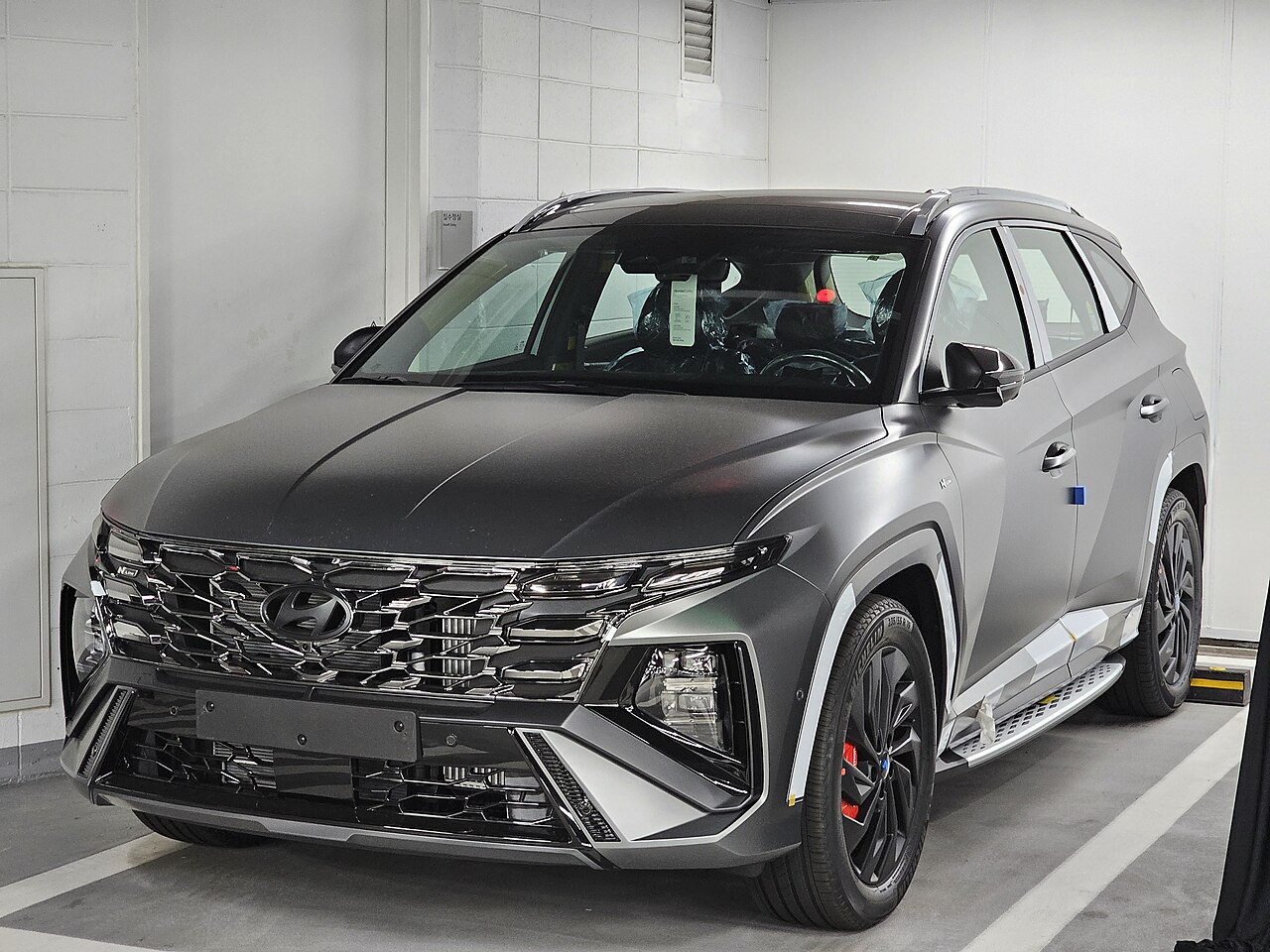
The gallery shows refreshed Korean-market cars. The N Line exterior and separate Inspiration cabin are labelled individually; neither establishes all the equipment of a US trim.
Body, platform & design
The refreshed nose retains the integration of lighting and grille, while the cabin photograph shows the revised display and control arrangement. The N Line car adds a distinct appearance, but appearance alone cannot identify the powertrain beneath it.
Check the roof and rear opening against actual family use. Bring a child seat or stroller if those are central requirements. Testing door access in a narrow bay can be more revealing than reading a maximum cargo figure.
.jpg)
Engine & drivetrain
Hyundai's US reveal describes a 2.5-litre gasoline engine alongside 1.6-litre turbocharged hybrid and plug-in-hybrid systems. It quotes 231 total system horsepower for the hybrid and 268 hp for the PHEV. Those are combined-system figures, not the gasoline engine's output alone.
The gasoline drivetrain uses an eight-speed automatic; the electrified versions use a six-speed automatic. Do not describe them as one common transmission. During a test drive, compare ordinary take-up, braking and an uphill merge rather than judging solely by maximum power.
.jpg)
Trim differences
First decide petrol, HEV or PHEV, then compare equipment within that choice. A high trim in one powertrain is not automatically the better value than a lower trim in another. Include tyres, insurance and any charging installation in the comparison.
Read the actual assistance list. Hyundai's model-year change bulletin notes changes to warning and assistance functions, so an older brochure's wording should not be assumed to describe a newer car.
Interior & seating
The refreshed cabin is a meaningful reason to sit in both old and new examples. Test climate adjustments and phone connection yourself. A display that looks impressive in a photograph may still require familiarisation for ordinary tasks.
Have rear passengers check seat comfort after the front seats are positioned. Load the cargo area with the seats in that same configuration. Family usability is about the complete arrangement, not one generous dimension in isolation.
Efficiency & range
The regular hybrid does not require external charging. The PHEV can use electricity from a plug, but its advantage depends on charging frequency and journey length. Compare petrol use and electricity cost together; a PHEV's blended test result is not its depleted-battery fuel economy.
For mostly highway driving, calculate the likely savings conservatively. For frequent short trips with charging at home, investigate the PHEV more closely. Avoid assuming the same answer fits both households.
Safety & equipment
Confirm the fitted collision, blind-spot and parking functions on the exact vehicle. Warning-only and actively intervening systems are different. Demonstrate alerts and controls without deliberately creating dangerous situations.
For used cars, check outstanding campaigns and accident repairs by VIN, including sensor calibration where required. No assistance package replaces attention, and choosing all-wheel drive does not eliminate tyre or braking limitations.
Strengths
The Tucson makes it possible to compare several degrees of electrification without abandoning a familiar five-seat SUV format. That is useful for buyers uncertain whether they are ready to charge a vehicle regularly.
Its strongest proposition is not necessarily the most expensive version. A properly chosen powertrain and sensible comfort equipment can be more valuable than buying every cosmetic option.
Start with the hybrid if you want electrification without plugging in; consider the PHEV only after checking charging and actual daily mileage. The ordinary petrol model still deserves a price-matched comparison.
Considerations
Avoid mixing short- and long-wheelbase market data or importing equipment assumptions from overseas photographs. On a used PHEV, establish charging operation and the condition of both the combustion and high-voltage systems.
Check the real payload and towing information for the exact build if those functions matter. A large cargo opening says nothing by itself about permitted weight.
Recommended use
The Tucson suits a household that wants an everyday five-seat SUV and enough powertrain choice to match its routine. It is not a substitute for a three-row vehicle when extra seating is regularly required.
Use the same route for petrol and hybrid test drives. Include parking, a rough surface and normal-speed acceleration so that a brief showroom impression does not dominate the decision.
Rivals & related
The Kia Sportage is a natural family-SUV comparison, while the Toyota RAV4 and Honda CR-V offer alternative hybrid shopping routes. Match model year, drivetrain and assistance equipment before comparing prices.
Within Hyundai, a smaller Kona or a larger Santa Fe may fit the actual passenger and luggage requirement better. Start with space needed rather than badge hierarchy.
FAQ
Does N Line automatically identify a unique engine? No; verify the market and build. Must the regular hybrid be plugged in? No.
Are these 2025 US power figures universal across every Tucson? No. They are a dated reference for the refreshed model, not a worldwide specification.
What makes the Hyundai Tucson different?
Start with the hybrid if you want electrification without plugging in; consider the PHEV only after checking charging and actual daily mileage. The ordinary petrol model still deserves a price-matched comparison.
Who should consider it?
Family transport with a powertrain matched to charging access
Sources & updates
Manufacturer references identify the dated specifications used here. Cariary buying assessments are editorial analysis, not a claimed first-hand road test or a diagnosis of an individual vehicle. Photographs carry individual source and licence credits. Confirm the exact build, market and equipment before purchase; photographs of another trim do not establish your car’s specification.
- Hyundai 2025 Tucson US reveal →
- Hyundai 2025 model-year changes →
- Photograph — Refreshed Hyundai Tucson N Line parked outdoors →Damian B Oh; CC BY-SA 4.0
View all official references (2 more)
- Photograph — White refreshed Hyundai Tucson NX4 →Damian B Oh; CC BY 4.0
- Photograph — Hyundai Tucson facelift Inspiration dashboard and cabin →Damian B Oh; CC BY 4.0
Last editorial review: September 20, 2026. Specifications remain market- and model-year-specific.