Core summary
The redesigned Traverse replaces the earlier V6 formula with a turbocharged four-cylinder. Its real buying question is whether the seating and luggage arrangement suits the whole family.
The third-generation Traverse is a three-row crossover designed around family transport. Its size is useful when several passengers and luggage must travel together, but it should not be bought simply because it is larger than a compact SUV.
Cariary would make the seating layout the first decision. A family needing eight places has a different requirement from one preferring a seven-seat arrangement with easier movement through the middle row.
History & generations
Chevrolet announced the redesigned Traverse in 2023 for the 2024 model year. It changes the powertrain from the earlier generation's V6 approach to a turbocharged four-cylinder. When shopping around the transition, confirm which body and engine the listing describes.
This page uses a US 2025 focus. The gallery's Z71 and High Country examples are identified 2025 vehicles, with their trim differences shown rather than merged into one equipment list.
Body, platform & design
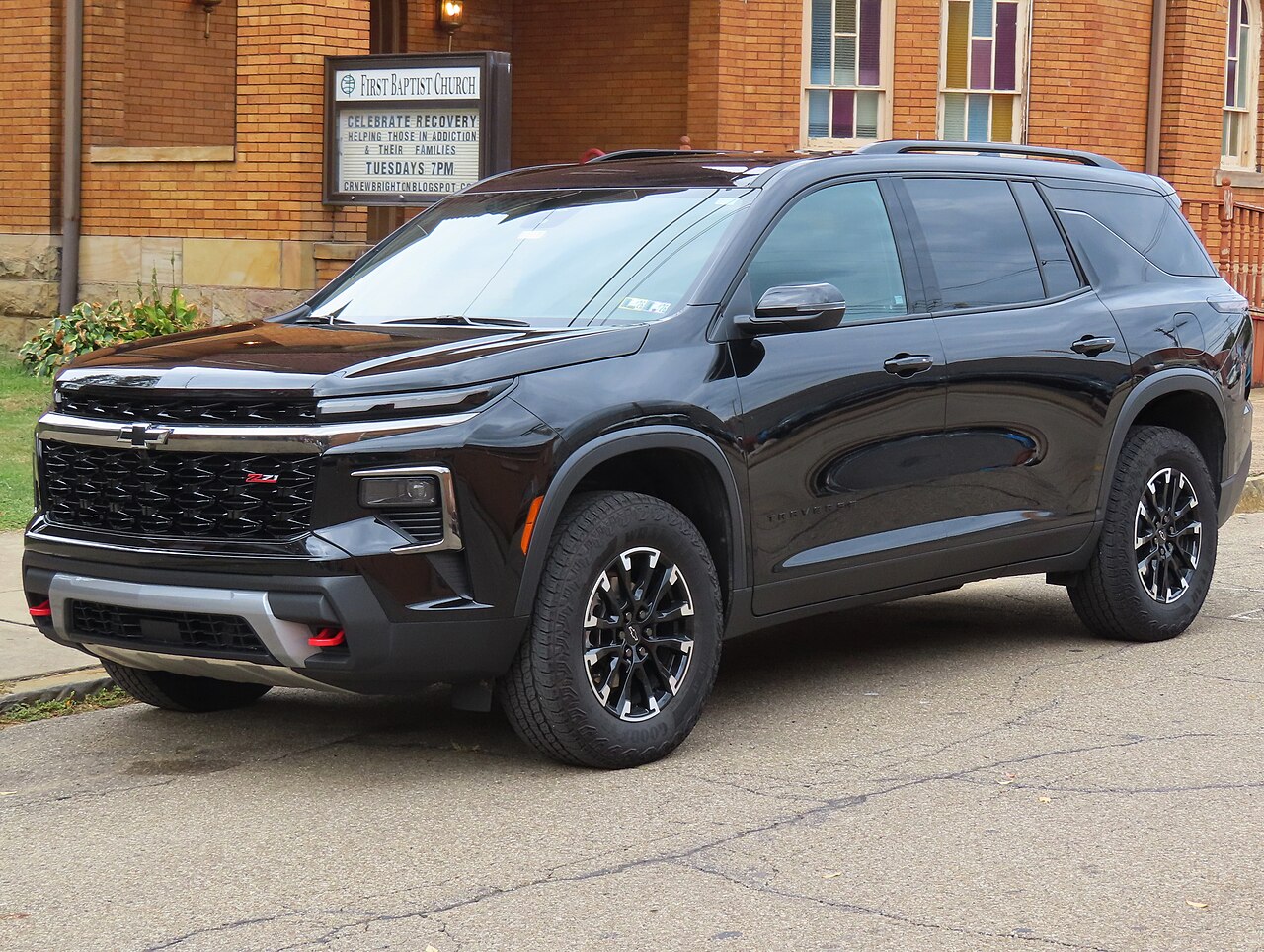
The new body's upright rear section communicates its three-row role. The black Z71 and blue High Country illustrate different styling treatments. Their wheels and exterior details do not prove that another trim carries the same equipment.
Check the dimensions where the vehicle will live. Open the tailgate under the garage ceiling and test rear-door access beside another car. Family convenience includes loading children in a real parking bay, not just space inside the cabin.

Engine & drivetrain
The redesigned model's 2.5-litre turbo four-cylinder is rated at 328 hp and 326 lb-ft in the cited US description, paired with an eight-speed automatic. Those figures belong to the new generation, not the older V6 model.
Choose FWD or AWD according to the exact configuration and your route. Assess acceleration with a realistic load during a lawful test drive; the number of cylinders alone does not settle suitability for a family trip.

Trim differences
Z71 has a different brief from a more road-focused or luxury specification. Select it because its equipment suits your use, not because its appearance implies a truck-based platform or unlimited rough-road ability.
Before choosing trim, establish the required seat count and second-row layout. Verify the individual window sticker: a feature displayed on a High Country photo is not automatically included on a different Traverse.
Interior & seating
Try all three rows with the front seats set normally. Test third-row access with child seats installed where they will actually be used. A quick demonstration with an empty cabin can hide the inconvenience of moving around a fitted child seat.
Load holiday bags with every required seat upright. Maximum cargo figures with seats folded are useful for moving furniture, but do not tell you how a fully occupied family vehicle will pack.
Efficiency & range
Budget around your usual occupancy, route and drive configuration. A large three-row crossover still has fuel, tyre and insurance costs even when most journeys carry only one person. Compare a smaller vehicle if the third row would be used only rarely.
For towing, check the exact vehicle's package and ratings. Passengers and luggage affect the available capacity; a range-wide maximum is not a universal allowance.
Safety & equipment
Confirm the fitted assistance systems and demonstrate their controls. Check recall status by VIN and inspect tyres and repair history on a used example. Cameras and warnings should help the driver, not replace looking around a large vehicle.
For family use, test child-seat fit and belt access in the actual seating arrangement. Ensure the selected layout supports how the household will travel rather than merely displaying enough places in a specification table.
Strengths
The Traverse's strongest case is genuinely needed three-row accommodation in a crossover format. Its usefulness is measured by whether passengers can enter, sit comfortably and bring their luggage.
The range offers different appearance and equipment choices, but the underlying family task should remain the priority. A less dramatic trim that fits everyone is a better answer than an unsuitable configuration bought for its wheels.
A sensible shortlist entry for buyers who genuinely use three rows. Choose the seating layout first, then decide whether Z71 styling and hardware or a more road-focused trim fits the job.
Considerations
The main compromises are size and the temptation to assume every three-row SUV is equally practical. Parking, access and cargo behind occupied seats require direct testing.
Do not blend old-generation V6 information with the redesigned turbo model. Also check market-specific seating: a brochure from another country can describe a different arrangement from the US car you are considering.
Recommended use
Shortlist the Traverse for a household that regularly uses more than two rows and wants an enclosed family vehicle rather than a pickup. It is less persuasive when the extra row and cargo volume are mainly hypothetical.
For long-distance use, give every regular passenger a voice in the test. Noise, access and seating comfort cannot be decided entirely from the driver's position.
Rivals & related
The Kia Telluride, Hyundai Palisade and Honda Pilot provide relevant three-row comparisons. A Toyota Grand Highlander is another useful reference for family packaging. Match model year and seating configuration before comparing specifications.
Bring the same child seats and luggage to each test. That practical comparison is more informative than ranking vehicles by their largest advertised cargo number.
FAQ
Does this Traverse have the older V6? No, this page covers the redesigned turbo-four generation. Is every example an eight-seater? No, configuration matters.
Are Z71 and High Country identical? No; their equipment and purpose differ. Can a maximum cargo figure describe luggage room with all seats occupied? No, check the measurement condition and test your real load.
What makes the Chevrolet Traverse different?
A sensible shortlist entry for buyers who genuinely use three rows. Choose the seating layout first, then decide whether Z71 styling and hardware or a more road-focused trim fits the job.
Who should consider it?
Family travel requiring three seating rows
Sources & updates
Manufacturer references identify the dated specifications used here. Cariary buying assessments are editorial analysis, not a claimed first-hand road test or a diagnosis of an individual vehicle. Photographs carry individual source and licence credits. Confirm the exact build, market and equipment before purchase; photographs of another trim do not establish your car’s specification.
- Chevrolet introduces redesigned 2024 Traverse →
- Chevrolet 2025 Traverse specification configurator →
- Chevrolet redesigned Traverse launch, Mexico; market differences →
View all official references (3 more)
- Photograph — Black 2025 Chevrolet Traverse Z71 →MercurySable99; CC BY-SA 4.0
- Photograph — Black 2025 Chevrolet Traverse Z71 rear →MercurySable99; CC BY-SA 4.0
- Photograph — Blue 2025 Chevrolet Traverse High Country →Mr.choppers; CC BY-SA 4.0
Last editorial review: September 20, 2026. Specifications remain market- and model-year-specific.