Core summary
The E 300 adds petrol performance without becoming an AMG. Its strongest case is an open-air touring car with usable rear seats and carefully chosen comfort equipment.
The E 300 Cabriolet occupies a useful position between the entry petrol E 200 and the more complex performance proposition of an AMG. It keeps the A238's four-seat soft-top format, with a four-cylinder petrol engine rather than the six-cylinder implied by older Mercedes naming habits.
Cariary sees its appeal in balance: enough reason to choose the stronger petrol model without assuming that every convertible buyer wants the running costs or character of an AMG. This is a specification-based assessment, not a first-hand road test.
History & generations
The A238 arrived in 2017 and was updated in 2020. Early and facelift E 300 advertisements can therefore refer to different engine and cabin specifications. The photographs here show a pre-facelift display car, while this article uses the original European launch engine figures as its dated reference.
Do not confuse it with the E 300 saloon, a diesel E 300 d, or an E 300 e plug-in model from another body range. The shared number is not a shared vehicle specification.
Body, platform & design
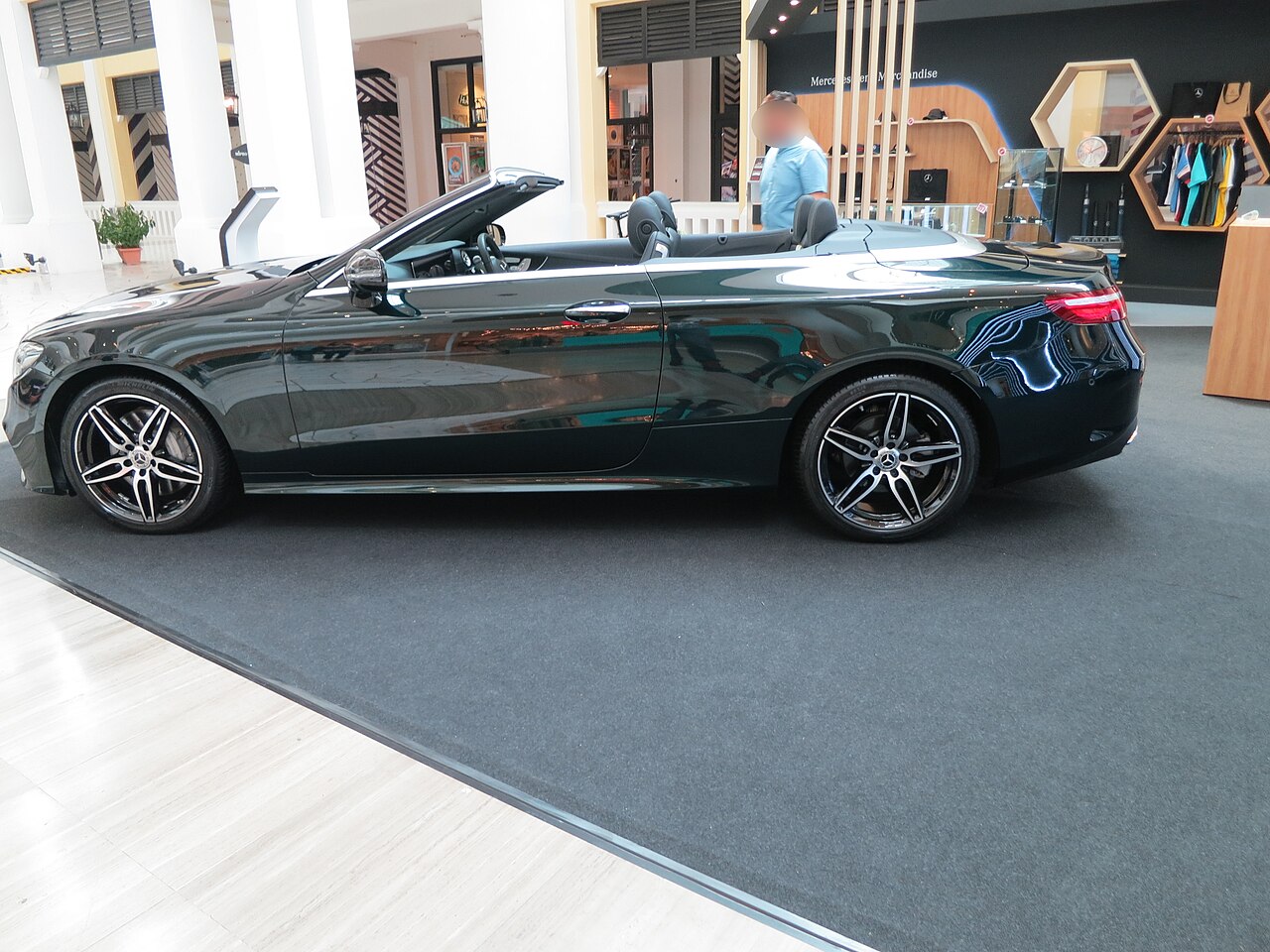
The side view shows why a four-seat cabriolet is a different purchase from a small roadster: there is a long cabin and a substantial rear deck. Those proportions allow occasional rear passengers but require a larger parking space.
The detail photographs show the display car's grille, brake caliper and seat controls. They illustrate that particular specification, not standard equipment across the E 300 range.
.jpg)
Engine & drivetrain
At the 2017 European launch, the E 300 used a 1,991 cc turbocharged four-cylinder rated at 180 kW/245 PS and 370 Nm, coupled to a nine-speed automatic and rear-wheel drive. A 300 badge here does not mean a three-litre engine.
For later examples, use the original specification for that year rather than adding a newer output figure to an older car. Check smooth starting, low-speed shifts and service documentation during a properly arranged inspection.
.jpg)
Trim differences
Engine designation and equipment line should be compared separately. AMG Line does not supply the E 53's engine, drivetrain or chassis simply because the bumpers look sportier.
Seat ventilation, neck-level heating, wind management and audio equipment can strongly influence enjoyment of this car. Test each fitted function and obtain the factory equipment record instead of relying on an advertisement's generic feature list.
.jpg)
Interior & seating
The A238 provides four individual seating positions under a fabric roof. Assess rear-seat room with the driver's seat adjusted normally, then check whether entering and exiting remains realistic for your passengers.
Roof-down motoring exposes the cabin to sun and dust. Inspect upholstery, switches and trim for uneven wear, and test the comfort controls shown in the gallery on the actual car rather than assuming they all work.
Efficiency & range
Use a consumption figure from the correct model year and test cycle. Mixing a launch NEDC value with a later WLTP figure can make a comparison appear more dramatic than it is.
For occasional leisure use, roof maintenance, tyres, servicing and insurance may dominate the budget. Set money aside for those items before spending the entire allowance on a newer registration or a more elaborate wheel design.
Safety & equipment
Review the VIN's service and recall records. Assistance systems differ by option package, so establish exactly which cruise, lane and parking functions are installed.
Inspect tyres and warning messages, and arrange a specialist assessment if the roof, windows or restraint systems show faults. A roof that opens once at a viewing is not evidence that every related system is healthy.
Strengths
The E 300's main advantage is the combination of a four-seat open cabin and a stronger four-cylinder specification than the early E 200. It need not be framed as an inferior AMG; it serves a different touring brief.
For a couple carrying occasional passengers, it can provide the desired sense of occasion without moving to the larger S-Class Cabriolet.
A useful middle ground in the A238 family. Prefer a healthy roof and documented upkeep to cosmetic options or an unsupported claim of a higher-output specification.
Considerations
The luggage partition and folded roof reduce usable packing space. Check your actual luggage before assuming the car can handle a four-person holiday with the roof down.
Look for water ingress and uneven window sealing, and ask a specialist to investigate suspicious noises or interrupted roof movement. The correct response to a fault is a repair estimate, not a blanket claim that convertibles always behave that way.
Recommended use
A good fit for a driver who wants scenic trips, occasional rear seats and everyday usability when the weather turns. Test it closed-roof on the roads you use most; the car will not spend every journey in a showroom-perfect summer setting.
If rear passengers are frequent, ask them to join the viewing. If they are rare, decide whether the larger body is worthwhile compared with a smaller two-seat alternative.
Rivals & related
Compare an E 200 on condition and equipment, and an E 53 only if its performance powertrain is genuinely part of your plan. These are not merely trim levels of the same mechanical package.
The Audi A5 Cabriolet and BMW 4 Series Convertible are relevant alternative four-seat convertibles. Assess roof arrangement, rear access and boot usability alongside engine figures.
FAQ
Is it a six-cylinder? The 2017 E 300 Cabriolet reference is a two-litre four-cylinder.
Is it a plug-in hybrid? The A238 petrol version covered here is not an E 300 e plug-in.
Can I use coupe specifications? Not indiscriminately: roof packaging and other figures differ.
What should come first at a viewing? Identity and records, followed by roof, windows, comfort equipment and a suitable test drive.
What makes the Mercedes-Benz E 300 Cabriolet different?
A useful middle ground in the A238 family. Prefer a healthy roof and documented upkeep to cosmetic options or an unsupported claim of a higher-output specification.
Who should consider it?
Four-seat convertible touring
Sources & updates
Manufacturer publications linked below provide the dated model and technical references. The buying assessments are Cariary editorial analysis, not a claimed first-hand road test. Photographs are independently credited, with early and facelift appearances identified where relevant. Equipment and homologated figures must be checked against the individual vehicle’s market and model year.
- Mercedes-Benz — A238 introduction and E 300 launch figures →
- Photograph — Dark green A238 E 300 Cabriolet side view with roof down →Bindydad123; CC BY-SA 4.0
- Photograph — Diamond-pattern grille on A238 E 300 Cabriolet →Bindydad123; CC BY-SA 4.0
View all official references (2 more)
- Photograph — Mercedes-Benz brake caliper behind E 300 wheel →Bindydad123; CC BY-SA 4.0
- Photograph — E 300 Cabriolet door-mounted seat and comfort controls →Bindydad123; CC BY-SA 4.0
Last editorial review: September 20, 2026. Specifications remain market- and model-year-specific.