Core summary
A front-wheel-drive compact electric SUV for everyday travel, with charging access and cabin needs more important than badge hierarchy.
The Mercedes-Benz EQA 250 is the front-driven version of the H243 electric compact SUV introduced in 2021. The original launch specification used a 140 kW (190 PS) front-axle motor and a 66.5 kWh usable battery. Those figures describe the early EQA 250, not every EQA 250+ or updated-market car; check the build date and local brochure before comparing advertised range or charging time.
Cariary’s view: the EQA 250 is most persuasive as a quiet premium commuter with occasional longer trips. It feels familiar to a driver moving from a GLA, but its conversion-derived packaging does not create the open interior or charging advantage of a dedicated EV platform. A convenient home or workplace charger makes more difference to the ownership proposition than the biggest advertised range number.
History & generations
Mercedes-Benz introduced the H243 EQA as an electric compact SUV in 2021. The first EQA 250 established the single-motor front-drive entry point; later EQA 300 and 350 4MATIC variants added a second driven axle. A later EQA 250+ is a separate battery-and-range proposition, so its figures should never be copied onto an early EQA 250.
Mercedes updated the EQA during its production run, including styling and infotainment changes. A registration year alone cannot establish whether the car is pre-update or facelifted. Compare the VIN, charging specification, usable battery capacity and software support for the exact market and build date.
Body, platform & design
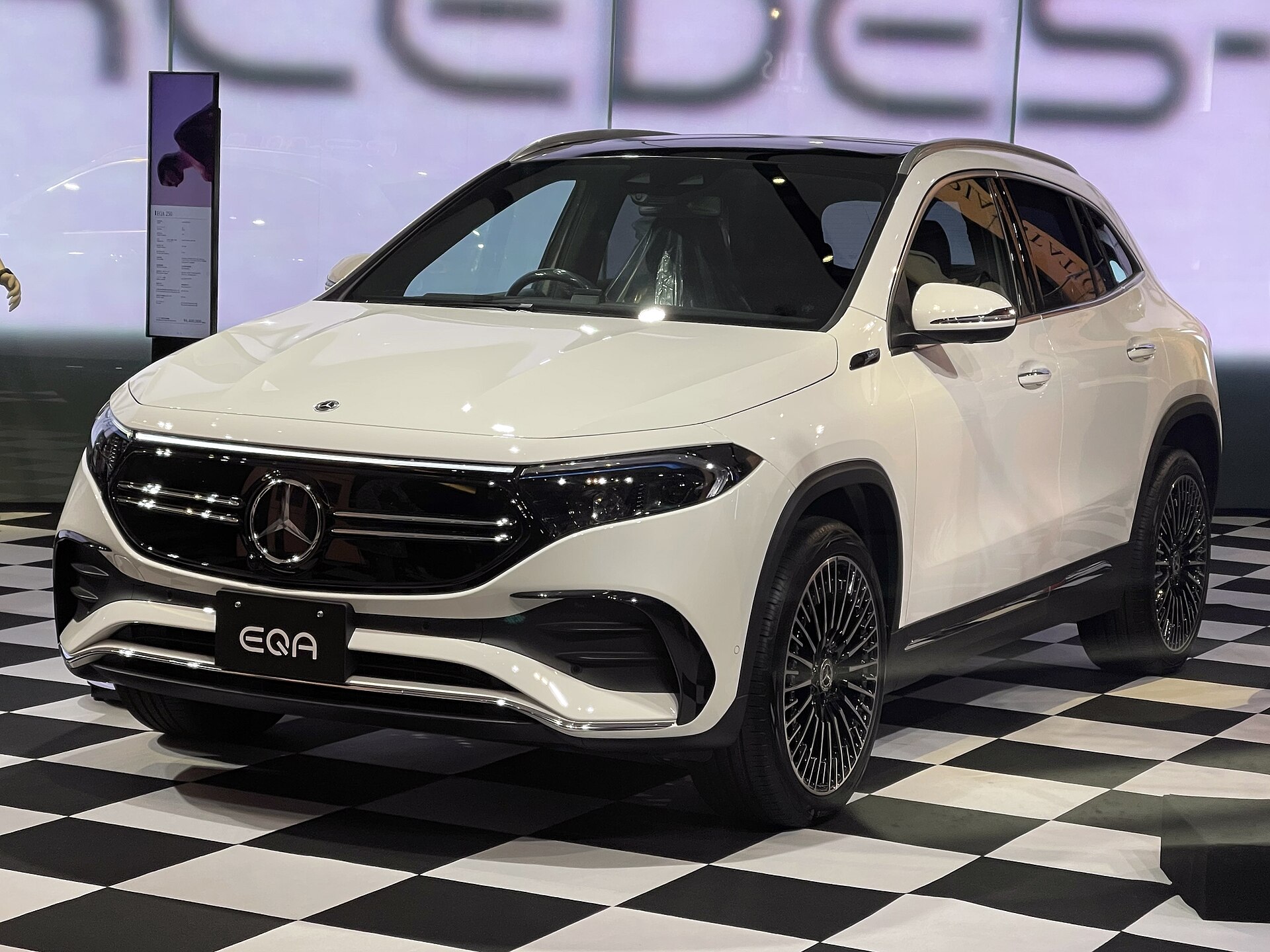
The EQA takes its compact crossover proportions from the GLA family and adds EV-specific front treatment, rear lighting and aerodynamic details. The H243 body makes the vehicle easier to place in a city than a larger EQ model, but it does not disguise its relatively high floor and conventional compact-SUV footprint.
Every image in the gallery is documented as an EQA 250 of the H243 generation by its Commons file record. Interior and wheel details are labeled as such, not as exterior three-quarter views. Wheel size and tire specification can change ride quality, road noise and consumption, so compare the actual car rather than relying on an appearance package.
_rear.jpg)
Engine & drivetrain
In the launch EQA 250, a single asynchronous electric motor drives the front axle through a single-speed reduction gear. Mercedes published 140 kW (190 PS) and 375 Nm for that version. It is not the dual-motor 4MATIC setup used in the EQA 300 and 350. The initial usable battery capacity was 66.5 kWh; updated variants and other markets may differ.
The front-drive layout suits calm commuting. During a test drive, check for a smooth transition between regeneration and friction braking, normal charging behavior, drivetrain warning messages and even tire wear. Battery health and warranty coverage matter more than a short demonstration of acceleration.
_interior.jpg)
Trim differences
The EQA 250, EQA 250+, EQA 300 4MATIC and EQA 350 4MATIC names identify materially different battery or drivetrain arrangements. Do not assume that a car advertised simply as “EQA” has the launch EQA 250 battery or the later 250+ range. Regional packages also change lamps, seats, driver assistance, displays and wheel sizes.
For a used example, decode the VIN and compare the build sheet with the charging hardware shown in the infotainment menus. Prioritize useful features such as parking cameras, suitable seats and the charging cables actually needed at home. Cosmetic AMG Line styling does not convert a front-drive EQA 250 into a 4MATIC model.
_interior.jpg)
Interior & seating
The dashboard follows the familiar Mercedes compact-car layout, which can ease the transition from a petrol GLA. Screen software and control details vary by year. The EQA remains a compact vehicle, however: the battery installation and rear-seat floor position deserve an actual seating test rather than an assumption based on its SUV silhouette.
Check the rear seating position, child-seat access and the luggage area with the cables you will carry. During inspection, test the climate system, preconditioning, displays, cameras and charge-port flap. A quiet electric drivetrain can make tire, wind or trim noise more noticeable.
.jpg)
Efficiency & range
Mercedes published a 66.5 kWh usable battery for the launch EQA 250, with up to 100 kW DC charging and 11 kW AC charging in its technical material. The quoted 10–80% DC charging time was about 30 minutes under suitable conditions. These are launch-version reference figures, not a promise for every charger, temperature or later EQA derivative.
Cold weather, motorway speed, elevation and larger wheels can cut real range. Test the trip that matters most to the owner and compare charging stops using a realistic charging curve. For daily use, confirm whether home or workplace charging is available; if it is not, the convenience and cost equation changes substantially.
Safety & equipment
Driver-assistance availability depends on year and equipment. Check the actual car for emergency braking, lane support, blind-spot monitoring, cameras and parking sensors rather than accepting a model-line feature list. Tire specification and condition affect braking and range alike.
Run the VIN through the manufacturer and local recall authority before purchase. Repairs around sensors, cameras or the front bumper may require calibration. Assistance systems support an attentive driver; they do not turn the EQA into an autonomous vehicle.
Strengths
The EQA 250 combines a manageable city-sized body with quiet electric propulsion and familiar Mercedes controls. Its front-drive, single-motor specification avoids the added complexity and energy demand of a second driven axle where all-wheel-drive traction is unnecessary.
For a driver with reliable charging, its daily smoothness and compact footprint are more compelling than an acceleration headline. The strongest examples have documented service, known software status, a clear battery warranty and wheels suited to comfort and range rather than showroom impact.
The EQA 250 makes most sense as a compact five-seat EV for regular commuting. Check the individual car's battery specification, charging equipment and rear-seat space before choosing it; specifications vary by model year and market.
Considerations
The H243 is not a ground-up EV platform. Its cabin and cargo packaging should be compared with newer dedicated EVs, especially if rear-seat space is important. Early EQA 250 range and charging performance are also not interchangeable with the later EQA 250+.
Before purchase, request charging history where available and confirm battery-warranty terms, charge-port condition, AC and DC operation, tire wear, brake condition and software updates. Public fast-charging reliance can undermine the convenience advantage that makes this compact EV appealing.
Recommended use
Best suited to a driver who wants a premium electric commuter, can charge reliably at home or work, and needs a vehicle easier to park than a larger SUV. Occasional long trips are possible, but should be planned around the actual car’s consumption and charging behavior.
It is a weaker fit for frequent high-speed motorway travel without dependable charging, or for buyers expecting dedicated-EV interior space. Compare the EQA 250 with the 250+ and 4MATIC variants only after identifying the specific use case and local-market equipment.
.jpg)
Rivals & related
Relevant compact premium EV alternatives include the Volvo EX40 and BMW iX1, with exact availability depending on market and year. Compare usable cabin space, rear-seat position, charging curve, range at motorway speed, tire cost and local service support—not just a headline battery size.
A used-car comparison should hold age, mileage and warranty coverage as constant as possible. The EQA can be appealing for a Mercedes-familiar driver, while a purpose-built EV may offer better packaging. Neither conclusion replaces a test drive and charging trial.
FAQ
Q: Is the original EQA 250 all-wheel drive?
A: No. The launch EQA 250 drives the front wheels; the EQA 300 and 350 4MATIC are distinct dual-motor variants.
Q: Does every EQA 250 have the same battery as the EQA 250+?
A: No. The 250+ is a separate later specification. Verify the VIN, battery data and local brochure.
Q: What should be tested before buying?
A: Confirm AC and DC charging, battery warranty, software status, tire wear, climate preconditioning and the real rear-seat fit.
Q: Who is it best for?
A: An owner with reliable routine charging who values a quiet, compact premium commuter over maximum long-distance range.
What makes the Mercedes-Benz EQA 250 different?
The EQA 250 makes most sense as a compact five-seat EV for regular commuting. Check the individual car's battery specification, charging equipment and rear-seat space before choosing it; specifications vary by model year and market.
Who should consider it?
Premium electric commuting
Sources & updates
Mercedes-Benz Media, “Die Technik des neuen EQA,” provides the launch EQA 250 motor, battery and charging specifications: https://media.mercedes-benz.com/article/3ba19c89-566c-45ae-aba7-971d5ed2362d
Mercedes-Benz EQA owner’s manual documents model-specific technical and operating information. Consult the manual and regional brochure for the exact model year: https://static.oneweb.mercedes-benz.com/css-oom-assets/en-iq/pdf/mercedes-eqa-suv-2023-march-h243-mbux-owners-manual-1.pdf
Each gallery image links to its own Wikimedia Commons file page for creator, license and model identification. Local recalls and campaign status must be checked against the vehicle VIN.
- Mercedes-Benz Media — EQA 250 launch technical data →
- Mercedes-Benz EQA owner’s manual →
- Wikimedia Commons — EQA 250 photo attribution →
Last editorial review: September 19, 2026. Specifications remain market- and model-year-specific.