Core summary
The G30 530e rewards a realistic charging plan. Early and later examples differ, so a single electric-range claim cannot describe the entire generation.
The 530e combines a petrol four-cylinder with an electric motor and an externally rechargeable battery. It is not the conventional 530i, and it should not be confused with the six-cylinder 545e. The owner has two energy sources to manage rather than a petrol car with an incidental badge.
Cariary's buying view: a working charging routine is the decisive option, even though it is not fitted to the car. Without somewhere dependable to plug in, much of the reason for choosing this version disappears.
History & generations
The G30 plug-in arrived in 2017. BMW announced a battery update and an xDrive addition for 2019, followed by the 2020 facelift. These stages make build-date research particularly useful on a used 530e.
Do not attach a later range estimate or power figure to an early car because both share a badge. The saloon is also separate from the G31 Touring and newer G60. Ask for the exact model and production data before comparing advertisements.
Body, platform & design
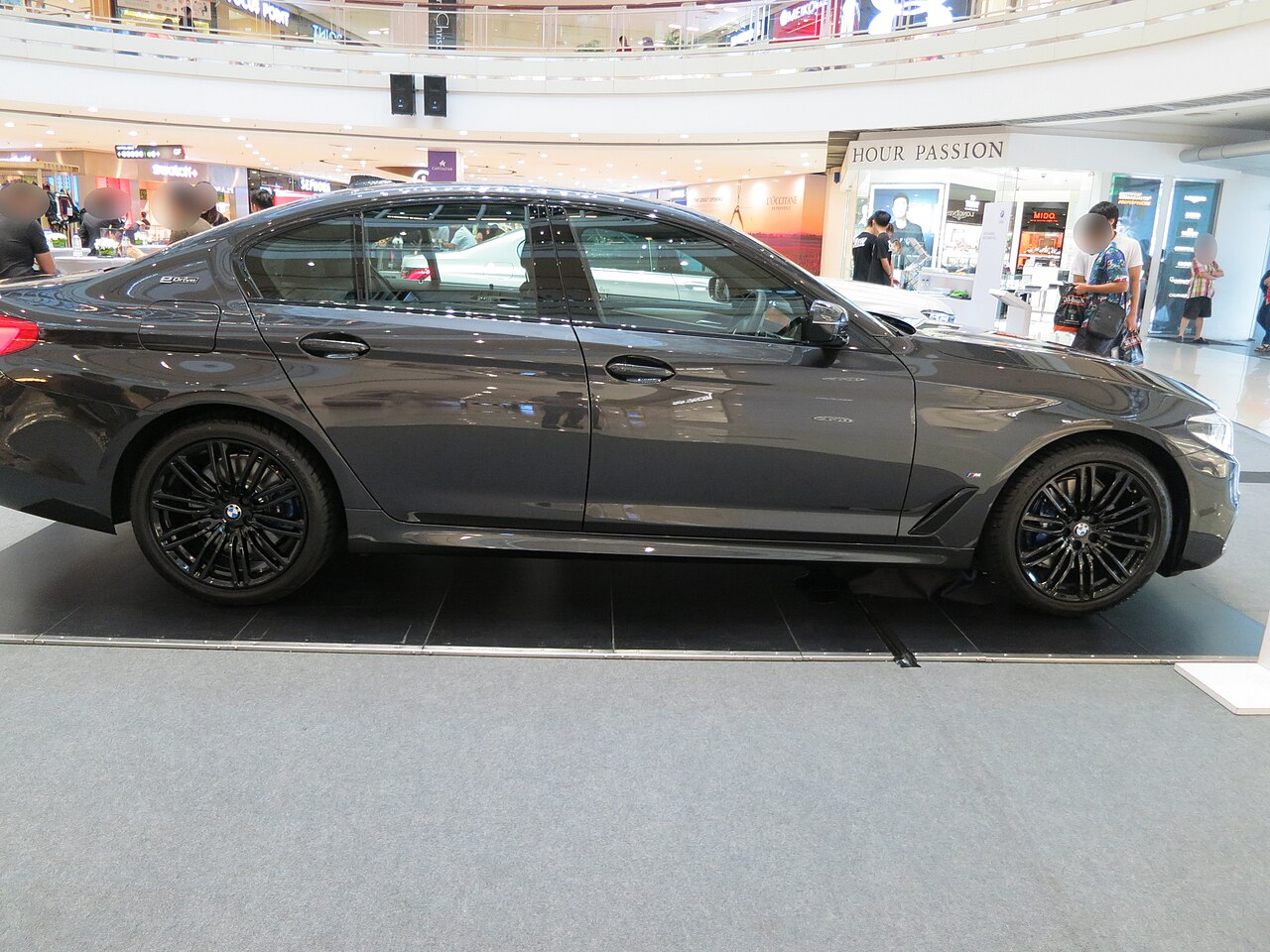
The gallery shows early G30 examples, including the charging flap ahead of the driver's door on a left-hand-drive car. The visual identity remains close to an ordinary 5 Series, which can make a mistaken listing easy to overlook.
Test the luggage compartment yourself. Hybrid hardware changes packaging, so the boot of a petrol 530i is not a safe substitute when deciding whether your own bags fit. Include charging-cable storage in that practical check.
_530e_(2017)_(53334772781).jpg)
Engine & drivetrain
The early global specification gave the system 185 kW/252 PS. The 2020 table lists 215 kW/292 PS and 420 Nm; these are system figures, not the output of the petrol engine alone. Availability of peak assistance depends on operating conditions.
A purchase inspection should cover electric driving, petrol operation and transitions between them. The car must also demonstrate charging on appropriate equipment. A quiet electric demonstration alone does not establish the condition of the engine or the complete hybrid system.

Trim differences
Separate rear-drive 530e from 530e xDrive, and distinguish early cars from battery-updated and facelift versions. M Sport styling says little about the health or capacity of the high-voltage battery.
Check charging equipment compatibility in your country, the included cable and any transferable battery coverage directly from the relevant documentation. Do not rely on a seller applying the warranty terms of a different market or newer car.
Interior & seating
The familiar G30 layout makes the 530e easy to compare with a conventional 5 Series, but the energy displays and drive modes deserve their own demonstration. Learn how the car reports charge, consumption and electric operation before using those displays to judge it.
Check the climate system during charging and driving, plus the normal seat and infotainment functions. A well-presented interior does not replace a technical battery inspection, and a healthy battery does not excuse broken comfort equipment.
Efficiency & range
For the 2020 saloon BMW listed WLTP electric ranges of 54–61 km for rear drive and 48–55 km for xDrive. Those are dated test ranges, not a guarantee for an aged battery in winter. Early examples have different references.
Budget petrol and electricity together. The weighted low fuel-consumption figure assumes a pattern involving electrical energy; it does not mean that an uncharged motorway trip consumes the same amount. Compare your commute with the car's observed usable range and charging schedule.
Safety & equipment
High-voltage work belongs with appropriately trained technicians. During a pre-purchase inspection, request a check of relevant faults, charging hardware and any outstanding campaigns rather than attempting electrical repairs yourself.
Normal tyres, brakes and assistance systems still matter. Ask about accident damage near the charging port and underbody. A dashboard without a warning at one moment is useful but is not equivalent to a complete inspection history.
Strengths
The 530e can combine electrically powered local travel with petrol flexibility for longer trips. That is a useful compromise for a household ready to charge but not ready to rely entirely on public charging for every journey.
Its conventional saloon format is another attraction. You do not need to choose an SUV simply to obtain a plug-in drivetrain. The benefit depends on using the electrical side frequently, not merely owning it.
Buy it as a plug-in system you will use, not as a low fuel-consumption headline. Verify charging, battery condition and actual luggage fit before purchase.
Considerations
Battery age, charging performance and packaging matter as much as mileage. Obtain a documented assessment of the specific car rather than treating the displayed predicted range as a laboratory measurement of battery health.
Also examine the petrol engine's service record. A plug-in still contains an engine, gearbox, cooling circuits and normal chassis equipment. A low petrol-use history does not make servicing optional, and an attractive purchase price should leave room for specialist support.
Recommended use
The strongest candidate has regular access to suitable charging and many journeys within a realistic electric range, plus occasional longer trips. Someone who cannot charge regularly should compare a 530i before deciding.
Before purchase, confirm where the cable will reach and whether the planned installation or outlet is suitable with a qualified provider. Then test the car on a representative route instead of relying solely on the electric range shown at the dealership.
Rivals & related
Compare with a same-era Mercedes-Benz E-Class plug-in and Volvo S90 Recharge/T8 where offered, allowing for different powertrains and battery generations. Charging capability and luggage space are more revealing than comparing peak horsepower alone.
The BMW 545e brings a six-cylinder plug-in arrangement; the 530i removes the charging requirement. Both help clarify whether your priority is electric commuting, engine character or a simpler refuelling routine.
FAQ
Q: Is the 530e a mild hybrid?
A: No. This G30 is a plug-in hybrid.
Q: Can it drive without plugging in?
A: It retains petrol capability, but regular charging is central to its intended benefit.
Q: Do all years have the same electric range?
A: No; battery updates, configuration and condition matter.
Q: Does 530e mean a six-cylinder engine?
A: No. The G30 530e uses a petrol four-cylinder; the 545e is different.
What makes the BMW 530e different?
Buy it as a plug-in system you will use, not as a low fuel-consumption headline. Verify charging, battery condition and actual luggage fit before purchase.
Who should consider it?
Chargeable daily commute with petrol long-trip flexibility
Sources & updates
The manufacturer references below identify the dated generations and specifications used in this profile. Buying assessments are Cariary editorial analysis, not a claimed first-hand road test or a diagnosis of an individual vehicle. Photographs carry separate credit and licensing information. Confirm exact equipment, ratings and campaign status for the car’s production date and original market.
- BMW — G30 launch specifications (2017) →
- BMW — summer 2019 model changes →
- BMW — 5 Series update (2020) →
View all official references (3 more)
- Photograph — Grey early G30 BMW 530e plug-in hybrid side view →Bindydad123; CC BY-SA 4.0
- Photograph — White early G30 BMW 530e rear three-quarter view →Alexander Migl; CC BY-SA 4.0
- Photograph — Grey G30 BMW 530e travelling on the road →Charles from Port Chester, New York; CC BY 2.0
Last editorial review: September 20, 2026. Specifications remain market- and model-year-specific.