Core summary
The original V8 X7 rewards buyers who want a large family tourer, but the xDrive50i must not be confused with the later M50i or M60i.
The X7 xDrive50i brings a V8 to BMW's early G07 three-row SUV. It is best understood as a family touring vehicle with substantial performance, not a sports coupe enlarged to carry seven people. The badge describes a particular early engine version rather than every petrol V8 X7.
Cariary would make passenger use the first buying question. If the third row is regularly needed, the X7 deserves consideration. If it will mostly carry one person through tight city streets, its size and operating costs need a stronger justification than the appeal of the badge.
History & generations
BMW announced the G07 in 2018 for a 2019 market launch. The xDrive50i belongs to that original range. It is separate from the M50i and the later facelift M60i; their specifications should not be attached to an early 50i listing.
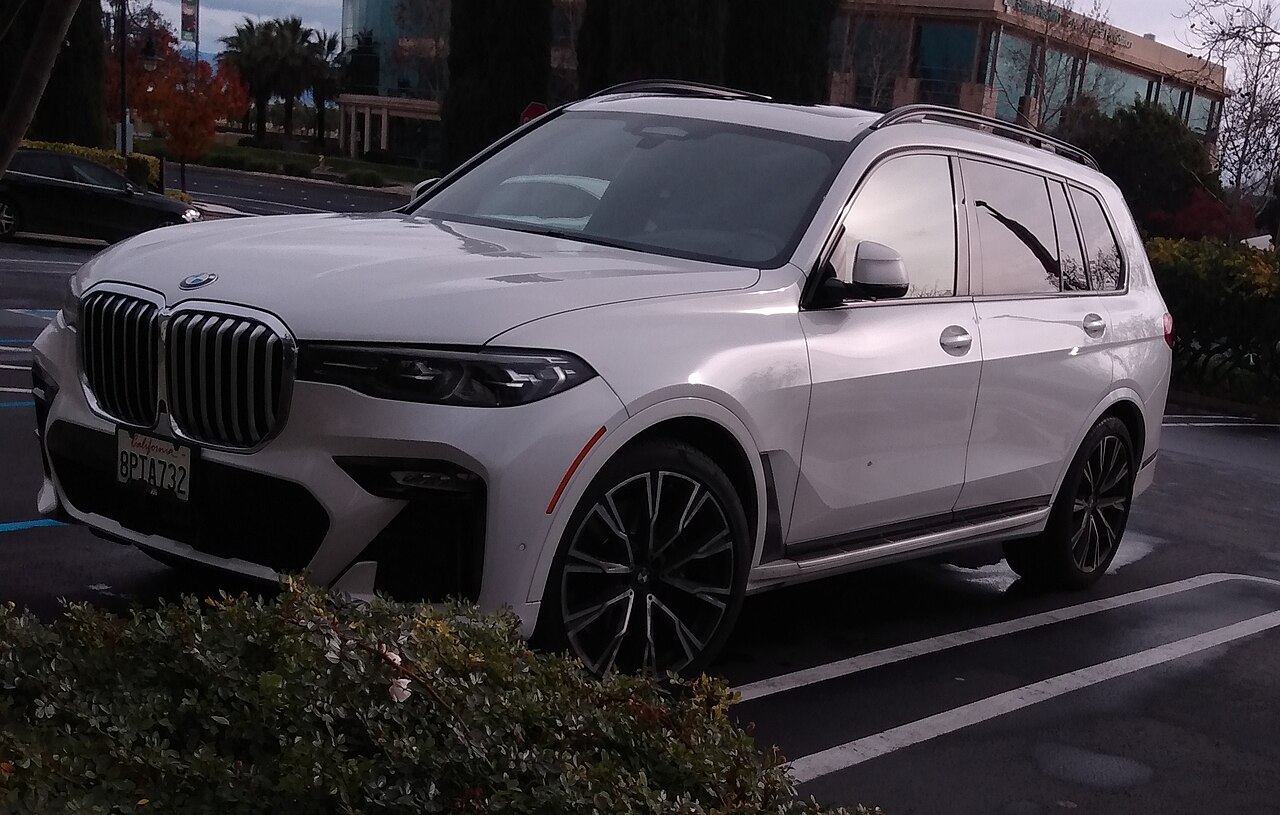
A used-car advert may simply say X7 V8. Obtain the exact model designation and production date before comparing performance or equipment. The original front-end design shown here is also distinct from the later split-headlamp facelift.
Body, platform & design
The white xDrive50i photograph shows the tall roof, upright passenger compartment and substantial side glazing of the early G07. These are practical proportions for a three-row vehicle, even if the grille dominates first impressions.
Assess the car in the place where it will actually live. Open the doors next to another parked car and check tailgate clearance under the garage ceiling. A camera view can help with positioning, but it cannot make a narrow parking bay physically wider.

Engine & drivetrain
BMW's launch data specifies a 4,395 cc V8, 340 kW/462 PS and 650 Nm, coupled to an eight-speed automatic and xDrive. The quoted 5.4 seconds is 0–100 km/h, not 0–60 mph. Metric PS should not be relabelled as US horsepower.
On a used example, prioritise a smooth cold start, predictable low-speed shifts and documented servicing. Ask an independent specialist to inspect leaks, cooling-system condition and stored faults. These are inspection priorities for a complex used V8, not a claim that every xDrive50i develops the same fault.
Trim differences
Seven seats were standard in the launch description, with a six-seat arrangement using individual second-row chairs available. That choice changes access and carrying flexibility more than a cosmetic package. Check the actual cabin, not merely a listing's seating count.
Do not assume M Sport body styling means M50i power. Likewise, a luxury option shown in a launch photograph need not be installed in a particular used car. The build record is the sensible basis for comparing two otherwise similar examples.
Interior & seating
Try the third row with the people who will use it, leaving the front seats in normal positions. Check how easily the second row moves and whether a child seat interferes with access. Electrically operated seating should be demonstrated through its full movement.
Load the luggage you expect to carry with every required seat upright. A seven-seat SUV can still force compromises when seven occupants also bring holiday bags. This is more useful information than a maximum cargo figure measured with most seats folded.
Efficiency & range
The 50i is not an economy-led choice. Separate the affordable used purchase price from fuel, tyres, insurance, servicing and possible suspension work. A good buying budget includes a reserve rather than consuming all available money on the car itself.
Compare the six-cylinder xDrive40i if the V8 is not central to your enjoyment. The right question is whether the extra engine character is worth the ownership commitment for your mileage, not whether the larger engine wins a specification comparison.
Safety & equipment
Check the fitted driver-assistance equipment and demonstrate parking cameras, warnings and relevant controls. Availability varies by market and option package. Assistance features should support an attentive driver, not substitute for familiarity with the car's dimensions.
Inspect tyre condition and have recalls checked by VIN. If the vehicle has had windscreen or collision repairs, ask for the associated sensor-calibration records.
Strengths
The 50i's strongest case is the combination of family accommodation and V8 performance in one vehicle. A buyer who frequently travels with several passengers can benefit from that combination without trying to turn the car into a track-focused machine.
Its appeal is clearest when the seating arrangement fits the household and the ownership budget allows maintenance to be done properly.
An appealing early X7 for a buyer who genuinely needs three rows and budgets for a complex V8 luxury SUV. Condition should outweigh the attraction of a depreciated purchase price.
Considerations
The main trade-off is scale. Manoeuvring, tyre replacement and storage all belong in the decision. On an older luxury SUV, an impressive equipment list also creates more functions to test before purchase.
Avoid judging condition from polished paint alone. Verify seat operation, climate control in the rear, suspension behaviour and service invoices. A cheaper example with unresolved warnings may not be the cheaper car to own.
Recommended use
Choose this X7 when long trips, family space and a V8 are all genuine priorities. It is a less convincing match for an owner who rarely uses the rear rows or must squeeze into a compact urban garage every day.
For occasional extra passengers, compare the whole household transport plan rather than automatically committing to the largest vehicle.
Rivals & related
A Mercedes-Benz GLS is the natural three-row luxury comparison. Within BMW, the X7 xDrive40i tests whether six-cylinder power is enough, while an X5 tests whether two main seating rows would meet the need.
Compare third-row access, luggage with occupied seats and ownership quotations on equivalent-age vehicles. Those tests are more revealing than comparing their largest advertised power figures.
FAQ
Is this the M50i? No. This page covers the earlier xDrive50i. Does 462 mean US hp? The quoted launch figure is metric PS; use the original-market rating when comparing advertisements.
Is every car a seven-seater? No: the optional individual second-row chairs create a six-seat layout. Is the acceleration figure 0–60 mph? No, the cited 5.4-second launch figure is 0–100 km/h.
What makes the BMW X7 xDrive50i different?
An appealing early X7 for a buyer who genuinely needs three rows and budgets for a complex V8 luxury SUV. Condition should outweigh the attraction of a depreciated purchase price.
Who should consider it?
Family touring with a V8 and three usable seating rows
Sources & updates
The manufacturer references below identify the dated specifications used in this guide. Cariary buying assessments are editorial analysis, not a claimed first-hand road test or a diagnosis of an individual vehicle. Photographs have individual source links and licence credits. Confirm equipment, ratings and campaign status for the exact production date and original market before buying.
- BMW X7 launch specifications, October 2018 →
- BMW X7 global launch information →
- Photograph — White 2019 BMW X7 xDrive50i G07 front and side →DestinationFearFan; CC BY-SA 4.0
Last editorial review: September 20, 2026. Specifications remain market- and model-year-specific.