Core summary
U.S. MY2025 Blazer EV. Source-based specification and buying analysis.
A Blazer EV comparison needs the full drivetrain designation. Trim badges alone can conceal differences in battery, driven wheels and charging capability that affect ownership.
History & generations
This guide refers to Chevrolet's archived MY2025 Blazer EV page. It is not a description of the gasoline Blazer or a current incentive offer.
Body, platform & design
Chevrolet states that this Blazer EV has no front trunk. Cargo planning should not assume a second luggage compartment under the hood.

Engine & drivetrain
Write the battery and driven-wheel configuration beside each quotation before comparing range. Avoid mixing the best figure from one version with another version's price.
Trim differences
Keep LT, RS and SS advertisements separate until the exact configuration is established. A wheel design or exterior color cannot identify the complete powertrain.
Interior & seating
The manufacturer lists up to 59.1 cubic feet of cargo volume. That maximum is not the same as luggage space with the rear seats occupied.
Efficiency & range
Chevrolet lists different DC charging peaks by configuration, including 150-kW and 190-kW versions. Peak power alone does not specify a complete charging-session duration.
Safety & equipment
Check the assistance package and its activation conditions on the actual vehicle. Do not translate a technology name into an unrestricted hands-free driving promise.
Strengths
The useful buying case is an EV whose cabin and charging configuration fit your routine. Attractive styling does not remove the need to verify both.
The useful buying case is an EV whose cabin and charging configuration fit your routine. Attractive styling does not remove the need to verify both.
Considerations
For public charging, establish connector compatibility and any required adapter before the first trip. A network logo does not guarantee every station or stall is usable.
Recommended use
Try a representative family load with the rear seats in their normal positions. The missing front trunk makes that physical loading check particularly worthwhile.
Rivals & related
Compare Equinox EV if your main goal is an electric Chevrolet crossover, and the gasoline Blazer only as a different powertrain and packaging decision.
FAQ
Can the maximum range, fastest charging and lowest price be combined in one specification? Do not assume so; verify that all three belong to the same version.
What makes the Chevrolet Blazer EV different?
The useful buying case is an EV whose cabin and charging configuration fit your routine. Attractive styling does not remove the need to verify both.
Who should consider it?
Electric family travel and performance commuting
Sources & updates
Reference scope: U.S. MY2025 Blazer EV. Research-based guide; no hands-on road test is claimed. Manufacturer specifications are distinguished from Cariary buying interpretation. Text reviewed 15 October 2026. Sources for the revised text:
https://www.chevrolet.com/content/chevrolet/na/us/en/index/electric/previous-year/2025-blazer-ev.html
- Manufacturer reference — U.S. MY2025 Blazer EV →Source used for the stated historical model-year specification; not a claim of a current range.
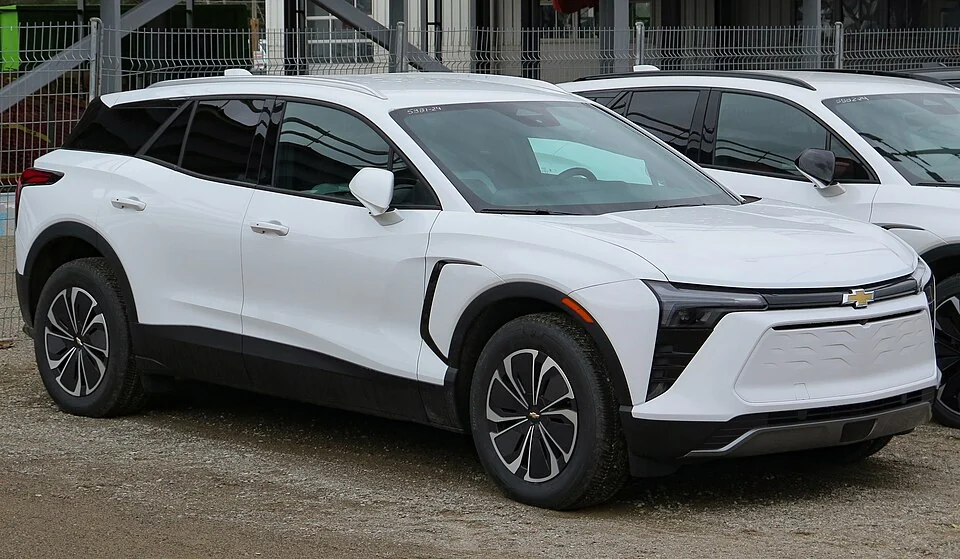
- Photo 1 — Elise240SX →Resized and encoded as WEBP; original composition retained. Front exterior. 2024 Chevrolet Blazer EV 2LT AWD photographed in Canada; earlier body reference, not evidence of every U.S. MY2025 battery or charging configuration.
- Photo 2 — Elise240SX →Resized and encoded as WEBP; original composition retained. Rear exterior. 2024 Chevrolet Blazer EV 2LT AWD photographed in Canada; earlier body reference, not evidence of every U.S. MY2025 battery or charging configuration.
View all official references (1 more)
- Photo reuse terms — CC BY-SA 4.0 →Applies to the photographs carrying this license above.
Last editorial review: October 15, 2026. Specifications remain market- and model-year-specific.