Core summary
U.S. MY2025 Hyundai Venue. Source-based specification and buying analysis.
For a Venue buyer, the useful exercise is to prioritize everyday features before moving up the trim ladder. Decide which assistance, lighting and comfort items will be used each week, then compare their actual cost.
History & generations
This guide uses the U.S. MY2025 Venue range. It does not combine the engine and equipment choices sold under the Venue name in other countries.
Body, platform & design
A two-tone roof is available on Limited. It is a styling choice rather than a separate engine version.
Engine & drivetrain
The U.S. range uses a 121-hp 1.6-liter four-cylinder engine. A higher trim does not bring a higher advertised output in the cited lineup.
Trim differences
SE, SEL and Limited are the three listed grades. SEL adds items such as blind-spot warning, proximity-key access and a sunroof; Limited includes LED headlights and heated front seats.
Interior & seating
SE has an eight-inch audio touchscreen, while Limited adds navigation to its eight-inch display. Match the unit to the grade rather than judging by screen size alone.
Efficiency & range
All three U.S. MY2025 grades are listed at 29 city, 33 highway and 31 combined mpg, EPA estimates.
Safety & equipment
SE includes pedestrian-detecting forward collision avoidance, lane-keeping assistance and a driver-attention warning. These features are not a guarantee of collision prevention.
Strengths
The trim comparison is unusually useful because it can stay focused on equipment. Our approach would be to identify a genuine missing feature before paying for the next grade, rather than upgrade by habit.
The trim comparison is unusually useful because it can stay focused on equipment. Our approach would be to identify a genuine missing feature before paying for the next grade, rather than upgrade by habit.
Considerations
Try the rear seat and luggage area with your normal load. A compact vehicle that works for solo commuting may still fail a particular child-seat or weekend-bag requirement; test that requirement directly.
Recommended use
For urban use, include a parking trial and a familiar route in the demonstration. If frequent high-speed journeys matter, assess that environment at legal speeds before deciding the compact format is sufficient.
Rivals & related
Compare other small crossovers using the same must-have equipment list. A low advertised base price is not a fair comparison if the features you require are only available further up the range.
FAQ
Which upgrade should come first? Choose the one that addresses an observed need during the test, not the one that looks most attractive in the configurator. Keep appearance preferences as a separate budget item.
What makes the Hyundai Venue different?
The trim comparison is unusually useful because it can stay focused on equipment. Our approach would be to identify a genuine missing feature before paying for the next grade, rather than upgrade by habit.
Who should consider it?
Urban commuting and practical daily travel
Sources & updates
Reference scope: U.S. MY2025 Hyundai Venue. Research-based guide; no hands-on road test is claimed. Manufacturer specifications are distinguished from Cariary buying interpretation. Text reviewed 14 October 2026. Sources for the revised text:
https://www.hyundaiusa.com/us/en/vehicles/2025-venue
- Manufacturer reference — U.S. MY2025 Hyundai Venue →Source used for the stated historical model-year specification; not a claim of a current range.
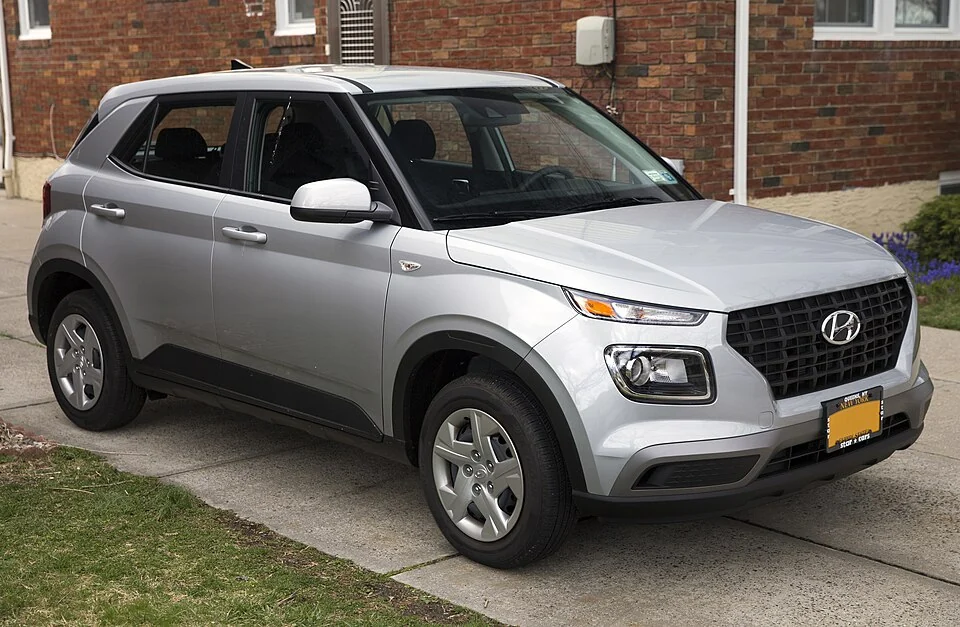
- Photo 1 — Mr.choppers / Wikimedia Commons / CC BY-SA 3.0 →Resized and encoded as WEBP; original composition retained. 2020 Hyundai Venue SE. U.S.-market first-generation Venue in Stellar Silver, photographed in April 2020. Earlier exterior reference only, not a MY2025 vehicle or evidence of MY2025 equipment.
- Photo reuse terms — CC BY-SA 3.0 →Applies to the photographs carrying this license above.
Last editorial review: October 14, 2026. Specifications remain market- and model-year-specific.