Core summary
The X290 AMG GT 53 is the six-cylinder member of the GT 4-Door family. It combines a large liftback body with all-wheel-drive performance, but should not be confused with the two-door AMG GT.
The GT 53 belongs to the AMG GT 4-Door family. Its name is easy to confuse with the two-door sports car, but this profile concerns the X290 four-door liftback. The buyer’s task is to decide whether the additional doors and luggage access justify a large performance car rather than a smaller coupe.
History & generations
The 53 identifies the six-cylinder branch of this GT 4-Door range, not a reduced specification of every GT model with the same number of letters. Use a model-year brochure when comparing equipment. The current US specification cited here provides an explicit reference point, rather than implying that all production years have identical packages.
Body, platform & design
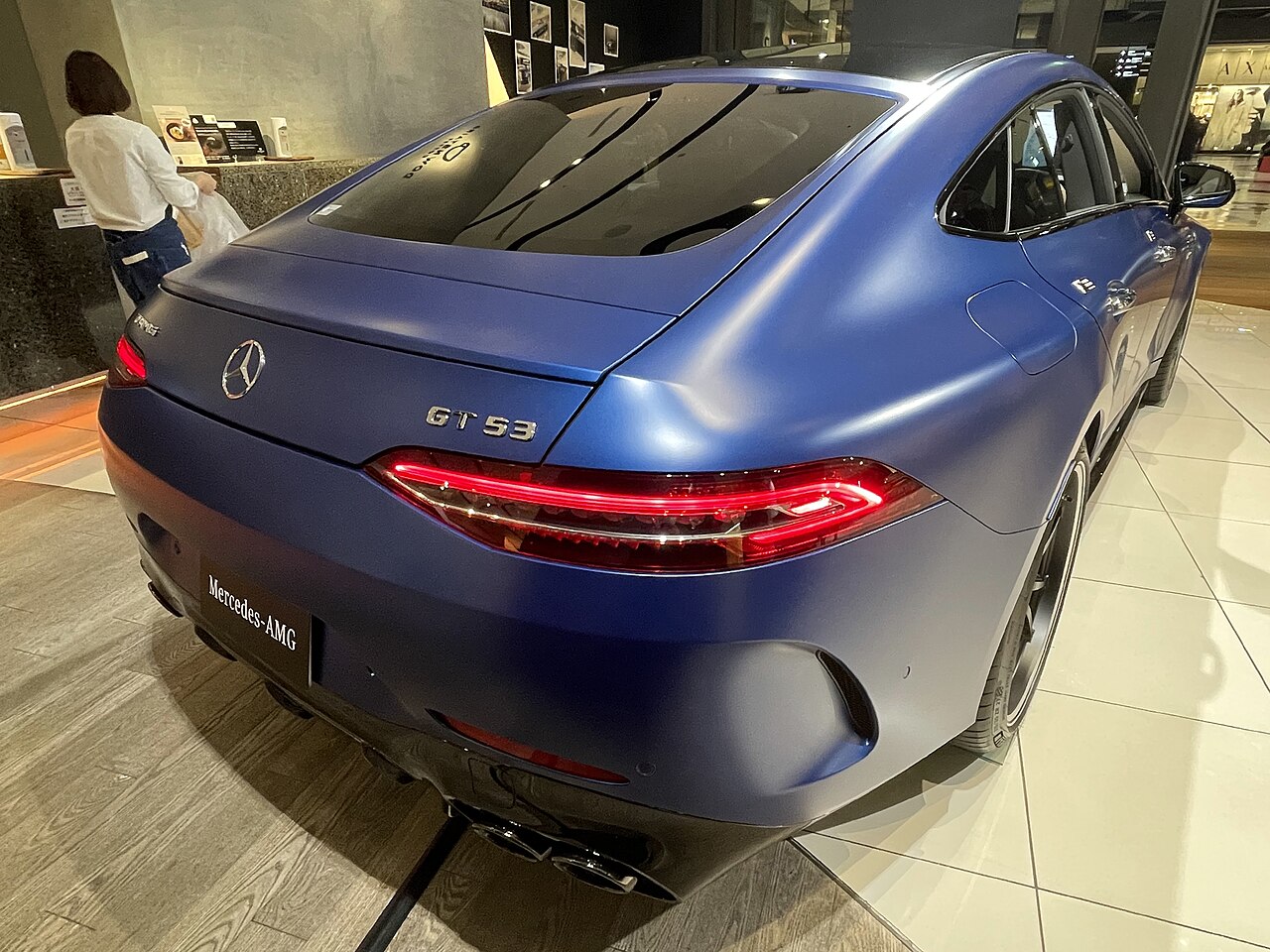
The rear hatch is central to its usability. Try the largest regular luggage item through the opening and check the space needed to open it in a garage. The long, low body should also be tested at the entrance to a parking space; four doors do not automatically make a large performance car convenient in a confined location.
_interior.jpg)
Engine & drivetrain
Mercedes-Benz USA lists a 3.0-litre turbocharged inline-six with hybrid assistance, 429 hp and 384 lb-ft, driving through a nine-speed automatic. Those US ratings should not be mixed with metric-PS figures from another market. The GT 53 is not the V8 GT 63, and the mild-hybrid arrangement is not a plug-in charging system.
Trim differences
Identify the rear-seat arrangement and suspension equipment on the actual example. The cited US page lists four seats with five available optionally. That makes seating a purchase-defining option, not a minor detail to settle after the car is chosen. An exterior package does not answer how many passengers the car can legally and comfortably carry.
Interior & seating
A family considering this instead of a sedan should test the rear seating positions with the intended occupants. Check both access under the roofline and space once seated. A nominal extra seat is not equivalent to three equally comfortable rear positions; a realistic passenger trial is more useful than interpreting the seat count alone.
Efficiency & range
Budget it as a performance-oriented petrol car. Hybrid assistance here does not promise an electric commute or eliminate fuel use in city driving. For long-distance ownership, estimate consumption and fuel cost for the routes and speeds normally used, then compare that with the alternatives being considered for the same journeys.
Safety & equipment
Confirm the fitted parking and driving-assistance equipment rather than assuming it follows automatically from the AMG badge. The size of the car makes a demonstration of camera coverage particularly worthwhile. A test of assistance settings is separate from a mechanical inspection, and neither is replaced by the presence of a clean dashboard.
Strengths
The combination of a hatch, rear seats and a performance drivetrain gives the GT 53 a more practical brief than a two-seat sports car. That is its strongest argument. If the rear seats are never used, the buyer should question whether the extra body size is serving a purpose.
The GT 53 makes sense as a fast, usable four-door rather than a substitute for the two-door GT. Rear-passenger needs should determine the seating configuration before power becomes the discussion.
Considerations
Tyres, brakes and suspension need to be evaluated as part of the purchase price. Ask for itemised replacement estimates for the exact fitted sizes and hardware. A low advertised price can be misleading if several consumables are due together, even when the car drives convincingly during a short demonstration.
Recommended use
It is a candidate for fast touring with passengers and luggage, particularly when one car must cover both leisure and ordinary travel. It is not an automatic recommendation for urban errands or for someone primarily seeking a small sports-car experience. Test the four-door practicality that is supposed to justify it.
Rivals & related
A Porsche Panamera is a useful alternative for a performance-focused four-door search. An Audi A7 or S7 can help test how much performance is really required, with market-specific engines kept separate. Within Mercedes, compare a conventional performance sedan if a hatchback is not essential; the body requirement should shape the shortlist.
FAQ
Q: Is this the two-door AMG GT?
A: No. It is the X290 GT 4-Door model.
Q: Is the GT 53 a V8?
A: No. The cited version has an inline-six.
Q: Does every example seat five?
A: No. Verify the individual rear-seat configuration before purchase.
What makes the Mercedes-AMG GT 53 4-Door Coupé different?
The GT 53 makes sense as a fast, usable four-door rather than a substitute for the two-door GT. Rear-passenger needs should determine the seating configuration before power becomes the discussion.
Who should consider it?
Fast touring with rear-seat and luggage access
Sources & updates
Specification reference: Mercedes-Benz USA: AMG GT 53 4-door specification. The linked manufacturer material identifies the edition used here; specifications are not universal across years or countries.
The buying comparisons and suitability judgements are Cariary editorial analysis, not claims from a road test. Existing photograph credits identify the photographed generation and any unverified trim; an illustrative photograph is not proof of equipment.
- Official model information →
- Manufacturer media archive →
- Photograph — Blue Mercedes-AMG GT 53 X290, rear three-quarter view →Tokumeigakarinoaoshima; CC BY-SA 4.0
View all official references (2 more)
- Photograph — Mercedes-AMG GT 63 S X290 dashboard and centre console →Tokumeigakarinoaoshima; CC BY-SA 4.0
- Mercedes-Benz USA: AMG GT 53 4-door specification →Dated specification reference; suitability comments are editorial analysis.
Last editorial review: September 20, 2026 — vehicle-specific editorial revision. Specifications remain market- and model-year-specific.