Core summary
The F66 keeps the short MINI hatchback format while changing its cabin interface. US Cooper and Cooper S share a 2.0-litre engine family but have different outputs.
The F66 is the current petrol MINI Cooper 2 Door. The name counts the passenger doors; the rear hatch is still a third opening. This guide focuses on regular US Cooper and Cooper S, not the separate electric Cooper or full John Cooper Works model.
For Cariary, its appeal begins with the short hatchback format. Buyers who rarely use the rear seats may accept compromises that would quickly become irritating in a family car carrying children every day.
History & generations
The F66 arrived in 2024 for the 2025 US model year. It belongs to MINI's renewed combustion-engined family, while the similarly named electric car uses a different programme.
Market differences matter here. A three-cylinder Cooper described in a European review should not automatically be used as the engine specification for the US car. Keep the regional reference attached to the number.
Body, platform & design
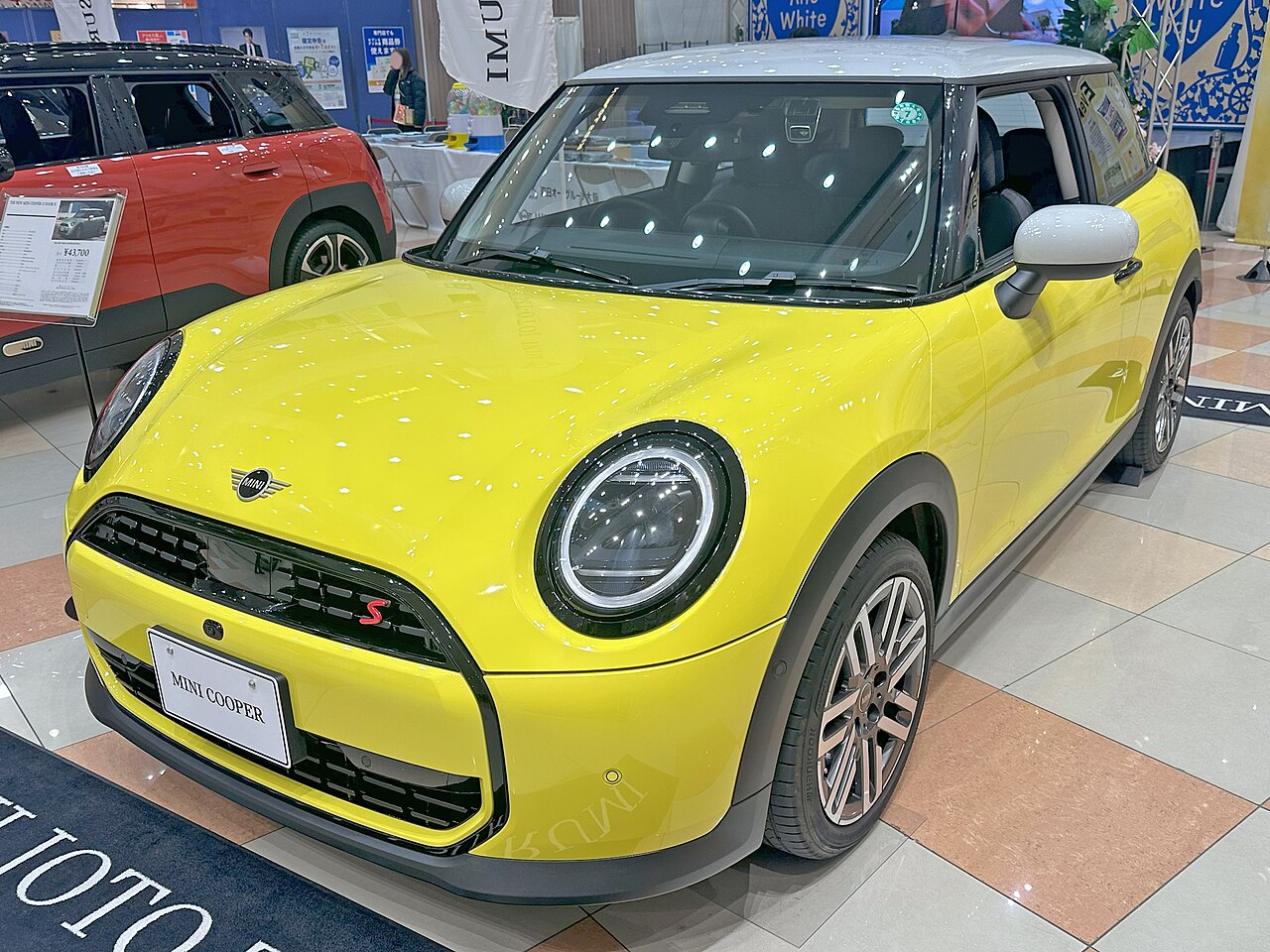
Round front lights and the compact two-door profile remain recognisably MINI. The gallery shows a Japanese-market Cooper S from front and rear, plus its right-hand-drive cabin. These are F66 photographs, not the electric J01.
The short body helps define the appeal, but long front doors need room to open. Test access in a normal parking space rather than assuming that a small overall footprint solves every urban inconvenience.
_rear.jpg)
Engine & drivetrain
MINI's US 2025 family announcement specifies a 2.0-litre turbo four-cylinder in both regular versions: 161 hp for Cooper and 201 hp for Cooper S. Both use front-wheel drive and a seven-speed dual-clutch automatic.
That makes the choice a question of output and specification rather than cylinder count in this market. Do not confuse a JCW styling package with the separately engineered John Cooper Works model.
_interior.jpg)
Trim differences
Start with the standard Cooper if the main use is commuting and city travel. Cooper S is worth comparing when its stronger response is something you actively value, but it does not add rear-seat access or luggage room.
Check wheels, seat finishes and option packages individually. A colourful roof or sporty body treatment can be desirable without changing the underlying engine, and a higher trim is not automatically the best value for every driver.
Interior & seating
The round 9.4-inch OLED display is central to the new cabin. The photographed right-hand-drive example also shows how different the layout is from an older MINI with more conventional instrumentation.
Try speed readout, demisting and navigation while parked. Rear passengers should test entry with the front seat adjusted for the regular driver. The four-seat capacity should not be mistaken for a comfortable solution to every four-adult journey.
Efficiency & range
Use the US economy label for the exact Cooper or Cooper S and wheel specification. A regional three-cylinder rating or an electric Cooper's range is not a substitute.
For low-mileage city use, fuel savings alone may not justify a more expensive trim. Compare the whole ownership cost, including tyres and insurance, then decide whether the performance and equipment are worth the difference to you.
Safety & equipment
Demonstrate parking aids and the assistance features actually fitted. A small car can still hide a low obstacle or pedestrian from view, particularly when manoeuvring beside larger vehicles.
On a used F66, check service and campaign records, tyre wear and all display functions. Test low-speed manoeuvring and stop-start traffic behaviour during the drive rather than evaluating the dual-clutch transmission only at cruising speed.
Strengths
The 2 Door offers a compact, characterful alternative to increasingly large crossovers. It makes the strongest case for buyers who genuinely want a small hatchback rather than merely accepting one to meet a budget.
The regular Cooper also preserves that design appeal without requiring the S. This gives the buyer room to prioritise cabin options or ownership costs instead of treating performance as the only meaningful upgrade.
The 2 Door is best chosen because its compact format suits your life. Test rear access and the central display before selecting Cooper S solely for the extra power.
Considerations
Rear access is the obvious trade-off. Child-seat installation or repeated adult entry can be awkward compared with a car with rear doors. Check this before assuming occasional inconvenience will stay occasional.
The new screen-led interior is another personal decision. A test should include everyday control tasks, not just a short drive focused on steering and acceleration.
Recommended use
The F66 suits one or two regular occupants who want compact dimensions and enjoy the MINI presentation. A rear-seat trial can establish whether occasional extra passengers are realistic.
If rear access is frequent, compare the 4 Door immediately. If electric driving is the priority, evaluate the electric Cooper separately rather than treating it as the same car with a different engine.
Rivals & related
An Audi A1 or Volkswagen Polo, where sold, provides a useful small-premium or mainstream comparison. US buyers may need to compare larger hatchbacks because the small-car market differs.
MINI Cooper 4 Door is the most direct practical alternative. Countryman offers a different, taller and larger role, not simply the same hatchback with two extra doors.
FAQ
Does 2 Door mean no hatch? No; it counts passenger doors.
Does the US base car have three cylinders? The referenced US F66 uses a 2.0-litre four-cylinder.
Is the electric Cooper the same F66? No.
Is JCW styling the full JCW model? No; verify the actual derivative.
What makes the MINI Cooper 2 Door different?
The 2 Door is best chosen because its compact format suits your life. Test rear access and the central display before selecting Cooper S solely for the extra power.
Who should consider it?
Compact urban driving with occasional rear passengers
Sources & updates
Manufacturer references identify the dated specifications used here. Cariary buying assessments are editorial analysis, not a claimed first-hand road test or a diagnosis of an individual vehicle. Photographs carry individual source and licence credits. Confirm the exact build, market and equipment before purchase; photographs of another trim do not establish your car’s specification.
- MINI US 2025 family announcement →
- MINI US 2 Door product overview →
- MINI US F66 specification attachment →
View all official references (3 more)
- Photograph — Yellow MINI Cooper S F66 front and side →Tokumeigakarinoaoshima; CC0
- Photograph — Yellow MINI Cooper S F66 rear →Tokumeigakarinoaoshima; CC0
- Photograph — Right-hand-drive MINI Cooper S F66 dashboard →Tokumeigakarinoaoshima; CC0
Last editorial review: September 20, 2026. Specifications remain market- and model-year-specific.