Core summary
The third-generation Panamera blends a low fastback body with four-seat grand-touring intent. Start by distinguishing the core V6 models from the broader hybrid and V8 range.
The 972 Panamera is the third generation of Porsche's large fastback. This page concentrates on the conventional V6 Panamera and Panamera 4 introduced with the new generation, using US power figures. E-Hybrid, GTS and Turbo derivatives need separate specifications.
Cariary's assessment starts with the body format. A buyer who enjoys sitting lower and wants a large hatchback may find the Panamera more appealing than an SUV, but should establish that its passenger access and luggage shape work for everyday life.
History & generations
The third generation was revealed in November 2023 for model years beginning in 2024. It follows the earlier Panamera generations rather than simply being a new trim of the outgoing car. Registration date alone can be misleading around the changeover.
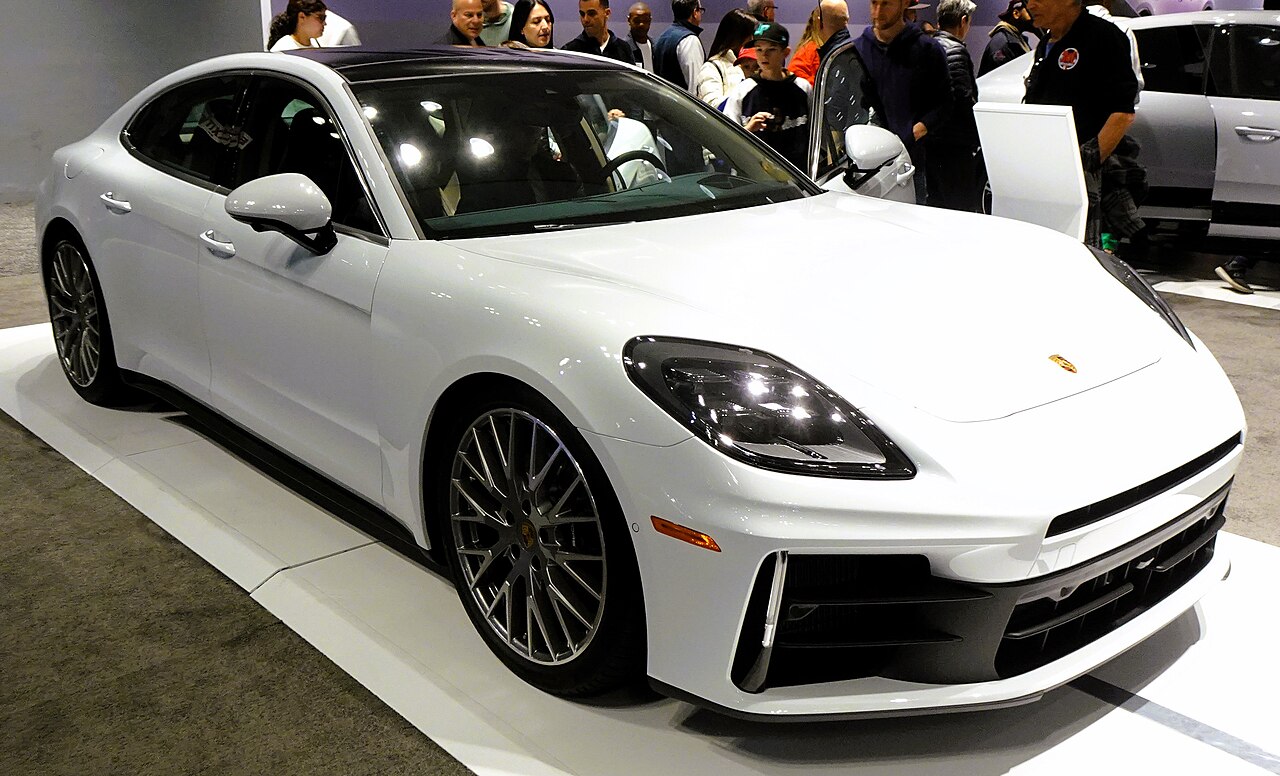
Use the vehicle's model documentation when comparing used listings. The gallery shows third-generation Panamera 4 examples. It does not illustrate an older Sport Turismo wagon or establish the equipment of a Turbo E-Hybrid.
Body, platform & design
The five-door fastback shape provides a large rear opening while keeping a lower silhouette than Porsche's SUVs. The white example is shown from front and rear angles; the silver Panamera 4 is a separate showroom vehicle photographed through glass.
Assess the loading opening with your own luggage. A hatchback body can be useful without offering an SUV's tall loading space. Rear visibility and the practical parking footprint also deserve attention before being won over by the profile.
.jpg)
Engine & drivetrain
The core US Panamera and Panamera 4 use a 2.9-litre twin-turbo V6 rated at 348 hp and 368 lb-ft in the cited specification. Panamera is rear-wheel drive; Panamera 4 adds all-wheel drive. An eight-speed PDK dual-clutch transmission is used.
European figures expressed in metric horsepower may look different without describing a different engine. Keep the unit and market with the number. Do not attach the power or electric-only range of an E-Hybrid to these conventional petrol versions.
_(53623960658)_(cropped).jpg)
Trim differences
The first choice here is between the rear-drive model and Panamera 4, not between unrelated horsepower headlines from the entire range. Inspect the options fitted to each car before deciding that one is better equipped solely because its badge includes a 4.
Porsche Active Ride is associated with suitable E-Hybrid derivatives, not a feature to assume on these base petrol models. Suspension descriptions in broad model reviews therefore need to be read carefully against the individual build.
Interior & seating
Porsche's Driver Experience arrangement puts the driving controls and displays around the driver. Try the selector, climate functions and steering-wheel controls while parked. Optional screens and seat features should be demonstrated on the actual car.
The standard four-seat arrangement suits a particular kind of family or executive use. If a fifth seating position is essential, confirm the permitted and fitted configuration, then test it. Do not infer comfort or legal seating capacity from a photograph of another example.
Efficiency & range
This V6 profile requires a petrol consumption comparison, not an electric-range claim. Use the relevant local rating for the exact model and wheel specification, then estimate costs from your normal journey pattern.
A plug-in Panamera may be an alternative for someone who can charge regularly, but that comparison includes battery, charging and purchase-cost considerations absent from these conventional cars. Lower quoted fuel consumption for a plug-in is not automatically a like-for-like running-cost result.
Safety & equipment
Check the fitted assistance systems and demonstrate parking cameras and warnings. A low driving position and a long body make familiarisation important, even for someone moving from another large vehicle.
For a used example, obtain service, repair and campaign records and a specialist inspection. Look at tyre wear and brake condition as well as cosmetic presentation. A clean cabin does not establish the condition of chassis components or explain a missing maintenance interval.
Strengths
The Panamera gives buyers a different answer to premium travel from the now-common large SUV. Its fastback access, lower seating and range of chassis choices can be attractive to someone who wants passenger accommodation without an SUV body.
The core V6 models also make it possible to choose the Panamera format without requiring the most complex or highest-powered derivative. That can keep the decision focused on daily use rather than a specification competition.
The standard Panamera and Panamera 4 make sense for buyers who want the shape and driving position without automatically moving to a hybrid or an upper performance derivative. Test the rear accommodation before choosing it over an SUV.
Considerations
Check access on the driveway and in the car park you actually use. Passengers who find a low seat difficult may prefer another body style regardless of how appealing the car feels from the driver's seat.
Equipment variation is significant in the used market. Price the actual wheels, tyres, insurance and scheduled care. Compare an option-rich base car with a sparsely specified Panamera 4 on merit rather than assuming a fixed hierarchy.
Recommended use
The Panamera suits longer trips with occupants who appreciate its seating position and have tested the rear accommodation. Rear drive can be a valid choice; all-wheel drive is not a substitute for suitable seasonal tyres.
If repeated short city trips dominate, evaluate parking and operating costs particularly carefully. If the main need is carrying bulky objects or frequent fifth passengers, test an alternative before committing to the fastback shape.
Rivals & related
Compare the BMW 8 Series Gran Coupe where available for a different low-roof grand-touring approach, while a Mercedes-Benz S-Class prioritises a more traditional luxury-saloon role. Exact availability and generations should be checked locally.
The Cayenne is an internal alternative when easier access and a taller luggage area matter. A Taycan is relevant only with a separate charging assessment; it is not simply an electric trim of the Panamera.
FAQ
Does Panamera 4 mean a four-cylinder engine? No. The 4 identifies all-wheel drive in the V6 model discussed here.
Is this the Sport Turismo? No. The photographs and specification concern the third-generation fastback.
Does it have a plug? Not in these conventional V6 versions.
Are the published figures a personal road test? No. They are manufacturer references accompanied by editorial analysis.
What makes the Porsche Panamera different?
The standard Panamera and Panamera 4 make sense for buyers who want the shape and driving position without automatically moving to a hybrid or an upper performance derivative. Test the rear accommodation before choosing it over an SUV.
Who should consider it?
Long-distance luxury travel with a lower driving position
Sources & updates
Manufacturer references identify the dated specifications used here. Cariary buying assessments are editorial analysis, not a claimed first-hand road test or a diagnosis of an individual vehicle. Photographs carry individual source and licence credits. Confirm the exact build, market and equipment before purchase; photographs of another trim do not establish your car’s specification.
- Porsche US new Panamera announcement →
- Porsche Panamera Driver Experience →
- Porsche Panamera technical specifications →
View all official references (3 more)
- Photograph — White third-generation Porsche Panamera 4 →Charles from Port Chester, New York; CC BY 2.0
- Photograph — White Porsche Panamera 4 rear and side →Charles from Port Chester, New York; CC BY 2.0
- Photograph — Silver Porsche Panamera 4 behind showroom glass →Tokumeigakarinoaoshima; CC BY-SA 4.0
Last editorial review: September 20, 2026. Specifications remain market- and model-year-specific.