Core summary
2026 Ford Bronco is a two- or four-door gasoline 4x4 SUV.
The 2026 Ford Bronco is a body-on-frame, gasoline-powered 4x4 SUV sold in two- and four-door forms. The U.S. lineup comprises Base, Big Bend, Outer Banks, Badlands, Heritage Edition, Stroppe Edition and Raptor series. Two-door models seat four people, while four-door models seat five. Every version uses removable doors and roof sections, a rear-mounted spare wheel and a swing-out tailgate. Engine choices span a 2.3-liter turbocharged inline-four, a 2.7-liter turbocharged V6 and a Raptor-specific 3.0-liter turbocharged V6. Depending on series and configuration, transmissions include a seven-speed manual or 10-speed automatic. Ford’s 2026 U.S. Bronco page lists maximum output of 418 horsepower and maximum towing of 4,500 pounds. The model’s defining engineering theme is configurable off-road performance, with selectable G.O.A.T. Modes, available electronic locking axles, trail cameras and the Sasquatch package. Regional programs differ. For example, Ford Qatar describes up to eight drive modes, while the U.S. Ford page lists up to seven.
History & generations
Ford introduced the Bronco for the 1966 model year after studying Jeep and International Harvester Scout owners. The original vehicle was conceived as a compact 4x4 combining utility, recreation and road manners. Ford offered Roadster, Sports Utility and Wagon body styles, each with standard four-wheel drive. The first generation continued through 1977 and gained larger engines, automatic transmission and power steering. A substantially larger F-Series-based Bronco arrived for 1978 and continued into 1979. The 1980 redesign became smaller and lighter, with V6 and V8 engines and independent front suspension. Ford updated the body and fuel system for 1987, then added airbags and three-point belts for the 1992-1996 fifth generation. Production ended on June 12, 1996, after 31 years and 1,148,926 Broncos. Ford revived the name for 2021 with a new two- and four-door family. The sixth generation returned removable doors and roof panels, a separate frame, trail-oriented hardware and a broad series structure. Heritage and Stroppe editions connect the modern model with Ford’s historic styling and Baja racing associations.
First generation
Original compact Bronco with standard 4x4 and multiple body styles.
Second generation
Larger F-Series-based Bronco with V8 power and increased cabin space.
Third generation
Smaller, lighter Bronco with improved efficiency and new front suspension.
Fourth generation
Updated full-size Bronco with aerodynamic styling and electronic fuel injection.
Fifth generation
Final original-era Bronco with airbags and expanded safety equipment.
Sixth generation
Modern two- and four-door Bronco with removable body panels and advanced 4x4 systems.
Body, platform & design
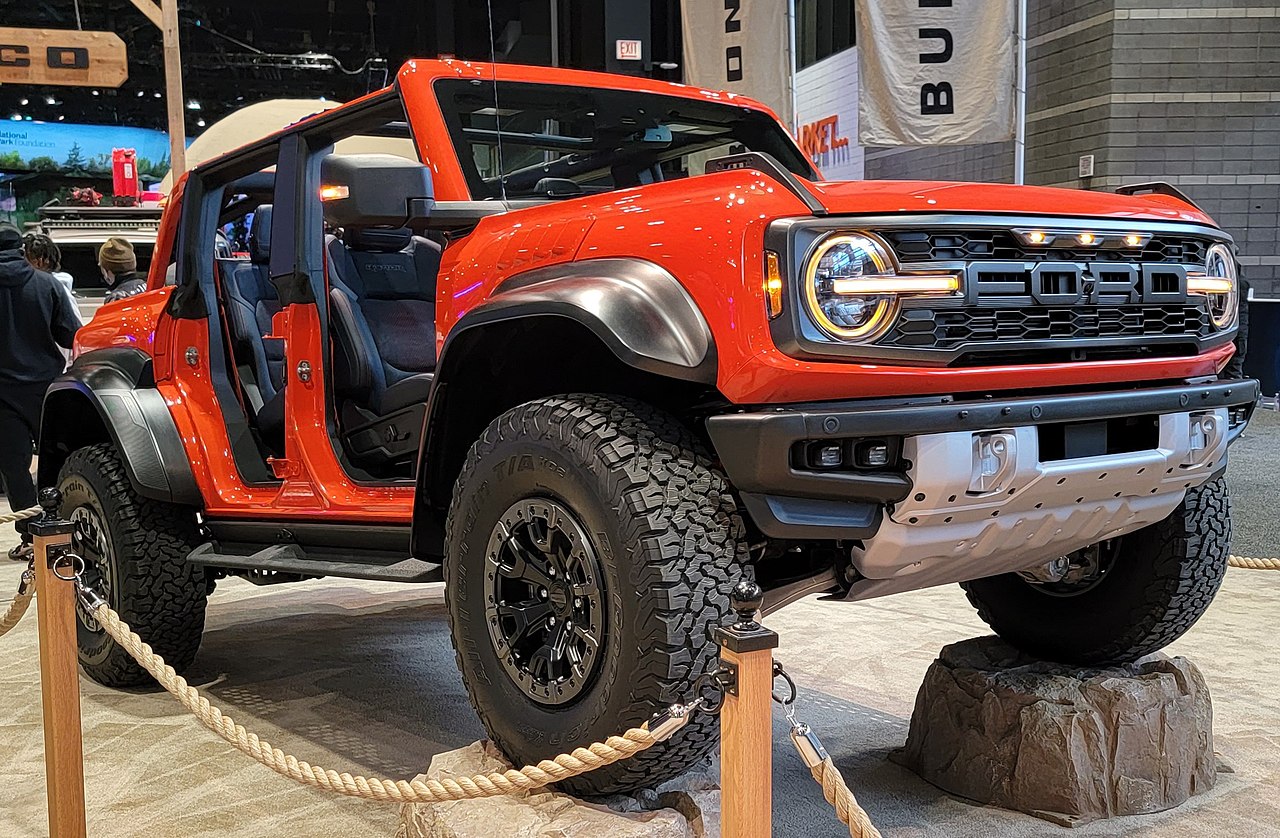
The current Bronco uses a deliberately upright shape with round headlamps, a broad grille and short overhangs. Its exterior references the 1966 model without reproducing the original vehicle’s compact dimensions. The body sits on a separate frame and uses removable doors, removable roof sections and exposed hinge hardware. Door storage is integrated into the vehicle, allowing removal without permanently relocating the doors. Two-door and four-door bodies share the same design language but use different wheelbases, lengths and cargo arrangements. The U.S. technical specifications list a 100.4-inch wheelbase for the standard two-door body and 116.1 inches for most four-door versions. Standard and optional tire sizes range from conventional all-terrain fitments to 35-inch packages. The Sasquatch package adds high-clearance components, larger tires and locking-axle hardware. Badlands and Raptor versions receive wider stances and more specialized suspension equipment. Heritage Edition uses period-inspired colors, a contrasting roof and vintage-style graphics. The 2026 Stroppe Edition is a four-door model in the U.S. program, reflecting the name’s desert-racing history while using the modern Bronco platform.
_1X7A6831.jpg)
Engine & drivetrain
The 2026 U.S. Bronco uses three turbocharged gasoline engines. Base, Big Bend, Outer Banks and Heritage Edition can use the 2.3-liter EcoBoost inline-four, rated at up to 300 horsepower and 325 pound-feet on premium fuel. Selected series offer the 2.7-liter EcoBoost V6, rated at up to 330 horsepower and 415 pound-feet. The Raptor uses a 3.0-liter EcoBoost V6 producing up to 418 horsepower and 440 pound-feet. The 2.3-liter engine can pair with a seven-speed manual transmission or a 10-speed automatic, subject to series and configuration. The larger engines use the 10-speed automatic. Ford’s four-wheel-drive system includes selectable high- and low-range operation, while equipment varies by series. Available hardware includes front and rear electronic locking axles, a disconnecting front stabilizer bar, Trail Control and terrain-specific drive modes. The Raptor adds high-output powertrain calibration, long-travel suspension components and 37-inch tire availability. Maximum conventional towing is 3,500 pounds for most configurations and 4,500 pounds for the Raptor. Fuel requirements and output ratings vary by engine and fuel grade.

Trim differences
The U.S. 2026 series range starts with Base, which provides the core Bronco structure and standard 4x4. Big Bend adds appearance and convenience equipment while retaining broad configuration flexibility. Outer Banks emphasizes road-oriented style and four-door practicality. Badlands concentrates on technical off-road capability with advanced suspension and locking-axle equipment. Heritage Edition uses vintage-inspired exterior treatment and combines retro design cues with current Bronco hardware. Stroppe Edition is a desert-racing-themed four-door series with distinctive graphics, wheels and equipment. Raptor sits at the top of the range with a dedicated high-output engine, long-travel suspension and larger tires. The Sasquatch package is available across selected series and is the main route to 35-inch tire capability outside Raptor. Package content changes by series. Mid, Lux, Black Diamond, Black Appearance, 60th Anniversary, trailer-tow and connectivity packages address different equipment priorities. The 2026 order guide identifies Stroppe Edition as four-door only and lists the Heritage Edition as outside fleet availability. Regional Ford programs use different series names, powertrains and equipment, so this trim chapter follows the U.S. production range.
_Washington_DC_Metro_Area,_USA.gif)
Interior & seating
The Bronco cabin combines washable, durable surfaces with modern connectivity hardware. The dashboard places grab handles, auxiliary switches and exposed fasteners in prominent positions, reinforcing the vehicle’s trail-oriented layout. Ford offers rubberized flooring and drainable interior features on selected configurations. The windshield can remain upright, while available roof panels and doors can be removed for open-air driving. Two-door models provide four seating positions and a shorter cargo area. Four-door models provide five seats and substantially greater rear-seat and cargo capacity. Ford’s 2026 technical specifications list 43.1 inches of front legroom and 36.3 inches of rear legroom in four-door models. Cargo volume behind the second row is listed at 35.6 cubic feet for hard-top four-doors and 38.3 cubic feet for soft-top four-doors. With the rear seats folded, listed capacity reaches 83.0 cubic feet in soft-top four-door form. SYNC 4 supports wireless Apple CarPlay and Android Auto compatibility. Available equipment includes a larger center display, connected navigation, premium audio, heated seats, adaptive cruise control and a 360-degree camera. Interior materials and screen equipment vary substantially by series and package.

Efficiency & range
The 2026 Bronco range is gasoline-powered and uses turbocharged engines.
Safety & equipment
Standard equipment includes front, side and side-curtain airbags, rollover sensing, a rear camera, AdvanceTrac with Roll Stability Control, trailer sway control and tire-pressure monitoring. Ford Co-Pilot360 features vary by series and package. Available systems include Pre-Collision Assist with Automatic Emergency Braking, Blind Spot Information System with Cross-Traffic Alert, Lane-Keeping System, adaptive cruise control and a 360-degree camera. The Bronco’s tall body, short overhangs and off-road suspension are designed around trail clearance rather than low center-of-gravity handling. NHTSA’s 2026 testing-selection list does not include the Bronco among the vehicles selected for that model-year testing cycle. IIHS publishes current midsize-SUV comparison information for the four-door Bronco, with individual results and coverage depending on test category and model year. Safety equipment, ratings and recall status should be checked against the specific vehicle identification number and market before purchase. Ford’s 2026 order guide also documents standard restraint systems and available driver-assistance equipment.
Strengths
Bronco’s strongest attribute is configuration breadth. Buyers can choose two- or four-door bodies, manual or automatic transmission on selected four-cylinder models, several engines, multiple roof types and a wide range of trail packages. Standard removable doors and roof panels give the model open-air utility rarely found among mainstream SUVs. The separate frame, low-range 4x4 system, terrain modes and available locking axles support serious trail use. Badlands, Sasquatch and Raptor versions provide progressively more specialized hardware. The four-door body combines trail access with useful rear-seat and cargo capacity. Ford also supports the model with factory accessories, trail instruction and dedicated Bronco Off-Roadeo programs. The 2026 lineup adds a 60th Anniversary package for Outer Banks and continues Heritage and Stroppe editions, giving buyers distinct visual identities without leaving the Bronco family. The model’s long-running nameplate, recognizable styling and strong aftermarket support further broaden its appeal. Its usefulness is greatest for owners who will regularly exploit removable body panels, trail hardware or towing capacity.
A highly configurable 4x4 SUV prioritizing trail capability and open-air utility.
Considerations
Bronco’s off-road hardware brings compromises on pavement. Large tires, tall bodywork, upright aerodynamics and specialized suspension can increase wind noise, road noise and fuel consumption relative to crossover SUVs. Two-door models trade rear access and cargo space for shorter overall dimensions. Four-door models are more practical but occupy more trail and parking space. Equipment varies sharply by series, and the most capable configurations can add substantial mass and cost. Manual transmission availability is limited to selected 2.3-liter configurations, while V6 and Raptor versions use automatic transmissions. The 3.0-liter Raptor requires premium fuel, and other engines have different fuel recommendations. Removable panels improve open-air use but add storage and weather-management considerations. Advanced driver assistance is package-dependent rather than uniform across the range. Towing capability also depends on engine, body style, equipment and trailer preparation. Regional versions can differ from the U.S. lineup in engines, trim names, drive modes and equipment. Buyers should compare the exact window sticker, technical specifications, recall record and local warranty terms for the vehicle being considered.
Recommended use
The Bronco suits owners who value trail access, open-air driving and factory-configurable hardware. The two-door body works well for buyers prioritizing maneuverability, shorter wheelbase dimensions and a traditional recreational 4x4 format. The four-door body is better suited to families, longer trips and regular rear-seat use. Base and Big Bend versions fit owners seeking the Bronco form with moderate equipment. Outer Banks is oriented toward comfort and appearance, while Badlands is aimed at technical trails. Heritage Edition serves buyers who want period-inspired design, and Stroppe Edition emphasizes Baja-themed character. Raptor is intended for high-speed desert terrain and buyers prepared for specialized running costs. The Bronco can handle daily transportation, but its body-on-frame construction and off-road tires make it less efficiency-focused than a unibody crossover. Towing is useful for small boats, utility trailers and recreational equipment within the vehicle’s rating. For serious trail use, tire choice, underbody protection, recovery equipment, driver training and local conditions matter as much as engine output.

FAQ
Q: Is the 2026 Ford Bronco available with two doors? A: Yes. Base and Badlands offer two-door configurations in the U.S. lineup.
Q: How many people can the 2026 Ford Bronco seat? A: Two-door models seat four; four-door models seat five.
Q: What is the most powerful 2026 Bronco engine? A: The Raptor’s 3.0-liter EcoBoost V6 produces up to 418 horsepower.
Q: Can the 2026 Bronco tow 4,500 pounds? A: Yes, the Raptor reaches 4,500 pounds when properly equipped.
Q: Does every 2026 Bronco have removable doors and roof panels? A: Removable doors and roof panels are core features of the Bronco design.
Q: Is Bronco Sport the same vehicle as Bronco? A: No. Bronco Sport is a smaller SUV on a different vehicle platform.
What makes the Ford Bronco different?
A highly configurable 4x4 SUV prioritizing trail capability and open-air utility.
Who should consider it?
Designed for trail driving, open-air recreation, towing and daily use.
Sources & updates
Research for this Ford Bronco profile prioritized current manufacturer specifications, model-year equipment pages and official press material. Independent safety or regulatory records were used where available. Historical references were kept separate from current-generation specifications and image identification.
Equipment, pricing and certified figures can vary by market, trim and model year. The expandable reference list below contains the linked sources used for verification. Last editorial review: August 29, 2026.
View all official references (9 more)
Last editorial review: August 29, 2026. Specifications remain market- and model-year-specific.