Core summary
2027 Toyota Corolla Hatchback
The 2027 Toyota Corolla Hatchback is the latest U.S.-market version of Toyota’s compact five-door hatchback. It uses the 12th-generation Corolla architecture, Toyota’s TNGA-C platform and a naturally aspirated 2.0-liter Dynamic Force four-cylinder engine. Output is 169 horsepower and 151 pound-feet of torque. Every U.S. version uses front-wheel drive and a Dynamic-Shift continuously variable transmission with a physical launch gear.
The 2027 range is offered in SE and XSE grades. SE pricing starts at $24,780 before Toyota’s dealer processing and handling fee, while XSE starts at $27,875. Toyota estimates 32 mpg city, 41 mpg highway and 35 mpg combined for SE; XSE is rated at 30 mpg city and 38 mpg highway.
The model remains smaller and lower than most compact crossovers while retaining five-passenger seating, a rear liftgate and foldable rear seatbacks. Standard equipment includes Toyota Safety Sense 3.0, Blind Spot Monitor with Rear Cross-Traffic Alert, an 8-inch Toyota Audio Multimedia system and wireless smartphone integration. The 2027 update concentrates on digital displays and cabin technology rather than a full redesign.
History & generations
Toyota’s official Corolla lineage records a liftback body style beginning with the third-generation Corolla in January 1976. That two-door Corolla Liftback used folding rear seats to increase luggage capacity and established an early connection between the Corolla name and hatchback utility. Later Corolla generations used several hatchback, liftback and wagon body styles in different markets.
The current North American Corolla Hatchback arrived for the 2019 model year as part of the 12th-generation Corolla family. Toyota described it as the return of the hatch after a long absence from the U.S. Corolla line. It introduced the TNGA platform, a 2.0-liter Dynamic Force engine, sport-tuned suspension, Toyota Safety Sense 2.0 and a choice of six-speed manual or Dynamic-Shift CVT transmissions.
The 2023 model year brought a refreshed exterior, Toyota Safety Sense 3.0, an 8-inch multimedia display, four USB-C ports and updated lighting. The 2025 model year used SE, Nightshade and XSE grades. For 2026, Toyota added the FX special edition and made Blind Spot Monitor with Rear Cross-Traffic Alert standard across the range. The 2027 model year replaces the FX grade with a two-grade SE/XSE lineup and adds larger digital displays.
12th-generation Corolla Hatchback
The current Corolla Hatchback generation uses Toyota’s TNGA-C platform and 2.0L Dynamic Force engine.
Body, platform & design
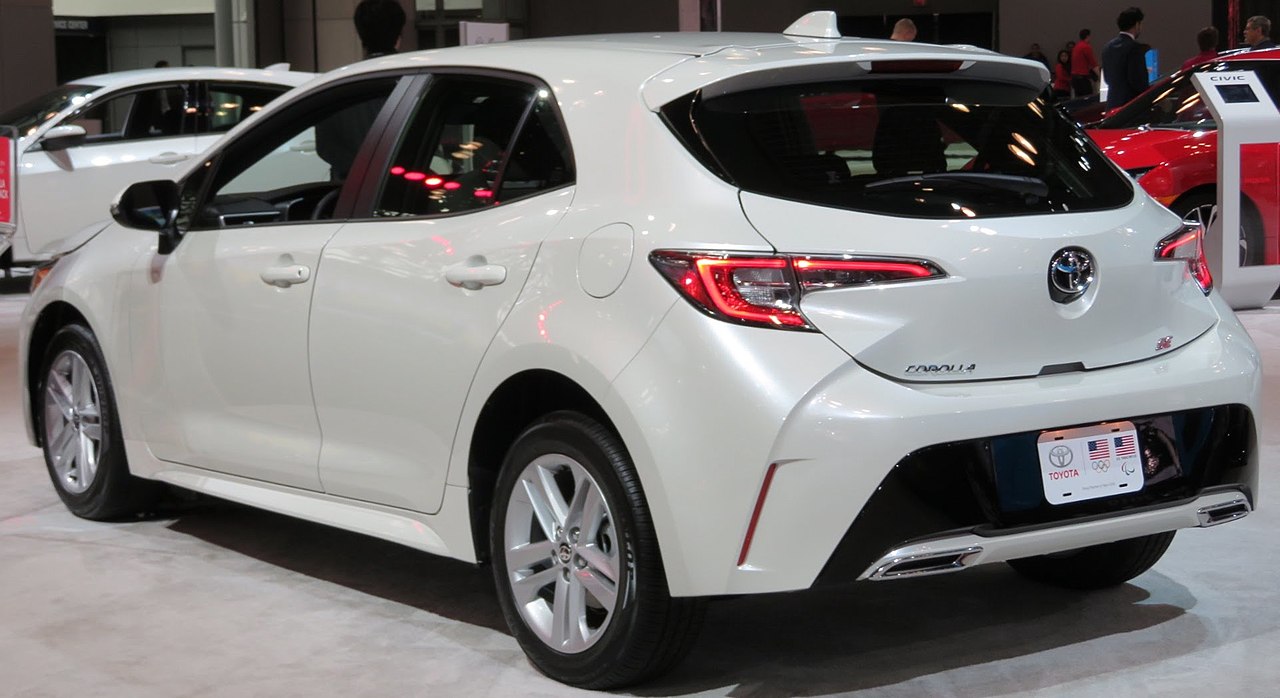
The 2027 Corolla Hatchback keeps the low, compact proportions established with the current generation. Toyota describes the body as rounded and muscular, with chiseled character lines, a condensed three-dimensional surface treatment and a planted stance. The design combines a short rear overhang with a high-mounted liftgate and roof spoiler, preserving hatchback utility without adopting crossover proportions.
Slim LED headlamps wrap toward the front fenders. The front grille surround is finished in gloss black, while the XSE adds integrated LED fog lights with chrome-finished bezels. SE uses 16-inch alloy wheels. XSE uses 18-inch graphite-colored alloy wheels, and Toyota Genuine accessory 18-inch gloss-white wheels are offered separately.
Toyota lists Blueprint, Inferno, Inked, Classic Silver Metallic, Finish Line Red, Magnetic Gray Metallic, Wind Chill Pearl and Ice Cap among the exterior colors. Two-tone black-roof combinations are offered with selected colors, including Blueprint, Classic Silver Metallic, Finish Line Red, Magnetic Gray Metallic and Wind Chill Pearl. Availability and color combinations are controlled by grade and market.

Engine & drivetrain
The 2027 Corolla Hatchback uses one powertrain in the U.S. market: a 2.0-liter Dynamic Force inline four-cylinder engine. Toyota identifies the engine as a DOHC, 16-valve unit with Dual Variable Valve Timing with intelligence. Output is 169 horsepower at 6,600 rpm and 151 pound-feet of torque at 4,800 rpm.
A Dynamic-Shift continuously variable transmission is standard. Its physical launch gear handles initial movement from a stop before the pulley-based CVT system takes over. Toyota also provides simulated ratios and steering-wheel paddle shifters. Drivers can select Normal, Eco or Sport modes. Sport mode sharpens the accelerator response and allows the driver to engage 10 preset ratios through the paddles.
The 2027 Corolla Hatchback is front-wheel drive. Toyota’s current U.S. materials do not list a manual-transmission option for this model year. The 2019 launch generation offered a six-speed intelligent manual transmission, but that earlier configuration belongs to the model’s historical development rather than the current production specification. There is no hybrid or all-wheel-drive Corolla Hatchback listed in the 2027 U.S. lineup.
.jpg)
Trim differences
Toyota offers the 2027 Corolla Hatchback in two U.S. grades: SE and XSE. The SE starts at $24,780 before the dealer processing and handling fee. It includes 16-inch alloy wheels, paddle shifters, Normal, Eco and Sport drive modes, Toyota Safety Sense 3.0, Blind Spot Monitor with Rear Cross-Traffic Alert, Smart Key, an 8-inch Toyota Audio Multimedia touchscreen and a six-speaker audio system. A 7-inch digital gauge cluster is standard.
The XSE starts at $27,875 before the dealer processing and handling fee. It adds 18-inch graphite-colored alloy wheels, integrated LED fog lights, a 12.3-inch digital gauge cluster, a 10.5-inch Toyota Audio Multimedia display, SofTex-trimmed heated front sport seats, an eight-way power-adjustable driver’s seat, dual-zone automatic climate control and JBL Premium Audio.
SE buyers can select a Premium Package that bundles the 12.3-inch digital gauge cluster and 10.5-inch multimedia display. Toyota Genuine accessory 18-inch gloss-white alloy wheels are also offered, requiring separate purchase of 225/40R18 tires for SE. Equipment, colors and packages can vary by regional Toyota sales area.
_back.jpg)
Interior & seating
The Corolla Hatchback’s cabin uses a conventional five-seat layout with front sport seats and a folding rear seatback. Toyota lists a six-way adjustable fabric driver’s seat and a four-way adjustable front passenger seat for SE. XSE uses SofTex-trimmed heated front sport seats, an eight-way power-adjustable driver’s seat and a four-way adjustable passenger seat.
The 2027 dashboard centers on Toyota Audio Multimedia. SE has an 8-inch touchscreen and a 7-inch digital gauge cluster. The available SE Premium Package and standard XSE equipment increase the displays to 10.5 inches for the multimedia screen and 12.3 inches for the instrument cluster. Wireless Apple CarPlay and Android Auto compatibility is standard.
The cabin includes a leather-trimmed tilt-and-telescopic steering wheel, paddle shifters, Smart Key and push-button start. XSE adds dual-zone automatic climate control and upgraded seat materials. The rear seatbacks fold to expand cargo flexibility, although rear legroom remains compact-car sized. Toyota lists a 17.8-cubic-foot cargo capacity in its U.S. comparison data, while folded-seat capacity depends on the measurement method used for the cargo configuration.
_Ascent_Sport_hatchback_(2018-11-02)_01.jpg)
Efficiency & range
Toyota estimates the 2027 Corolla Hatchback SE at 32 mpg city, 41 mpg highway and 35 mpg combined. XSE is estimated at 30 mpg city and 38 mpg highway. The difference reflects the larger 18-inch wheels and wider tires used by XSE. These are manufacturer-estimated ratings presented for the U.S. vehicle range.
The 2.0-liter engine uses Toyota’s Dynamic Force design and direct- and port-injection technology. The Dynamic-Shift CVT contributes to efficiency through a launch gear for initial acceleration and a broad operating range after the vehicle is moving. Eco mode changes throttle response to support efficiency-focused driving.
The Corolla Hatchback is gasoline-powered and does not use regenerative braking or a hybrid system in the 2027 U.S. configuration. Real-world fuel consumption varies with speed, temperature, traffic, driving style, tire selection and vehicle loading. XSE’s 18-inch wheels improve its visual and handling specification but carry a lower official fuel-economy rating than SE. Regional fuel-economy labeling may differ outside the United States because testing procedures and certification rules vary.
Safety & equipment
Toyota Safety Sense 3.0 is standard on every 2027 Corolla Hatchback grade. The suite includes Pre-Collision System with Pedestrian Detection, Full-Speed Range Dynamic Radar Cruise Control, Lane Departure Alert with Steering Assist, Lane Tracing Assist, Road Sign Assist, Automatic High Beams and Proactive Driving Assist. These systems are driver-assistance features and do not replace attentive driving.
Blind Spot Monitor with Rear Cross-Traffic Alert is also standard across the range. Toyota describes Blind Spot Monitor as helping detect vehicles alongside the Corolla Hatchback, while Rear Cross-Traffic Alert provides warnings when vehicles approach from either side during reversing. The model also includes Toyota’s Star Safety System and 10 airbags.
NHTSA identifies the Corolla among the 2026 model-year vehicles selected for testing in the five-door hatchback category. The 2025 Corolla Hatchback received a five-star overall NHTSA safety rating according to Toyota’s model information. Safety ratings apply to specific model years and configurations, so results should not be transferred automatically between model years.
Strengths
The Corolla Hatchback’s strongest attributes are its compact footprint, efficient gasoline powertrain and practical liftgate body. At 172 inches long in Toyota’s U.S. comparison data, it is easier to place in tight urban spaces than many compact crossovers. The five-door layout provides more loading flexibility than a conventional sedan, while the folding rear seats allow the cargo area to accommodate longer objects.
The 2.0-liter engine supplies substantially more output than the smaller engines used in some economy hatchbacks. The CVT’s launch gear gives the transmission a more direct initial response than a belt-only design, and the three drive modes let drivers prioritize response or efficiency.
The 2027 model also has a strong standard technology package. Toyota Safety Sense 3.0, Blind Spot Monitor with Rear Cross-Traffic Alert, wireless smartphone integration and Smart Key are standard. XSE adds larger displays, heated SofTex sport seats, dual-zone climate control and JBL audio. The principal advantage of SE is its better official fuel economy and lower purchase price.
A compact hatchback combining efficient performance, modern safety and flexible cargo space.
Considerations
The Corolla Hatchback is compact inside, especially in the rear seating area. Toyota lists 29.9 inches of rear legroom in its U.S. comparison data, so adults who regularly use the rear seats may find the space restrictive. The 17.8-cubic-foot cargo figure is useful for a small hatchback but remains below the cargo capacity of many small crossovers.
The 2027 lineup is narrower than earlier U.S. model years. Toyota lists only SE and XSE grades, and the current model uses a CVT rather than the six-speed manual offered when the generation launched. Buyers seeking a hybrid, all-wheel drive or a manual transmission need to consider another Toyota model or a different market.
XSE provides more equipment but carries a lower official fuel-economy rating than SE because of its 18-inch wheels and tires. Connected-service trials are included, but continued access to subscription-dependent functions can require a paid plan after the trial period. Toyota also notes that equipment and availability can vary outside mainland U.S. vehicles.
Recommended use
The Corolla Hatchback is best suited to drivers who want a small gasoline car with a liftgate, straightforward dimensions and a stronger technology package than many basic subcompacts. It fits daily commuting, city parking, highway travel and routine errands. Its five-seat cabin works for occasional rear-passenger use, while the folding rear seats support grocery runs, small equipment and compact recreational gear.
SE is the more efficiency-oriented choice. Its 16-inch wheels produce the highest Toyota-estimated fuel economy in the range, and its standard equipment covers the principal safety, connectivity and convenience requirements. The SE Premium Package is appropriate for buyers who want the larger digital displays without moving to XSE.
XSE suits buyers who place greater value on cabin features, heated front seats, larger displays, premium audio and 18-inch wheels. Neither grade is designed as a high-capacity cargo vehicle, off-road vehicle or towing vehicle. The front-wheel-drive layout and low ride height favor paved-road use. The Corolla Hatchback can serve as a practical primary car for one or two adults, but frequent full-load passenger travel is better matched to a larger hatchback, sedan or crossover.

FAQ
Q: What is the exact current U.S. vehicle name? A: 2027 Toyota Corolla Hatchback.
Q: How many seats does it have? A: Five seats.
Q: What engine powers the 2027 Corolla Hatchback? A: A 2.0-liter Dynamic Force four-cylinder engine.
Q: How much power does it produce? A: 169 horsepower and 151 pound-feet of torque.
Q: Does the 2027 model offer a manual transmission? A: Toyota lists the 2027 U.S. model with a Dynamic-Shift CVT.
Q: Which grades are offered? A: SE and XSE are the two listed 2027 U.S. grades.
What makes the Toyota Corolla Hatchback different?
A compact hatchback combining efficient performance, modern safety and flexible cargo space.
Who should consider it?
Daily commuting, urban driving and light cargo use
Sources & updates
Research for this Toyota Corolla Hatchback profile prioritized current manufacturer specifications, model-year equipment pages and official press material. Independent safety or regulatory records were used where available. Historical references were kept separate from current-generation specifications and image identification.
Equipment, pricing and certified figures can vary by market, trim and model year. The expandable reference list below contains the linked sources used for verification. Last editorial review: August 29, 2026.
View all official references (9 more)
Last editorial review: August 29, 2026. Specifications remain market- and model-year-specific.