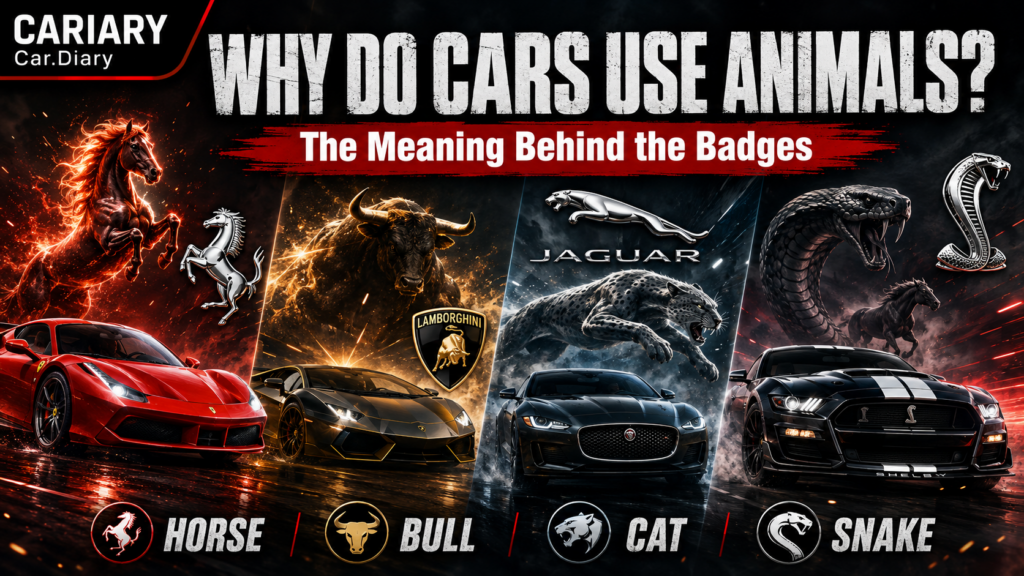
Car Brand Animal Symbols help automakers turn machines made from metal, glass, rubber and software into characters we can instantly remember. A horse, bull, lion, cat or snake can make a car feel alive before we read a single specification.
Table of Contents
- Quick Summary
- Why Animals Appear Everywhere in the Automotive World
- Animals Give Machines Personality
- Ferrari: Why the Prancing Horse Is Not Simply About Speed
- Porsche: The Other Famous Horse
- Ferrari vs Porsche: Same Animal, Different Meaning
- Lamborghini: The Bull as a Whole Brand Universe
- Jaguar: When the Animal Becomes the Brand
- Peugeot and the Lion
- Why Model Names Use Animals
- Viper, Cobra and the Power of Danger
- RAM and the Symbol of Impact
- Logo vs Model Name: Two Different Jobs
- Why Car Brand Animal Symbols Work Globally
- How Symbols Influence Vehicle Design
- Common Misconceptions
- Cariary Thoughts
- FAQ
- Related Thoughts
- Sources
Quick Summary
Car Brand Animal Symbols are not just decorations. They are a branding language that lets automakers give a machine emotion, personality, memory, and cultural meaning before the driver even reads a specification sheet.
A horse can suggest speed, motion and freedom. A bull can suggest strength and aggression. A big cat can suggest elegance and predatory speed. A snake can suggest danger. These meanings are not perfectly universal, but they are easy to understand across languages.
The more interesting point is that the same animal can tell completely different stories. Ferrari and Porsche both use horses, but Ferrari’s horse is tied to racing heroism, while Porsche’s horse is tied to Stuttgart heritage.

_(53619769044).jpg)
Why Animals Appear Everywhere in the Automotive World
Car brands use animals because animals carry meaning very quickly. A paragraph can say “powerful, aggressive and dramatic,” but a bull can communicate most of that in one glance.
That speed matters in branding. Cars are complicated products filled with engines, batteries, transmissions, suspension parts, safety systems and software. A strong symbol helps people remember the car as something more than a technical object.
This is why animal symbolism appears in logos, model names, hood ornaments and even design language. The animal becomes a shortcut to the feeling the brand wants the car to have.
Animals Give Machines Personality
A car is not alive. It does not have instinct, pride, fear or ambition. But branding can make a machine feel as if it has a character.
That is the key idea of this article: animals give machines a personality. The Ferrari horse makes the car feel like it is moving even when parked. The Lamborghini bull makes the car feel aggressive before the engine starts. The Jaguar name makes the brand feel elegant and predatory at the same time.
This is not shallow decoration when it is done well. The best automotive symbols tell the reader what the car wants to be.
Ferrari: Why the Prancing Horse Is Not Simply About Speed
Ferrari’s Prancing Horse is easy to explain badly. It would be too simple to say, “Ferrari is fast, so Ferrari uses a horse.” The real story is more emotional.
The horse was linked to Francesco Baracca, the Italian World War I pilot who used a prancing horse symbol. Enzo Ferrari later adopted the symbol for his racing cars after a connection with Baracca’s family.
So Ferrari’s horse is about speed, yes, but also about racing history, victory, memory, and Italian motorsport mythology. That is why the symbol feels deeper than a generic fast-animal choice.
Porsche: The Other Famous Horse
Porsche also places a horse at the center of its crest, but the story is different. Porsche’s horse points to Stuttgart, the company’s home city, whose identity is historically connected to horses.
This makes Porsche a useful comparison with Ferrari. Both brands use a horse. Both brands make fast cars. But the symbolic meaning is not identical.
Ferrari’s horse feels like racing heroism. Porsche’s horse feels like hometown identity and heritage. Same animal, different story. That difference is exactly what makes car branding interesting.
.jpg)
Ferrari vs Porsche: Same Animal, Different Meaning
This is where the topic becomes richer than a logo list. If we only say “horse means speed,” we miss the real point.
An animal has a general symbolic meaning, but each brand adds history and context. Ferrari borrowed a heroic racing story. Porsche borrowed a regional identity. Mustang borrowed the feeling of wild freedom.
So when we study car symbols, we should ask two questions: what does the animal usually suggest, and why did this specific brand choose it?
Lamborghini: The Bull as a Whole Brand Universe
Lamborghini is probably the most complete example of animal branding in the performance-car world. The bull is not only a logo. It spreads into model names, design language and brand attitude.
Ferruccio Lamborghini was associated with Taurus, and the company developed a strong connection with bulls and bullfighting culture. Names such as Miura, Islero, Murcielago and Aventador show how deeply that world entered Lamborghini identity.
The design language fits too: low, wide, sharp, aggressive and intimidating. Lamborghini does not merely show a bull on the badge. It tries to make the whole car feel like one.
.jpeg)
Jaguar: When the Animal Becomes the Brand
Jaguar is even more direct because the animal is the brand name. The word itself suggests a fast, silent, elegant predator.
That fits the traditional Jaguar image very well: long body lines, smooth performance, luxury, and a certain restrained danger. A Jaguar should not feel like a blunt instrument. It should feel graceful and quick.
This is a good reminder that animal branding is not only about aggression. Sometimes it is about elegance, silence and movement.
.jpg)
Peugeot and the Lion
Peugeot’s lion is a different kind of example. The lion is old, corporate and historical, not simply a modern performance symbol.
A lion can suggest authority, confidence, durability and strength. But Peugeot’s use of the lion also connects to the company’s older manufacturing identity before automobiles became the center of the brand.
That means not every animal logo begins as a car-performance idea. Some symbols carry heritage first, and performance meaning later.

Why Model Names Use Animals
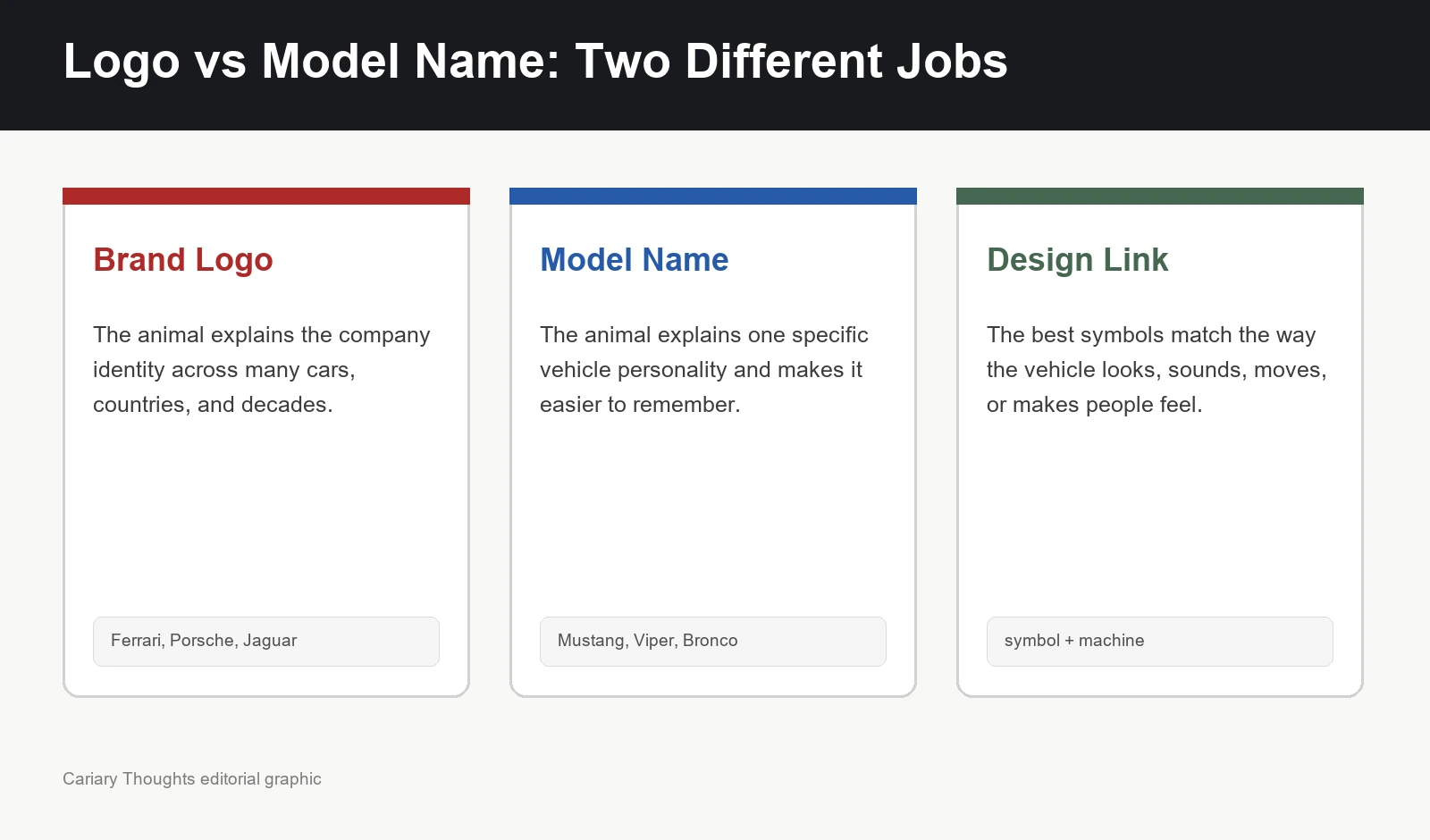
A brand logo and a model name do different jobs. A logo explains the company across many decades. A model name gives one specific vehicle an immediate personality.
Ford Mustang is the best example. “Mustang” suggests a wild horse, open roads, American freedom and youthful energy. The name does emotional work before the brochure starts talking about engines.
Ford Bronco works in a similar way for adventure and off-road freedom. The animal idea helps the model feel tough, outdoorsy and independent.
_(4361800842).jpg)
Viper, Cobra and the Power of Danger
Some animal names work because they feel beautiful. Others work because they feel dangerous. Dodge Viper and Shelby Cobra are in the second group.
A viper or cobra suggests speed, precision, venom and risk. Those meanings fit extreme performance cars because the name makes the machine feel slightly threatening.
That does not mean the car is actually unsafe when driven responsibly. It means the brand wants the driver to feel that the car has sharp edges, even emotionally.
.jpg)

RAM and the Symbol of Impact
RAM is useful because it shows a different direction from sports cars. A ram does not mainly suggest elegance or high-speed agility. It suggests toughness, impact and strength.
That symbolism fits pickup culture well. Trucks are often marketed around pulling, carrying, durability and confidence. A ram head feels physically direct, almost like a symbol of pushing through resistance.
Again, the animal is not random. It compresses a whole attitude into a shape.
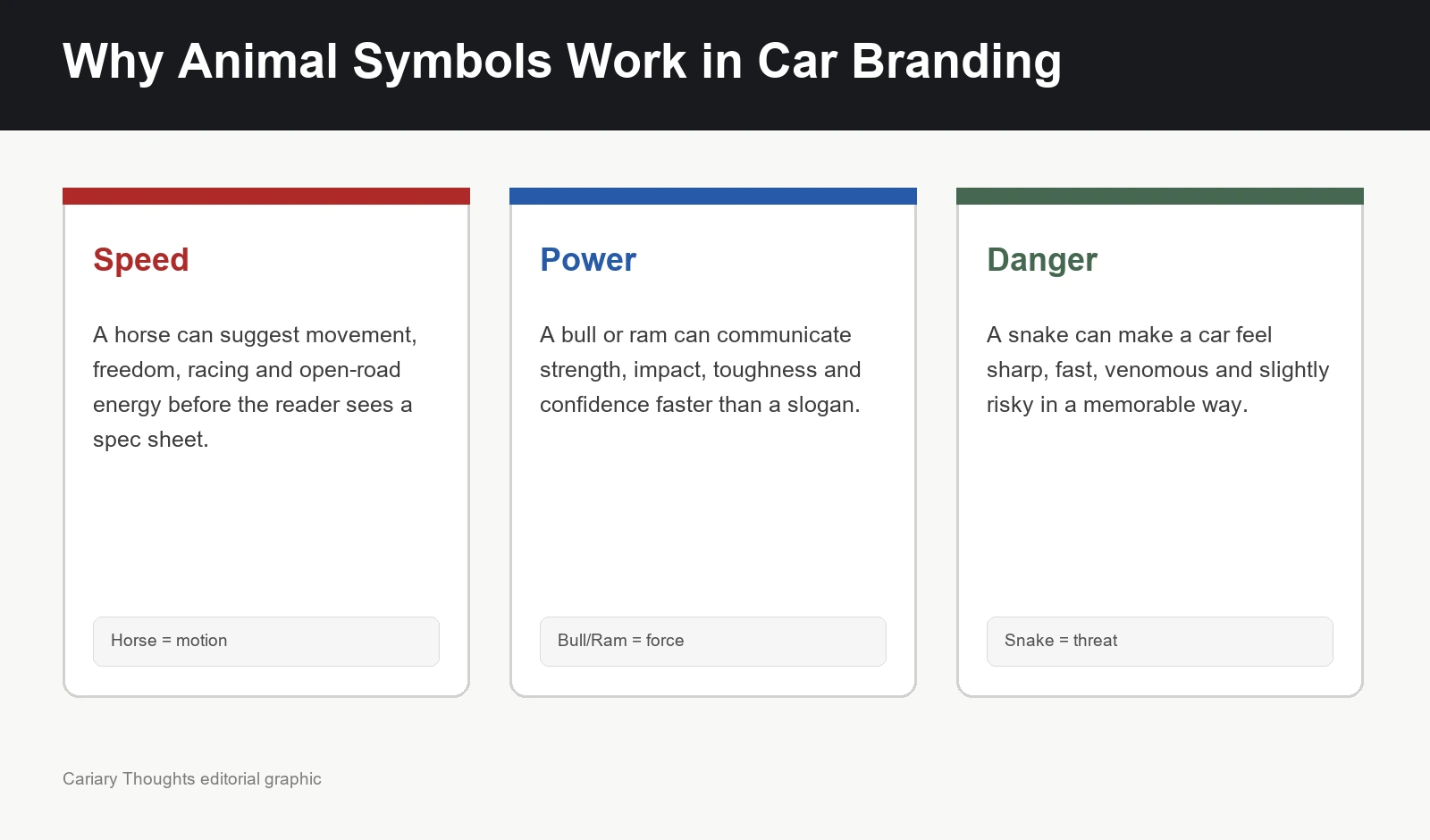
Logo vs Model Name: Two Different Jobs
Animal logos usually build brand identity. Ferrari, Porsche, Lamborghini, Jaguar and Peugeot use animal symbols to make the entire company easier to recognize and remember.
Animal model names work more narrowly. Mustang, Bronco, Viper and Cobra do not explain every vehicle the company makes. They explain one vehicle’s mood.
This distinction matters because it keeps the article from becoming just a list. The animal may be doing corporate identity work, model personality work, or both.
Why Car Brand Animal Symbols Work Globally
Animal symbols travel across languages better than slogans do. A phrase may need translation, but a charging bull or running horse is instantly readable in many cultures.
Of course, meaning can change by region. No symbol means exactly the same thing everywhere. But animals give brands a strong starting point because people already carry emotional associations with them.
That is especially useful for global car brands. Ferrari, Porsche, Ford, Lamborghini, Jaguar and Peugeot all come from different countries, but their animal symbols are easy for international audiences to remember.
How Symbols Influence Vehicle Design
Good branding becomes stronger when the symbol and the vehicle design speak the same language. Lamborghini’s bull image matches low, wide and angular supercars. Jaguar’s animal image fits long, smooth, elegant forms.
Mustang’s running horse fits a car associated with youthful energy and the open road. Cobra and Viper fit cars that feel raw, loud and slightly intimidating.
The symbol does not design the car by itself, but it gives the design team and the audience a shared emotional direction.
Common Misconceptions
Misconception one: car companies use animals only because they look cool. Looking cool helps, but the real value is personality, memory and identity.
Misconception two: one animal always means one thing. Ferrari, Porsche and Mustang all use horse imagery in different ways. Context changes the meaning.
Misconception three: animal names are old-fashioned. They still work because emotional memory is still important, even when modern cars become electric, digital and software-defined.
Misconception four: animal branding is only for sports cars. Peugeot and RAM show that animal symbols can also express heritage, durability or toughness.
Cariary Thoughts
At first, this topic looked simple to me: Ferrari has a horse, Lamborghini has a bull, Jaguar is a big cat. But the more interesting part is not the animal itself. It is the story attached to the animal.
Ferrari and Porsche are the best example. If two brands can use the same animal but create completely different emotional meanings, then a logo is clearly doing more than decoration. It is carrying memory.
This is why automotive branding is fun to study. A car may begin as engineering, but a good symbol gives that engineering a face, a mood and a story. The machine becomes easier to remember because it starts to feel like a character.
One-Line Summary
Car companies use animals because a strong animal symbol can turn a machine into a memorable character with emotion, history and identity.
FAQ
Why do so many car brands use animals in logos? Because animals communicate personality quickly. They can suggest speed, strength, elegance, danger, freedom or heritage without needing a long explanation.
Why does Ferrari use a horse? Ferrari’s Prancing Horse is tied to Francesco Baracca and Italian racing history, not only the idea that a horse is fast.
Why does Lamborghini use a bull? Lamborghini’s bull reflects Ferruccio Lamborghini’s Taurus connection and the brand’s long use of bullfighting-related names and aggressive design language.
Do Ferrari and Porsche horses mean the same thing? No. Ferrari’s horse is connected to racing heroism, while Porsche’s horse is connected to Stuttgart heritage.
Why are Mustang, Viper and Cobra such memorable names? They instantly give the car a personality: Mustang suggests freedom, while Viper and Cobra suggest danger, speed and attack.
Related Thoughts
For another look at how brand philosophy shapes performance identity, read AMG vs BMW M vs Audi RS.
For a technical example of how names and real vehicle behavior connect, see FWD vs RWD vs AWD.
Sources
This article was prepared with official brand history references and Wikimedia Commons image metadata for editorial image credits.
- Ferrari – the Prancing Horse story
- Porsche – the Porsche crest and Stuttgart identity
- Lamborghini – company history
- Lamborghini – Aventador and bullfighting name tradition
- Ford – Mustang heritage
- Jaguar – brand and heritage
- Peugeot – brand history and lion emblem
- Ram Trucks – official brand site

