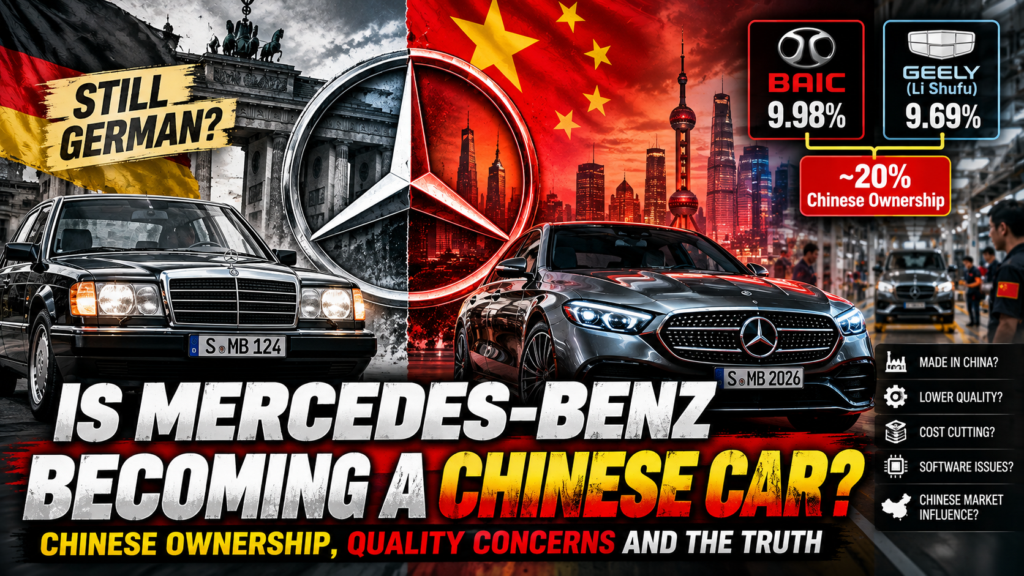
Mercedes-Benz Ownership sounds like a question with a simple answer: is the company still German, or has it become Chinese? Then a story about shareholders gets mixed with a complaint about a dashboard, and suddenly two very different arguments look like one.
I wanted to understand that connection rather than repeat it. China matters enormously to Mercedes-Benz, and some recent reliability evidence deserves attention. But neither observation automatically explains the other.
The useful question is not which flag we should put on the bonnet. It is what has actually changed: the shareholders, the business relationships, the engineering, or the experience of living with the car.
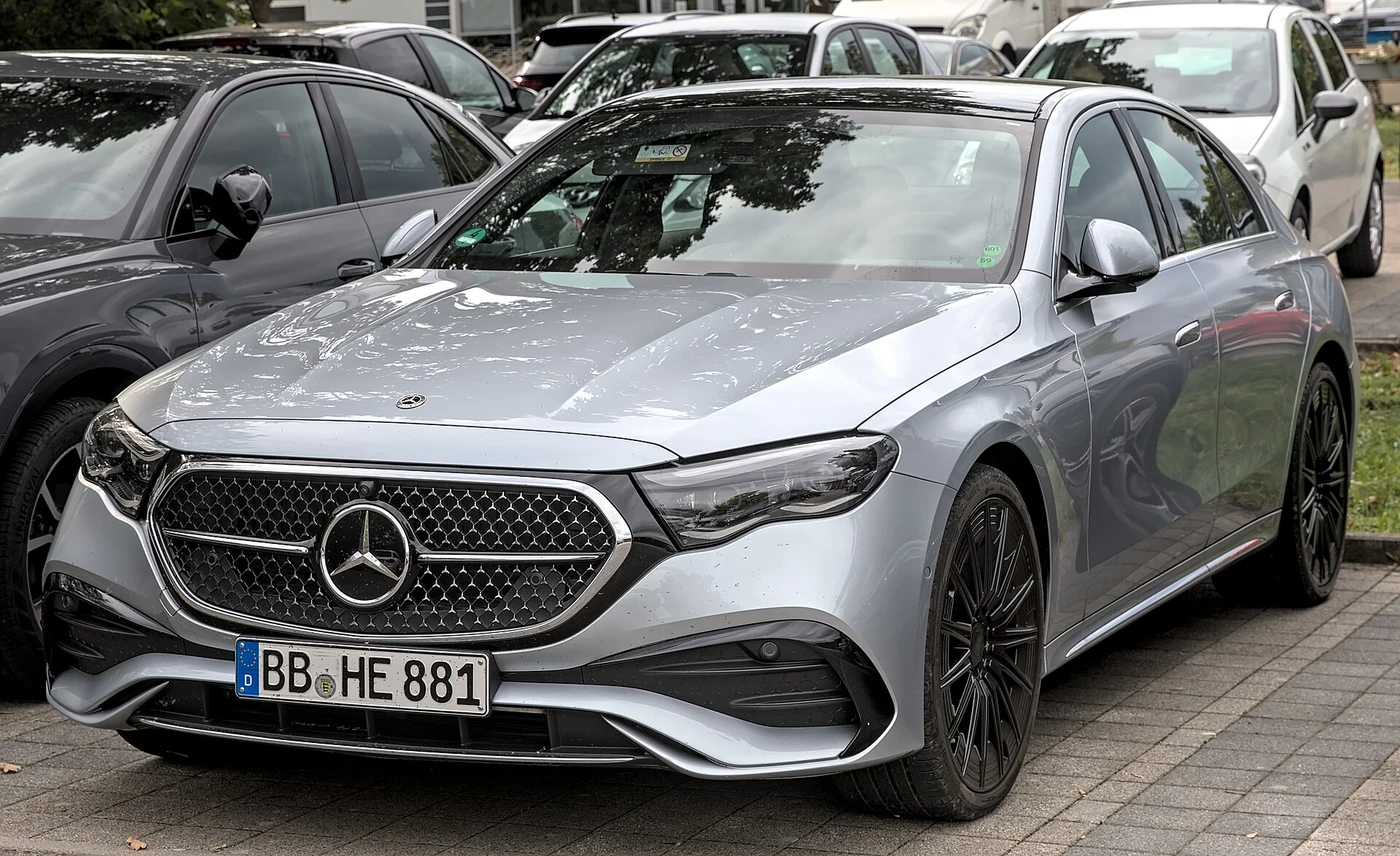
Quick Summary
- Mercedes-Benz Group remains a German company headquartered in Stuttgart; international shareholders do not automatically change that identity.
- Two major reported holdings associated with China add up to 19.67%, but that arithmetic does not establish a joint controlling shareholder.
- Chinese factories, customers and technology partners influence the business in different ways.
- Some model-year reliability findings and specific recalls are real concerns, not something to dismiss as nostalgia.
- The sources examined here do not establish that Chinese investment caused a deterioration in vehicle quality.
1. Mercedes-Benz Ownership Is Not the Same as Control
Start with the company rather than the rumor. Mercedes-Benz Group’s corporate information identifies the business in Stuttgart, Germany. That tells us where the company is based, not the nationality of every investor, engineer or component.
Its shareholder structure, referenced to 30 June 2026, reports these holdings:
| Shareholder | Reported holding | What the number tells us |
|---|---|---|
| BAIC | 9.98% | A substantial individual holding |
| Li Shufu, through Tenaciou3 Prospect Investment Limited | 9.69% | A separate substantial holding |
| All other shareholders combined | 80.33% | The remainder, not a German-ownership percentage |
The first two stakes total 19.67%. However, adding them does not turn two investors into one decision-maker. The shareholder page does not establish that they operate as a single controlling bloc.
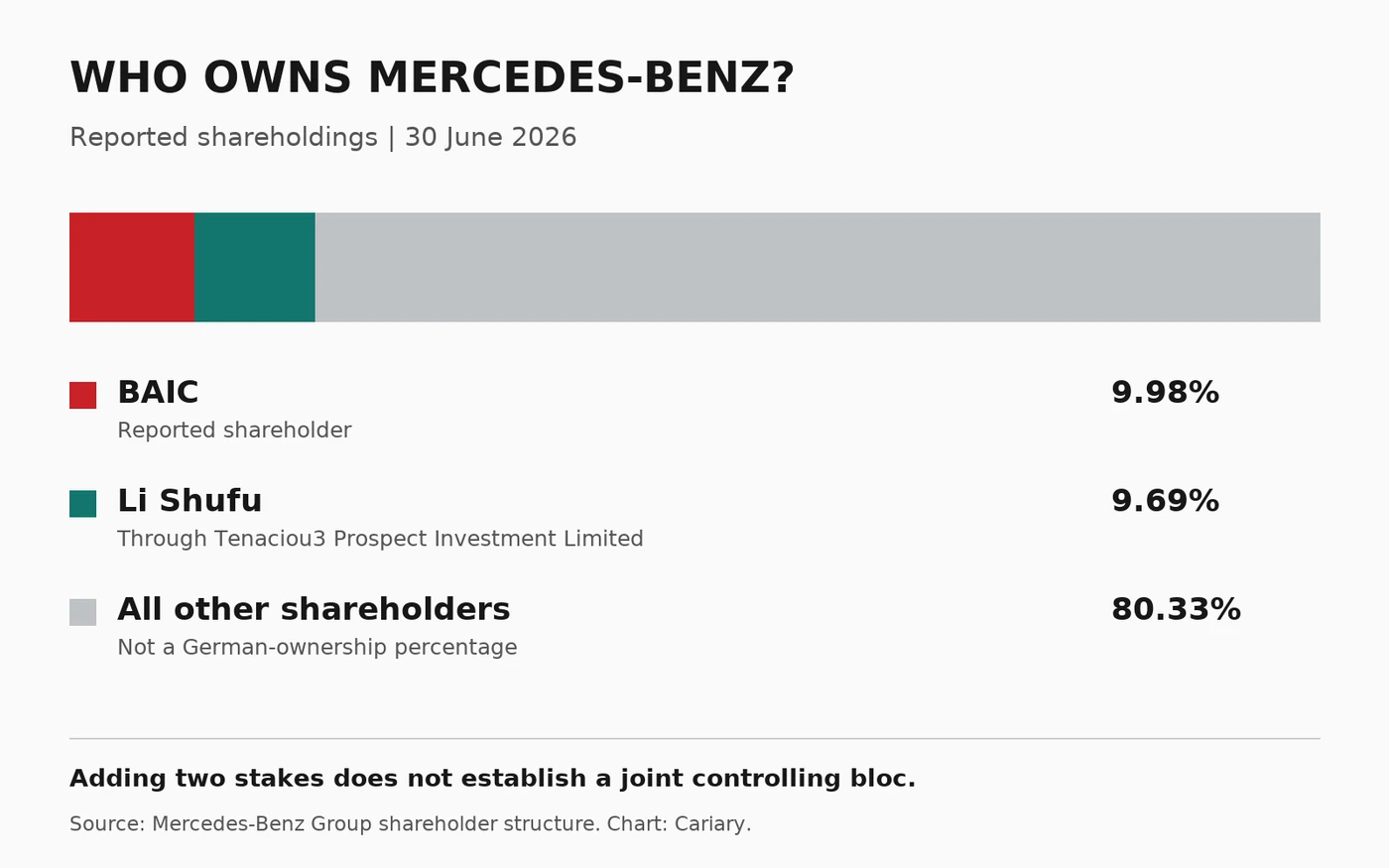
A minority shareholder can still have influence. Nor is 50% a universal magic line below which control is impossible: voting arrangements and the wider governance structure matter. The careful conclusion is narrower: these percentages alone do not show that China has taken control of Mercedes-Benz.
Germany’s governance framework also matters. The company’s Supervisory Board description sets out a 20-member board, divided equally between shareholder and employee representatives, with oversight responsibilities. That is not the same thing as a shareholder personally directing vehicle development.
Think of three different questions: who owns shares, who has decision-making powers, and who manages the business? They overlap, but they are not interchangeable.
For this article, “German company” describes corporate identity and headquarters. It is not a claim that the entire business is designed, funded and manufactured inside Germany.
2. China Matters Beyond the Share Register
A company can remain German while becoming more closely connected to China. That is not a contradiction.
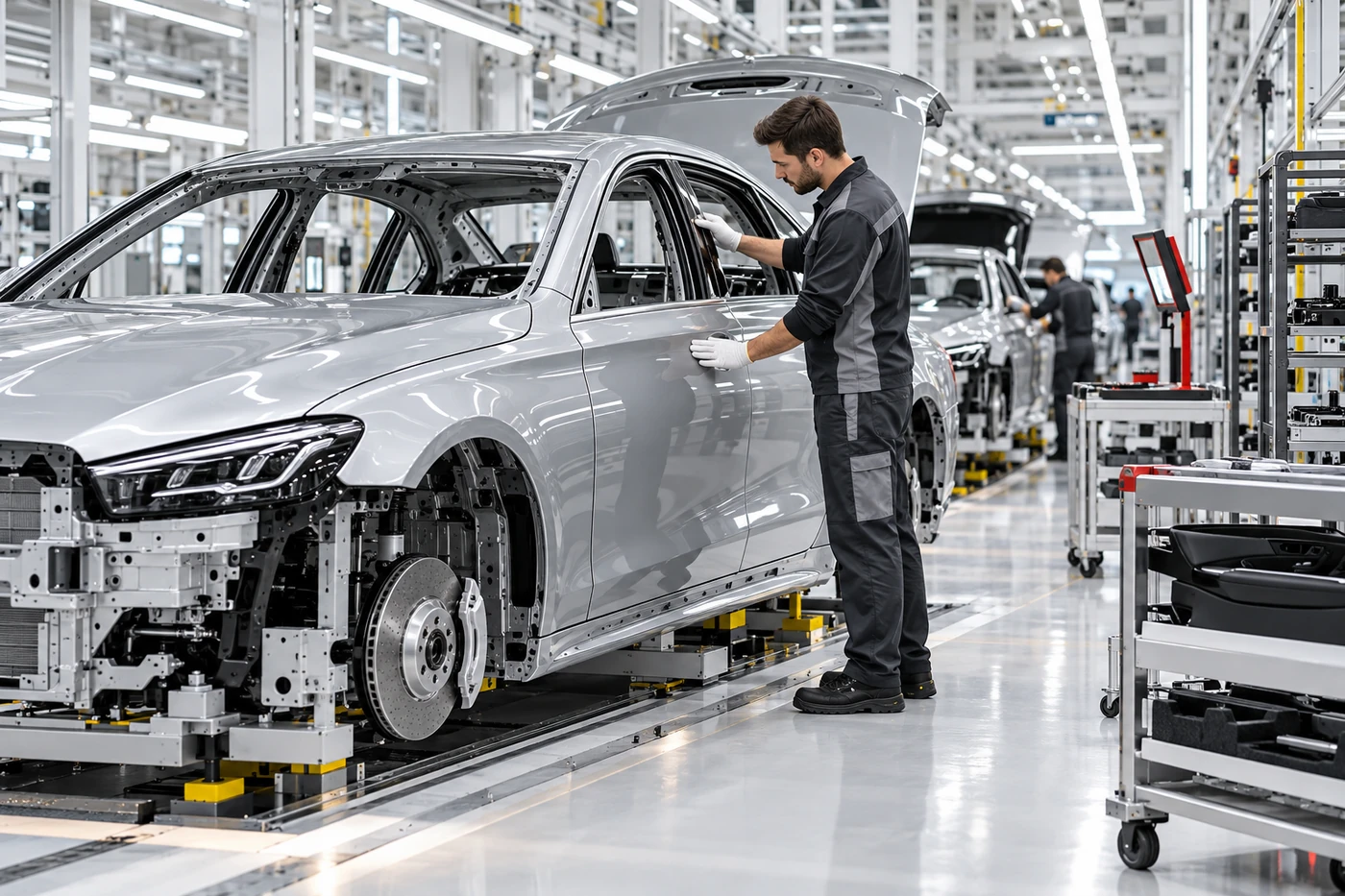
Consider manufacturing. Mercedes-Benz describes Beijing Benz Automotive Co., Ltd. as a joint venture with BAIC Motor, producing passenger cars since 2005 and engines since 2013. That is a production relationship involving a specific business, not a statement that the listed parent company has changed nationality.
The same distinction applies to research and technology partnerships. In its 2025 results presentation, Mercedes-Benz describes a stronger local ecosystem in China and names partners including Momenta and ByteDance. Those relationships show that development is not simply a one-way export of ideas from Stuttgart.
They do not mean every Mercedes worldwide uses the same partner, software or feature set. Market-specific products and approvals must be checked separately.
Here is a more useful way to read the discussion:
| Connection | What to investigate | What not to assume |
|---|---|---|
| Shareholding | Voting rights and governance | Every investor acts as one bloc |
| Local manufacturing | The plant and model concerned | The whole brand has changed nationality |
| Local development | The product and market scope | Every feature is globally identical |
| Technology partnership | The function supplied | A partner controls the entire vehicle |
| Customer demand | Which preferences shape products | Every compromise has one national cause |
These distinctions matter because a single phrase, “Chinese influence,” can conceal several unrelated mechanisms.
For example, selecting a local supplier can be about logistics, technical capability or cost. A feature developed for Chinese customers can reflect local competition. Neither fact, on its own, tells us whether the finished system is dependable.
3. smart Is a Different Ownership Story
smart makes this conversation particularly confusing because it has a familiar historical connection to Mercedes.
Today, smart’s own company description identifies smart Automobile Co., Ltd. as a 50:50 joint venture between Mercedes-Benz AG and Geely Automobile Group Co., Ltd. That is a specific ownership arrangement for smart.
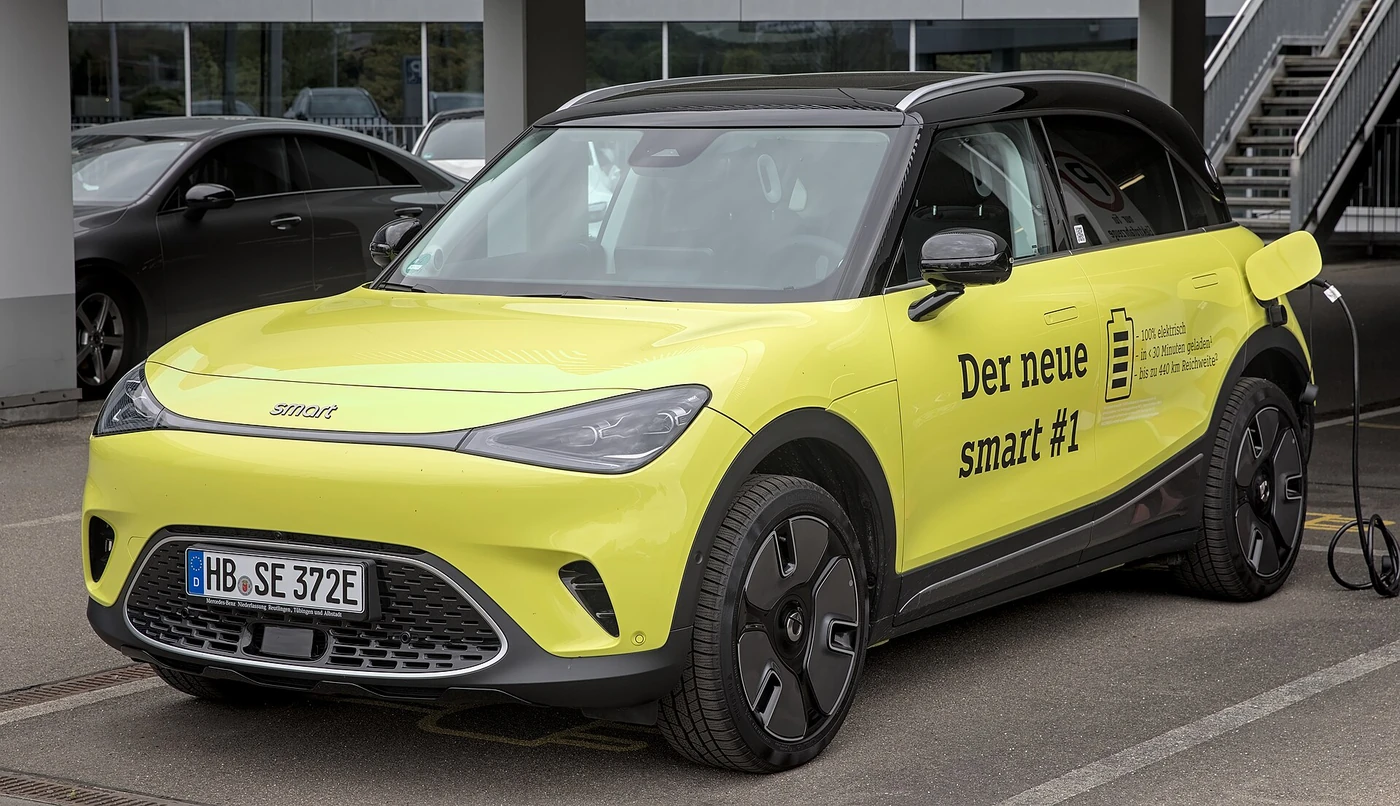
It does not mean Mercedes-Benz Group itself is a 50:50 German-Chinese joint venture. The names are connected, but the corporate entities are different.
This is the point at which I found it helpful to stop thinking only in badges. A badge is easy to recognize; a corporate relationship is not. Yet the latter is what determines whether we are discussing a shareholder, a subsidiary, a manufacturing partner or a jointly owned company.
The smart example also shows why a brand’s history and its present industrial organization can be different stories. We can acknowledge both without forcing every related company into the same ownership category.
4. Quality Complaints Need Better Categories
Now we can ask the second question: is Mercedes-Benz quality getting worse?
Before answering, we need to decide what “quality” means. A cabin can feel expensive and still suffer software faults. A dependable control can feel ordinary. A difficult menu can be frustrating without being broken.
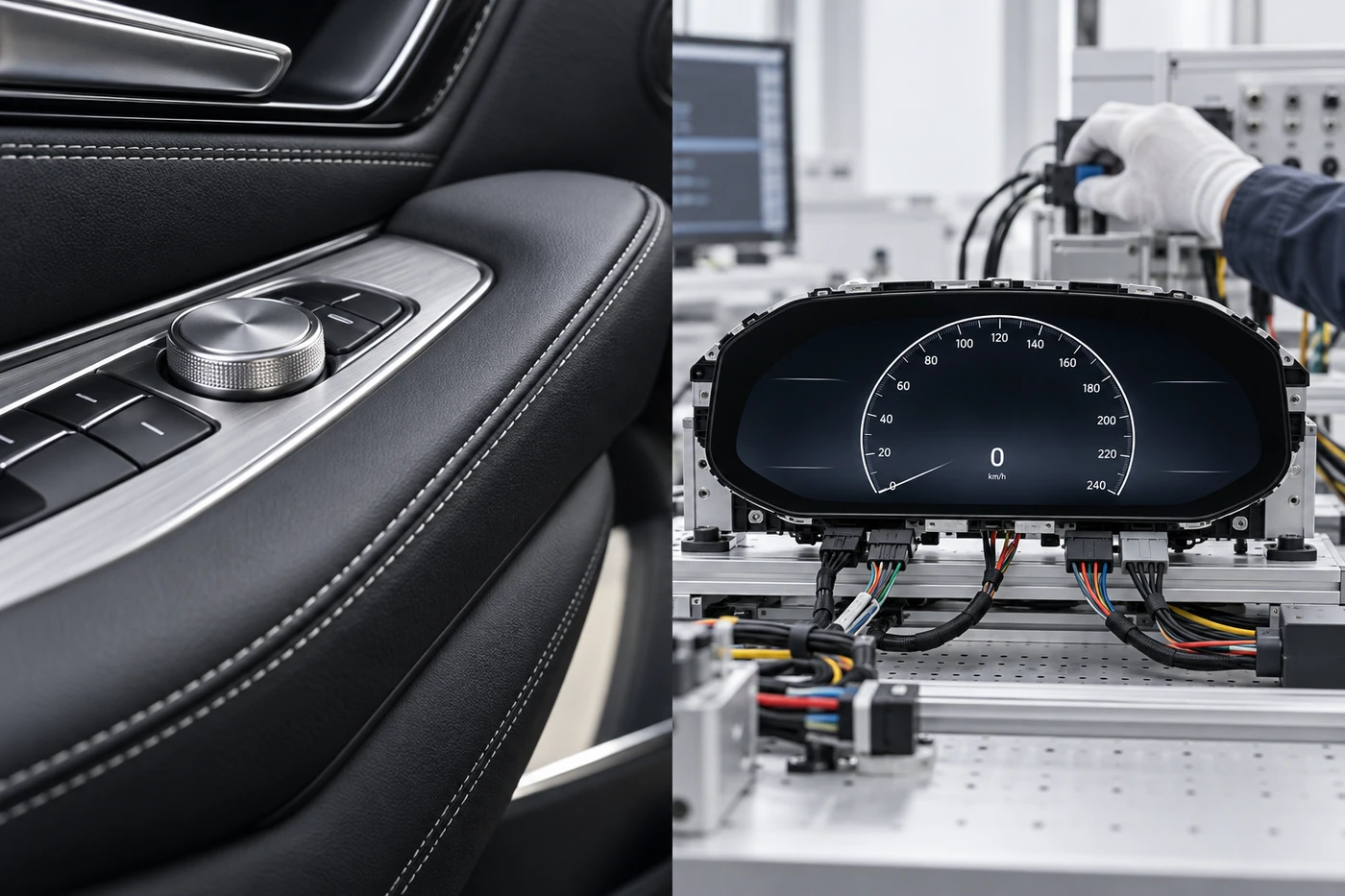
| Dimension | A practical example | Evidence that helps |
|---|---|---|
| Perceived quality | Trim feel, switch action, fit and finish | Careful inspection and consistent comparisons |
| Reliability | A system stops working as intended | Model-year surveys and documented failures |
| Usability | A routine function takes too many steps | Task-based testing in comparable conditions |
| Durability | Materials or components deteriorate with use | Long-term evidence with mileage and maintenance context |
| Repair burden | A fault takes time or money to resolve | Repair records, parts availability and warranty coverage |
Calling all of these “bad quality” makes a strong complaint harder to investigate, not easier.
What the public survey evidence says
Consumer Reports’ public 2025 E-Class reliability page describes that model year as less reliable than other vehicles of the same year. Its 2025 GLE page uses the stronger assessment “much less reliable.”
Those are meaningful negative findings. They should not be waved away because the badge has a distinguished history.
But they are model-year findings, not a controlled demonstration that every new Mercedes is worse than every old one. They also do not identify a shareholder as the cause. We are using the publicly available summaries here, not inventing numerical scores from subscriber-only details.
The same discipline applies to the GLC: check the exact year and evidence rather than assigning it a rating borrowed from another model.
A documented problem is more useful than a vague accusation
There is a concrete example in NHTSA recall 26V281. Mercedes-Benz reported that infotainment software in certain 2024–2026 vehicles, including specified C-Class, E-Class and GLC vehicles, could initiate resets that briefly interrupt instrument-cluster information.
The report identifies affected software versions and a software-update remedy through authorized dealerships. A display interruption is not merely an argument about whether touchscreens look nice: it can prevent the driver from seeing driving-related information.
However, an affected vehicle population is not a count of vehicles that actually failed. A recall is also not a brand-wide failure rate. Its usefulness here is that it identifies a specific mechanism and remedy.
If your own vehicle may be involved, check its VIN through the relevant national recall service and Mercedes-Benz. Do not decide applicability from a model name in an article.
5. Software Complexity Is a Real Engineering Question
Why can a luxury car feel beautifully assembled and still frustrate its owner?
Part of the answer is that materials and system behavior are different engineering jobs. A dashboard can have excellent stitching while the software behind its display struggles with a particular interaction.
Imagine a camera producing information, a computer processing it and a display presenting it. Each component might work in isolation. The complete system must also handle timing, interruptions, unusual inputs and recovery from faults.
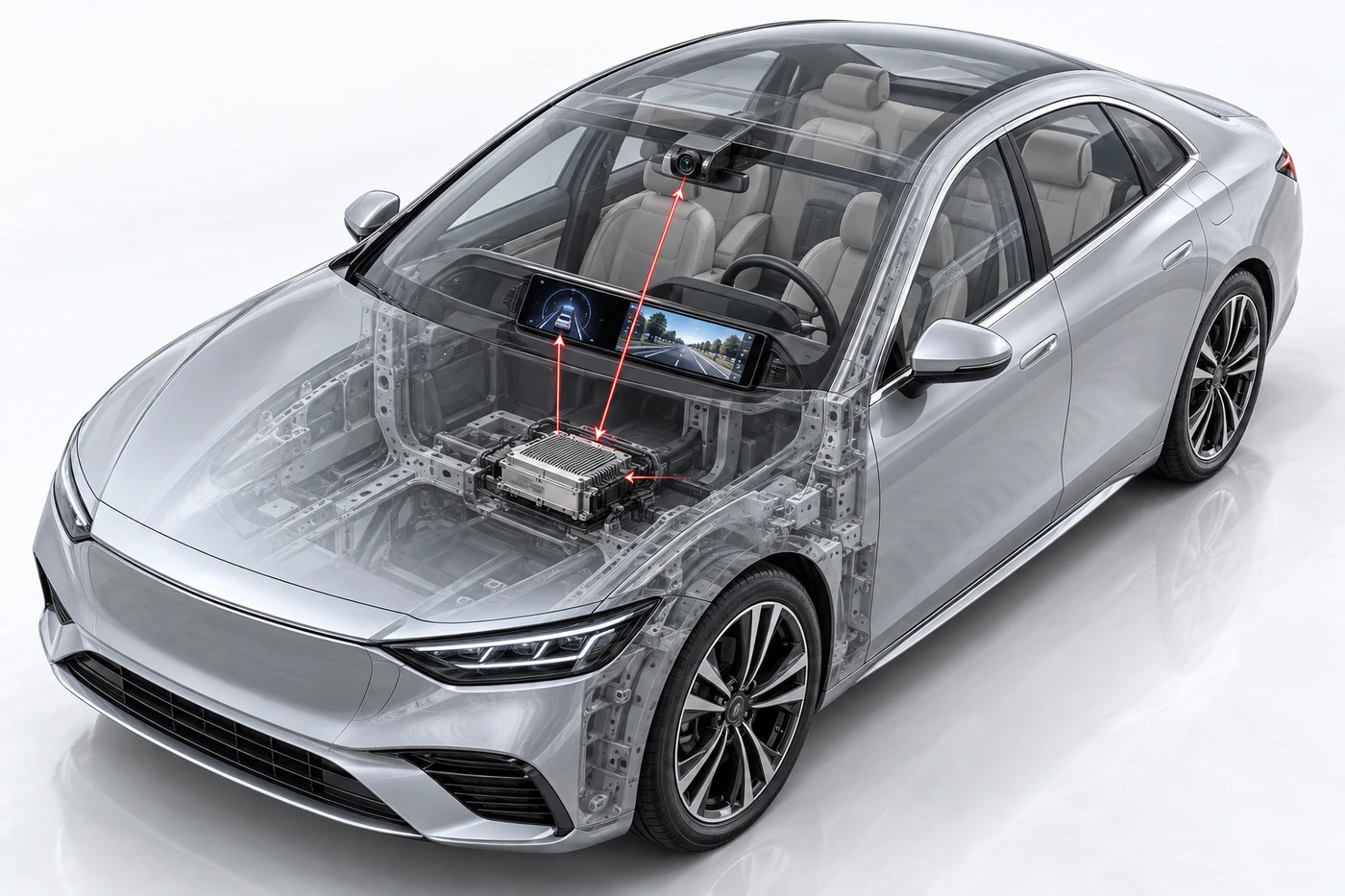
That is why “more technology” is not automatically equivalent to either better or worse reliability. Added functions introduce more interactions to validate, but good architecture, fault isolation and testing can improve resilience.
Our guide to how self-driving car sensors see the world explains why sensing and interpretation are separate tasks. Here, the additional question is whether all those tasks remain dependable together.
MBUX and MB.OS are not interchangeable labels
Mercedes describes the new CLA introduced in 2025 as the first vehicle fully operating on its MB.OS architecture. That matters when discussing older model-year complaints.
MBUX is the user-experience and infotainment name familiar to many owners. MB.OS refers to the broader operating architecture introduced with the new CLA. Calling every earlier screen issue an “MB.OS failure” would mix different implementations and timelines.
Likewise, an advanced assistance feature available in one market should not be assumed to exist in the same form everywhere.
Updates are useful, but not magic
Over-the-air software delivery can make some corrections more convenient. It cannot repair every physical fault, and releasing an update is not the same as proving that every affected vehicle has received it.
The engineering question is how problems are detected, diagnosed, corrected and checked after the correction. An owner ultimately needs the function to work reliably, not merely an explanation that modern cars are complicated.
Complexity is therefore a legitimate area to investigate. It is not a blanket excuse for failures, nor proof that software explains every complaint.
6. Cost Reduction Is Not Automatically Quality Reduction
The concern about cost cutting is understandable. When a premium car disappoints, it is natural to wonder whether someone saved money in the wrong place.
There are actual targets to discuss. In its February 2026 2025 results announcement, Mercedes-Benz set out China-related cost ambitions with its local joint ventures for 2027, compared with 2024:
| Cost category | Announced reduction target | Plain-English interpretation |
|---|---|---|
| Local material costs | 10% | Spending on locally sourced materials and components |
| Variable production costs | 20% | Production expenses that vary with output |
| Fixed costs | 20% | Costs that do not move directly with each additional vehicle |
These are targets, not a declaration that every saving has already been achieved. Their China-related scope should not be silently turned into a universal specification change for every Mercedes.
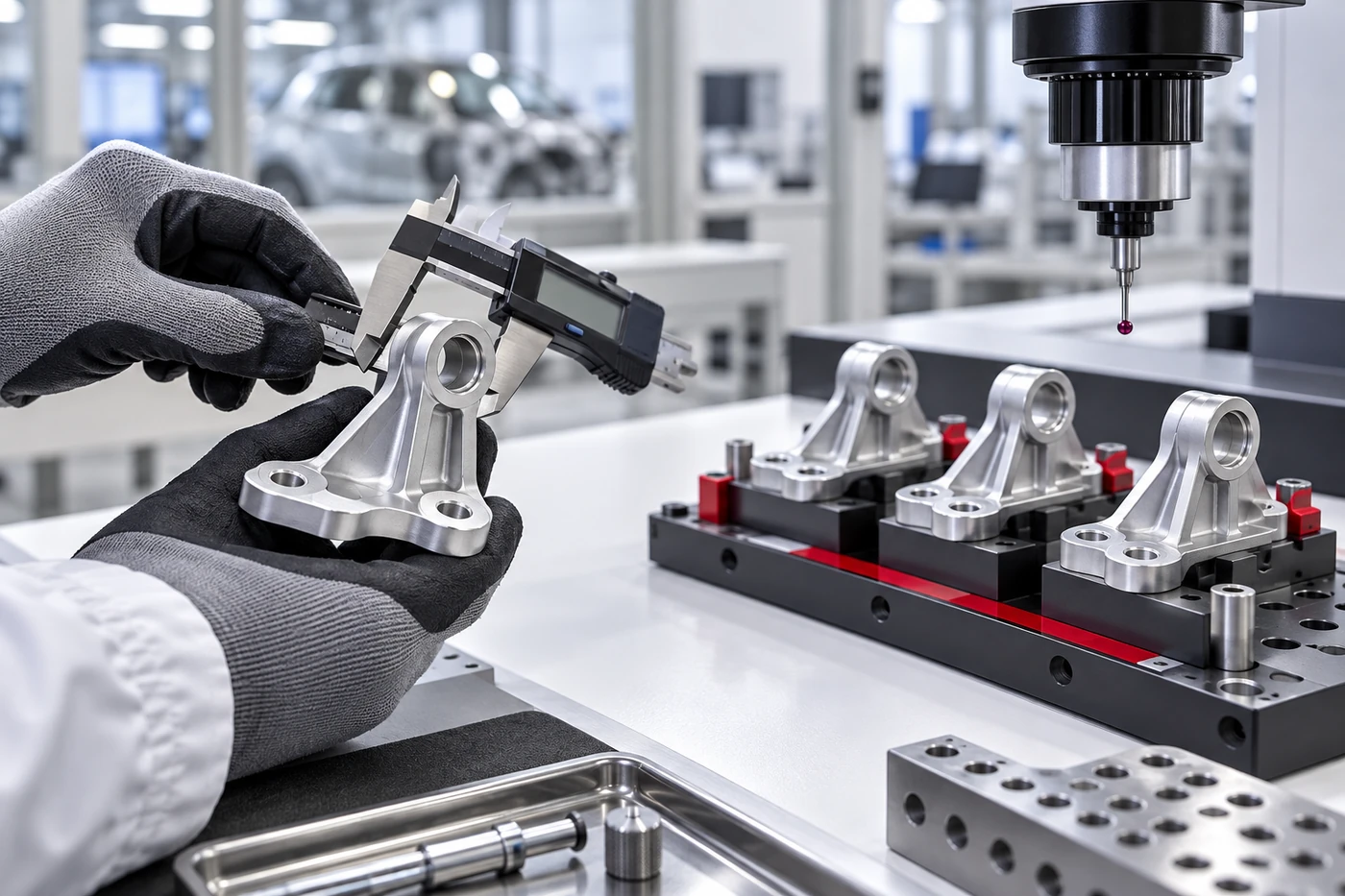
More importantly, a cost target does not identify how the saving is obtained.
A hypothetical factory could reduce waste, simplify logistics or use fewer component variations. Those changes need not make the car less durable. Conversely, weakening a component specification or shortening necessary validation could create problems. We would need evidence of that actual decision and its consequences before saying it happened.
The distinction is between spending less and delivering less. They can coincide, but they are not the same statement.
To connect a cost program to a fault, I would want to see the chain: which component or process changed, why it changed, what failure followed, and whether comparable vehicles support that explanation.
Without that chain, blaming either a nationality or a spreadsheet is still a hypothesis.
7. The Old Mercedes Comparison Needs Context
There is an emotional side to this debate that shareholding tables cannot answer.
An older Mercedes cabin can communicate solidity through its shapes, switches and restrained layout. The W124, W140 and W201 are often the cars people have in mind when they say the brand used to feel different.
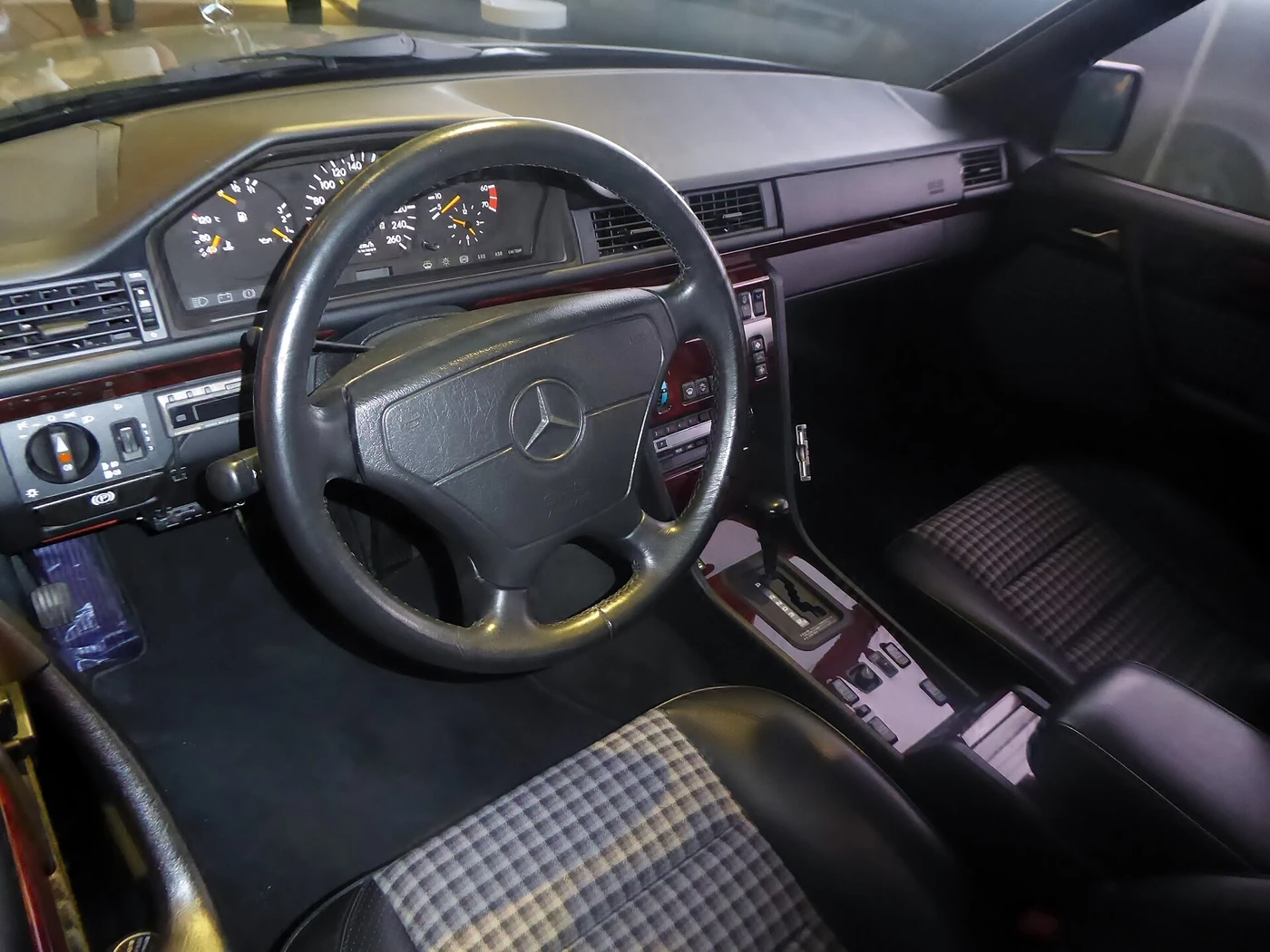
That experience is worth discussing. It is also different from proving that an entire generation had fewer faults.
We mostly meet the survivors
A beautifully maintained older car is a selected example. The neglected, damaged or uneconomical examples may already have disappeared from the comparison.
Maintenance also matters. Two cars carrying the same badge and build year can have very different histories. Comparing one carefully preserved classic with one disappointing new car tells us something about those two cars, but not enough about their whole populations.
Nor should we give every old Mercedes the same list of weaknesses. Systems, materials and known problems vary by generation, engine and equipment.
The ownership experience has changed
Older physical controls and newer screen-based interfaces ask different things of the driver. Someone can reasonably prefer a traditional cabin without claiming that every electronic function is inherently unreliable.
Our car design evolution guide explores how the appearance and priorities of cars change. Here, it helps explain why a shift in interface design can feel like a shift in identity.
For a fair reliability comparison, we would also need similar age, mileage, use, maintenance and a clear definition of failure. Otherwise, nostalgia and frustration end up doing the work that data should do.
Common Misconceptions
“Two Chinese-linked shareholders own nearly a fifth, so China runs the company.” That jumps from a sum of holdings to a conclusion about coordinated control. The cited ownership information does not establish that conclusion.
“Made in China means lower quality.” A production country does not tell us the specification, process control, supplier performance or validation standard of a particular vehicle.
“A recall proves the whole brand is unreliable.” A recall documents an issue and its affected scope. It does not provide a complete comparison of failure rates across brands.
“Premium materials prove mechanical dependability.” Materials, durability, electronics and repairability need different evidence.
“Cost reduction always means cheaper, worse parts.” It may involve efficiency, purchasing or process changes. The specific mechanism matters.
“If Chinese investment is not the proven cause, there is no quality problem.” That is the opposite mistake. We can take documented faults seriously without accepting an unsupported explanation.
How to Read the Next Mercedes Quality Story
The next time a headline makes you wonder what happened to Mercedes, try these checks:
- Identify the exact company being discussed: the listed group, smart, a factory joint venture or a supplier.
- Identify the model, year, powertrain and market behind the complaint.
- Separate a broken function from an unpopular design choice.
- Look for a survey, service record or official defect description rather than a compilation of anecdotes.
- Ask whether the proposed cause is documented or merely suggested.
- For an actual vehicle, verify its recall and maintenance history rather than extrapolating from a headline.
Our complete car maintenance guide is a useful companion for that last step. Maintenance cannot explain away a design defect, but its history is essential context for understanding an individual car.
Cariary Thoughts
What changed my view while researching this was not a single reassuring number. It was realizing how many different arguments had been compressed into the word “Chinese.”
Investment, manufacturing and technology cooperation are real. So are some disappointing model-year findings and documented software problems. The temptation is to draw a straight line between them because it makes the story simple.
But a simple story can make us less demanding in the wrong way. If we blame a country, we may stop asking which engineering decision failed, who was responsible and whether the remedy works.
For me, the more interesting standard for Mercedes is not whether the business can preserve an image of being untouched by globalization. It is whether the experience still earns the confidence associated with its badge: controls that behave predictably, problems that are resolved properly, and engineering that works beyond the showroom.
That is an interpretation, not a claim that every current Mercedes succeeds or fails. I would rather keep learning from specific evidence than defend an old reputation or dismiss a whole company with a new stereotype.
One-line Summary
Mercedes-Benz is still German, China is deeply involved in its business, and quality concerns deserve model-specific evidence rather than a nationality-based explanation.
FAQ
Is Mercedes-Benz a Chinese company now?
No. Mercedes-Benz Group remains a German company based in Stuttgart. Its international shareholding and Chinese business relationships are important, but they do not by themselves change that corporate identity.
Who owns the two large China-linked stakes?
The company’s shareholder page reports BAIC at 9.98% and Li Shufu, through Tenaciou3 Prospect Investment Limited, at 9.69%, referenced to 30 June 2026. They should not be treated as one controlling bloc without further evidence.
Does Geely own half of Mercedes-Benz?
No. The 50:50 arrangement discussed here concerns smart Automobile Co., Ltd., not Mercedes-Benz Group. Confusing those entities produces a very different story from the documented one.
Are all Mercedes-Benz cars made in China?
No. Chinese local production is one part of a broader manufacturing business. Establish where a particular vehicle was built from its own records, not from the nationality of a shareholder.
Is Mercedes-Benz reliability getting worse?
Some recent model-year evidence is unfavorable, including the public Consumer Reports assessments discussed above. That supports scrutiny of those vehicles, not a universal conclusion about every model or a measured historical decline across the entire brand.
Are all recent screen problems caused by MB.OS?
No. Different vehicles use different software generations. The new CLA was introduced as the first fully MB.OS-based vehicle; earlier complaints must be assessed against their own systems and software versions.
Do the cost targets prove Mercedes is using worse materials?
No. They establish an intention to reduce specified costs, not the quality of every resulting component. A claim about degraded materials needs evidence of the actual change and its consequences.
Does Chinese investment explain the quality concerns?
The sources used here do not establish that causal link. That does not invalidate owners’ complaints; it means the proposed explanation needs stronger evidence.
Related Thoughts
- How self-driving cars see the world: understand the sensors and processing behind increasingly complex vehicles.
- How car design evolved: explore changing shapes, interfaces and priorities.
- The complete car maintenance guide: put an individual vehicle’s condition and service history in context.
References
- Mercedes-Benz Group corporate information and shareholder structure.
- Mercedes-Benz Group Supervisory Board.
- Beijing Benz Automotive company profile.
- smart company description.
- Mercedes-Benz 2025 results, presented in February 2026.
- Consumer Reports: 2025 E-Class reliability and 2025 GLE reliability.
- NHTSA Part 573 report: recall 26V281.
- Mercedes-Benz USA: the new CLA and MB.OS.
Research checked on 20 October 2026. Shareholding reference date: 30 June 2026. Reliability summaries concern the specified U.S. model years; recall applicability and software availability vary by vehicle and market. Photographs, original charts and AI-generated concepts are identified in their captions and credits.