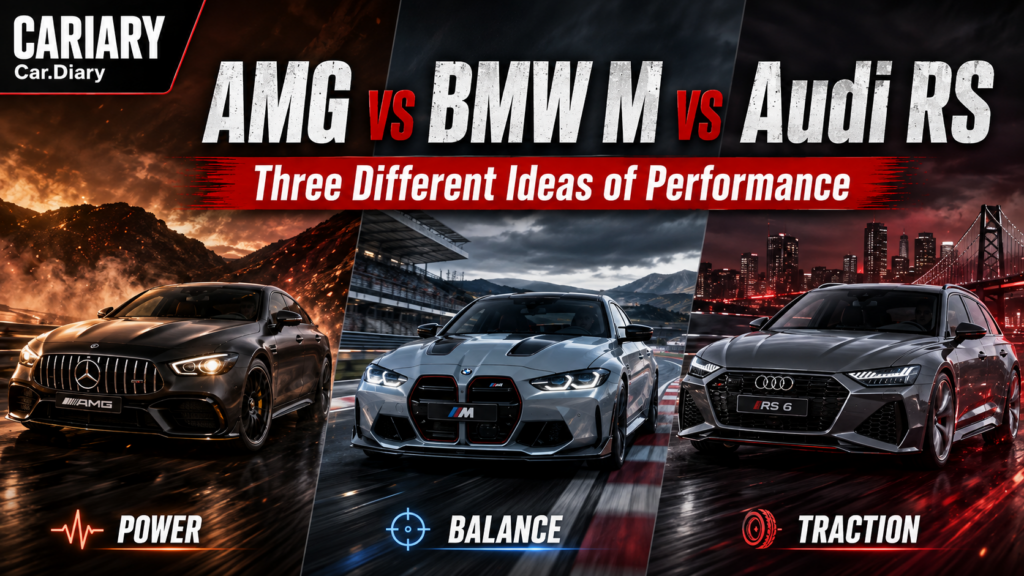
AMG, BMW M, and Audi RS all make very fast German performance cars. But once we look past horsepower numbers, they start to feel like three different answers to one question: what should a performance car be?
Table of Contents
- Quick Summary
- Why AMG, M, and RS Are Not the Same Thing
- AMG: The Engine Comes First
- Iconic AMG Cars and What They Teach Us
- BMW M: Motorsport Becomes a Road Car
- Iconic BMW M Cars and What They Teach Us
- Audi RS: quattro Turns Power Into Usable Speed
- Iconic Audi RS Cars and What They Teach Us
- Why the Audi R8 Is Different
- R8 vs M8 vs AMG GT 63 S: Why the Category Matters
- Nürburgring: Where the Philosophies Become Visible
- Which Philosophy Is Best?
- Common Misconceptions
- Cariary Thoughts
- FAQ
- Related Thoughts
- Sources
Quick Summary
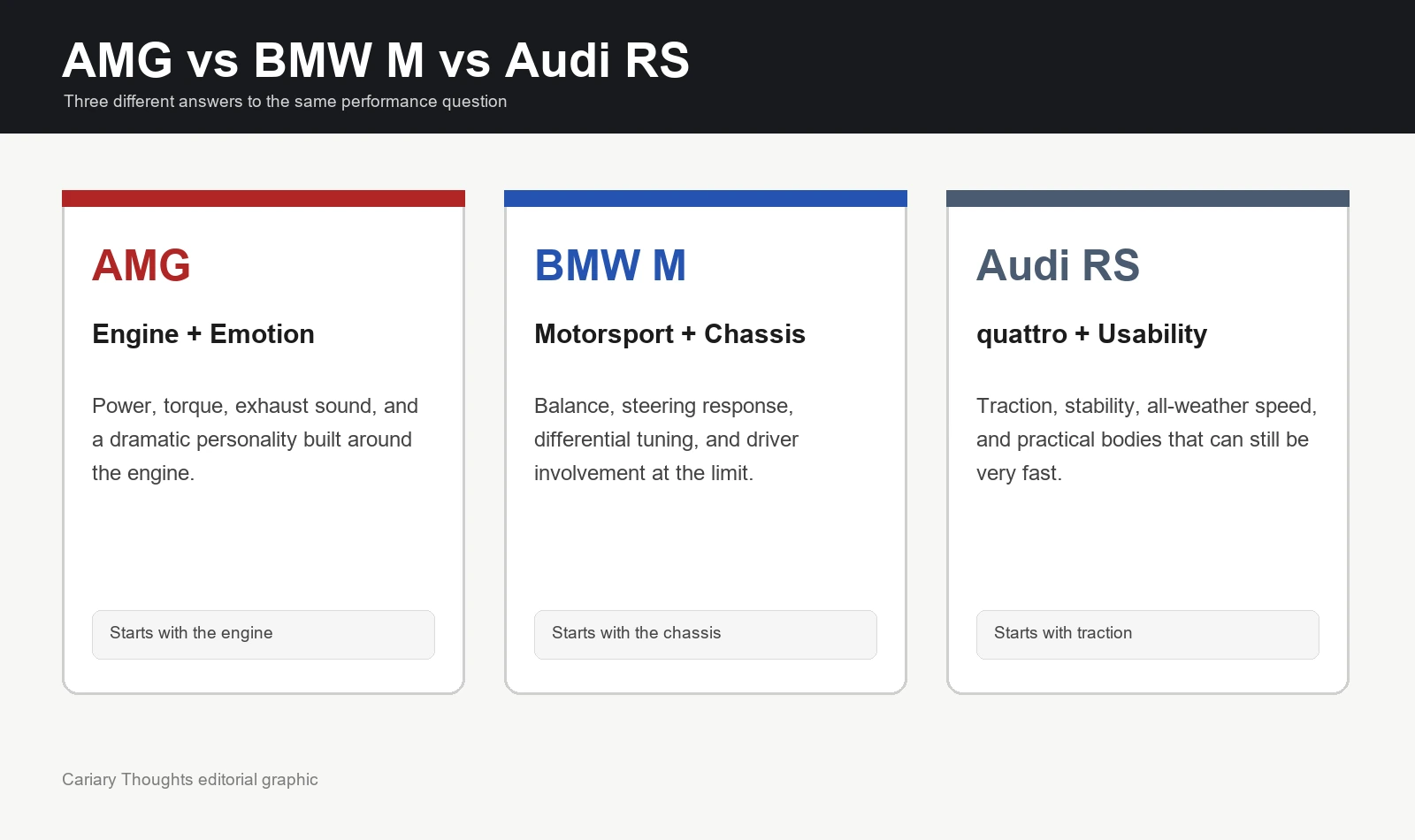
AMG vs BMW M vs Audi RS is not really a question with one clean winner. The more interesting question is what each brand has traditionally meant by performance: AMG often begins with engine drama, BMW M with chassis balance, and Audi RS with quattro traction and everyday speed.
That does not mean every AMG, M, or RS car follows the old stereotype perfectly. Modern cars overlap more than they used to. AMG now builds very serious track machines, BMW M has become brutally powerful, and Audi RS cars have become sharper and more playful than older Audis.
But the old roots still help us understand why these cars feel different. AMG tends to feel emotional and muscular. BMW M tends to feel like it wants to rotate, communicate, and attack a road or circuit. Audi RS tends to feel stable, confident, and fast in almost any weather.

Why AMG, M, and RS Are Not the Same Thing
At first glance, these three badges look like direct rivals. They sit at the top of Mercedes-Benz, BMW, and Audi performance ranges, and they often compete in the same price and horsepower territory.
But they did not begin from the same idea. AMG started as an independent tuner that made Mercedes-Benz cars more powerful and more dramatic. BMW M was created as BMW Motorsport, a factory motorsport division. Audi RS grew out of Audi’s quattro-centered performance culture and Audi Sport GmbH, formerly quattro GmbH.
So instead of asking only which one is fastest, it is more useful to ask what each brand was trying to prove. That is where the comparison becomes much more fun.
AMG: The Engine Comes First
AMG was founded in 1967 by Hans Werner Aufrecht and Erhard Melcher. The name comes from Aufrecht, Melcher, and Grossaspach, the town connected to Aufrecht. Early AMG was not simply a Mercedes-Benz department. It was an independent performance specialist with deep Mercedes engineering roots.
That matters because AMG’s character was built around transformation. Take a Mercedes, give it a bigger heart, make it louder, faster, more emotional, and sometimes slightly outrageous. This is why old AMG stories often feel like someone asked, “What if we put a much bigger engine in this?”
The 300 SEL 6.8 AMG Red Pig is the perfect symbol. It was a large luxury sedan turned into a racing car. That sounds almost unreasonable, which is exactly why it explains AMG so well.
_(53773540247).jpg)


Iconic AMG Cars and What They Teach Us
The Red Pig teaches us that AMG was willing to mix luxury and motorsport in a way that looked almost contradictory. It was not a tiny lightweight racer. It was a big Mercedes that refused to behave like one.
The AMG Hammer took the same spirit to the road. A W124-based Mercedes sedan looked restrained from the outside, but serious V8 power turned it into a sleeper performance car. It helped create the idea that AMG could make a luxury Mercedes feel secretly wild.
The W204 C63 AMG made that idea unforgettable for a modern generation. A compact C-Class with a 6.2-liter naturally aspirated V8 is not subtle engineering restraint. It is personality through displacement, sound, and torque. In a car like that, the engine is not just a component. The engine is the character.
BMW M: Motorsport Becomes a Road Car
BMW M began differently. BMW Motorsport GmbH was founded in 1972 to handle BMW’s racing activities. So the root of M is not outside tuning. It is factory motorsport.
That changes the philosophy. A traditional M car is not only a normal BMW with more power. It is supposed to rethink the way the car behaves: steering response, chassis balance, differential tuning, brake performance, suspension geometry, cooling, rigidity, and weight distribution.
The simple version is this: AMG traditionally asks how much more emotional and powerful the car can become. BMW M asks how the car can behave better at the limit.


.jpg)
Iconic BMW M Cars and What They Teach Us
The BMW M1 is important because it shows BMW M was never only about sedans. It was a true sports car project, and the M1 Procar series made the M badge feel naturally connected to racing.
The E30 M3 may be the purest expression of early BMW M. It was not famous only because of horsepower. It was famous because of motorsport homologation, balance, response, and the feeling that the whole car was built around cornering.
The E39 M5 shows the second great M idea: take a usable sedan and make it feel like a driver’s car. It is practical enough to live with, but engineered so the person behind the steering wheel feels involved.
Audi RS: quattro Turns Power Into Usable Speed
Audi RS has its own logic. Audi’s performance identity is deeply connected to quattro all-wheel drive, and Audi Sport GmbH grew from quattro GmbH. That name tells us where the brand’s performance confidence came from: traction.
Audi RS cars are often less about theatrical oversteer and more about deploying power cleanly. They make speed feel stable, repeatable, and usable. Rain, cold roads, long highway drives, poor surfaces, family luggage: Audi RS has traditionally tried to make performance work in real life, not only on a perfect dry road.
This does not make RS cars boring. It means their excitement often comes from how easily they cover ground. The drama is not always in the slide. Sometimes it is in how confidently the car exits a corner and keeps pulling.

.jpg)
Iconic Audi RS Cars and What They Teach Us
The Audi RS2 Avant is the origin story that explains almost everything. It was an Avant wagon, developed with Porsche involvement, and it proved that a practical family-shaped Audi could have serious performance credibility.
The RS6 Avant continued that idea on a bigger scale. It is one of the clearest Audi RS statements: a fast, luxurious, all-wheel-drive wagon that can carry people and luggage while moving with supercar-like urgency.
That is why Audi RS often feels different from AMG and BMW M. It does not always ask the driver to sacrifice practicality to access performance. Its message is closer to this: why not have speed, stability, and usability in the same body?
Why the Audi R8 Is Different
The Audi R8 deserves its own section because it is not simply an RS6 with a lower roof. Audi itself describes the R8 as its first high-performance sports car and the first completely in-house development by quattro GmbH from the ground up.
The layout changes everything. A mid-engine, two-seat sports car with a naturally aspirated V8 or V10 belongs to a different world from a front-engine luxury GT or high-performance sedan. The second-generation R8 V10 also sat close to Lamborghini territory through shared Volkswagen Group supercar engineering.
But Audi did not make the R8 feel like a wild Lamborghini clone. The R8 was refined, predictable, stable, and surprisingly usable for a supercar. In a way, Audi carried its own RS-like strengths into a true supercar package.

R8 vs M8 vs AMG GT 63 S: Why the Category Matters
This is where direct comparisons can become misleading. A BMW M8 and a Mercedes-AMG GT 63 S are extremely fast and expensive, but they sit closer to high-performance luxury GT territory. They are front-engine cars designed around speed, comfort, distance, and premium usability.
The Audi R8 is structurally different. Its mid-engine layout, two-seat architecture, low body, and supercar packaging make it a true supercar rather than just a very powerful grand tourer.
So if someone asks whether the R8 is “better” than an M8 or AMG GT 63 S, the first answer should be: they are not trying to solve the same problem. The R8 is about supercar architecture. The others are about luxury performance with greater long-distance and daily-life flexibility.
Nürburgring: Where the Philosophies Become Visible
The Nürburgring Nordschleife is useful because it punishes almost everything: weight, heat, aero balance, tire choice, braking stability, steering confidence, and power delivery. But lap times should still be read carefully. A hypercar, a compact sedan, an SUV, and a track special are not the same kind of machine.
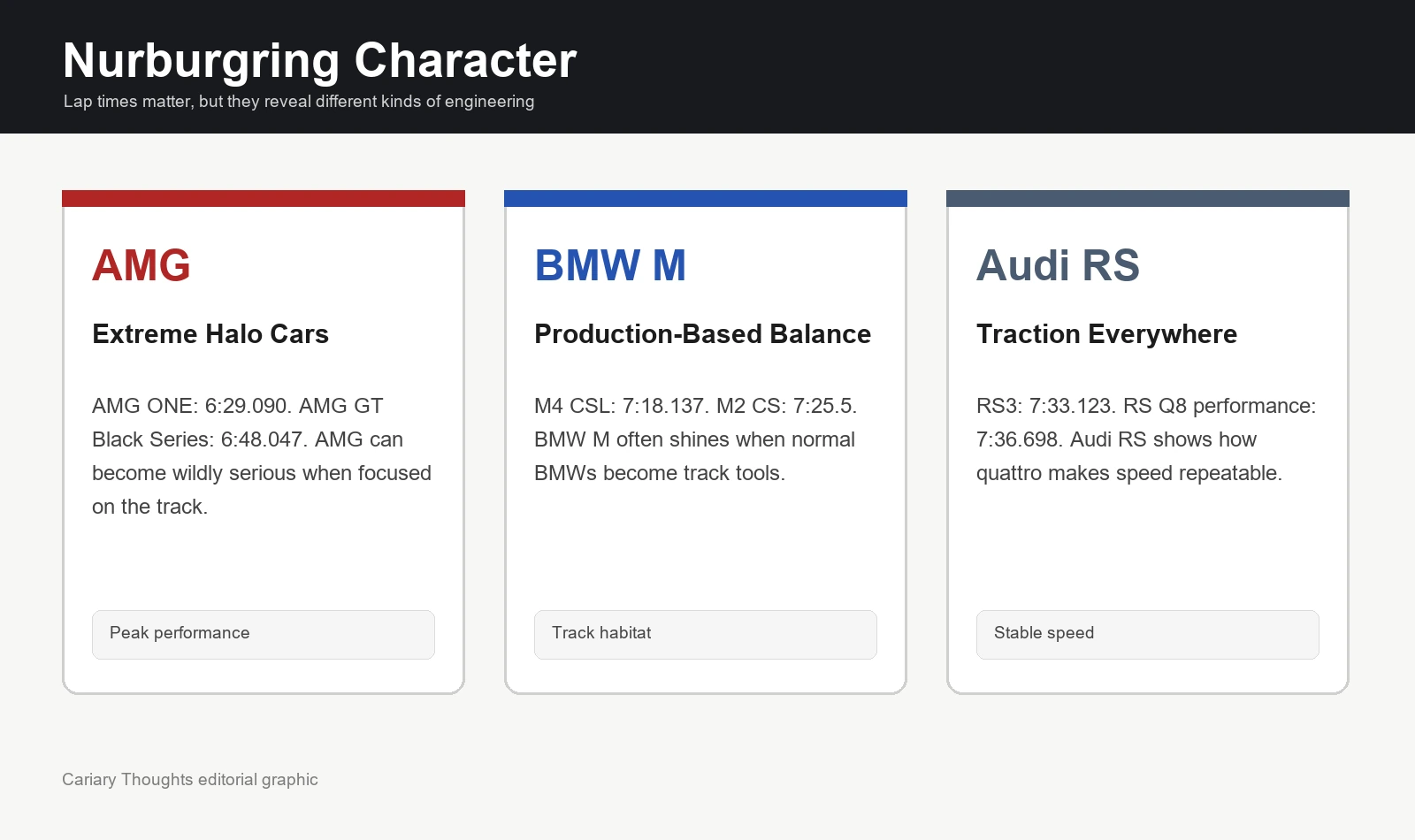
AMG can be outrageous when it builds an extreme track-focused car. The Mercedes-AMG GT Black Series recorded 6:48.047 over the full 20.832-kilometer layout, and the Mercedes-AMG ONE pushed the production-car benchmark to 6:29.090 with Formula 1 hybrid technology for the road.
BMW M looks especially convincing when production-based cars are judged as driver’s tools. BMW cites 7:18.137 for the M4 CSL and 7:25.5 for the newer M2 CS. Those numbers support the old impression that M is very comfortable turning ordinary BMW shapes into circuit-capable cars.
Audi RS shows a different kind of speed. The RS3 recorded 7:33.123 in the compact class, while the RS Q8 performance achieved 7:36.698 as a production SUV benchmark. Those examples fit Audi RS perfectly: traction, stability, and surprising speed from bodies that are not always pure sports cars.
Which Philosophy Is Best?
For engine drama, AMG may be the most emotionally direct answer. The best AMGs feel muscular and theatrical, with torque and sound shaping the entire personality of the car.
For driver involvement and track balance, BMW M has the strongest traditional identity. It is the brand most naturally associated with rotation, steering feel, rear-drive behavior, and the idea that a sedan or coupe can become a precise driving instrument.
For all-weather speed and daily usability, Audi RS may be the most complete real-world answer. It makes huge performance feel accessible and stable, especially when traction and confidence matter more than sideways drama.
So the best choice depends on what “best” means to the driver. If best means emotion, AMG makes sense. If best means chassis conversation, BMW M makes sense. If best means fast in more situations with less effort, Audi RS makes sense.
Common Misconceptions
Misconception one: AMG is only straight-line power. That old image exists for a reason, but modern AMG has produced serious track-focused cars, including the GT Black Series and AMG ONE.
Misconception two: BMW M is always the light, pure driver’s choice. Many modern M cars are heavier, more powerful, and more complex than older icons. The philosophy remains, but the execution has evolved.
Misconception three: Audi RS is only safe and boring. Older RS cars often emphasized stability more than playfulness, but modern systems such as torque vectoring and rear-biased tuning have made some RS models much more agile.
Misconception four: Nürburgring lap time alone decides the best brand. It does not. Lap times are useful, but they depend on tires, weather, driver, vehicle category, aero, power, weight, and the exact purpose of the car.
Cariary Thoughts
Personally, this comparison became more interesting once I stopped asking which badge is simply fastest. The real personality appears when we ask what each brand is trying to make the driver feel.
AMG makes me think of emotion first. BMW M makes me think of control and balance. Audi RS makes me think of confidence and usable speed. None of those ideas is automatically superior. They are different ways of understanding performance.
If I had to describe it very simply, AMG may build the more dramatic car, Audi RS may put the power down better, and BMW M has traditionally treated the racetrack as its natural habitat. That is probably why many enthusiasts instinctively imagine BMW M as the most “circuit-minded” of the three, even when AMG and Audi can produce astonishing lap times too.
One-Line Summary
AMG starts with engine emotion, BMW M starts with chassis balance, and Audi RS starts with quattro usability, so the best one depends on what kind of performance you value most.
FAQ
Is AMG better than BMW M? Not universally. AMG often feels more dramatic and engine-led, while BMW M traditionally focuses more on chassis balance and driver involvement.
Is BMW M better than Audi RS on track? BMW M often has the stronger track-focused identity in production-based cars, but specific lap times depend on the model, tires, setup, and vehicle category.
Is Audi RS better for daily driving? Audi RS often makes a strong daily case because quattro traction, stability, comfort, and practical body styles are central to the brand’s performance identity.
Is the Audi R8 a true supercar? Yes. Unlike RS sedans and wagons, the R8 uses a mid-engine, two-seat sports-car architecture, which places it in true supercar territory.
Which is best: AMG, BMW M, or Audi RS? AMG is best for emotion and power, BMW M for balance and driver involvement, and Audi RS for traction and everyday speed. The best answer depends on the driver.
Related Thoughts
To understand why traction changes a performance car’s personality, read FWD vs RWD vs AWD.
For another motorsport-based learning guide, see How to Watch F1.
Sources
This Thoughts article was prepared from manufacturer histories, official performance pages, and Nürburgring-related releases from Mercedes-AMG, BMW M, Audi, and Nürburgring-context sources.
- Mercedes-AMG history
- Mercedes-AMG about AMG
- BMW M about BMW M GmbH
- BMW M Heritage
- Audi Sport GmbH 40 facts
- BMW M2 CS Nürburgring record press release
- BMW M4 CSL official BMW M article
- Mercedes-AMG ONE Nürburgring record
- Audi RS Q8 performance Nürburgring release
- Audi RS 3 Nürburgring record release

