Quick Summary
Formula 1 can look confusing at first.
The cars are fast, the teams look similar, the helmets change, the TV graphics move quickly, and commentators use words like “undercut,” “DRS,” “compound,” “stint,” “dirty air,” and “track limits” as if everyone was born knowing them.
But F1 becomes much easier once you know what to look for.
You do not need to understand every technical detail from the beginning. The best way to enjoy F1 is to start with a few simple questions:
- Which team or driver do I want to follow?
- How can I recognize them during the race?
- What do the tire colors mean?
- Why do cars pit at different times?
- How are points awarded?
- What do flags and Safety Cars mean?
- Which moments actually change the race?
This guide is not trying to make anyone an F1 expert overnight. Cariary is learning it step by step too. The goal is simpler: let’s make F1 easier to watch, easier to understand, and more fun to follow.
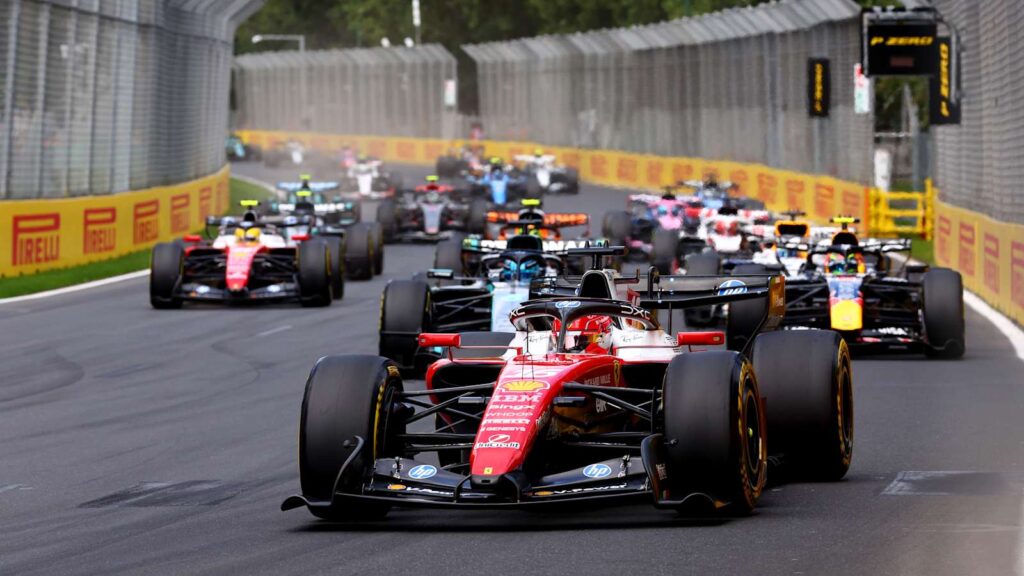
Image: Formula 1 / formula1.com
Why F1 Feels Difficult at First
F1 is not difficult because the basic idea is complicated.
The basic idea is very simple: finish the race faster than everyone else.
What makes F1 hard for beginners is everything happening around that simple idea.
There are 20-plus drivers, different teams, different tire strategies, changing weather, pit stops, penalties, flags, radio messages, Safety Cars, and constant timing gaps on the screen.
Also, unlike many sports, the “ball” is not easy to follow. Every car is moving at huge speed, and many cars can look similar from a distance.
That is why the first step is not memorizing engineering terms. The first step is learning how to visually read the race.
Step 1: Choose a Team or Driver to Follow
The easiest way to enjoy F1 is to pick one or two drivers first.
You do not have to choose the “best” driver. You can choose based on driving style, personality, team history, nationality, car color, or even just whose story interests you.
Cariary personally likes Lewis Hamilton and Max Verstappen.
Hamilton is fascinating because of his long career, race intelligence, smooth driving style, and cultural impact beyond F1. Verstappen is fascinating because of his precision, aggression, and incredible confidence in corners and wheel-to-wheel racing.
Following one driver gives the race a personal storyline. Instead of watching 20 cars randomly move around, you start asking:
- Is my driver gaining time?
- Did they choose the right tire?
- Are they stuck in traffic?
- Did their pit stop work?
- Are they faster than their teammate?
That is when F1 starts to feel alive.
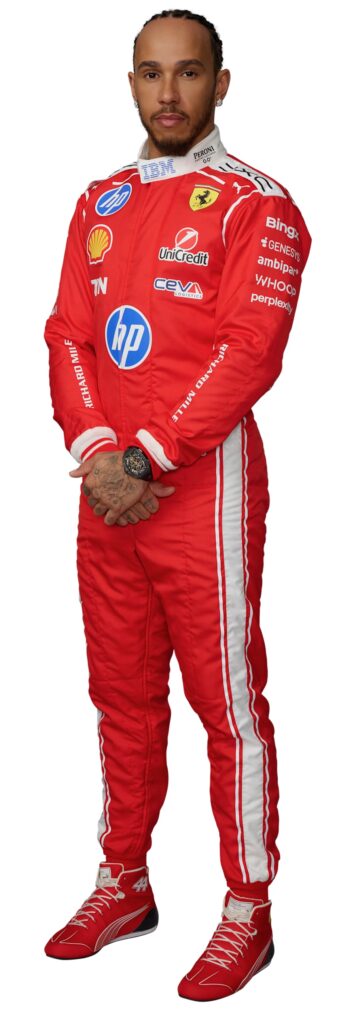
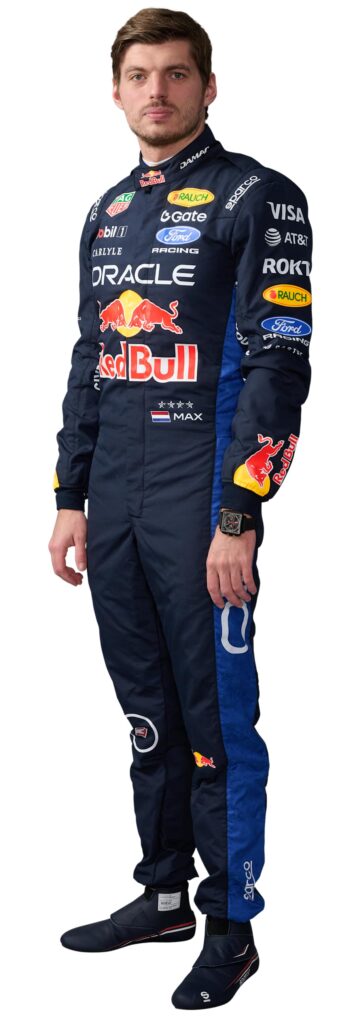
Image credits: Formula 1 / formula1.com; Pirelli Press; Mercedes-Benz Media; Cariary graphics based on publicly available Formula 1 reference information.
Step 2: Learn Team Colors First
When watching F1 on TV, the fastest way to recognize cars is by team color.
Each team has its own livery, which means the paint and visual design of the car. For example, Ferrari is strongly associated with red, McLaren with papaya orange, Mercedes with silver and black, Red Bull with dark blue, and Aston Martin with green.
This matters because drivers from the same team usually drive cars with almost identical liveries. So first, recognize the team. Then learn how to distinguish the two teammates.
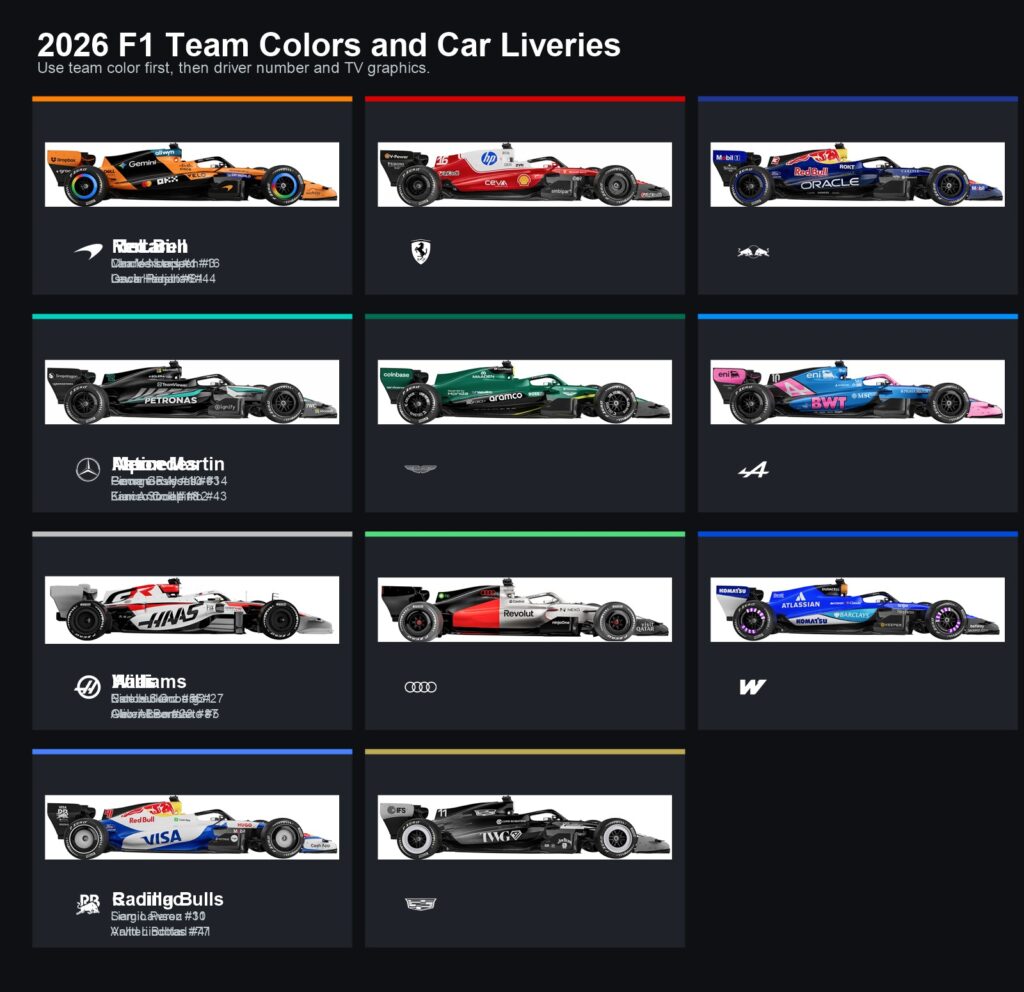
Image credits: Formula 1 / formula1.com; Pirelli Press; Mercedes-Benz Media; Cariary graphics based on publicly available Formula 1 reference information.
Step 3: Use Driver Numbers
Every F1 driver has a permanent racing number.
This number appears on the car and in TV graphics. For beginners, driver numbers are extremely useful because helmets and liveries can be hard to read at speed.
For example, Lewis Hamilton races with number 44, and Max Verstappen races with number 1 when he is the reigning champion.
Once you remember your favorite driver’s number, race broadcasts become much easier to follow.
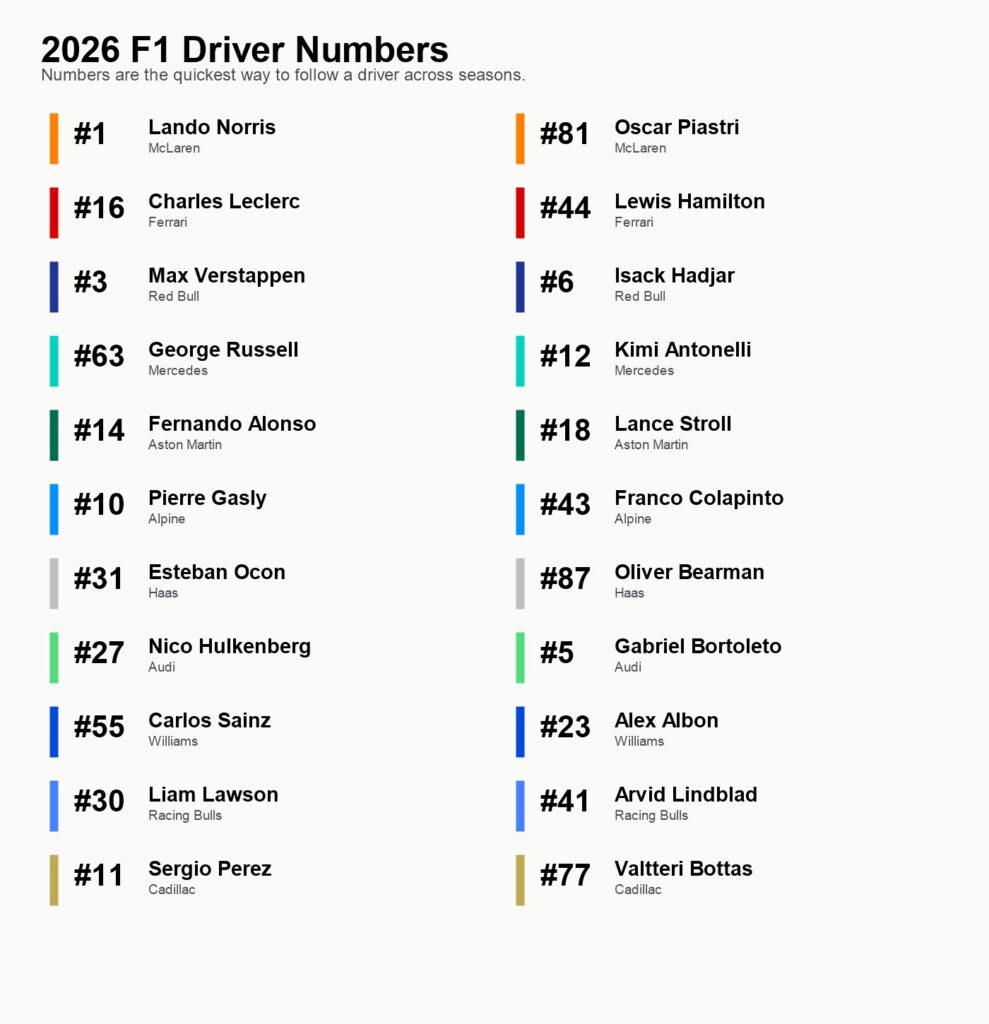
Image credits: Formula 1 / formula1.com; Pirelli Press; Mercedes-Benz Media; Cariary graphics based on publicly available Formula 1 reference information.
Step 4: Understand TV Graphics
F1 TV graphics can look intimidating, but the most important part is usually the timing tower on the left side of the screen.
It normally shows:
- Current race position
- Driver abbreviation
- Gap to the car ahead
- Tire compound
- Pit stop information
- Penalties or warnings
The “gap” is especially important. If the gap between two cars is falling, the car behind is catching up. If the gap is growing, the car ahead is pulling away.
So even if the camera is not showing your favorite driver, the timing tower tells you their story.
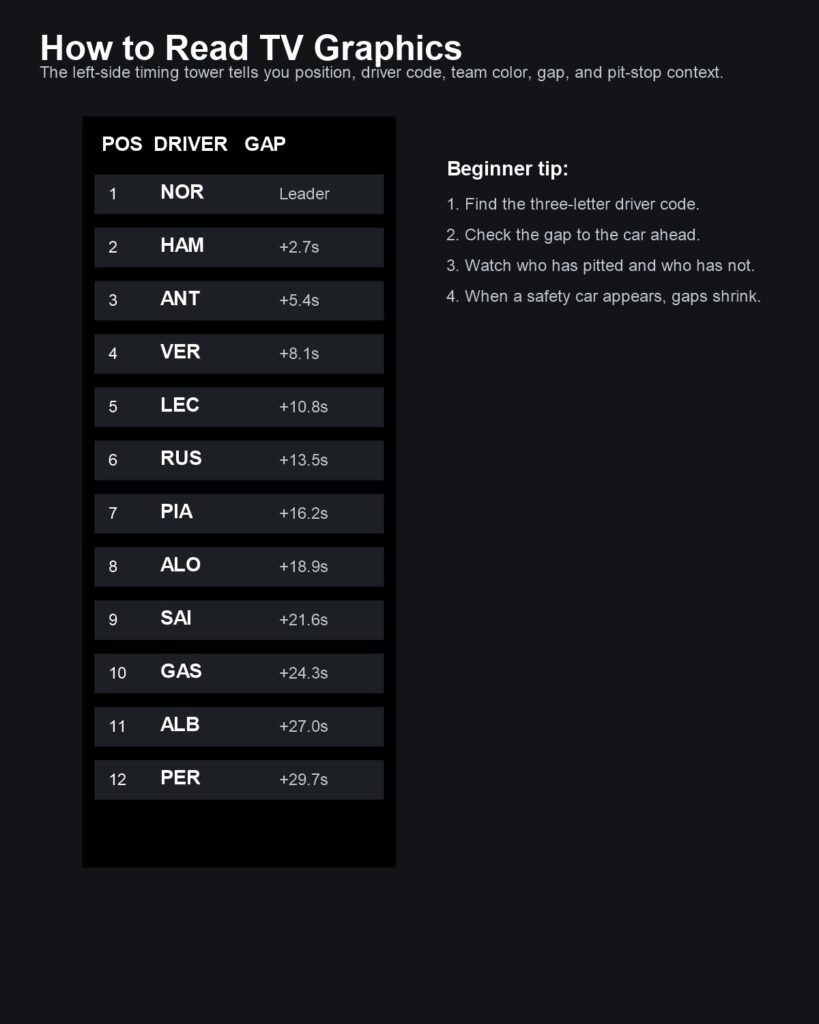
Image credits: Formula 1 / formula1.com; Pirelli Press; Mercedes-Benz Media; Cariary graphics based on publicly available Formula 1 reference information.
Step 5: Helmets and T-Cams Help Too
Because two teammates drive very similar cars, F1 uses small visual details to help separate them.
One useful detail is the T-cam, the camera pod above the driver’s head. Teammates often use different T-cam colors, commonly black for one driver and yellow or another color for the other.
Helmet design also matters. Some drivers keep a very recognizable helmet style, while others change special designs for specific races.
At first, this feels like too much. But after a few races, you naturally begin to recognize the drivers faster.
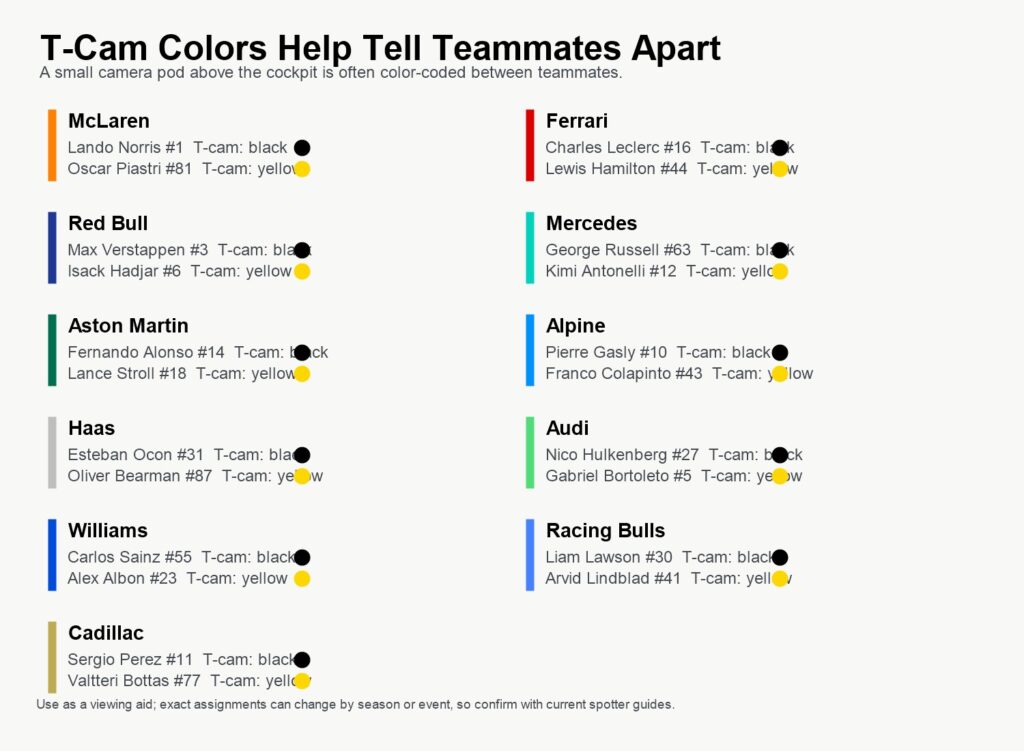
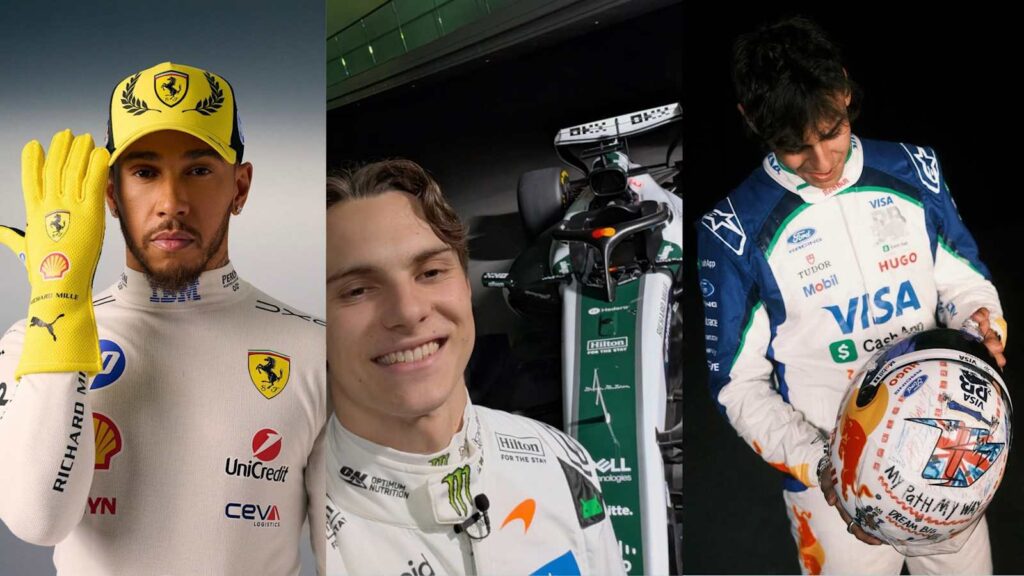
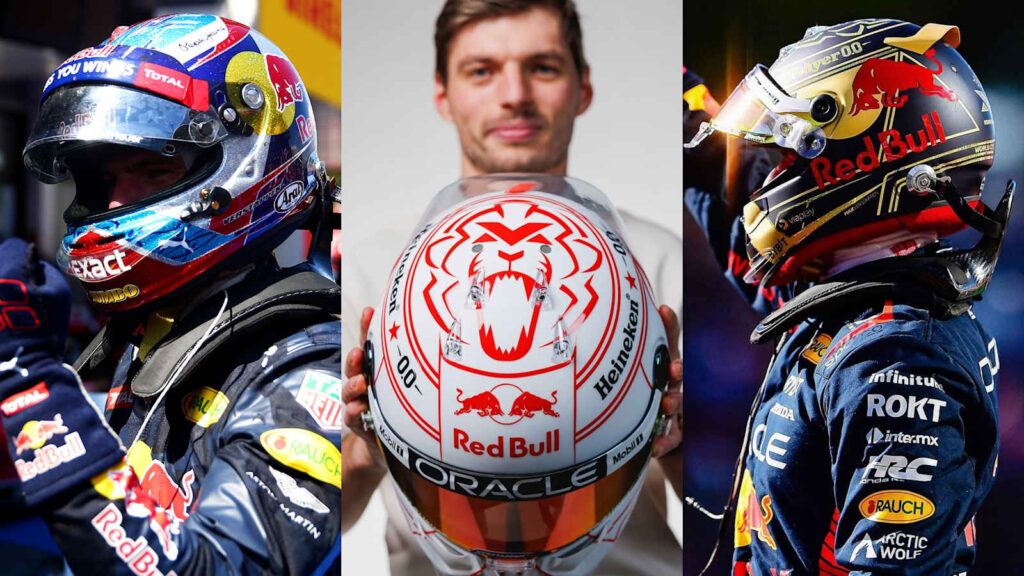

Image credits: Formula 1 / formula1.com; Pirelli Press; Mercedes-Benz Media; Cariary graphics based on publicly available Formula 1 reference information.
How an F1 Season Works
An F1 season is made up of multiple Grand Prix weekends around the world.
As of the 2026 Formula 1 calendar, the season has 24 races, held across different countries and circuits. Each Grand Prix has its own character. Some circuits are narrow street tracks, some are high-speed permanent race tracks, and some are famous for heat, rain, altitude, or tire wear.
A normal F1 weekend usually includes:
- Practice sessions
- Qualifying
- Race
Some weekends also include a Sprint format, which adds another shorter race and extra points.
The main race usually happens on Sunday, and the result determines how many championship points each driver and team earns.
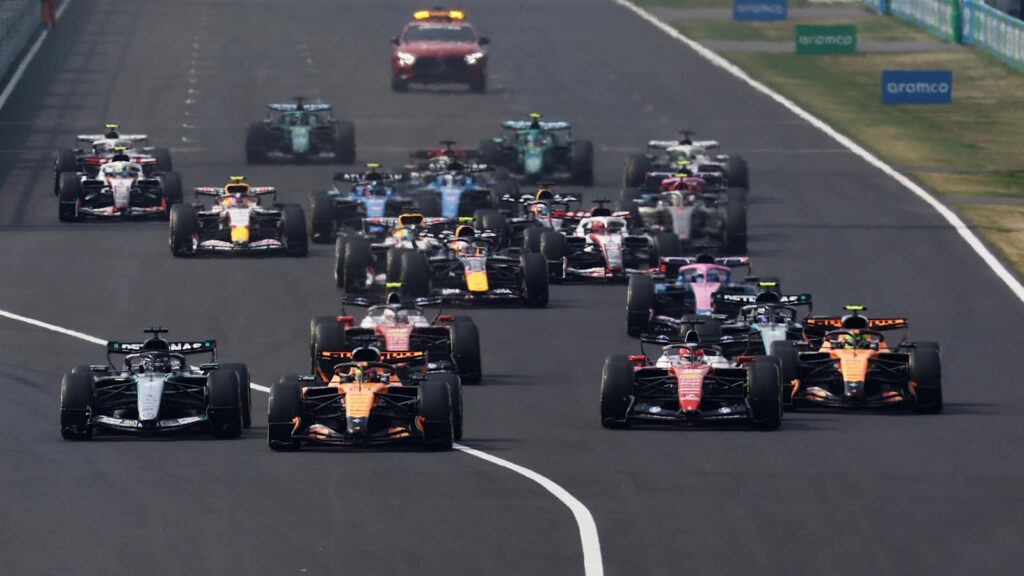
Image credits: Formula 1 / formula1.com; Pirelli Press; Mercedes-Benz Media; Cariary graphics based on publicly available Formula 1 reference information.
How F1 Points Work
F1 has two championships:
The Drivers’ Championship is for individual drivers.
The Constructors’ Championship is for teams.
In a Grand Prix, the top 10 finishers score points. The winner gets the most points, and the points decrease down to 10th place.
This is why finishing 7th or 8th can still be very important, especially for midfield teams. Not every race is about winning. Sometimes a great result means scoring a few points when the car was not expected to be competitive.
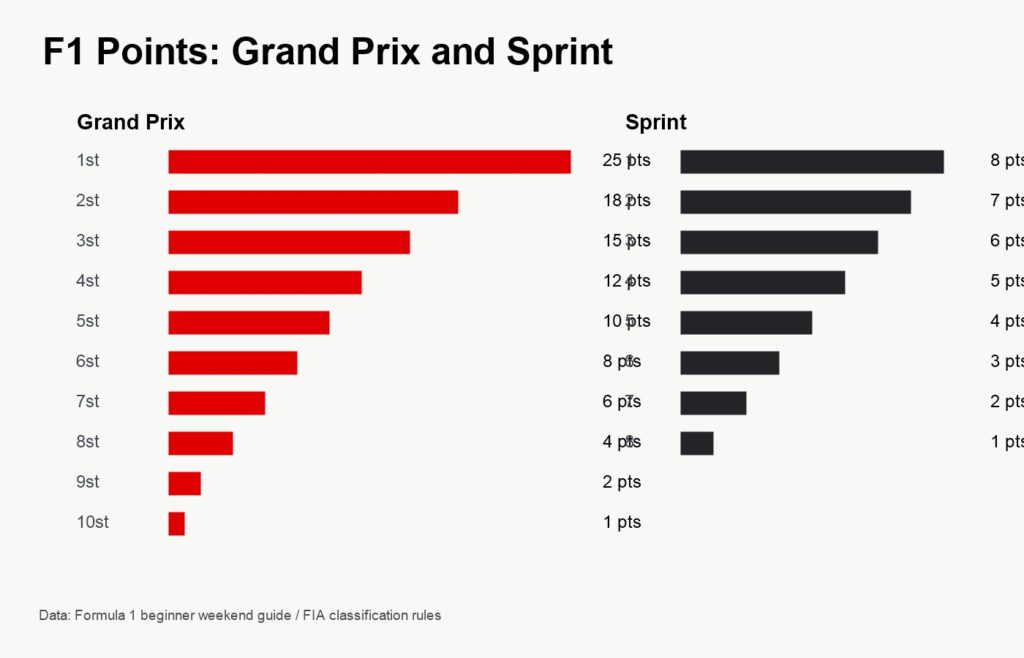
Image credits: Formula 1 / formula1.com; Pirelli Press; Mercedes-Benz Media; Cariary graphics based on publicly available Formula 1 reference information.
Current Drivers: What Are Their Strengths?
Every F1 driver is fast. That sounds obvious, but it is important. The difference between “good” and “great” in F1 can be tiny.
Still, each driver tends to have recognizable strengths.
Max Verstappen is known for extreme confidence under braking, sharp corner entry, and relentless race pace. He often looks especially strong when attacking or defending in corners.
Lewis Hamilton is known for race intelligence, tire management, wet-weather skill, and the ability to stay calm under pressure.
Charles Leclerc is famous for qualifying speed and emotional, attacking laps.
Lando Norris is smooth, quick, and increasingly strong over race distance.
Oscar Piastri is calm, precise, and unusually composed for a younger driver.
George Russell is consistent, analytical, and strong in difficult race conditions.
Fernando Alonso is one of the smartest racers on the grid, with excellent positioning and defensive racecraft.
Carlos Sainz is balanced, strategic, and good at reading race situations.
The more you watch, the more these differences become visible. F1 is not just car versus car. It is also personality versus personality, decision versus decision.
Why Do F1 Tires Have No Grooves?
Dry F1 tires are called slicks.
They have no grooves because the goal is to put as much rubber as possible on the road. More rubber contact means more grip on a dry track.
This is very different from normal road tires. Road tires need grooves to push water away during rain. But on a dry race track, grooves would reduce the contact patch and lower grip.
F1 slick tires are usually divided into compounds, such as soft, medium, and hard. A softer tire gives more grip but wears faster. A harder tire lasts longer but may be slower.
This creates strategy.
Do you use a fast tire now and pit earlier? Or use a slower tire that lasts longer and avoid traffic later?
That is one of the reasons F1 is not just about driving fast. It is also about choosing the right tire at the right time.
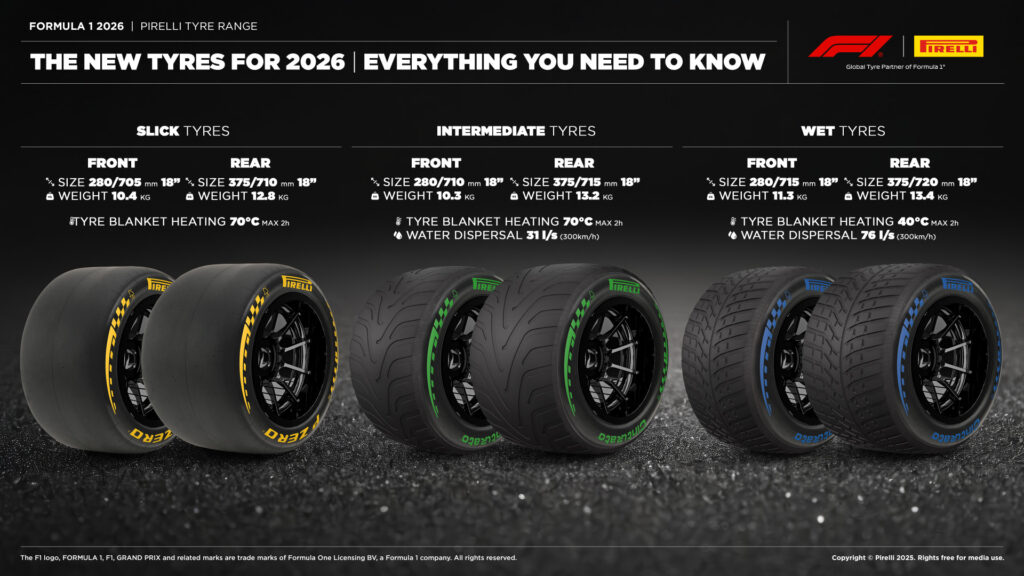
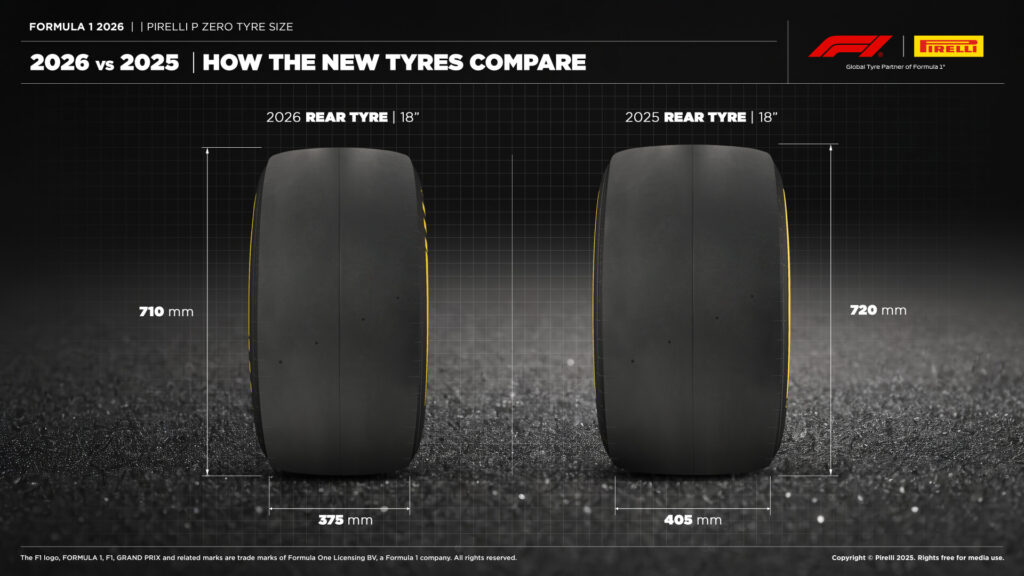
Image credits: Formula 1 / formula1.com; Pirelli Press; Mercedes-Benz Media; Cariary graphics based on publicly available Formula 1 reference information.
When Do F1 Cars Change Tires?
There is no fixed rule like “change tires after three laps.”
Teams decide pit timing based on many things:
- Tire wear
- Lap time drop-off
- Track temperature
- Traffic
- Safety Car possibility
- Weather
- Rival strategy
- Mandatory tire compound rules
Sometimes a team pits early to gain an advantage. This is called an undercut.
An undercut happens when a driver pits before a rival, gets fresh tires, drives faster laps, and jumps ahead after the rival eventually pits.
The opposite idea is an overcut. This happens when a driver stays out longer, uses clear air, or benefits from track position to come out ahead later.
Pit stops look simple from the outside, but they are one of the biggest strategic weapons in F1.
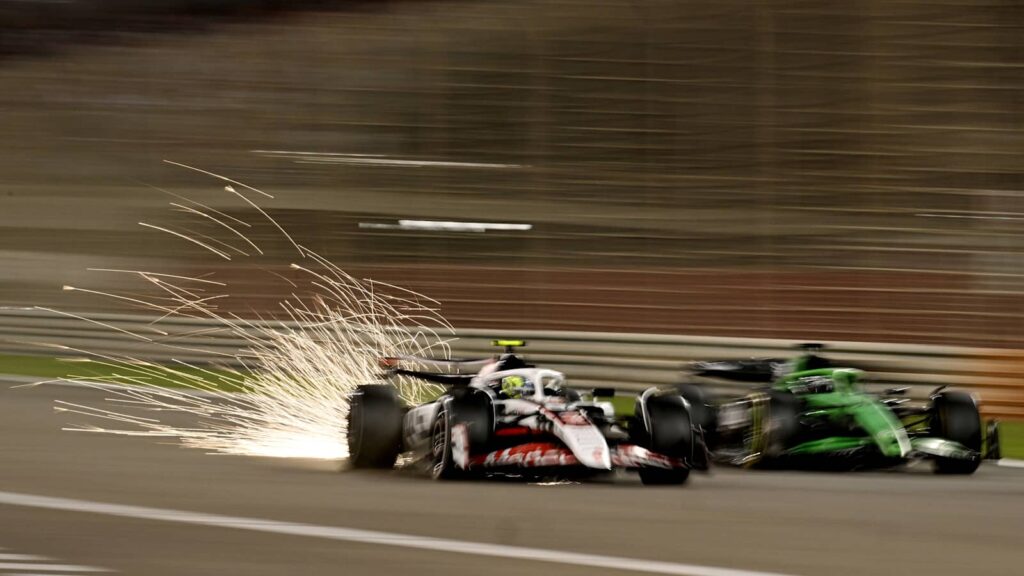
Image credits: Formula 1 / formula1.com; Pirelli Press; Mercedes-Benz Media; Cariary graphics based on publicly available Formula 1 reference information.
What About Rain Tires?
F1 has special wet-weather tires.
There are usually two main types:
Intermediate tires are used when the track is damp or lightly wet. They have grooves, but not as deep as full wet tires.
Full wet tires are used when there is heavy rain or standing water. They have deeper grooves to move more water away from the tire.
This is why tire choice becomes dramatic when the weather changes. If a driver switches to dry slicks too early, they may slide off. If they stay on wet tires too long, they may lose several seconds per lap.
Rain turns F1 into a judgment game.
Important F1 Terms Beginners Should Know
DRS means Drag Reduction System. It opens part of the rear wing on certain straights, reducing drag and helping the car go faster for overtaking.
Dirty air is turbulent air behind another car. It makes the following car lose aerodynamic grip, especially in corners.
Clean air means driving without another car directly ahead. The car gets smoother airflow and usually performs better.
Undercut means pitting earlier than a rival to use fresh tires and gain time.
Overcut means staying out longer and trying to gain time before pitting.
Stint means a section of the race between pit stops.
Compound means tire type, such as soft, medium, hard, intermediate, or wet.
Track limits means the legal boundary of the track. If drivers go beyond it too often, they can receive penalties.
Box means pit now. When a team says “box, box,” they are calling the driver into the pit lane.
Lift and coast means lifting off the throttle before braking to save fuel, brakes, or temperatures.
Degradation means tires losing performance over time.
These terms are repeated constantly during broadcasts. Once they become familiar, the race becomes much easier to understand.
What Do F1 Flags Mean?
F1 flags are like the track’s language.
A green flag means normal racing.
A yellow flag means danger ahead, slow down, and no overtaking.
A red flag means the session is stopped.
A blue flag tells a slower car that a faster car is coming through, usually when being lapped.
A chequered flag means the session or race is finished.
For beginners, the most important ones are yellow, red, blue, and chequered. These flags often explain why drivers suddenly slow down, stop attacking, or lose time.
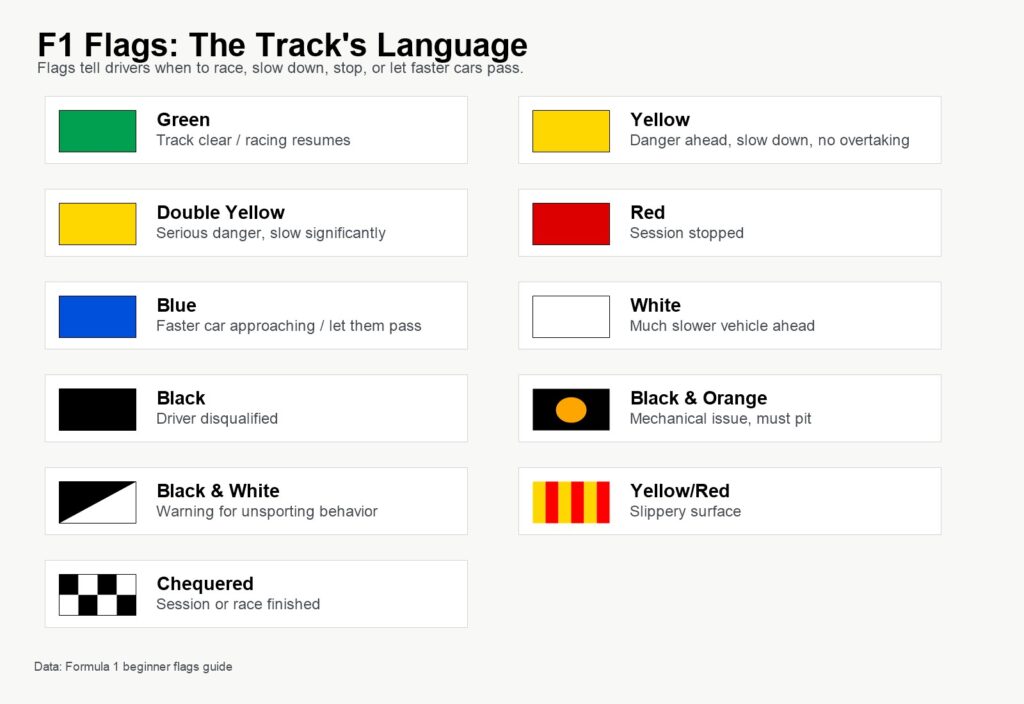
Image credits: Formula 1 / formula1.com; Pirelli Press; Mercedes-Benz Media; Cariary graphics based on publicly available Formula 1 reference information.
What Happens at the Start?
In many racing stories, we imagine a flag being waved at the start.
In modern F1, the race start is controlled by lights.
The cars line up on the grid. Red lights illuminate one by one. When the lights go out, the race begins.
The start is one of the most intense moments in F1 because every driver is heavy with fuel, tires are not fully settled, and everyone is fighting for position into Turn 1.
A good start can change the race immediately. A bad start can ruin a strategy before the first lap is even over.
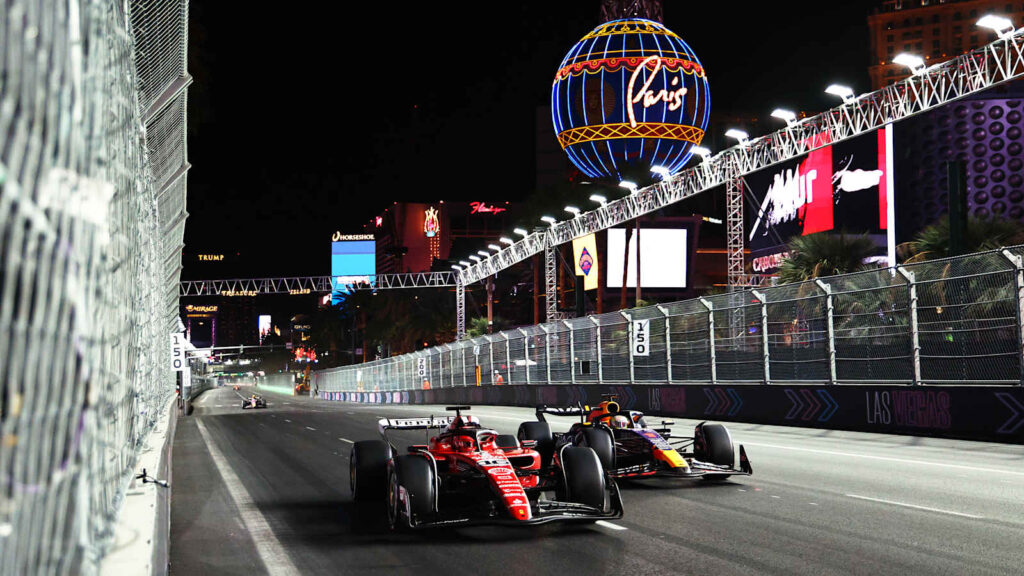
Image credits: Formula 1 / formula1.com; Pirelli Press; Mercedes-Benz Media; Cariary graphics based on publicly available Formula 1 reference information.
What Is the Safety Car?
The Safety Car is used when there is danger on track but the race does not need to be fully stopped.
For example, if a car crashes, debris is on track, or conditions become unsafe, the Safety Car may come out. Drivers must slow down and follow it in order.
This bunches the field together, which can completely change a race.
A driver who had a big lead may lose that advantage. A driver who needs a pit stop may get a cheaper stop because everyone is driving slowly.
That is why commentators become excited when a Safety Car appears. It is not just a safety procedure. It can reset the race.

Image credits: Formula 1 / formula1.com; Pirelli Press; Mercedes-Benz Media; Cariary graphics based on publicly available Formula 1 reference information.
How F1 Connects to Engine Technology
This guide is mainly about how to watch F1, but engine technology is a big part of why the sport is fascinating.
Modern F1 cars do not use huge naturally aspirated engines like many people imagine. Today’s F1 power units are smaller, turbocharged, hybrid systems designed around efficiency, energy recovery, and extreme performance.
That is a great topic to connect with Cariary’s previous Thoughts article:
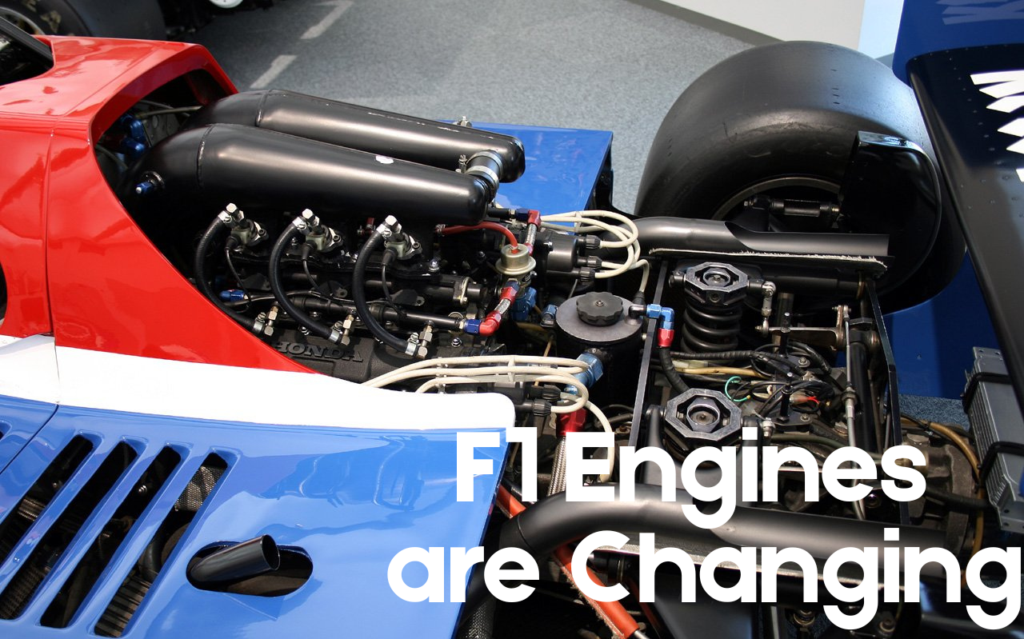
Once you understand how F1 engines changed, current racing becomes easier to appreciate. The sport is not only about speed. It is also about energy, heat, battery deployment, fuel efficiency, and how engineers extract performance from strict regulations.
Common Misconceptions
“All F1 cars are basically the same.”
They look similar because the rules are strict, but they are not the same.
Aerodynamics, suspension setup, tire behavior, cooling, power unit integration, and strategy can make cars behave very differently.
“The fastest car always wins.”
Not always.
Strategy, tire wear, qualifying position, weather, pit stops, penalties, and Safety Cars can all change the result.
“Pit stops happen at fixed lap numbers.”
No. Pit stops are strategy decisions.
Teams react to tire performance, rivals, traffic, weather, and race situation.
“Rain tires are just normal tires with grooves.”
Not exactly.
F1 wet tires are designed to clear water at racing speeds. They are highly specialized tools for very specific conditions.
“You need to understand engineering to enjoy F1.”
Not at all.
Engineering makes F1 deeper, but the sport is enjoyable even if you start with simple things: drivers, teams, tires, overtakes, and strategy.
Cariary Thoughts
At first, F1 can feel strangely distant.
The cars look similar. The drivers are hidden behind helmets. The screen is full of abbreviations. The commentators talk quickly. And if you are new, it can feel like everyone else already knows the language.
But once I started looking at F1 as a story rather than just a race, it became much easier.
A race is not only about who is first. It is about who is catching whom, who is saving tires, who is stuck behind traffic, who has a smarter pit strategy, and who can stay calm when the Safety Car changes everything.
I also realized that choosing a driver to follow makes a huge difference. Watching Hamilton is different from watching Verstappen. Watching Ferrari is different from watching McLaren or Mercedes. Every team and driver carries a different rhythm, pressure, and personality.
So if someone is new to F1, I would not say, “Study all the rules first.”
I would say: pick one driver, learn their car color and number, watch the timing gaps, and listen for tire strategy.
That is enough to start.
The deeper parts will come naturally.
One-line Summary
F1 becomes much easier to enjoy when you learn how to recognize the teams, follow one or two drivers, understand tires and pit stops, and read the race through timing, flags, and strategy.
FAQ
How should a beginner start watching F1?
Start by choosing one team or driver to follow. Then learn their car color, driver number, teammate, and basic tire strategy.
How can I tell F1 drivers apart?
Use team livery first, then driver number, helmet design, and T-cam color. TV graphics also show driver abbreviations and positions.
How many races are in an F1 season?
The 2026 Formula 1 calendar has 24 races across different countries and circuits.
What does DRS mean in F1?
DRS means Drag Reduction System. It opens part of the rear wing on certain straights to reduce drag and help overtaking.
Why do F1 tires have no grooves?
Dry F1 tires are slicks. They have no grooves because maximum rubber contact gives more grip on a dry track.
When do F1 cars change tires?
There is no fixed lap number. Teams pit based on tire wear, pace, traffic, weather, Safety Car chances, and rival strategy.
What is an undercut?
An undercut is when a driver pits earlier than a rival, uses fresh tires to set faster laps, and tries to come out ahead after the rival pits.
What does the Safety Car do?
The Safety Car slows and controls the field when the track is unsafe, often after crashes, debris, or dangerous conditions.
What are the most important F1 flags?
For beginners, the key flags are yellow, red, blue, green, and chequered. They tell drivers when to slow down, stop, let faster cars pass, resume racing, or finish the race.
Do I need to understand F1 engines to enjoy races?
No. But learning about F1 engine evolution helps you understand why modern F1 is about energy recovery, turbo hybrid systems, and efficiency as much as raw speed.
Data Reference Date
August 6, 2026