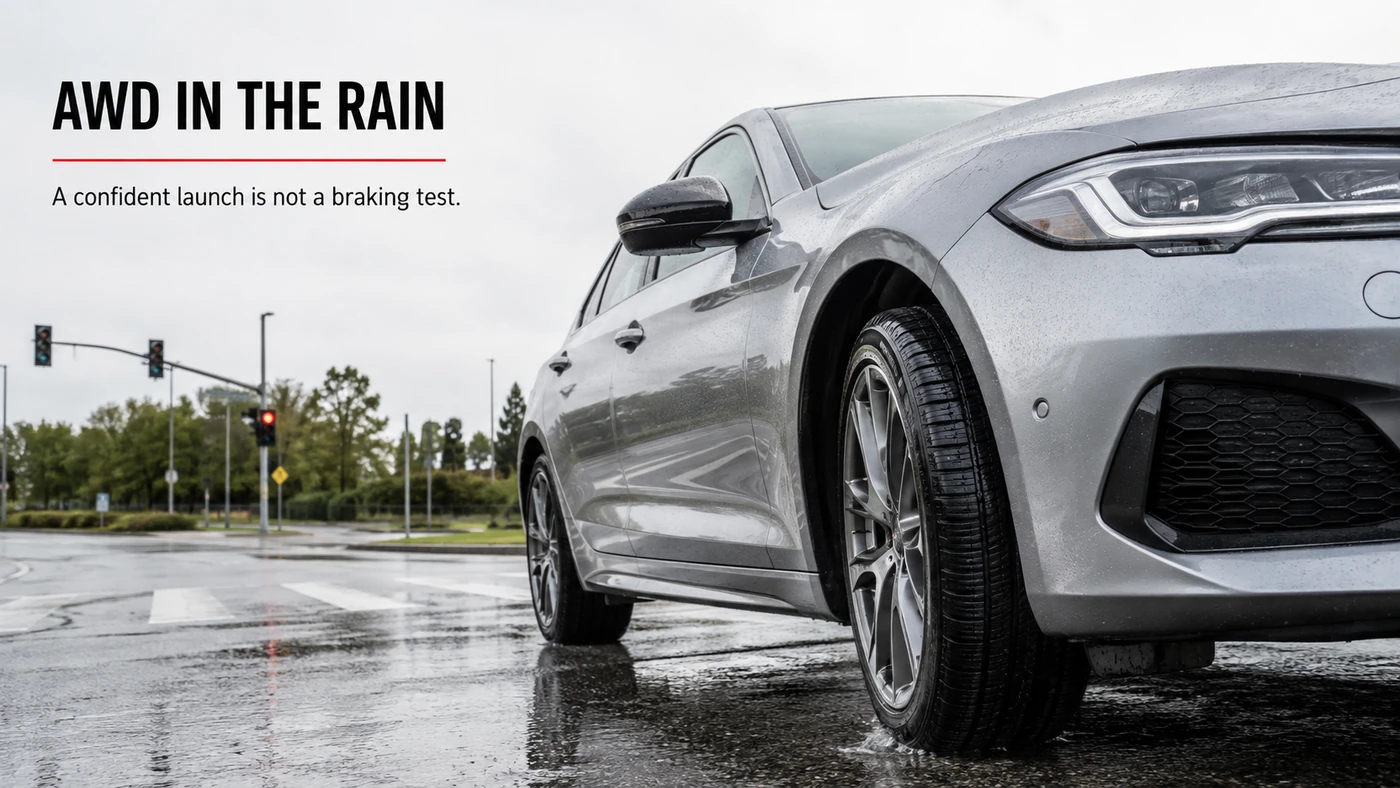
AWD in the Rain can feel wonderfully reassuring. You pull away from a wet junction, the car gathers speed with little fuss, and the tires seem to find traction without the struggle you remember from another car. It is easy to turn that feeling into a much bigger conclusion: this must be safer at everything.
That is the first question in Cariary’s new Car Myths series. Not whether all-wheel drive is useful, because it clearly can be, but whether the benefit we notice during acceleration carries over to braking, cornering and standing water.
The short answer is not automatically. AWD helps the drivetrain use available grip across more driven wheels. It does not give the rubber a new ability to grip wet asphalt, and it cannot substitute for suitable tires, sensible speed or space to stop.
Quick Summary: AWD in the Rain
- The clearest benefit is acceleration traction: more driven tires can share the work of putting power down.
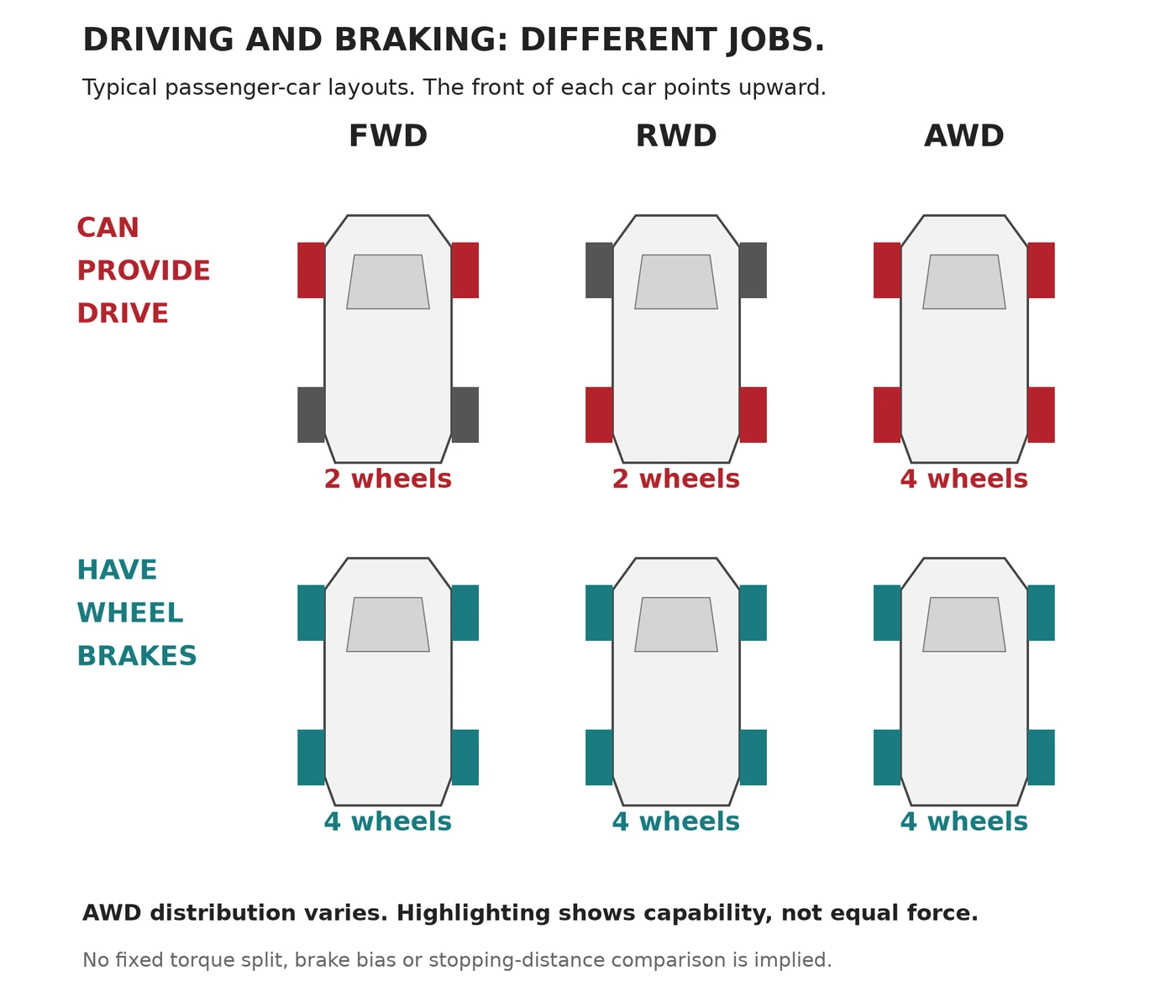
- Braking is a different question: FWD, RWD and AWD passenger cars already use brakes at all four wheels.
- Cornering benefits depend on the complete system: torque distribution can help balance and corner exits, but tire limits remain.
- Hydroplaning is not prevented by an AWD badge: water, speed, tires and road conditions still govern contact.
- The useful priority is a combination: appropriate tires and careful driving first, with AWD helping where its capabilities apply.
1. Why AWD Feels Safer: The Benefit Is Real
On a two-wheel-drive car, propulsion comes through two tires. With AWD, both axles can contribute. When available traction limits acceleration, spreading the required driving force across more tires can reduce how hard each driven tire must work.
This does not mean every AWD vehicle continuously divides engine torque into four equal portions. Front-to-rear distribution, differential behavior and the circumstances in which another axle connects vary by design. An electric AWD vehicle may distribute drive torque through separate motors rather than a mechanical shaft between axles.
Still, the practical advantage can be easy to feel. A wet uphill start or an uneven-grip junction may produce less wheelspin and a more composed departure. There is a genuine engineering reason behind that confidence.
Where the myth begins
The mistake comes when “it found traction easily while accelerating” becomes “the road has plenty of grip for everything.” A smooth launch has tested one demand under one set of conditions. It has not measured the distance needed for an emergency stop at a higher speed.
Modern AWD vehicles also integrate traction and stability controls. The driver experiences one coordinated response, not separate reports from the drivetrain, brakes and software. It is understandable that the AWD badge gets credit for the entire result.
This is a plausible way confidence can become misplaced, not a claim that every AWD driver takes more risks. The lesson is about interpreting the feedback a car gives us.
2. Acceleration Traction Is Not Braking Grip
FWD does not mean front-wheel braking. RWD does not mean rear-wheel braking. Typical modern passenger cars in both groups have brakes at all four wheels, just like AWD cars.
The brake system produces torque that resists wheel rotation. The tire-road contact then transmits the force that slows the vehicle. Adding another driven axle does not automatically improve that contact during an emergency stop.
ABS, the anti-lock braking system, modulates pressure to control impending wheel locking. It helps manage the available tire-road interaction; its intervention is not proof that the car has discovered extra grip. Nor is tire friction a single unchanging number: it varies with the tire, loading, surface, water and operating conditions.
A fair thought experiment
Imagine two hypothetical cars travelling at the same speed on the same wet surface. Hold the tires, their condition and temperature, tire pressures, vehicle mass, load distribution, brakes and control behavior constant. Change only which wheels can receive propulsion.
There is no new tire-road friction merely because one car is labeled AWD. This is a conceptual comparison, not a claim that two production variants will record exactly the same stopping distance. Real AWD versions can differ in mass, tires, suspension, control calibration and other details.
The drivetrain is not irrelevant to every deceleration event, either. Engine braking, differential behavior and regenerative braking can affect how slowing forces are managed. A dual-motor EV may have different regenerative capabilities from a single-motor version. None of that establishes a universal emergency-braking advantage for an AWD badge.
Now return to the junction and ask both cars to accelerate on limited grip. Here, using another axle can make a direct difference. Starting and stopping are different tests of the complete vehicle.
Our Brake and Tire Basics guide explores the distinction between braking torque, heat capacity and tire grip in more detail.
3. The Tires Can Matter More Than the Driven Wheels
For a wet-road stop, tire compound, tread design, tread depth, condition and correct inflation all matter. So do water depth, road texture and speed. Grooves help accommodate and evacuate water, while the rubber and tread structure determine how the tire behaves in contact with the surface.
Deeper-looking grooves alone do not rank every tire’s wet performance. A suitable tire is a complete design, and a premium price or a sporty tread appearance is not a substitute for relevant test evidence. Michelin’s tire-maintenance explanation connects condition and maintenance with wet-road control.
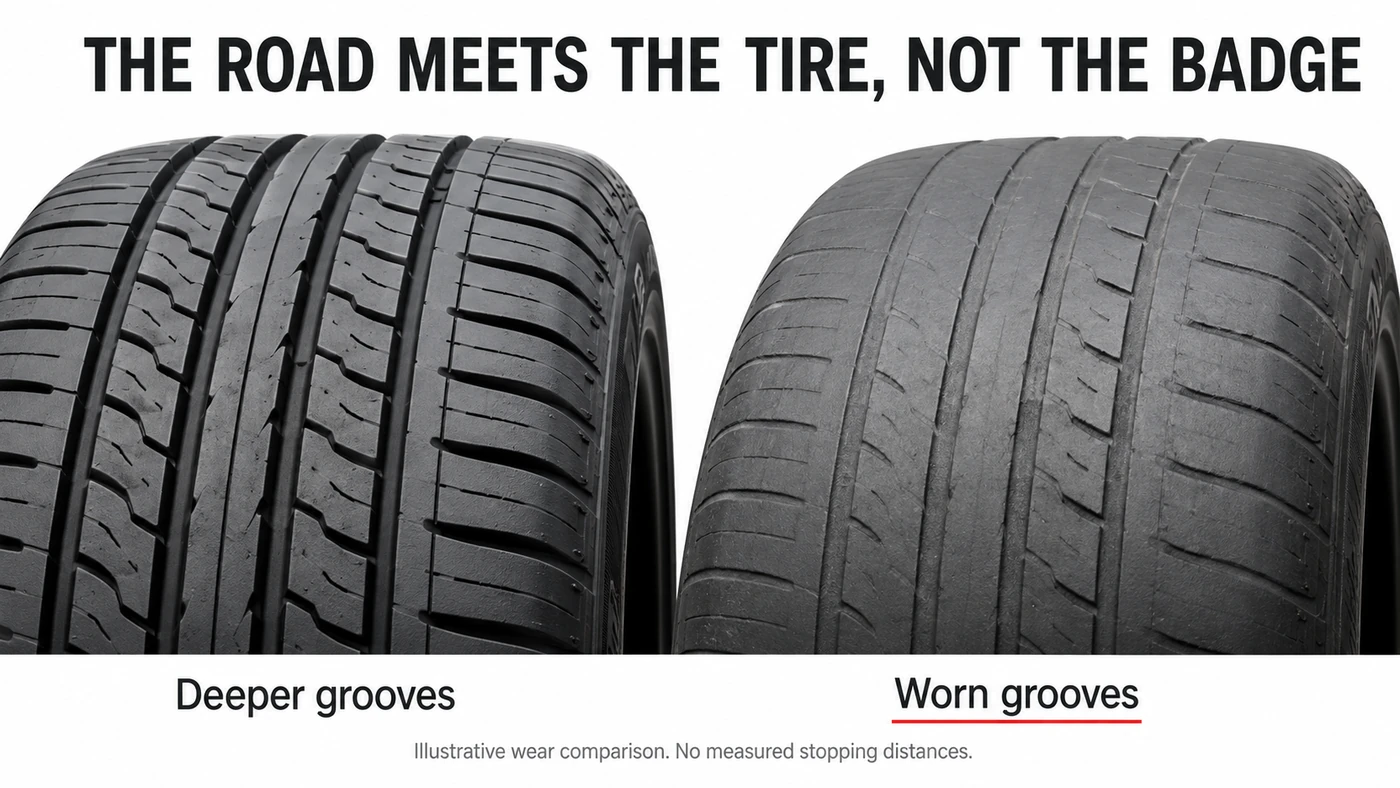
Good tires on FWD versus poor tires on AWD
Consider an FWD car with suitable, well-maintained tires that perform well in the relevant wet conditions. Compare it with an AWD car on worn, damaged or inappropriate tires.
The FWD car can stop and corner more effectively. That is not a universal ranking of two unspecified vehicles, and we are not inventing a stopping-distance result. It illustrates why AWD cannot compensate for inadequate tire performance at the contact patch, the small region where the tire meets the road.
This is also why “old,” “cheap” and “bad” should not be treated as interchangeable labels. Age, storage, damage, wear and actual performance need proper assessment. A budget tire is not automatically unsafe, and an expensive tire is not automatically appropriate for every temperature or surface.
A good tire on a 2WD car can matter more than AWD on a bad tire. The important comparison is capability in the conditions, not the prestige of either badge.
4. Cornering: Sharing the Work Does Not Remove the Limit
A tire asked to generate more driving or braking force has less room for additional sideways force near its combined limit. The familiar friction circle is a simplified picture of this relationship. Real tires do not behave as perfect circles, but the idea helps explain why accelerating, braking and turning cannot be treated as unlimited, independent abilities.
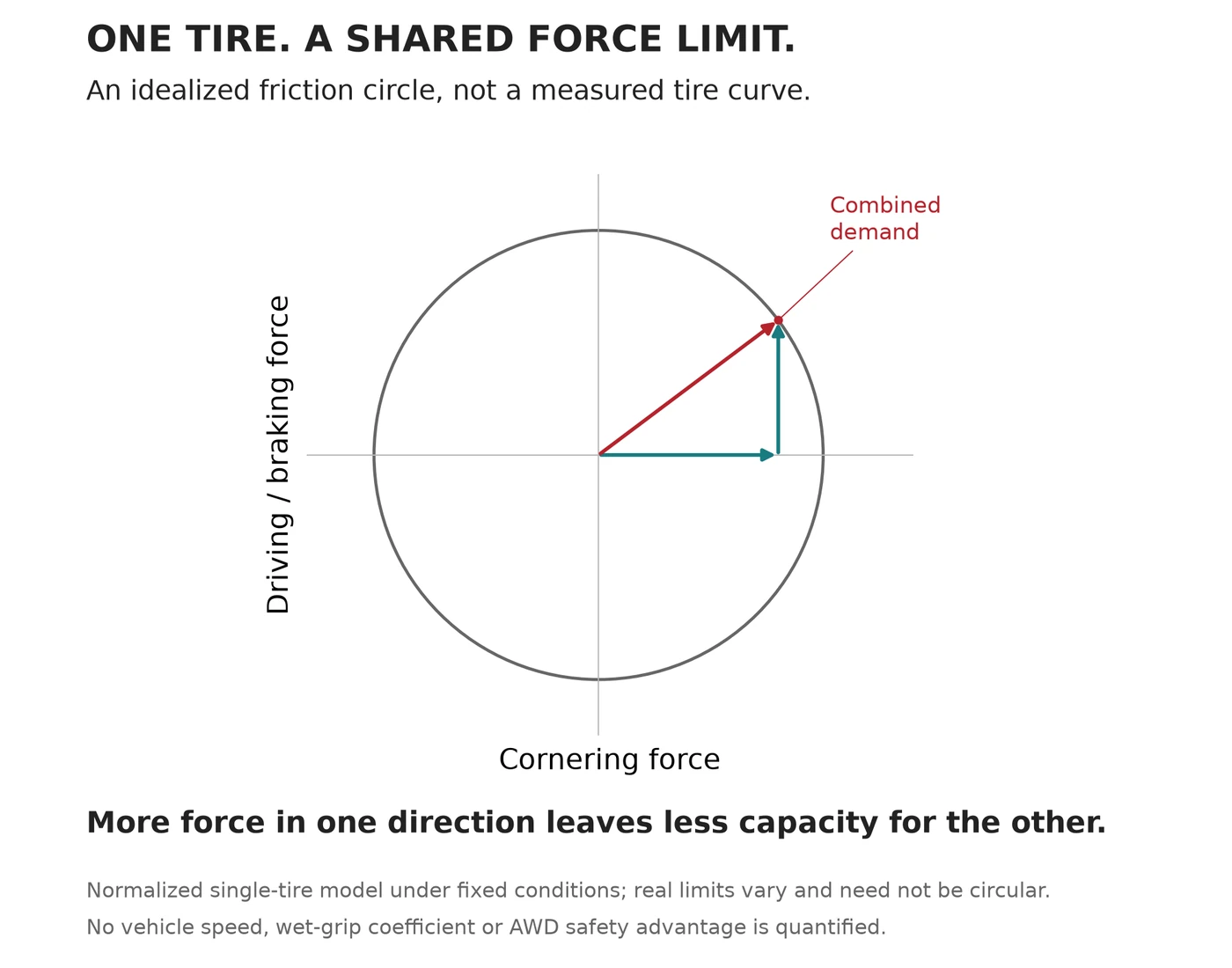
AWD can redistribute propulsion demand between axles. Some systems also work with active differentials, individual-wheel braking or torque vectoring, which changes wheel-to-wheel torque to influence vehicle motion. These can help the car use available tire capability and improve its behavior under particular conditions.
That matters especially on a corner exit, when the car is turning and the driver requests more drive torque. It does not mean that entering the same corner too quickly becomes safe. The front tires can still run out of cornering capability and the car can run wide; the rear can also slide if its demands exceed what is available.
Individual-wheel brake intervention is not exclusive to AWD. A well-developed two-wheel-drive car can also have effective stability control and differential-related functions. The hardware names must not hide the role of tires, geometry and calibration.
What about an emergency lane change?
This is another complete-vehicle test. Speed, tires, mass distribution, suspension, steering input and stability-control tuning all affect the response. AWD or torque-vectoring features may help in some circumstances, but AWD alone cannot establish which car will perform the maneuver better.
The useful distinction is between managing available forces and increasing the limit simply by adding driven wheels. The first can be a valuable engineering achievement. The second is the myth we need to avoid.
5. Hydroplaning: The Contact Can Disappear
Hydroplaning, also called aquaplaning, occurs when water support reduces or removes the tire’s contact with the road. It can be partial, affect one tire before others, or become more extensive. It is not necessary for all four tires to lose contact at once before vehicle control is affected.
The risk depends on the interaction of speed, water depth, road surface, tire design, wear, inflation and loading. There is no single universal speed below which every tire is immune. Michelin’s wet-road driving guide explains why water evacuation and speed matter.
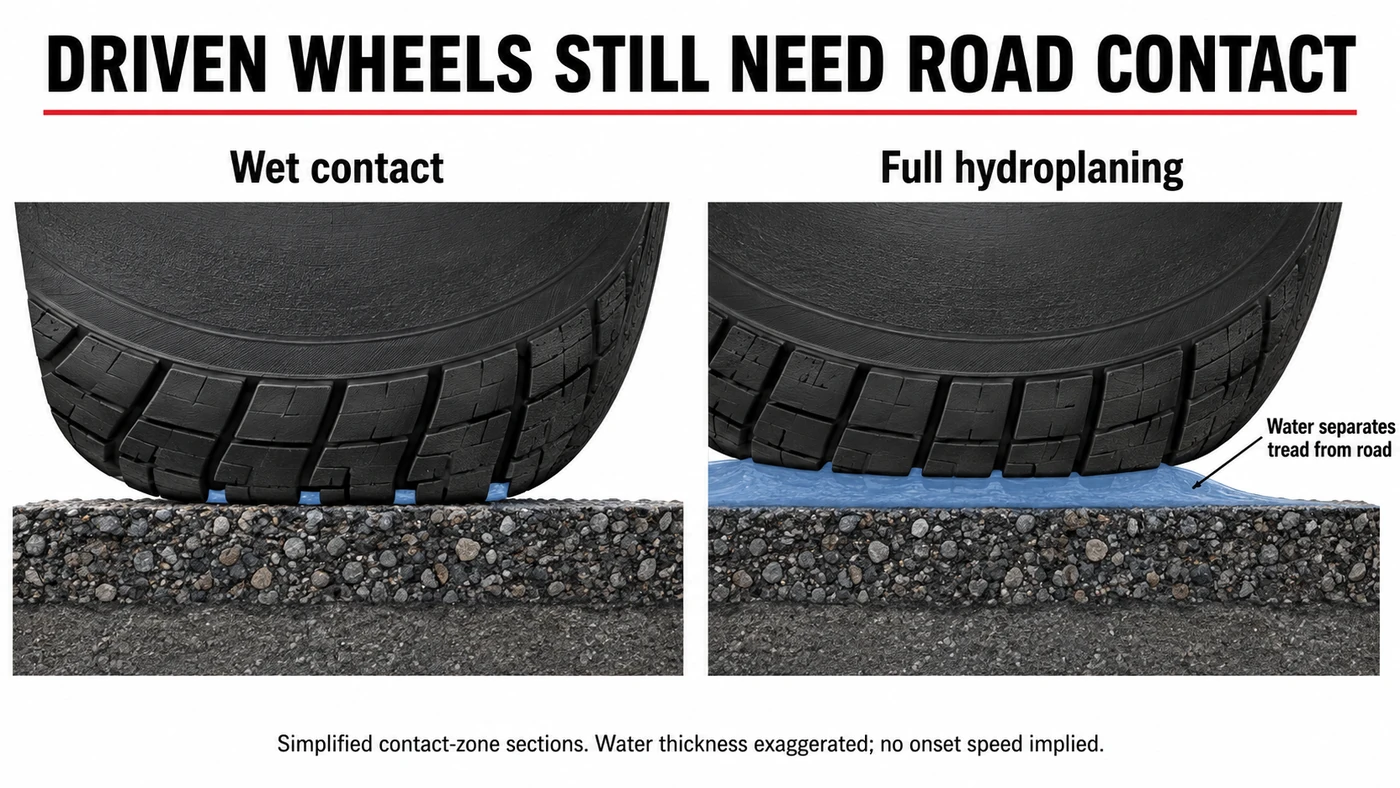
When a tire has lost effective road contact, commanding drive torque cannot recreate the missing rubber-asphalt connection. Tires that still have contact may continue to provide forces, but neither AWD nor stability control can guarantee recovery or immunity.
This is why an AWD vehicle’s clean launch is particularly poor evidence about a later patch of standing water. You have changed speed, water conditions and possibly the state of the contact itself.
Do not test the limit to find it. Reduce speed for wet conditions, leave more space, avoid abrupt demands and do not enter flooded roads. Floodwater also brings hazards far beyond hydroplaning, including hidden road damage and moving water. NHTSA’s severe-weather guidance emphasizes adapting to conditions and avoiding flooded routes.
6. AWD, TCS, ESC and ABS Do Different Jobs
These systems cooperate, which can make their separate purposes difficult to recognize from the driver’s seat. The simplest way to distinguish them is to ask what each is trying to manage.
| System | Main question | What it does not promise |
|---|---|---|
| AWD | Which axles can receive drive torque, and how should it be distributed? | More tire-road grip in every maneuver |
| TCS: traction control | Is excessive driven-wheel spin developing? | Unlimited acceleration on low-grip surfaces |
| ESC: electronic stability control | Is measured vehicle motion diverging from the intended path? | Guaranteed correction beyond available tire forces |
| ABS: anti-lock braking | Is a wheel approaching locking during braking? | A fixed stopping distance on every surface |
TCS can reduce drive torque and use wheel braking as appropriate. ESC compares signals such as steering input and measured vehicle rotation, then can apply selected brakes and influence drive torque. ABS controls brake pressure to manage wheel slip during braking. Bosch’s stability-system overview explains these integrated functions.
The systems are valuable. The correction is not to dismiss them, but to stop assigning all their work to a single drivetrain badge. Keep the vehicle’s safety systems in their recommended road-use settings and follow the owner’s manual; turning them off is not a wet-road experiment worth making.
Why powerful cars use AWD
Consider a hypothetical 500 hp RWD car and a 500 hp AWD car. If the driven tires are already limiting acceleration on a wet surface, the AWD layout may make more of the available engine output usable. Peak horsepower alone does not quantify the difference: tires, torque delivery, ratios, mass and controls still matter.
This helps explain the appeal of performance-oriented AWD systems. It is not an invitation to compare full-throttle launches on public wet roads.
- BMW M xDrive: BMW’s 2025 M5 technical introduction describes variable front-to-rear distribution and an electronically controlled rear differential working together. That is a particular model’s integrated system, not a specification for every BMW AWD car.
- Mercedes-AMG 4MATIC+: The Mercedes-Benz 4MATIC explanation describes variable distribution for AMG applications. The broader 4MATIC family includes different layouts, so one badge does not identify identical hardware across the range.
- Audi quattro: Audi’s quattro technology discussion distinguishes mechanical arrangements, disconnect-capable systems and electric drive. Quattro is a family of implementations, not one universal torque split.
Some AWD systems disconnect part of the driveline when it is not needed to reduce losses. Others distribute torque through independent motors or different mechanical arrangements. The general principle is additional control over drive delivery, not a universal increase in tire friction.
For the mechanical foundation behind these names, read Drivetrain Basics.
A short note on AWD versus 4WD
AWD often refers to automatically managed road-oriented drive distribution. 4WD often describes systems built around off-road needs, sometimes including selectable locking modes and low-range gearing. Manufacturers do not use the terms consistently enough for this to be an absolute rule.
In particular, do not assume a locked part-time 4WD mode is appropriate simply because a paved road is wet. Use the mode and surface guidance for the actual vehicle. The deeper FWD vs RWD vs AWD guide explores how purpose changes the choice of layout.
7. The Practical Priority: Conditions, Tires and Then Capability
AWD’s benefits are especially relevant when starting or climbing on limited grip, handling uneven grip across axles, or delivering substantial engine or motor torque. Drivers who repeatedly face slippery inclines or snow may use those capabilities much more often than someone commuting gently in a mild climate.
That does not make AWD useless in ordinary driving. It means the benefit has a context. Additional mechanical hardware can bring mass, cost, losses and service requirements; disconnect strategies and electric layouts change those trade-offs rather than making every AWD design identical.
The sensible question is not whether AWD is always worth having. It is which conditions and demands make its capabilities useful, and what else must support them? This remains a learning question, not a verdict on which car to buy.
Snow makes the same lesson easier to notice
AWD may provide a very noticeable advantage in getting moving or climbing on snow. Deeper snow also introduces ground clearance and other limitations; four driven wheels are not a guarantee of getting through.
Braking and cornering still depend on the tires. A two-wheel-drive car on appropriate winter tires can outperform an AWD car on summer tires in snow or ice, subject to the vehicles and conditions being compared. The point is not that 2WD always wins. It is that propulsion layout does not replace a tire designed for the surface and temperature.
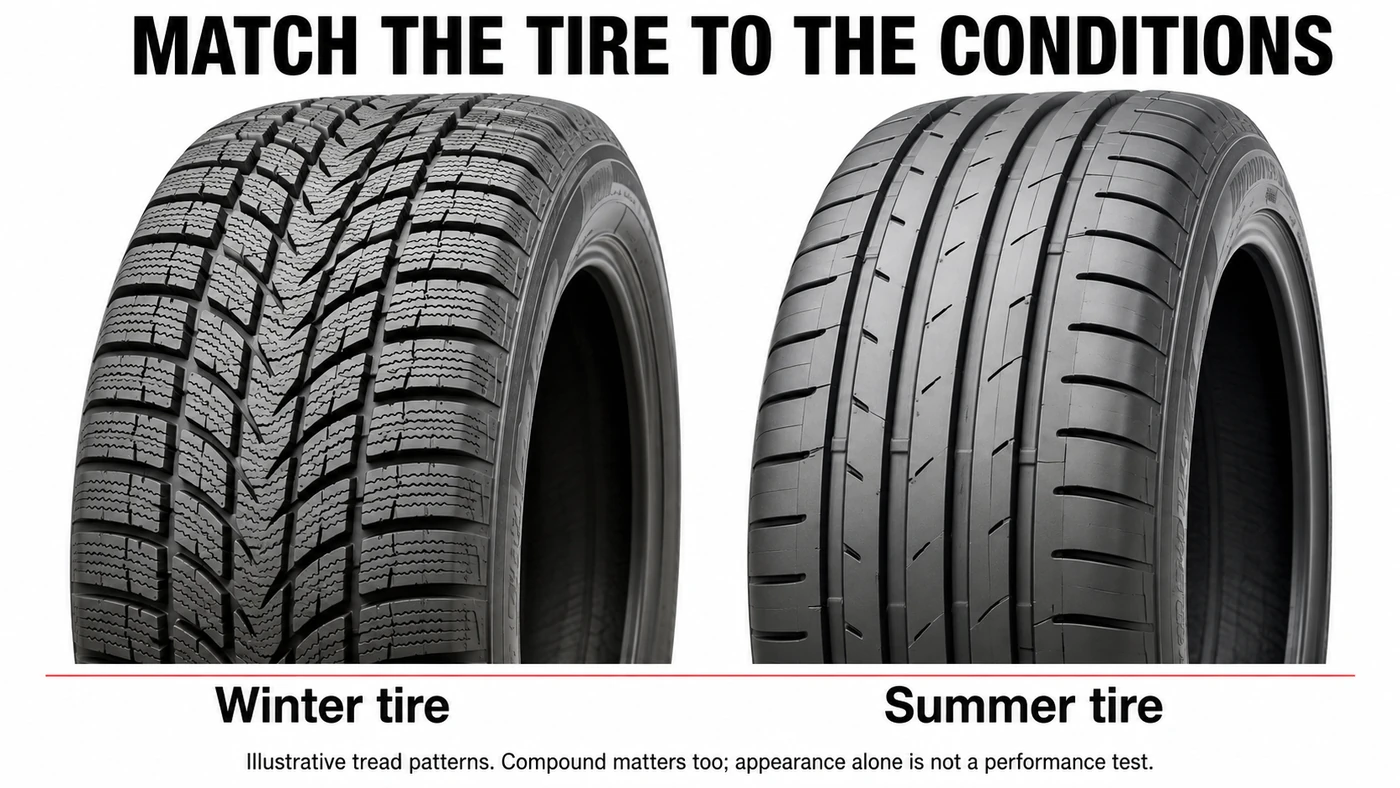
Winter tires use compound and tread choices aimed at cold-weather conditions. Fine tread cuts, called sipes, are one visible feature, but appearance alone cannot establish performance. Summer tires are not automatically poor in rain at suitable temperatures; wet summer roads and snow are different environments.
Michelin’s winter-tire guide explains why AWD still needs appropriate tires. When winter tires are used, fit the complete set specified for the vehicle rather than mixing seasonal capabilities between axles; Continental’s four-tire guidance explains the balance concern.
A tire check is more useful than confidence in a badge
- Suitability: Check that the tire type suits the season and intended conditions. Relevant wet-grip evidence is more useful than styling or price alone.
- Condition: Look for damage, cracking and uneven wear, and arrange professional inspection when needed. Legal tread minimums vary and are not a promise of strong performance in every depth of water.
- Pressure: Use the vehicle manufacturer’s recommended cold pressures, not the maximum number on the tire sidewall. Do not invent a special wet-weather pressure adjustment.
- Consistency: Follow the vehicle’s approved tire sizes and matching requirements. Some AWD systems are sensitive to rolling-circumference differences; factory-approved staggered sizes are a separate, engineered case.
- Driving margin: Adjust speed and following distance to conditions and visibility. A clean departure from one junction does not assess the grip at the next bend or standing-water patch.
NHTSA’s tire-safety guidance recommends regular pressure and tread checks, including checking cold pressures at least monthly. Tire condition is part of the vehicle’s basic safety foundation, regardless of its driven wheels.
Common Misconceptions
“AWD means four-wheel stopping, while FWD only brakes at the front.” All three common passenger-car drive layouts normally have four-wheel brakes. The letters describe propulsion, not the number of braking wheels.
“No wheelspin means the road has plenty of grip.” It means the requested acceleration was managed at that moment. Higher speed, a different maneuver or deeper water may reveal a different limit.
“Torque vectoring makes tires grip harder in every direction.” It helps manage the distribution of forces and vehicle motion. The tire’s combined capability remains finite.
“An AWD car is immune to hydroplaning.” Water can interrupt contact regardless of drive layout. Neither more driven axles nor electronics can guarantee contact through standing water.
“If AWD does not guarantee shorter stops, it has no safety value.” Better-controlled drive delivery and integrated vehicle-dynamics functions can be genuinely useful. Their benefit should be described in the situations where it applies.
Cariary Thoughts
The interesting thing about this myth is that it grows from a real advantage. AWD often does make it easier to put power down on a slippery surface. We do not have to deny that experience to question the conclusion that follows it.
What became clearer while studying this was the difference between confidence in a response and evidence about a limit. A calm, controlled launch tells us something useful about the drivetrain and its controls. It tells us much less about how the car will stop from the speed it has just gained.
This is exactly the kind of connection we explored in Car Basics for Enthusiasts. An impressive system still relies on the systems around it. AWD needs tires, tires need suitable conditions and loading, and the driver needs enough margin for the whole combination.
So my takeaway is not “avoid AWD.” It is to appreciate its specific strengths without asking it to do a tire’s job. That is a more useful understanding than either treating the badge as a safety guarantee or dismissing the technology completely.
One-line Summary
AWD is useful. Tires are essential. Neither replaces the judgment to leave a safety margin.
FAQ
Does AWD stop faster in the rain?
Not automatically. Typical FWD, RWD and AWD cars already brake at all four wheels. Tires, surface conditions, speed, brakes and vehicle setup determine the result; the drivetrain badge alone does not establish a shorter stopping distance.
Is AWD safer than FWD on wet roads?
It can improve acceleration traction and work with other systems to support vehicle stability. That does not create a universal advantage in braking, corner entry or standing water. Compare the complete vehicles, their tires and the conditions.
Does AWD prevent hydroplaning?
No. Hydroplaning concerns water reducing tire-road contact. AWD cannot prevent that mechanism, and tires still touching the road cannot be assumed to guarantee control when others lose contact.
Are good tires more important than AWD?
For transmitting braking and cornering forces on wet roads, suitable tires in good condition are fundamental. A well-tired 2WD car can outperform a poorly tired AWD car in those tasks. That does not mean AWD offers no additional acceleration benefit when both have suitable tires.
Does AWD help in corners?
It can help distribute propulsion demand, especially on exits. Some systems also cooperate with active differentials and stability functions. It does not make excessive corner-entry speed safe or remove the tires’ combined-force limits.
Do AWD cars still need winter tires?
AWD does not replace winter suitability. In snow and ice, appropriate winter tires can improve braking and cornering as well as traction. Follow the vehicle manufacturer’s requirements and applicable local rules when selecting the complete tire set.
What is AWD’s biggest benefit in rain?
Its most direct benefit is using available traction across more driven tires when accelerating. Wet starts, slippery climbs and high-torque applications can make that difference especially noticeable.
Related Thoughts
- Drivetrain Basics: driven wheels, differentials and torque delivery.
- Brake and Tire Basics: braking, tire markings and electronic controls.
- FWD vs RWD vs AWD: how different layouts serve different purposes.
- Car Basics for Enthusiasts: The Complete Guide: connect the systems before judging one specification.
References
- NHTSA: Tire Safety Ratings and Awareness
- NHTSA: Driving in Severe Weather
- Michelin Canada: Driving Safely on Wet Roads
- Michelin: Why Tire Maintenance Is Important
- Michelin: Winter Tire Buying Guide
- Continental: Two or Four Winter Tires?
- Bosch: Electronic Stability Program
- BMW: The 2025 M5 and M xDrive
- Mercedes-Benz: 4MATIC All-Wheel Drive
- Audi: Quattro Drive and Suspension Technology
- Michelin: Mixing Tires and AWD Matching Requirements
Data Reference Date: September 7, 2026. Vehicle-system examples refer to the applications described in the linked sources. Comparisons and diagrams are teaching aids, not measured wet-road tests or instructions to test vehicle limits. Use the owner’s manual and professional tire advice for vehicle-specific requirements.

