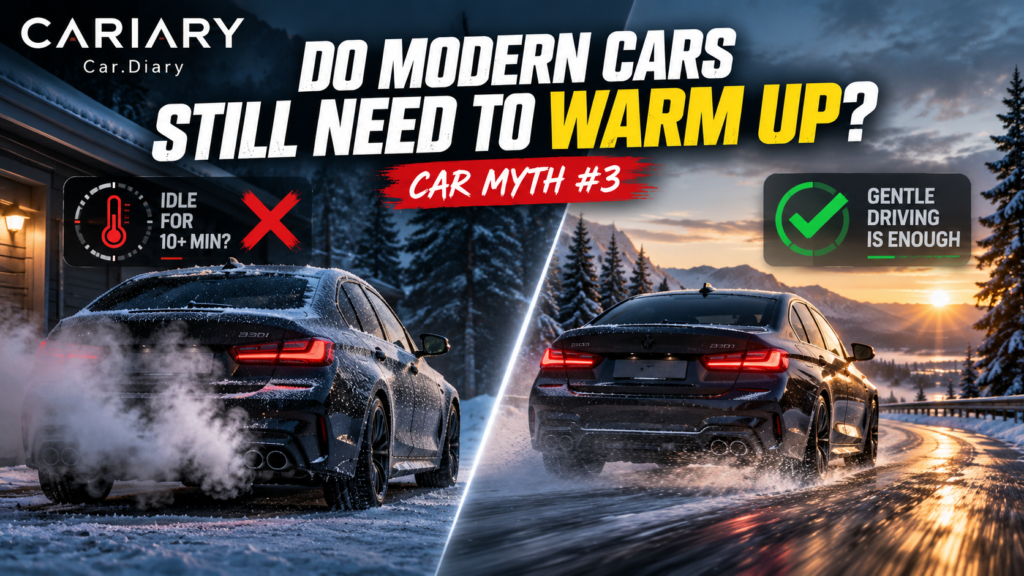
Car Warm-Up is one of those habits that can feel like good mechanical manners. Start the engine, listen to the elevated idle, and wait until the car seems ready. On a freezing morning, leaving it running for five or ten minutes can feel especially responsible.
But what are we waiting for: stable combustion, circulating oil, warm engine parts, or simply a comfortable cabin? I wanted to separate those things, because they do not happen together.
Modern cars still need to warm up. Most fuel-injected passenger cars do not need to do it by sitting still for several minutes. The usual approach is a brief settling period followed by gentle driving, with the owner’s manual taking priority. That is very different from starting a cold engine and immediately asking for maximum power.
Quick Summary
- For a healthy modern gasoline car, a short pause and smooth departure usually make more sense than a long stationary warm-up.
- Oil pressure and oil temperature are different. Circulating oil does not mean the engine is ready for hard use.
- Moderate driving starts warming the transmission and other moving driveline components too; a coolant gauge cannot speak for all of them.
- Clear visibility, extreme cold, specific diesel instructions and older carbureted cars require their own judgment. Thirty seconds is guidance, not a universal countdown.
- Hybrids manage engine operation automatically. EV battery preconditioning is a different process, not combustion-engine idling.
1. Why the Old Car Warm-Up Habit Made Sense
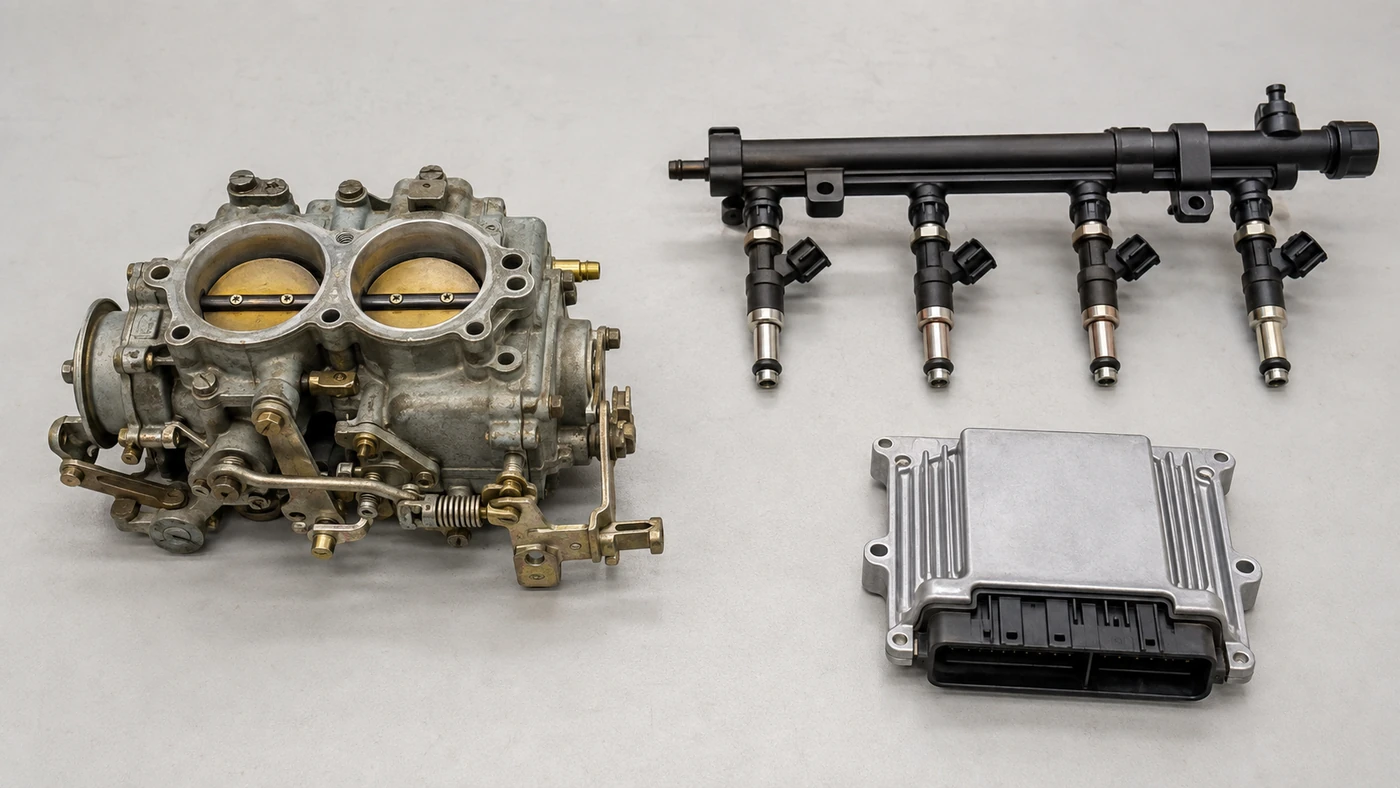
Before electronic fuel injection became common, a carburetor mixed fuel with incoming air. Cold conditions made that job harder: gasoline vaporized less readily, and some of the fuel could condense on cold intake surfaces rather than arrive as a useful mixture.
A choke helped by restricting incoming air, making the mixture richer, meaning more fuel relative to air. Depending on the car, the driver or an automatic mechanism controlled it. Fast-idle hardware also helped the cold engine keep running. Holley’s choke and fast-idle explanation shows why those were real mechanical functions, not just old-driver superstition.
Some older cars hesitated or stalled if asked to pull away before they would run reliably. Giving them time could be sensible. Even then, the appropriate procedure depended on the vehicle, its adjustment and the weather; every carbureted car did not need the same ten-minute ritual.
What electronic control changed
In a modern car, the ECU, or engine control unit, uses sensor information to manage the cold start. It can alter injected fuel quantity, idle speed and ignition timing, while also following an emissions warm-up strategy. Port injection supplies fuel into the intake ports; direct injection supplies it inside the cylinders. Both can use electronic cold-start control.
Bosch’s gasoline injection overview describes how fuel delivery, air supply and ignition are coordinated. The important change for our question is control: the driver generally no longer has to nurse the mixture with a choke.
That does not make cold metal behave like warm metal. It means being able to drive smoothly and being ready for maximum load are separate milestones.
Why the habit survived
Advice often travels further than the technology that created it. A parent teaches a careful routine, the next generation keeps it, and the high idle after starting appears to confirm that waiting is necessary.
Cabin heating reinforces the habit too. A warmer seat makes the car feel prepared, even though seat temperature tells us nothing about the rear differential. The habit is understandable; the reason behind it deserves updating.
2. Oil Pressure Is Not Oil Temperature
Engine oil reduces friction and helps protect moving surfaces. Its viscosity, or resistance to flow, rises as it gets colder. Think of how a liquid pours more reluctantly when chilled, while remembering that engine oil is engineered for a much wider operating range than a kitchen ingredient.
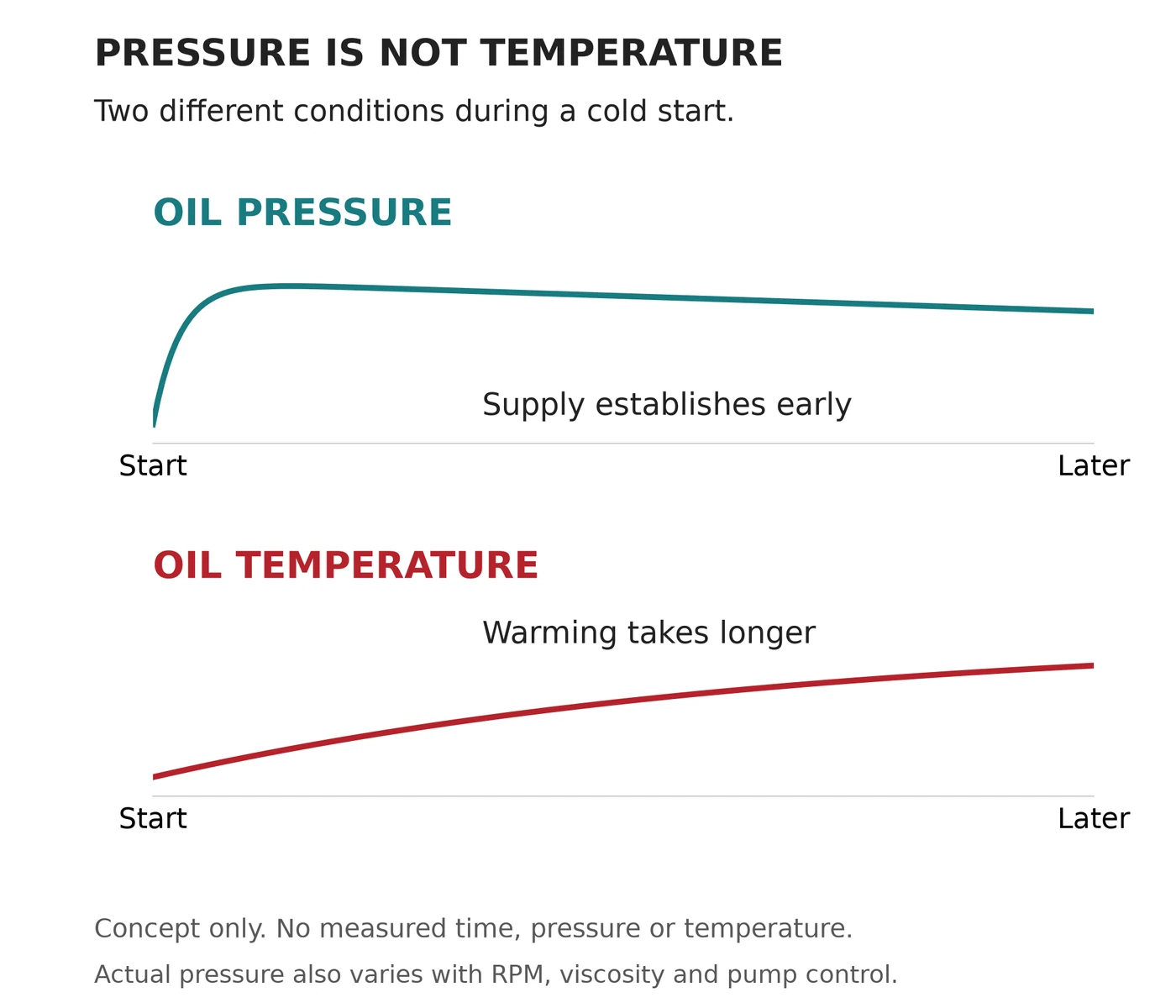
The pump begins supplying oil as the engine turns. In a healthy engine using the correct oil, pressure should establish promptly according to the vehicle’s normal starting behavior. It is misleading to picture a modern engine spending several routine minutes completely dry while oil slowly travels upstairs.
But pressure is not a thermometer. The system can be supplying lubricant while that lubricant remains cold. Pressure also depends on engine speed, oil viscosity, pump control and the engine’s design; a high reading is not proof of better protection or readiness.
What the oil grade actually tells us
In grades such as 0W-20 and 5W-30, the W means winter. The first designation describes standardized low-temperature performance; the second describes a hot-viscosity grade. Those numbers are not degrees Celsius, nor do they mean the oil becomes thicker as it warms.
Castrol’s viscosity-grade guide explains the distinction. Use the viscosity and approvals specified for your engine and conditions. Picking the lowest W number on the shelf is not a substitute for meeting the full specification.
Synthetic oil can offer useful cold-temperature performance, but it does not remove the need for sensible warm-up. Oil choice, service condition, temperature and engine design all matter. No general article can promise an exact oil-delivery time for every car at every temperature.
A warning light is not a warm-up timer
If an oil-pressure warning stays on or appears while the engine is running, do not assume it will disappear after a little more idling. Stop safely and follow the manual’s shutdown and assistance instructions. Do not rev the engine to try to extinguish it.
For example, Ford’s Tourneo Connect manual directs the driver to stop and switch off for a low-pressure warning. A fault is outside the scope of a normal warm-up routine.
The coolant needle cannot report every temperature
Coolant carries heat away from the engine. Oil does a different job, in different passages and reservoirs. Heat exchangers can connect their thermal behavior, but the fluids do not have to reach their working ranges simultaneously.
Oil can still be warming after coolant reaches its normal indicated range. The transmission and differential may be at different temperatures again. Some cars provide an oil-temperature display or a temperature-dependent engine-speed limit; follow those indications as the manufacturer describes them.
Without such a display, keep your demands moderate through the early part of the journey. There is no reliable universal rule that a centered needle, a fixed number of minutes or one specific RPM unlocks full performance.
3. Gentle Driving Warms More Than the Engine
At idle, an engine does comparatively little useful work. Driving adds a moderate load, so it produces more heat while also putting the rest of the driveline into use.
The US Department of Energy and EPA’s cold-weather fuel-economy guidance says most manufacturers recommend setting off gently after about 30 seconds. It explains that the engine warms faster when driven. Treat that as a general starting point for ordinary passenger-car use, not an instruction to ignore your own manual.
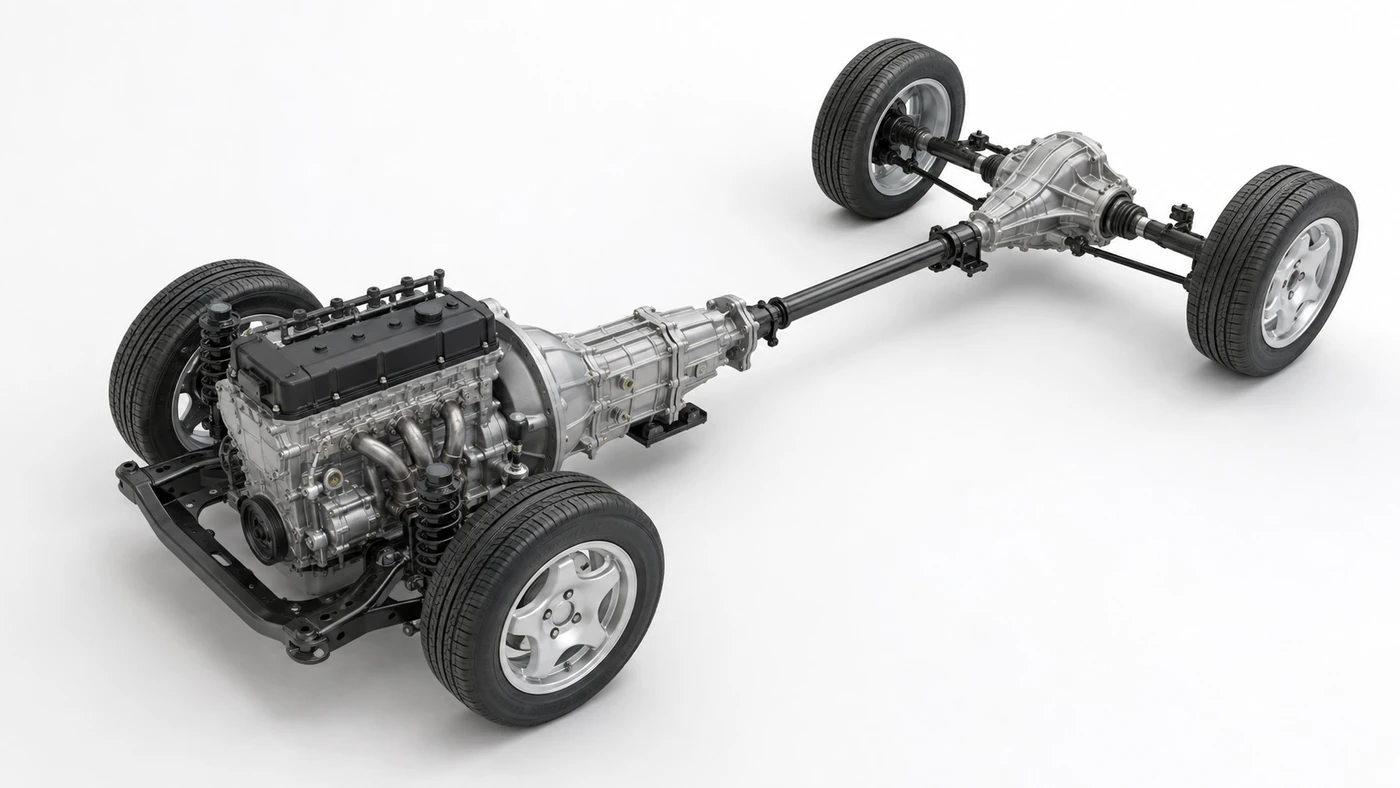
A gearbox changes the relationship between engine speed and wheel speed. A differential lets driven wheels turn at different speeds through a corner. Their moving parts and lubricants also begin a cold morning below their normal working temperatures. Our Drivetrain Basics guide follows that path from engine to road.
It would be too absolute to say a stationary car cannot warm any transmission fluid. An automatic can circulate fluid in Park, and some vehicles use heat exchangers or other thermal-management hardware. However, idling does not work the entire driveline as driving does, particularly a separate rear differential whose gears are not turning.
A warm engine is not a certificate that the whole car is warm. That is the useful idea, rather than a claim that every parked component remains exactly at outdoor temperature.
The catalyst needs heat too
A catalytic converter is an exhaust-treatment device that helps convert harmful pollutants into less harmful substances. Its reactions work effectively only once it is sufficiently hot. The beginning of that useful activity is often called light-off.
DOE’s personal-vehicle idling guide explains that driving brings the catalyst into effective operation sooner than unnecessary idling. Some engines deliberately run faster or use different ignition settings after starting to help this process.
The brief change in sound and RPM can therefore be intentional. It does not automatically mean a fault, but persistent rough running, warnings or unusual mechanical noises deserve attention rather than a longer waiting ritual.
Why an extra ten minutes is not free protection
An idling engine consumes fuel without covering distance and continues producing exhaust. DOE’s idle-reduction overview also identifies engine wear as a concern with unnecessary idling.
That is not a prediction that one remote-start cycle ruins an engine. Wear depends on operating conditions and maintenance, and there is no universal amount of damage per minute. The practical question is whether the extra running serves a necessary purpose. If the car is ready for gentle use and visibility is clear, waiting longer is not automatically kinder.
4. What Gentle Actually Means: Load Matters as Well as RPM
Avoiding the redline is only half the idea. An engine can be turning slowly while working very hard, such as when the driver uses a large throttle opening in a high gear up a steep hill.
Engine speed is how fast it turns; load is how much work it is being asked to do. For warm-up, smooth acceleration and moderate demand matter together. Do not force an engine to struggle at very low RPM simply to keep the tachometer number small. Use an appropriate gear and let the car’s normal controls do their job.
There is no useful one-size-fits-all instruction to stay below exactly 2,000 or 3,000 RPM. Different engines, gearing, road gradients and transmissions make those numbers mean different things. The Engine Power Basics guide explains why torque, RPM and output need to be considered together.
Turbocharged and naturally aspirated engines
A turbocharger uses exhaust energy to compress the engine’s incoming air. Asking for strong boost soon after starting raises the demand on an engine whose oil and hardware are still warming. Avoid full throttle, heavy boost and high engine speeds during that period.
Turbo bearings need suitable lubrication, and many turbochargers also use coolant for thermal control. Garrett’s technical explanation of water-cooled turbochargers helps show that oil and cooling systems serve related but different purposes.
A naturally aspirated engine, which breathes without turbocharging, is not exempt. It still has cold oil, changing component temperatures and a drivetrain that needs progressive use. The sensible distinction is not turbo versus no turbo; it is cold, lightly loaded operation versus immediately demanding everything.
Starting high, then settling down
Waiting briefly while idle settles can fit naturally into fastening your belt and checking mirrors. It is not something to feel guilty about. However, waiting until every elevated-idle phase has finished is not a universal mechanical requirement either.
Ford’s June 2023 English-language Tourneo Connect manual pairs two instructions: avoid high engine speeds and heavy demand when cold, and depart once window visibility allows rather than warming up while stationary. That combination is more informative than either slogan alone.
Cooling down is a separate question
After a hard run, the issue is removing accumulated heat, especially around a turbocharger. Some designs use water cooling, natural coolant circulation after shutdown or powered thermal-management systems. Their equipment and instructions differ.
Do not turn that into another universal timer. Normal commuting, towing and track use are not the same thermal event. Follow the specific post-load guidance in the manual; cold-start advice is not a replacement for it.
5. Winter Exceptions: Visibility and the Manual Come First
At -10 C (14 F) or -20 C (-4 F), clearing ice and restoring visibility may take longer than the engine’s initial settling period. Battery output falls in the cold, oil is harder to move and the cabin may be uncomfortable. More extreme conditions can require a manufacturer-approved block heater or a special starting procedure.
Do not calculate the needed idle time by outdoor temperature alone. Vehicle instructions, oil specification, actual starting behavior and the ability to see are more useful than a social-media temperature chart.
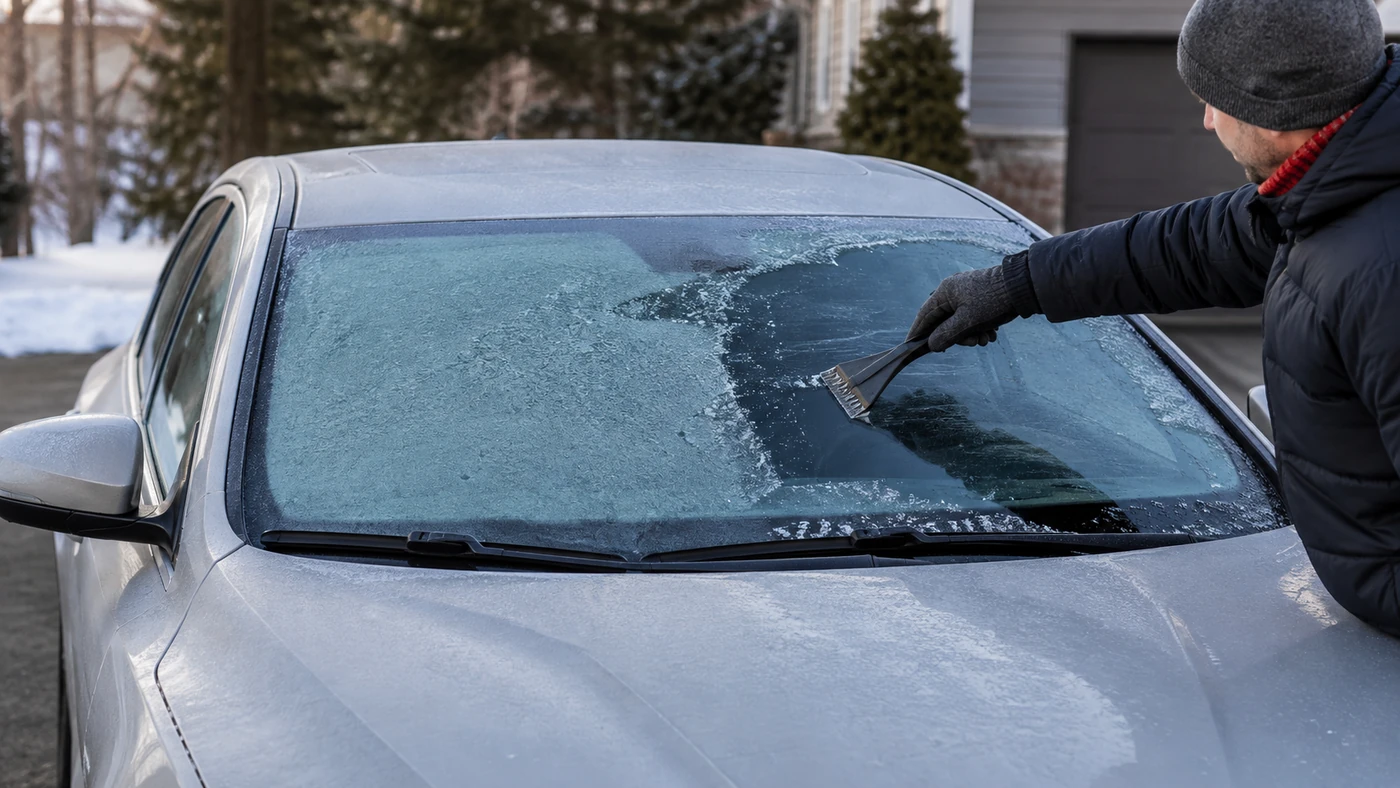
Defrosting is a real need, not an excuse to rush
Do not depart until you can see safely, and can keep seeing safely. Clear the necessary windows and mirrors, remove obstructing snow and use the car’s demisting or defrosting system as instructed. A small scraped peephole is not enough.
Keep the tailpipe clear of snow. Never use an enclosed space as a place to idle-warm a car, and never run it in an attached garage even with the door open. Carbon monoxide cannot be detected by its smell. The CDC explains both vehicle carbon-monoxide precautions and the danger of snow-blocked tailpipes.
Diesel guidance deserves its own line
Diesels ignite fuel through compression rather than a spark. Glow systems help cold combustion, while fuel suited to the season, the correct oil and functioning emissions equipment also matter. Bosch’s glow-system overview explains how the plugs help starting and combustion stability.
There are genuine model-specific exceptions to brief-idle advice. The 2020 Ford F-150 diesel manual recommends several minutes of idling when starting in extreme cold around -26 C (-15 F). It also describes a cold-start protection strategy that can temporarily prevent accelerator use. See Ford’s diesel starting instructions.
That instruction belongs to that application, not every diesel. Equally, generic 30-second advice must not overrule it. Older carbureted vehicles, specialized equipment and other diesel applications also need their own manuals.
Argonne’s earlier idle-versus-driving research found that the tested diesel’s catalyst could struggle to warm at idle in very cold conditions. This supports questioning unnecessary idling, but it is historical test evidence, not a guarantee about every current diesel emissions system.
Remote start: comfort is not the same claim as protection
Remote start does not instantly harm an engine simply because a button outside the car initiated it. It can be useful for the cabin or glass. The misunderstanding is believing that a daily 10- or 20-minute idle is mechanically required in every modern car.
Use it only in a safe location, follow the vehicle’s instructions and do not run longer than the circumstances call for. A comfort choice can be valid without being presented as essential engine maintenance.
6. Hybrids, Stop-Start and EVs Change the Question
A hybrid manages when its engine runs
A hybrid has a combustion engine, but the driver does not directly choose every start and stop. Battery charge, temperature, cabin demand and emissions needs can influence whether the engine runs.
For example, Toyota’s 2022 Venza Hybrid manual explains that the engine may remain running while it warms or charges the battery. Follow the vehicle’s READY indication and driving instructions rather than trying to force the engine on, or force electric mode to defeat warm-up control.
A warm restart is not another overnight cold start
Automatic stop-start systems use suitable hardware and control conditions to decide when a stop is appropriate. An engine restarting at a traffic light may still have warm oil and a hot catalyst. It is not in the same state as an engine parked overnight in freezing weather.
Argonne’s restart and idling study measured substantial differences between cold starts and warm restarts in its test vehicle, while explicitly warning against broad generalization from one vehicle. Stop-start therefore does not prove that cold engines can be treated harshly, and it is not an instruction to manually switch off in unsafe traffic situations.
An EV needs thermal preparation, not engine idling
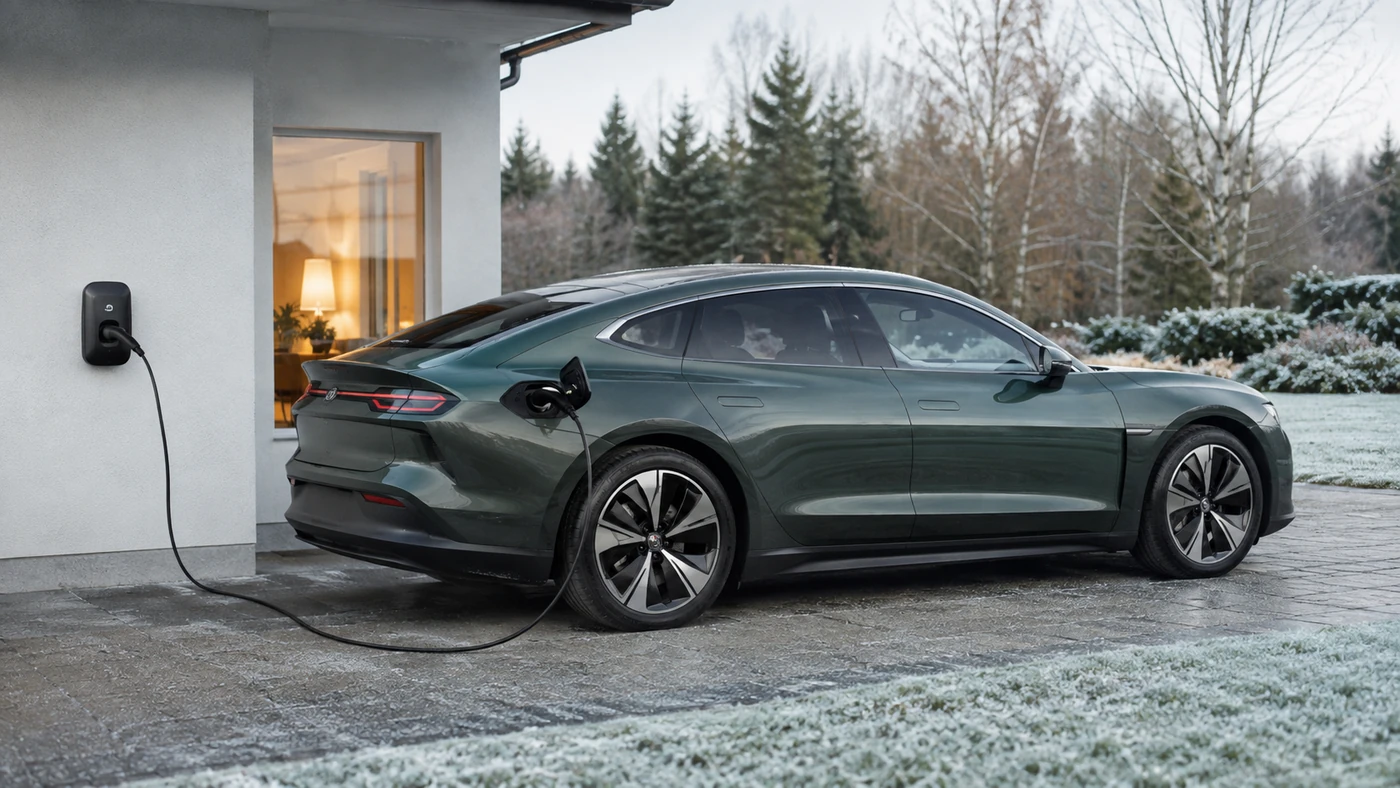
A battery-electric car has no combustion engine to idle. A cold battery can instead limit charging, available power or regenerative braking, which recovers some driving energy while slowing the car.
Preconditioning prepares the battery or cabin before use, where the car supports it. Tesla’s Model 3 cold-weather guidance describes temperature-related limitations and scheduled preparation.
Doing this while plugged in can draw energy from the supply rather than relying entirely on the traction battery, subject to charger capacity and vehicle control. It does not make heating energy-free, and a warm cabin alone does not prove a battery is ready for its maximum charging rate. Cabin preparation, departure preparation and fast-charging preparation can be different settings or targets.
Respect any displayed power or regeneration limitations. The broader lesson survives the switch to electricity: different parts of a car can need different thermal conditions.
7. A Better Car Warm-Up Routine
For a healthy modern gasoline passenger car in ordinary conditions, with no contrary manual instruction, the routine can be simple:
- Prepare the car for a safe departure. Clear obstructing snow and ice, check visibility and choose your route while parked.
- Start normally and check that warning indications behave as described in the manual. Do not rev it to manufacture warmth.
- Allow the brief stabilization appropriate to the vehicle while fastening your belt and checking mirrors. About 30 seconds is common guidance, not an alarm you must obey.
- Pull away smoothly once visibility and the vehicle permit. Accelerate progressively with moderate engine speed and load.
- Avoid full throttle, high RPM, heavy boost and making the engine struggle in too high a gear while temperatures rise.
- Continue following any temperature displays or warm-up limitations. Increase demand gradually; road safety and conditions remain the limit even after the car is warm.
Two drivers, one cold morning
Imagine Driver A waits ten minutes, sees the coolant indication rise, then uses full throttle straight away. Driver B waits briefly, clears the windows and drives smoothly through the early part of the trip.
For an ordinary modern car without a special cold-start requirement, B is generally closer to the intended approach. A’s stationary wait is not evidence that every fluid or component is ready for hard use. This is an illustrative comparison, not a measured test or a promise about a particular journey.
If your driveway feeds directly onto a steep climb or fast road, plan the departure sensibly. Do not merge at an unsafe speed to protect an arbitrary RPM target. Safe control of the car comes first; where practical, choose a route that allows progressive demand.
Short trips need realistic expectations
A very short journey may finish before all the fluids warm thoroughly. Adding a long idle does not necessarily solve that. Combining suitable errands reduces repeated cold starts, and frequent short-trip use may call for the manual’s applicable service schedule.
The aim is not to stage a perfect ceremony before every trip. It is to understand what the car is experiencing and avoid unnecessary extremes.
Common Misconceptions
| Familiar claim | A more useful interpretation |
|---|---|
| Modern engines need no warm-up at all. | They still warm progressively; stationary waiting is not usually the main method. |
| Oil needs several routine minutes to reach the engine. | Supply should establish promptly in a healthy system; oil temperature takes longer to rise. |
| Low RPM always means gentle driving. | Heavy load in a tall gear can demand a lot from the engine even at low RPM. |
| The coolant needle is normal, so every fluid is warm. | Coolant, engine oil and driveline lubricants can be in different thermal states. |
| A turbo needs ten minutes at idle. | Turbocharging does not create a universal waiting period; cold load and the manual matter. |
| An automatic transmission cannot warm at all in Park. | Some fluid circulation and heat exchange are possible, but idling does not exercise the whole driveline. |
| Thirty seconds overrides all winter advice. | Visibility, extreme cold and specific vehicle procedures take priority. |
| EV preconditioning is just electric idling. | It prepares thermal systems without running a combustion engine. |
Cariary Thoughts
The most interesting part for me was that the familiar question contained several different questions. Can the engine run smoothly? Is it lubricated? Is the oil warm? Can I see? Is the car ready for high load?
We tend to answer all of them with one action: wait. Once those questions are separated, the routine becomes less mysterious. A short pause can make sense without turning into a long idle, and driving away can be appropriate without driving hard.
The same pattern appears in arguments about premium fuel. Paying for a higher number or waiting for a longer time can both feel protective. Neither becomes useful simply because it is more. What matters is whether it matches the machine’s actual needs, a theme running through our complete Car Basics guide.
Good car care does not have to be theatrical. Sometimes it means using the correct fluid, paying attention to a warning, clearing the glass and taking the first part of the journey calmly.
One-line Summary
Modern cars still need to warm up; most do it best through a brief settling period and gentle driving, with clear visibility and the owner’s manual first.
FAQ
How long should I warm up my car before driving?
For most healthy modern gasoline passenger cars, briefly let the start stabilize and depart gently when safe. DOE cites about 30 seconds as common manufacturer guidance. Your vehicle’s instructions and conditions take priority, particularly in extreme cold.
Is it bad to drive immediately after starting?
Smooth departure in accordance with the manual is different from immediate hard acceleration. Check normal warning behavior and visibility, allow appropriate stabilization, then keep the early driving moderate. Persistent faults need attention, not a longer timer.
Should I wait for the idle RPM to drop?
A short wait can be reasonable, but completing every fast-idle phase is not a universal prerequisite. Follow the car’s instructions, and do not mistake normal emissions-control behavior for proof that several minutes of waiting are essential.
Do turbo cars need longer stationary warm-up?
Not automatically. They need suitable oil supply and restrained demand while cold, just as naturally aspirated engines need appropriate care. Avoid strong boost and full throttle until the vehicle’s temperature guidance permits more demand.
Should a diesel idle longer in winter?
Some diesel applications have specific extreme-cold instructions, so consult the exact manual. Glow-plug operation, oil grade and seasonal fuel also matter. Do not apply either a universal 30-second rule or a universal ten-minute rule.
Does idling warm the transmission, and is coolant enough to judge readiness?
Some transmissions circulate fluid or exchange heat while stationary, but the rest of the driveline is not being used normally. Coolant temperature alone does not confirm oil or transmission readiness. Engine oil may still be warming, so follow the relevant displays and keep demand progressive.
When can I use full throttle after a cold start?
There is no universal number of minutes or RPM threshold. Respect the manufacturer’s temperature indications and limitations, allow progressive warming, and remember that a warm car still needs suitable tires, road conditions and a safe, legal place for any demanding driving.
Do EVs and hybrids need the same warm-up routine?
No. Hybrids manage combustion-engine operation themselves within their control strategy. EVs may benefit from supported battery and cabin preconditioning, especially while plugged in, but they do not idle an engine. Follow the vehicle’s READY state and temperature-related limitations.
Related Thoughts
- Engine Power Basics: 5 Essential Ideas to Enjoy Cars
- Drivetrain Basics: 5 Essential Ideas to Enjoy Cars
- Car Basics for Enthusiasts: The Complete Guide
References
- US DOE and EPA: Fuel Economy in Cold Weather
- US DOE: Idling Reduction for Personal Vehicles
- US DOE Alternative Fuels Data Center: Idle Reduction
- Ford Tourneo Connect owner’s manual, English, June 2023
- 2020 Ford F-150 manual: Starting a Diesel Engine
- Holley: Choke and Fast Idle
- Bosch: Gasoline Direct Injection
- Castrol: Oil Viscosity Grades
- Garrett: Water Cooling for Turbochargers
- Bosch: Glow Systems
- Argonne: To Idle or Not to Idle
- Argonne: Idle or Stop and Restart?
- Toyota: 2022 Venza Hybrid System Features
- Tesla Model 3: Cold Weather Best Practices
- CDC: Carbon Monoxide Poisoning Basics
- CDC: Clear Snow from Tailpipes
Data Reference Date: September 7, 2026. Vehicle-specific examples apply to the manuals identified, not automatically to other engines, markets or model years.

