
Engine power basics become much more interesting when the numbers start describing a feeling. Why does one car surge forward without many revs, while another seems to wake up as the needle climbs? And how can a small turbo engine produce the power we once associated with something much larger?
We wanted to understand that connection, too. This is Part 1 of Car Basics for Enthusiasts: five linked ideas that take us from the air entering an engine to the character we feel from the driver’s seat. No engineering degree required, and no need to memorize every abbreviation.
Quick Summary: Engine Power Basics in Five Ideas
| Question | The useful answer |
|---|---|
| Why add a turbocharger? | To supply more air mass, allowing the engine to burn more fuel and produce more output. |
| Why is there turbo lag? | Increasing turbo speed and building the requested intake pressure take time. |
| Why add an intercooler? | Compression heats the intake air; cooling it improves charge density and thermal margin. |
| How are torque and horsepower different? | Torque is a turning effect. Power combines torque with rotational speed. |
| Why do NA and turbo engines feel different? | Their breathing, response and torque curves can encourage different ways of using the rev range. |
Why This Matters: Start With Air, Not Horsepower
A specification sheet gives us the result. Understanding the engine means following the process that produces it.
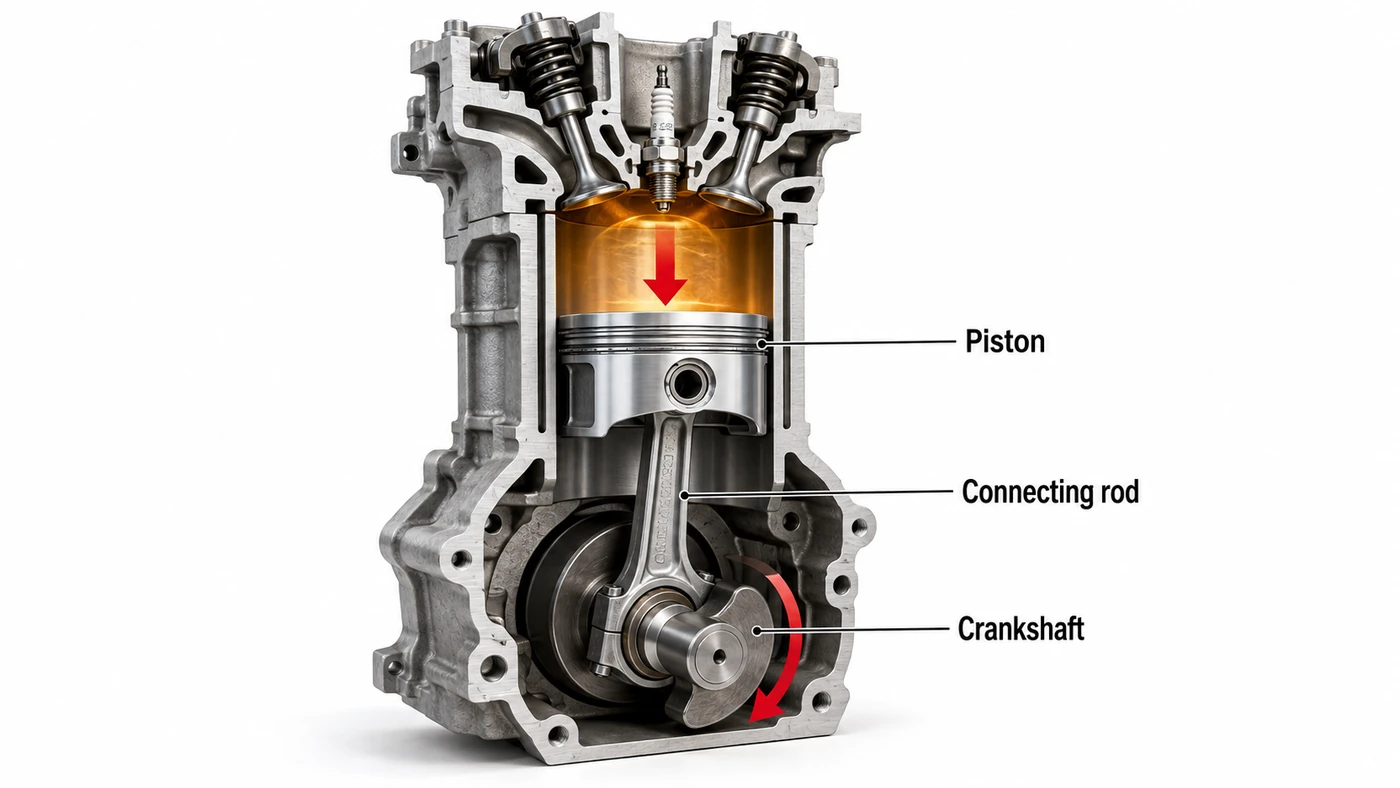
In a typical four-stroke petrol engine, air enters, the piston compresses the charge, the spark starts combustion, and expanding gases push the piston down. A connecting rod transfers that push to an offset part of the crankshaft, turning it. The exhaust stroke clears the cylinder for another cycle.
That is controlled combustion, not a series of desirable uncontrolled explosions. The cutaway below isolates the power stroke so we can see the connection between pressure, piston movement and rotation.
Two terms make the rest easier. Displacement, such as 2.0 liters, is the combined volume swept by all the pistons. RPM, or revolutions per minute, tells us how quickly the crankshaft turns. Neither number, by itself, tells us how much useful power the engine produces.
The engine also needs oxygen to burn its fuel. Once we think in terms of how much air can enter the cylinders, the turbocharger stops looking like a mysterious performance accessory.
1. Why Does an Engine Need a Turbocharger?
It does not necessarily need one. A naturally aspirated, or NA, engine works without a turbocharger or supercharger. During the intake stroke, the descending piston helps create a pressure difference, allowing atmospheric pressure to move air into the cylinder.
But a given engine has limits on how much air it can admit. Valve timing, intake design and engine speed all matter. A turbocharger offers another route: compress the incoming air so more air mass can fit into the available cylinder volume.
Two wheels, one shaft, separate gas paths
Exhaust gas drives a turbine. A shaft connects that turbine to a compressor, which draws in fresh air and compresses it. The exhaust does not become the fresh intake air; energy passes through the shaft while the gas paths remain separate. Garrett’s turbocharger introduction explains this arrangement.
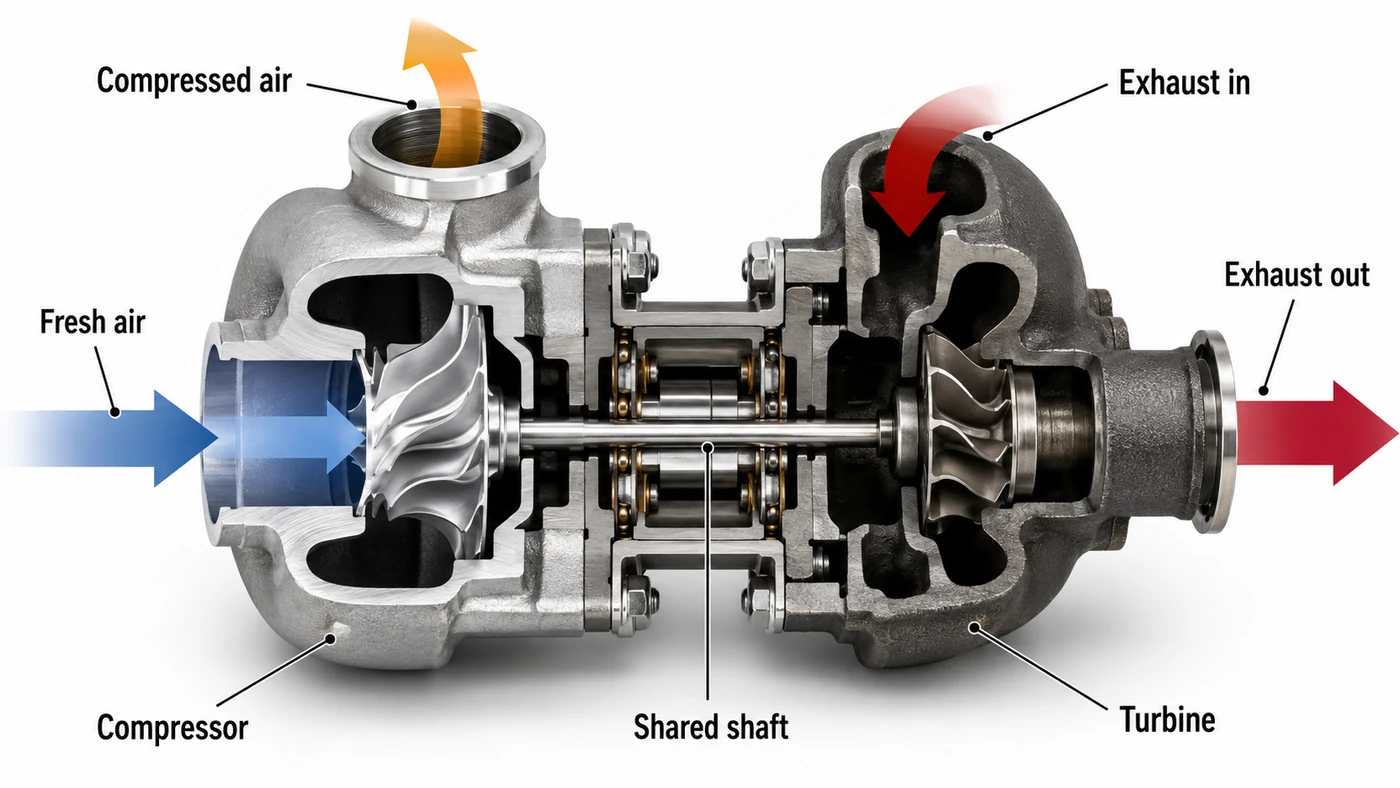
Follow the chain: exhaust energy turns the turbine, the shaft turns the compressor, and compressed intake air travels toward the engine. With more oxygen available, the engine management system can supply more fuel while controlling combustion.
Boost usually means intake pressure above atmospheric pressure. It is not an extra fuel, and it is not a separate engine switching on.
Why a smaller engine can do a bigger engine’s job
Turbocharging can let a smaller engine match the output of a larger NA engine. That is the idea behind downsizing. It can bring efficiency benefits under suitable operating conditions, but demanding high output still requires fuel. A turbo does not turn a small engine into an unlimited supply of economical power.
There is another useful advantage at altitude. Thinner air reduces the air mass available to an NA engine. A turbo can compensate by working harder, but only within its airflow, shaft-speed and temperature limits. Garrett’s altitude explanation makes that limit important: compensation is possible, not endless.
2. Why Does Turbo Lag Happen?
Imagine asking for strong acceleration after cruising gently. Your right foot makes the request immediately. The air system cannot always fulfill it immediately.
The turbo’s rotating assembly has inertia: it resists a change in speed. Exhaust energy must accelerate it, while the intake system builds toward the requested pressure. That transient delay is turbo lag.
The useful sequence is: driver requests torque, engine controls respond, exhaust energy and turbo speed change, then boost and delivered torque build. Fueling is coordinated with the available air. It is not simply a case of dumping in extra fuel and waiting for the engine RPM to rise.
Lag and boost threshold are different
Lag is about time. Boost threshold is about operating conditions. At sufficiently low engine speed or load, a turbo system may not have enough exhaust energy to provide substantial boost, even after waiting. Once the conditions support boost, it can still take time to reach the requested level.
An engine can build boost under load at roughly constant RPM. Equally, high RPM with very little load does not guarantee high boost. Flyin’ Miata’s technical explanation distinguishes these ideas.
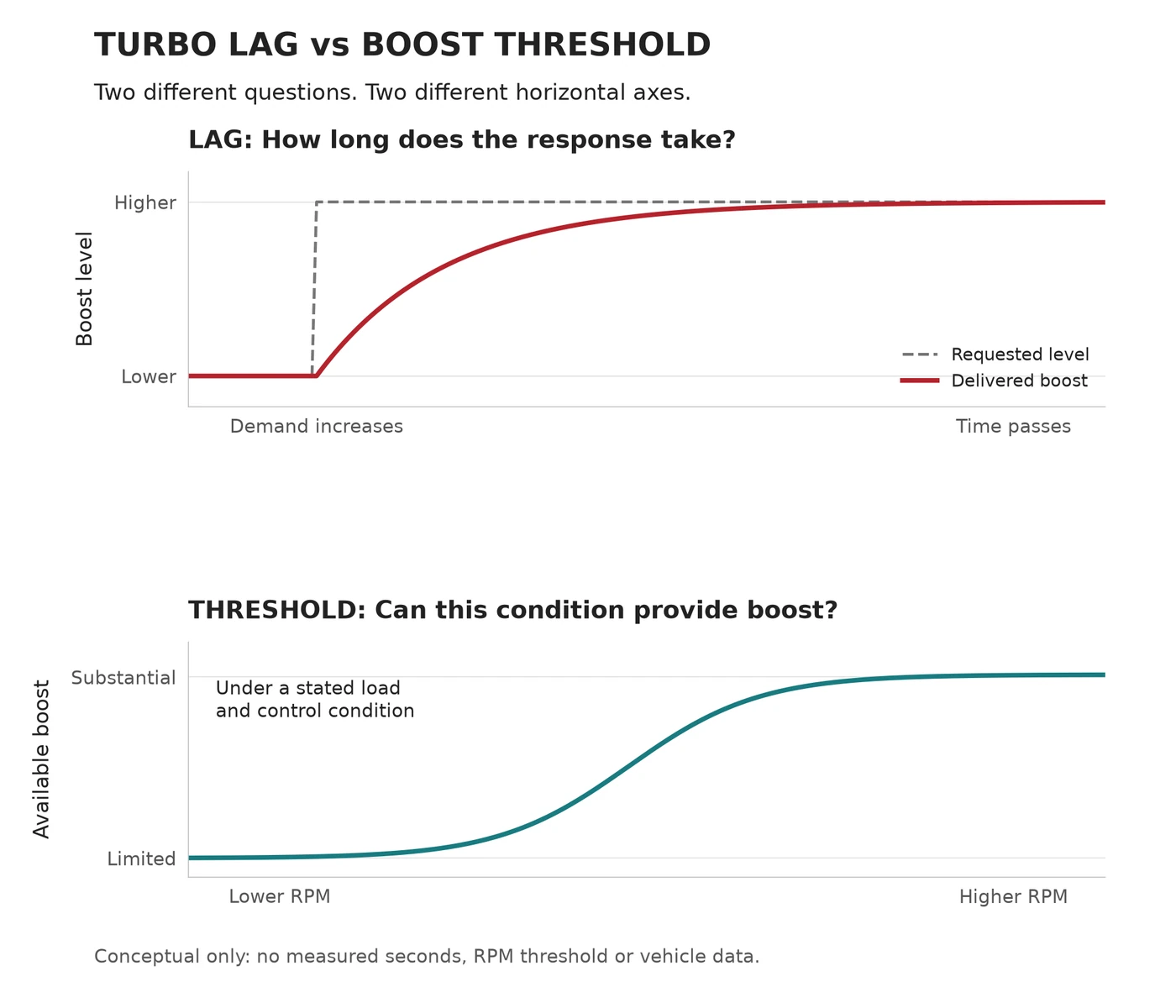
The upper chart changes time after a demand increase. The lower chart changes engine speed under a stated load condition. They answer different questions, so their horizontal axes must not be confused. These are teaching curves, not measurements from a particular car.
How engineers make the response quicker
There is no single magic part. Engineers balance rotating mass, exhaust pulse energy, flow capacity and control of the whole air system.
| Approach | What it changes | The important qualification |
|---|---|---|
| Smaller, lighter rotating parts | Can accelerate with less energy | High-flow capacity still has to match the engine’s output target. |
| Larger-flow turbo hardware | Can support more air at high output | Size alone does not determine lag; inertia, turbine design and matching matter. |
| Twin-scroll housing | Keeps selected exhaust pulses separated before the turbine | It is not the same thing as two turbochargers. |
| Variable turbine geometry | Adjusts the turbine’s inlet passages to suit operating conditions | Materials, temperature limits and control complexity matter. |
| Better boost control | Coordinates the wastegate and engine management | Software cannot remove every physical limitation. |
A wastegate is a valve that lets some exhaust bypass the turbine to help control boost. Electronic actuation improves how precisely that valve can be managed; it is not itself an electric motor driving the turbo.
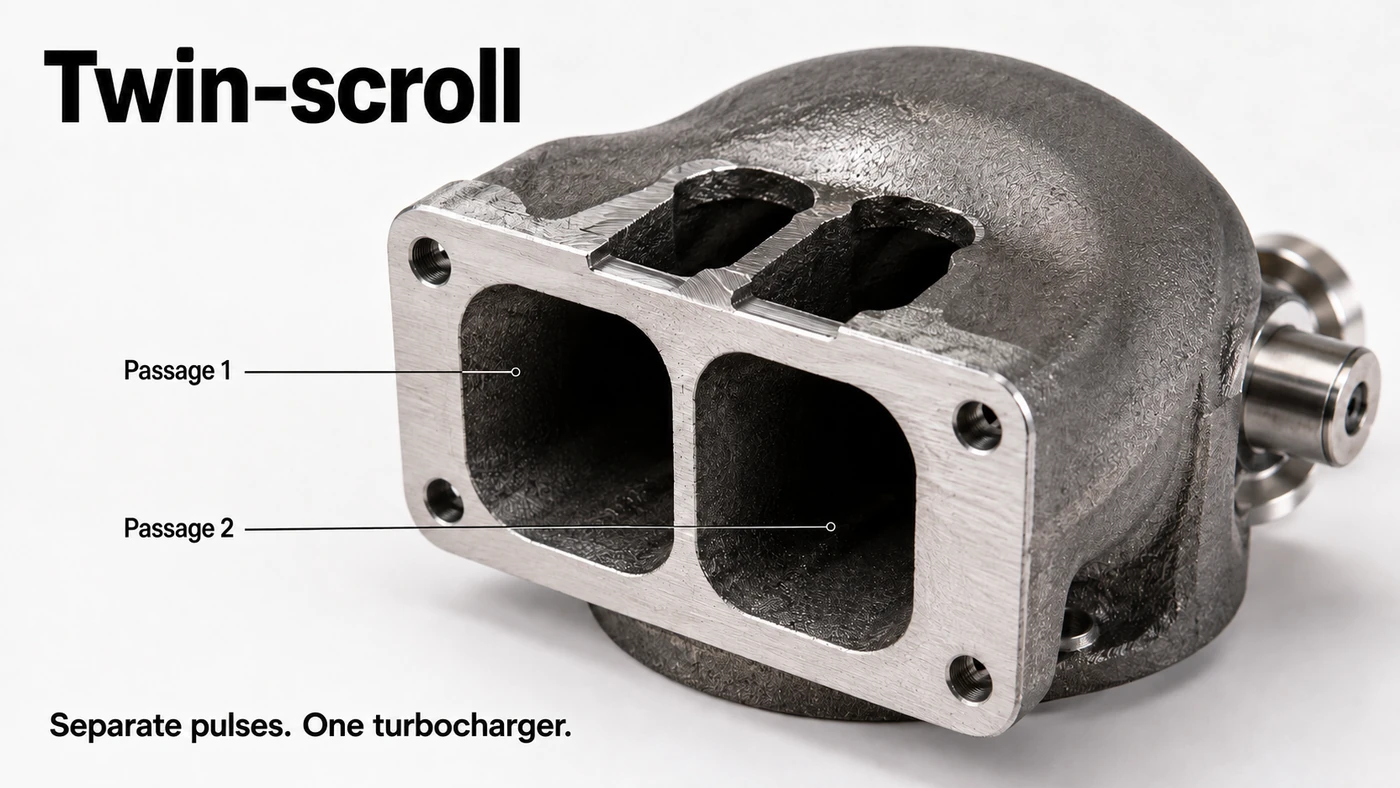
Twin-scroll means two separated exhaust passages feeding one turbine. Correct cylinder grouping and manifold design help preserve the pulses instead of allowing them to interfere upstream. The inlet illustration shows the separation, not the complete internal flow geometry. BorgWarner’s twin-scroll explanation describes why the housing and exhaust arrangement work together.
Twin-turbo simply means two turbochargers. In a parallel arrangement, each may serve one bank of a V-engine. Sequential or staged systems manage how multiple units contribute across operating conditions; they do not all follow a simple small-turbo-off, big-turbo-on switch. The architecture matters more than the badge.
Variable-geometry systems use movable vanes to change the turbine inlet conditions rather than physically changing the wheel size. Garrett’s variable-nozzle overview illustrates that different approach.
Electric turbo, electric compressor and hybrid assistance
These are three different solutions that are easily mixed up:
- An electric turbo has a motor assisting the shaft shared by its turbine and compressor.
- A separate electric compressor pressurizes intake air without needing an exhaust turbine on that particular unit.
- Hybrid torque fill uses a traction motor to help drive the car while the combustion engine’s response builds. It need not spin the turbo at all.
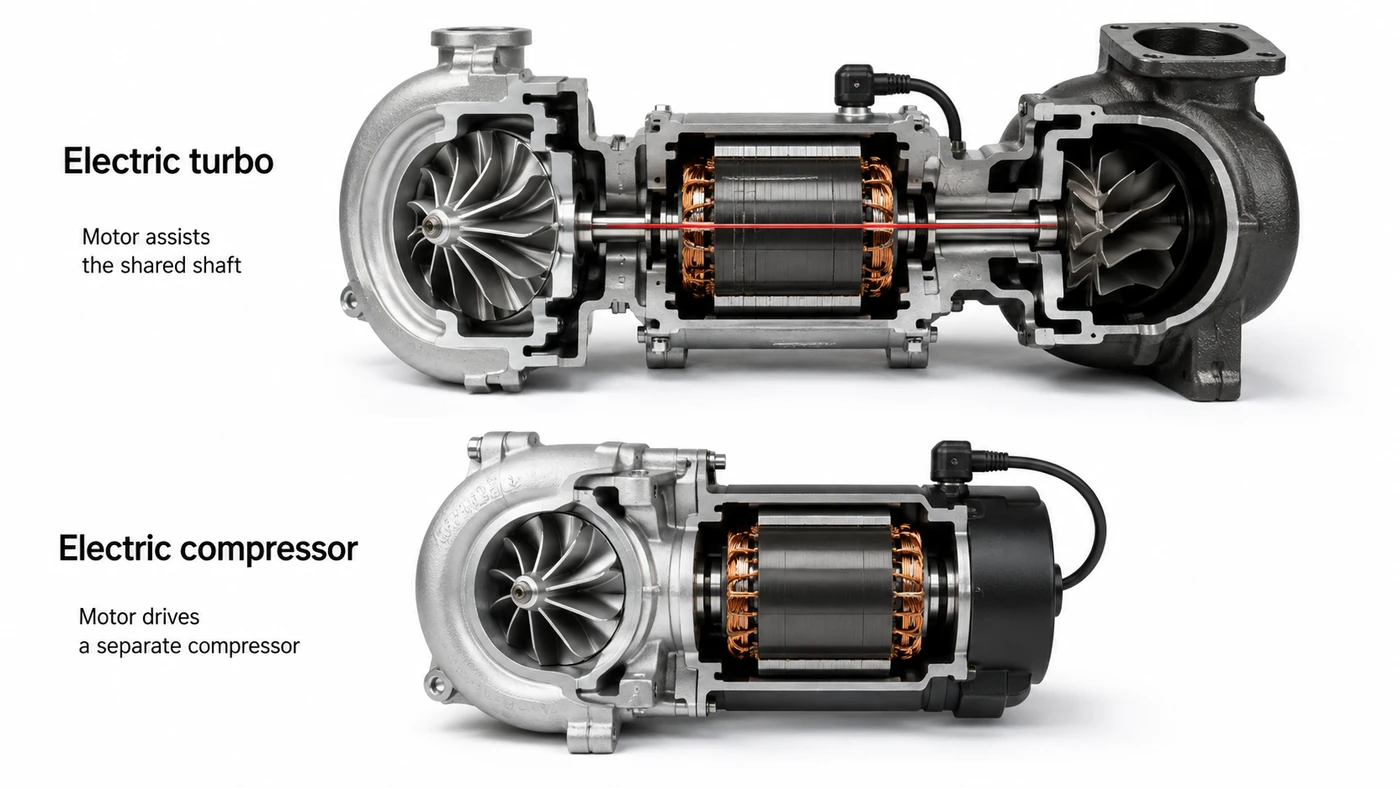
BorgWarner’s electric boosting technologies show why the first two names are not interchangeable. Both can improve air delivery, but electricity and thermal capacity still have to come from somewhere.
This also helps separate ordinary road-car boosting from the more complex power-unit story in our F1 engines guide. Similar words do not always describe identical systems.
3. Why Does a Turbo Engine Need an Intercooler?
Compressing air raises its temperature. Think of a bicycle pump warming during repeated use: compression work is part of the reason, alongside friction and heat transfer.
For a given pressure, cooler air is denser than hotter air. That qualification matters. Hot compressed air can still be denser than the ambient air it started as; heating simply reduces some of the density benefit we could otherwise obtain. NASA’s equation-of-state explanation connects pressure, temperature and density.
An intercooler, also called a charge-air cooler, removes heat from the compressed intake air before it enters the engine. Think of it as a heat exchanger for the intake charge, not another device that creates boost.
Cooling the air without mixing it
In an air-to-air intercooler, charge air travels through internal passages while outside air passes through the surrounding fins. Heat crosses the metal between them. The two air streams do not mix.
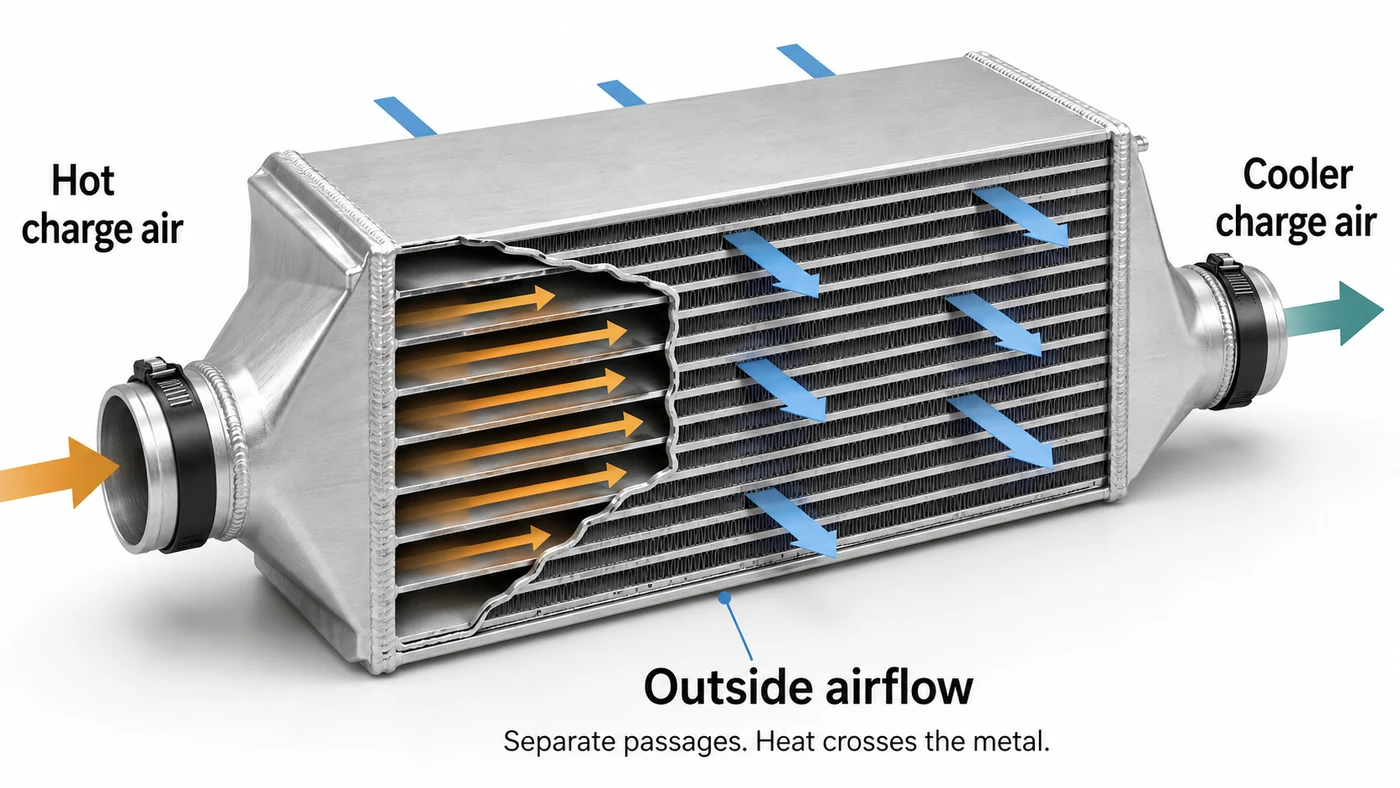
An air-to-liquid system transfers charge-air heat to coolant in a separate circuit, which then rejects it through another heat exchanger. The coolant should not enter the intake air. Packaging, airflow and the complete cooling system determine which layout suits a vehicle. Garrett’s intercooler overview explains these heat-transfer paths.
Why cooler intake air matters beyond density
High charge temperatures can reduce the margin against knock in a petrol engine. Knock involves abnormal self-ignition of unburned mixture, producing sharp pressure oscillations instead of the intended smooth combustion process. Engine controls may change ignition timing and other settings to protect the engine. Bosch explains how knock detection informs ignition control.
After repeated heavy loads, the intake and cooling system can become heat-soaked: heat is arriving faster than the system can comfortably reject it under those conditions. Available performance may change as temperatures and protective controls change. A car feeling slower is not, by itself, proof of heat soak or a failed intercooler.
A larger intercooler is not automatically a better one. Cooling capacity must be balanced against pressure drop, airflow through the vehicle, charge-system volume and packaging. Garrett’s system-optimization guidance is a useful reminder to assess the complete system rather than one impressive-looking component.
4. Horsepower vs Torque: What Is the Difference?
Torque is a turning effect, measured here in newton-meters, or Nm. Power is the rate of doing work, measured in kilowatts or horsepower.
The familiar wrench example is useful because we can feel the difference. Push perpendicular to a wrench handle farther from the bolt and the same force produces more torque. A longer lever arm gives the force more turning effect.
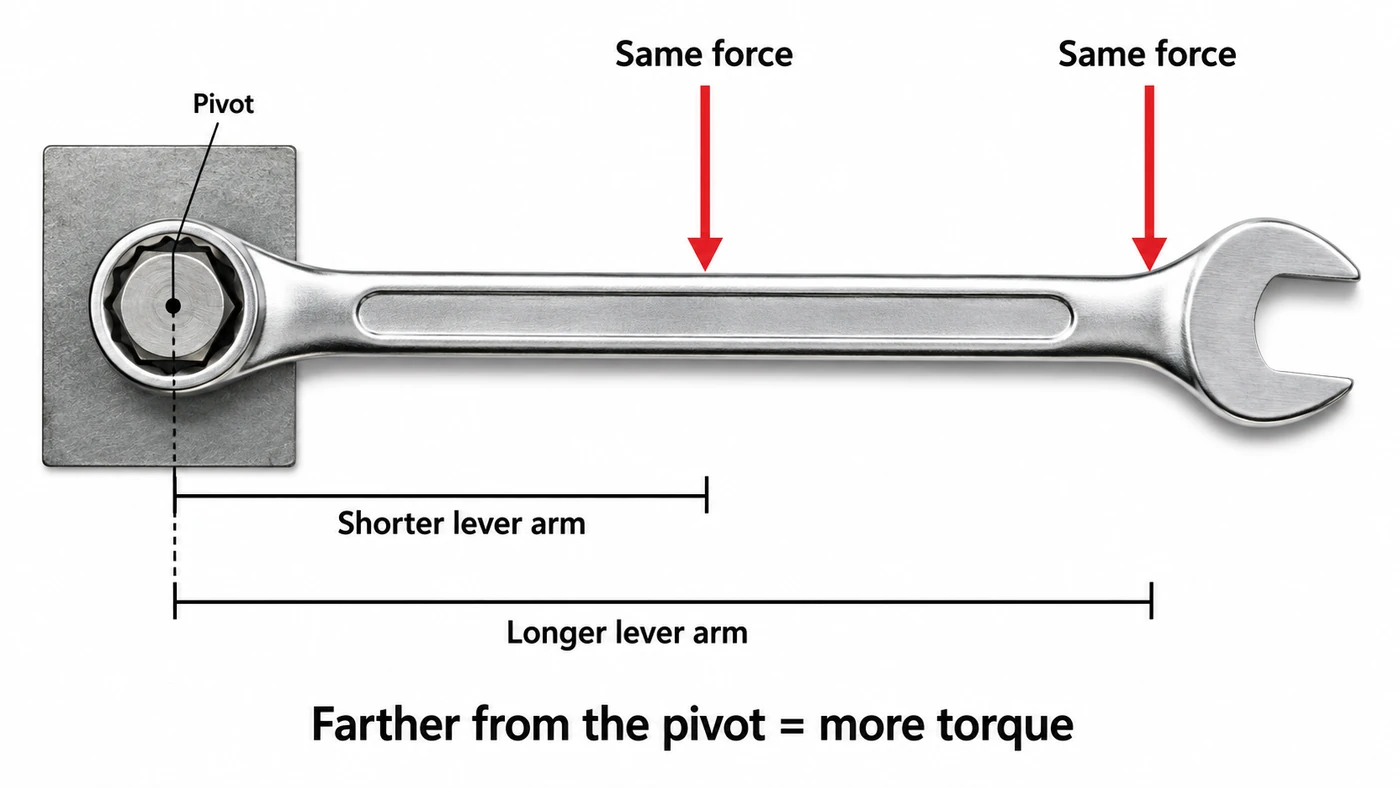
Now imagine maintaining a turning torque while rotating the shaft. If it turns faster with the same torque, it delivers more work each second. That is more power. OpenStax’s rotational-power explanation expresses the relationship as torque multiplied by angular speed.
One equation, no memorization test
For the units used in this guide:
Power in kW = torque in Nm x RPM / 9,550, approximately.
Mechanical horsepower is another power unit: 1 hp is approximately 0.746 kW. Metric horsepower, often labeled PS, is slightly different, so check the unit before comparing closely matched specification sheets.
Here is the useful consequence. 400 Nm at 3,000 RPM and 200 Nm at 6,000 RPM both produce about 126 kW, or 169 mechanical hp. Half the torque at twice the rotational speed gives the same power.
That is why a relatively modest-torque engine can still make substantial horsepower if it maintains torque at high RPM. And it is why the torque peak and power peak usually occur at different engine speeds.
Why engine torque alone cannot predict acceleration
The tires receive torque through the transmission and final drive. A lower gear multiplies engine torque more, while requiring more engine revolutions for the same wheel speed. It trades speed for turning effect; it does not create extra power.
For an idealized example, 200 Nm through a 4:1 overall ratio and 400 Nm through a 2:1 ratio both become 800 Nm at the driven axle before losses. At the same wheel speed, the first engine turns twice as fast. Tire radius, grip, vehicle mass and drivetrain losses then affect what happens on the road.
So “torque is acceleration, horsepower is top speed” is too simplistic. Power matters to acceleration, too. Which wheels can use the available force is another part of the story, explored in FWD vs RWD vs AWD.
Read the curve, not just the largest number
Below is a fictional teaching engine with a broad 400 Nm torque plateau. Its power keeps rising across that plateau because RPM is rising. Even after torque begins falling, power can still increase if the increase in RPM more than offsets the torque reduction.
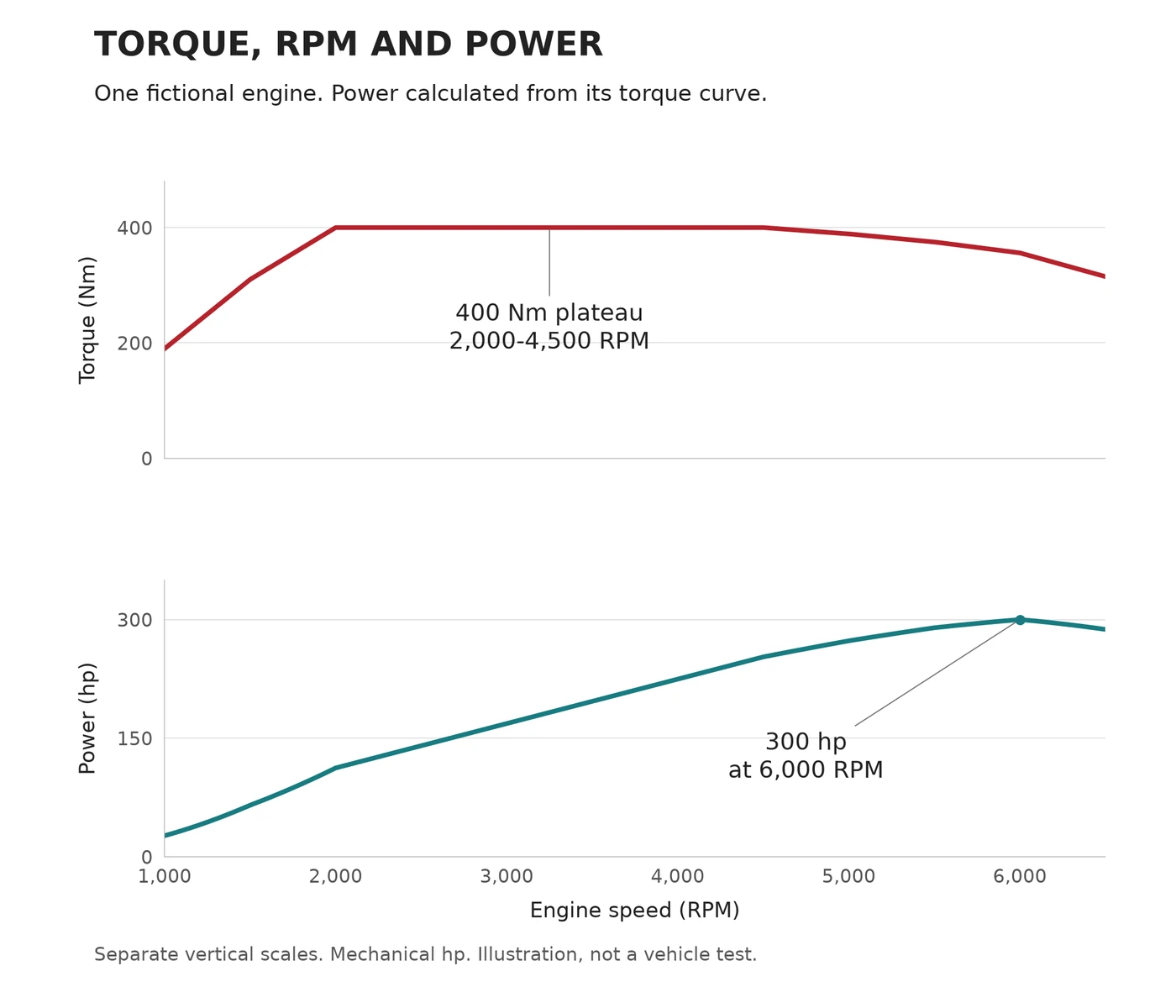
The two plots share an RPM axis but use separate labeled scales. They are calculated from the same hypothetical torque data, not drawn independently. There is no special meaning to where differently scaled torque and power lines would happen to cross.
5. Why Do Naturally Aspirated and Turbo Engines Feel Different?
Now the mechanical pieces connect to driving character. The difference is not simply that one engine is fast and the other is emotional. It is how the engine responds to a request and where useful output appears in its rev range.
Naturally aspirated: enjoying the climb through the revs
An NA engine has no turbo boost-building process. A well-calibrated example can feel closely connected to small accelerator changes. That is part of throttle response: how the engine reacts to the driver’s demand.
But “10% more pedal means exactly 10% more power” is not a physical rule. Electronic throttle mapping, valve control and the gearbox all shape the response. NA does not mean perfectly linear or literally instantaneous.
Some performance NA engines make their strongest impression high in the rev range. The original Japanese-market Honda S2000 is a clear historical example: Honda lists its 2.0-liter engine’s peak power at 8,300 RPM and maximum engine speed at 9,000 RPM. Those figures are specific to that version, not every S2000. Honda’s model history provides the context.
That kind of engine encourages the driver to select a gear that keeps it in its lively range. The interaction can be the attraction: choosing the gear, hearing the pitch change and feeling output build. A large-displacement NA engine, however, can deliver substantial low-speed torque. Not all NA engines are high-rev specialists.
Turbocharged: enjoying the strength in the middle
Many road-car turbo engines are calibrated for a broad low-to-midrange torque band. Once the requested boost is available, they can pull strongly without needing the driver to chase high RPM.
That can feel effortless. It is not the same as saying maximum torque appears instantly whenever the tachometer reaches the first number on the specification sheet. Published full-load torque capability is different from transient response after a gentle cruise.
Nor does turbocharging prevent an exciting top end. Turbine sizing, breathing, cooling and calibration can support very different characters. The torque curve and response matter more than an assumption attached to the word “turbo.”
Advantages and trade-offs, without picking a winner
| Area | Naturally aspirated | Turbocharged |
|---|---|---|
| Air delivery | No forced-induction compressor | More air mass can be supplied by compression |
| Response | No turbo spool-up process | Response depends on turbo matching and the complete control system |
| High output | Often pursued through displacement, RPM and breathing efficiency | Can achieve high output from relatively small displacement |
| Daily character | Can reward revs, but varies widely | Often tuned for accessible midrange torque |
| Complexity and heat | Still needs effective cooling, lubrication and control | Adds turbo hardware, charge plumbing and thermal demands |
| Efficiency | Depends on the engine and operating conditions | Downsizing can help, but heavy boost still uses fuel |
Extra components create additional things to engineer and maintain, not proof that every turbo engine is unreliable. Use the specified oil and service schedule, and follow the vehicle’s own guidance for warm-up or cooldown. A universal long-idling ritual is not a substitute for the owner’s manual.
Sound also contributes to the impression, but cylinders, firing order, intake design and exhaust tuning matter. It would be misleading to promise a particular soundtrack from aspiration type alone.
Where Does a Supercharger Fit?
A conventional mechanical supercharger takes drive from the engine’s crankshaft, typically through a belt or gears, to move intake air. Unlike an exhaust-driven turbo, it does not have to wait for exhaust energy to drive its compressor. But that mechanical drive consumes some engine power: a parasitic load.
There are different designs. Roots-type and twin-screw units can deliver strong low-speed response; a centrifugal supercharger’s boost characteristic rises more strongly with speed. So “all superchargers make full boost immediately” is another shortcut to avoid. ProCharger’s explanation of mechanical supercharging and its design-specific FAQ help separate those cases.
For now, remember the source of compressor drive: exhaust energy, mechanical engine drive, or electricity. That question cuts through a surprising amount of terminology.
Put It Together: Read This Fictional Specification
2.0-liter turbo / 300 mechanical hp at 6,000 RPM / 400 Nm from 2,000 to 4,500 RPM.
These are the example engine’s figures, not a claim about a production model. What can we reasonably infer?
The 2.0-liter displacement does not limit it to modest output because its air supply is pressurized. The broad torque plateau suggests substantial full-load capability through the middle of the rev range. Cooling and charge-air management are important parts of sustaining that capability.
But 300 hp is not available everywhere on the plateau. At 2,000 RPM, 400 Nm corresponds to about 112 hp; at 4,500 RPM, it is about 253 hp. Reaching 300 hp at 6,000 RPM requires approximately 356 Nm there. The arithmetic connects the numbers instead of treating them as unrelated trophies.
We still cannot deduce the car’s weight, gear ratios, lag after a sudden request, tire grip or sound. A specification sheet gives us informed questions, not a complete driving experience.
Common Misconceptions
- “A turbo pumps exhaust into the engine.” Its compressor handles fresh intake air; the turbine receives exhaust. A shaft transfers energy between them.
- “Every delay after pressing the accelerator is turbo lag.” Gear selection, throttle calibration and traction control can also affect the response.
- “Twin-scroll means twin-turbo.” Two separated scrolls can feed one turbine; twin-turbo means two turbochargers.
- “The engine with more peak torque must accelerate faster.” Gearing, available power, mass and grip belong in that comparison.
- “Every NA engine needs high revs, and every turbo engine runs out of excitement early.” These are familiar patterns, not definitions.
Cariary Thoughts
What changed for us while putting this guide together was the question we asked of a specification sheet. Instead of stopping at “How much horsepower?”, we started asking, “Where does that power come from, and what has to happen before the driver gets it?”
A turbocharger, an intercooler and a torque curve are not three disconnected facts. They are parts of the same story: moving air, managing heat and turning combustion into useful work.
There is room to enjoy both kinds of character. One engine may invite us to work through the rev range; another may make its strength easy to access. Understanding the engineering does not remove that feeling. It helps explain why the feeling exists, while leaving space for the actual car to surprise us.
One-line Summary
Air supply shapes the engine’s possibilities; torque and RPM describe its output; response and gearing help turn those numbers into a driving experience.
FAQ
Does a turbocharger work only at high RPM?
No. Useful boost depends on load, engine speed, turbo design and control strategy. Many road engines can provide substantial boost at relatively low RPM under load, while high RPM at light load does not guarantee it.
Is turbo lag the same as waiting to reach the boost threshold?
No. Lag is the transient delay in delivering requested boost under conditions that can support it. The threshold concerns whether the operating conditions can provide useful boost in the first place.
Is an intercooler the same as the engine radiator?
No. Both are heat exchangers, but they serve different circuits. An intercooler cools the intake charge; the main engine radiator rejects heat from engine coolant. An air-to-liquid charge-cooling system also uses a separate coolant circuit and heat exchanger.
Which matters more, horsepower or torque?
They describe related aspects of output rather than competing features. Read torque alongside RPM and gearing, and remember that power is torque multiplied by rotational speed. Peak engine torque alone cannot rank acceleration.
Why can power rise while torque falls?
Because the engine is turning faster. If RPM increases enough to outweigh the fall in torque, power still rises. The calculated example in this guide shows that relationship.
Are turbo engines always more economical?
No. Downsizing can improve efficiency in suitable operating conditions, but fuel use also depends on demanded output, vehicle mass, gearing and driving conditions. Producing high power requires fuel, with or without a turbo.
Does a naturally aspirated engine always respond faster?
It has no turbo boost-building delay, but the complete vehicle still matters. Throttle mapping, transmission behavior and other controls can change the response. Modern boosted and hybrid systems can respond very quickly.
What should I learn after engine power basics?
Follow the power toward the road: gear ratios, transmissions, differentials and driven wheels. Those are the planned focus of Part 2, Drivetrain Basics. Our existing drivetrain article below is a useful bridge while the series develops.
Related Thoughts
- F1 Engines Explained: see how turbocharging, energy recovery and racing rules meet in a more specialized application.
- FWD vs RWD vs AWD: follow the next question, which wheels receive the power and why that changes a car’s behavior.
- AMG vs BMW M vs Audi RS: explore why performance character involves more than peak engine output.
References
Data Reference Date: September 7, 2026. Generic component illustrations are AI-generated educational cutaways, not photographs or exact service drawings. Both charts are original calculated or conceptual teaching graphics, not manufacturer test results.
- Garrett: turbocharger operation, system optimization and intercooler construction.
- Garrett: altitude compensation and its limits and variable-nozzle turbine technology.
- BorgWarner: twin-scroll housings, boosting architectures and electric boosting.
- Flyin’ Miata: understanding turbo lag.
- NASA Glenn: pressure, temperature and density.
- Bosch: knock detection and control.
- OpenStax: work and power in rotational motion.
- Honda: S2000 history and Japanese-market engine specifications.
- ProCharger: mechanical supercharging and design-specific characteristics.

