Quick Summary
This WRC beginner guide is for anyone who wants to enjoy rally without feeling lost in stage times, pace notes, tire choices, and changing road surfaces.
- WRC, or the World Rally Championship, is not circuit racing. Cars usually start one by one and compete against the clock.
- The main unit of competition is the special stage, a timed section of real road.
- A WRC event is built from many stages across several days, and the lowest total time wins.
- WRC is fascinating because the driver, co-driver, tires, road surface, car durability, and stage strategy all matter at the same time.
- If F1 is about racing other cars on a controlled circuit, WRC is about reading unpredictable roads faster than anyone else.
Table of Contents
- Why WRC feels different from F1
- How stages and rally timing work
- How WRC points are awarded
- Why rally tires matter so much
- How pace notes help drivers see the road ahead
- What to watch as a beginner
- Key WRC terms and rally classes
Why This Matters
WRC can feel strange when you first watch it, which is exactly why a WRC beginner guide should start with how the sport is watched, not only how it is engineered.
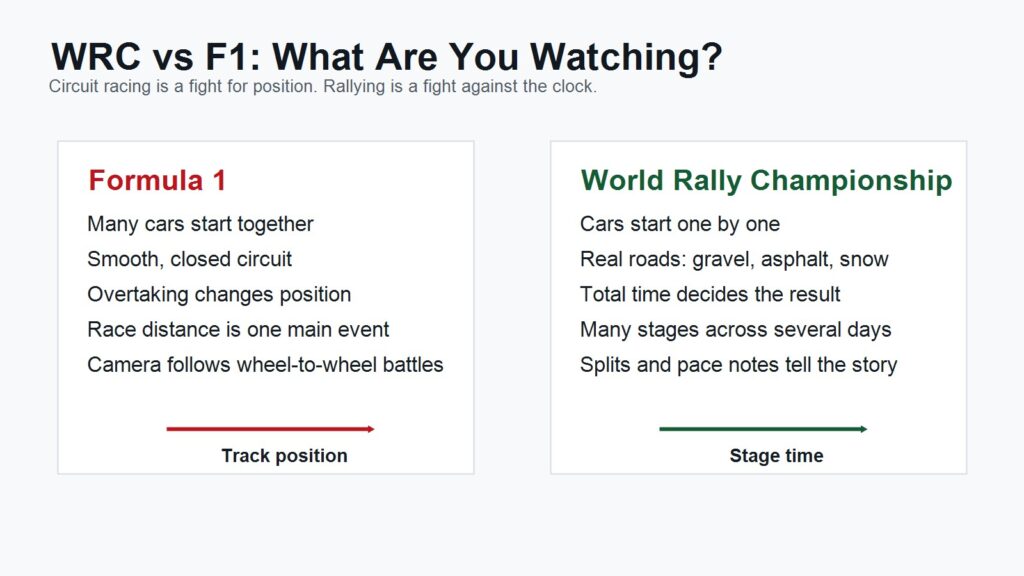
In F1, many cars line up on a circuit, start together, and fight directly for track position. The story is easy to see: one car is ahead, another car is behind, and an overtake changes the order immediately.
WRC works differently.
The cars usually start one by one at set intervals. They are not racing side by side most of the time. Instead, each driver and co-driver crew is trying to complete a road section faster than everyone else.
That means the real opponent is not always visible on screen.
The real opponent is time.
Once that idea clicks, WRC becomes much easier to enjoy. You stop waiting for wheel-to-wheel battles and start watching stage times, split times, tire choices, road conditions, pace notes, and how much risk each driver is willing to take.
How WRC Works
The basic idea is simple.
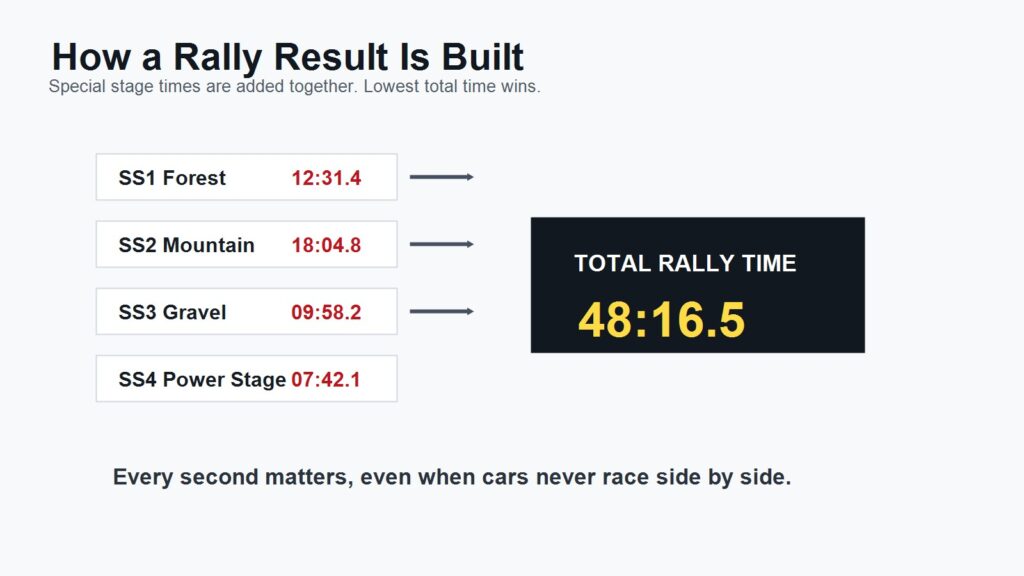
A rally is made of multiple timed road sections called special stages. Each crew drives through each stage as fast as possible. At the end of the rally, all the stage times are added together.
The crew with the lowest total time wins.
But the roads make that simple idea very difficult.
A WRC stage can run through gravel, asphalt, snow, ice, mud, forest roads, mountain passes, village roads, or desert-like terrain. One corner may have grip. The next may be covered in dust, stones, water, or ice.
Unlike a racing circuit, a rally stage does not feel perfectly repeatable. The road changes as cars pass through it. Gravel gets swept away. Ruts form. Mud moves. Weather changes. Rocks appear. Visibility can disappear in dust or spray.
That is why WRC is not only about driving fast.
It is about adapting quickly.
WRC Also Works as a Season
WRC is a season-based championship, just like F1.
A simple way to think about it is this:
F1 season = multiple Grand Prix weekends
WRC season = multiple rally events
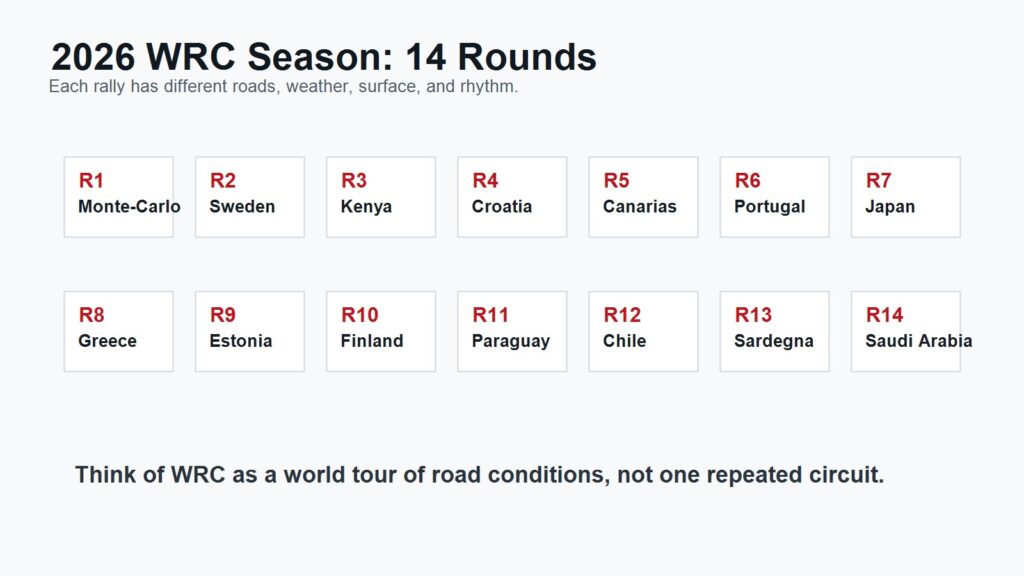
Each rally event usually runs over several days. Across the season, the championship visits different countries and different road surfaces.
In 2026, the FIA World Rally Championship calendar has 14 rounds across five continents. Each rally gives points toward the Drivers’ Championship, Co-Drivers’ Championship, and Manufacturers’ Championship.
That is why Toyota, Hyundai, and M-Sport Ford are not only trying to win one rally. They are trying to build a whole season.
How Long Is One WRC Rally?
This part surprised me when I first started looking into WRC.
An F1 race is usually around 300 km. WRC is structured differently, but the total timed distance of special stages in one rally can also be roughly around that kind of range, depending on the event.
But WRC has something extra: road sections.
Between special stages, rally cars must drive on public roads to reach the next stage. During those sections, they are not racing. They must follow normal traffic laws.
So a WRC event is not just a few short blasts through a forest.
It is a multi-day endurance test for the driver, co-driver, mechanics, tires, suspension, brakes, cooling system, and the whole car.
Surviving the rally is part of the competition.
What Is a Special Stage?
A special stage is the timed part of a rally.
This is where the car is driven flat out and the clock matters. Each crew completes the stage, and their time is recorded.
A rally has many special stages. Some are short. Some are long. Some are repeated. Some are on gravel, some on asphalt, some on snow, and some can change condition during the day.
At the end of the rally, all stage times are added together.
The crew with the lowest total time wins.
It sounds simple, but one small mistake can echo through the whole rally. A driver might lose two seconds in one corner because the surface changed. Another driver might save the tires early and attack later. Someone else might hit a rock and lose minutes changing a wheel.
In WRC, every second has a memory.
How WRC Points Work
WRC points can feel a little more layered than F1 points.
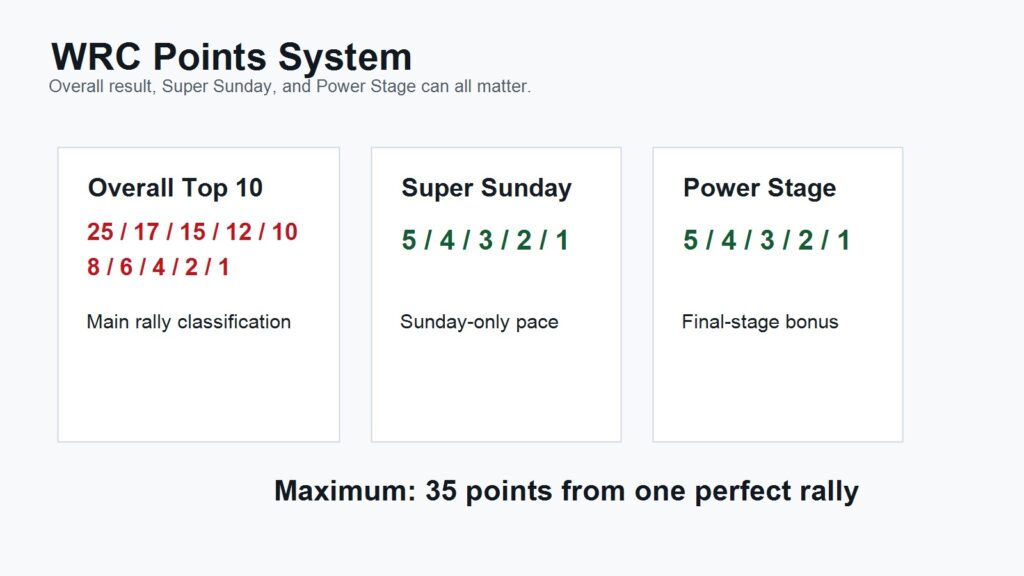
For 2026, the main rally classification awards points to the top 10 finishers using this scale:
25 / 17 / 15 / 12 / 10 / 8 / 6 / 4 / 2 / 1
There are also extra points available on Sunday. The top five crews in the Sunday classification can score:
5 / 4 / 3 / 2 / 1
And the rally-ending Power Stage also gives bonus points to the top five:
5 / 4 / 3 / 2 / 1
So a perfect rally can bring a maximum of 35 points.
This system matters because it gives drivers a reason to keep pushing even late in the rally. Even if the overall win is gone, Sunday points or Power Stage points can still change the championship.
The Most Surprising Part: Rally Tires
When watching WRC, one of the first things you might think is:
How do those tires survive this?
That is a fair question.
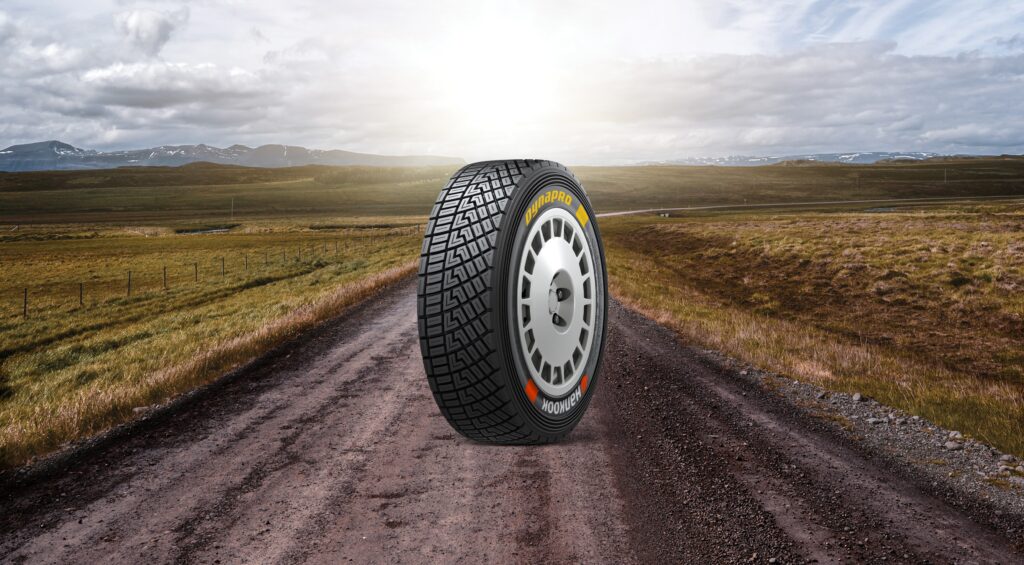
WRC tires are very different from normal road tires. Rally tires must deal with impacts, sharp stones, temperature changes, mud, snow, and huge loads when the car lands after jumps.
A gravel rally tire has deep tread blocks that can dig into loose surfaces. It also needs a strong sidewall to survive impacts from rocks and ruts.
A tarmac rally tire needs precision and grip on paved roads.
Snow and ice tires need to bite into frozen surfaces, sometimes with studs depending on the event and regulations.
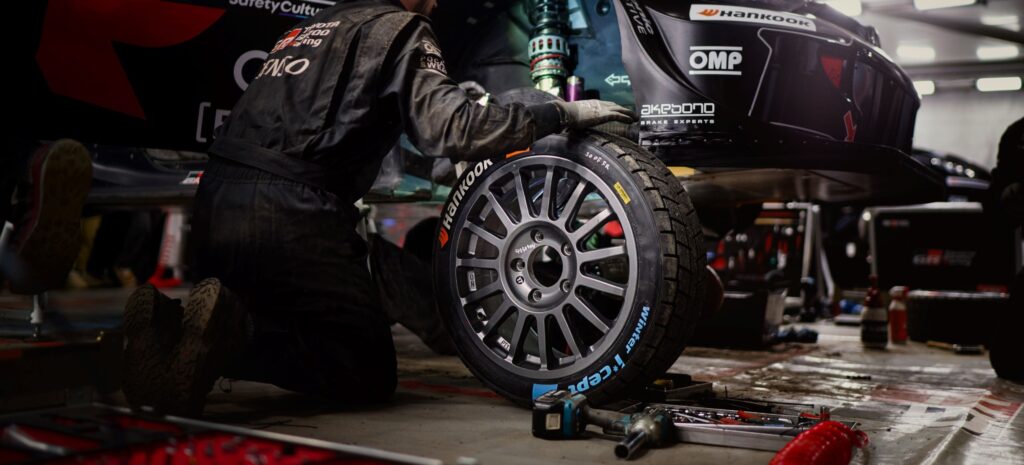
Since 2025, Hankook has been the official exclusive tire supplier for WRC, including top-level and support categories.
But even the best rally tire is not invincible. A sharp rock can still cause a puncture. A damaged sidewall can ruin a stage. A driver who pushes too hard in the wrong place can lose far more time than they gained.
That is why rally driving is not always about driving at 100 percent.
Sometimes, driving at 97 percent is the faster strategy.
How Does a Driver Know Tire Condition?
There is no video game-style display saying:
Tire durability: 72%.
A rally driver has to feel the car.
They use steering feel, vibration, grip level, braking response, car balance, and noise to understand what is happening. If the steering suddenly feels strange, or the rear of the car starts moving differently, the driver may suspect tire damage.
This is one of the reasons WRC drivers seem almost unreal.
They are not only reacting with their eyes. They are reading the car through their hands, feet, body, and ears.
The car is constantly talking to them. The best drivers know how to listen.
Why WRC Driving Looks So Special
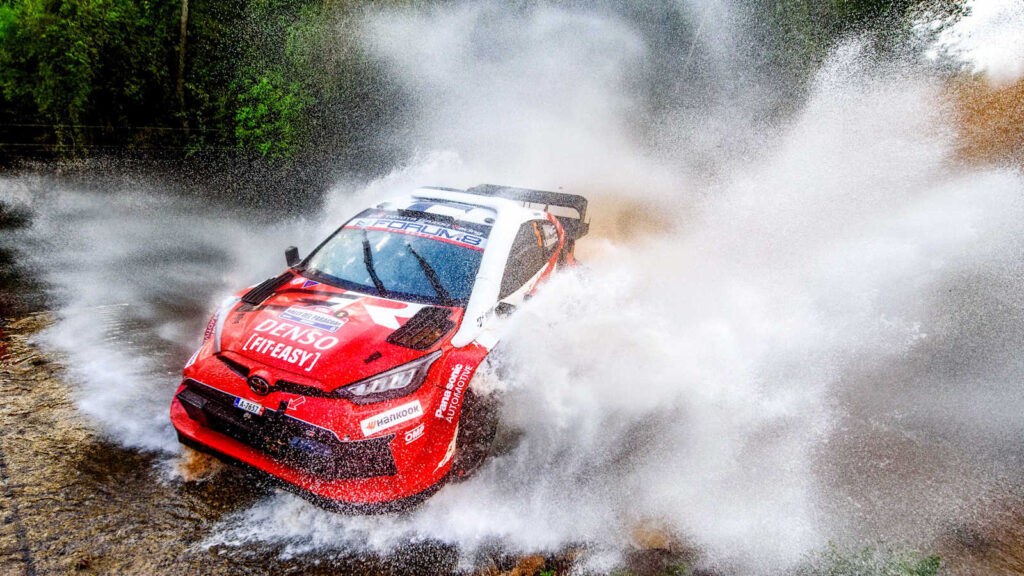
One of the most amazing things in WRC is how drivers rotate the car before a corner.
On normal roads, if a car starts sliding, most of us feel panic. In rally, controlled sliding can become a tool.
Before a corner, the driver may brake hard to move weight onto the front tires. This gives the front more bite. Then they use steering, throttle, braking, and sometimes the handbrake to rotate the rear of the car.
The goal is not just to slide for style.
The goal is to point the car toward the exit as early as possible.
On tight hairpins, drivers may use a technique similar to the Scandinavian flick. The car is briefly moved away from the corner, then sharply turned back in, using weight transfer to help rotate the car.
It looks dramatic, but the real skill is precision.
How much slide?
When to start it?
When to catch it?
When to return to throttle?
That is where rally becomes beautiful.
What Is the Co-Driver Saying?
The co-driver is one of the biggest reasons WRC is so fascinating.
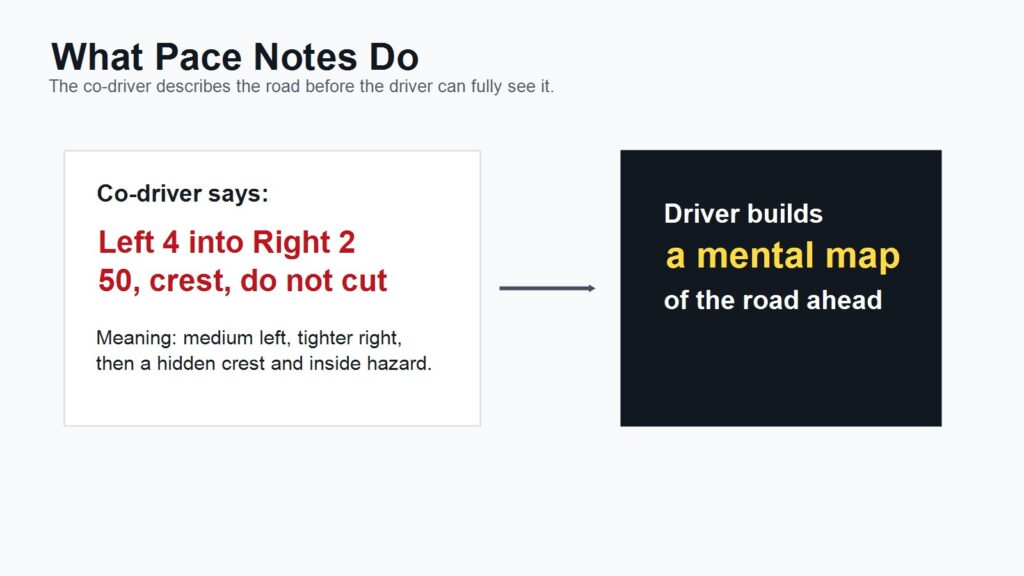
In the passenger seat, the co-driver reads pace notes. These notes describe the road ahead before the driver can fully see it.
For example, a co-driver might say:
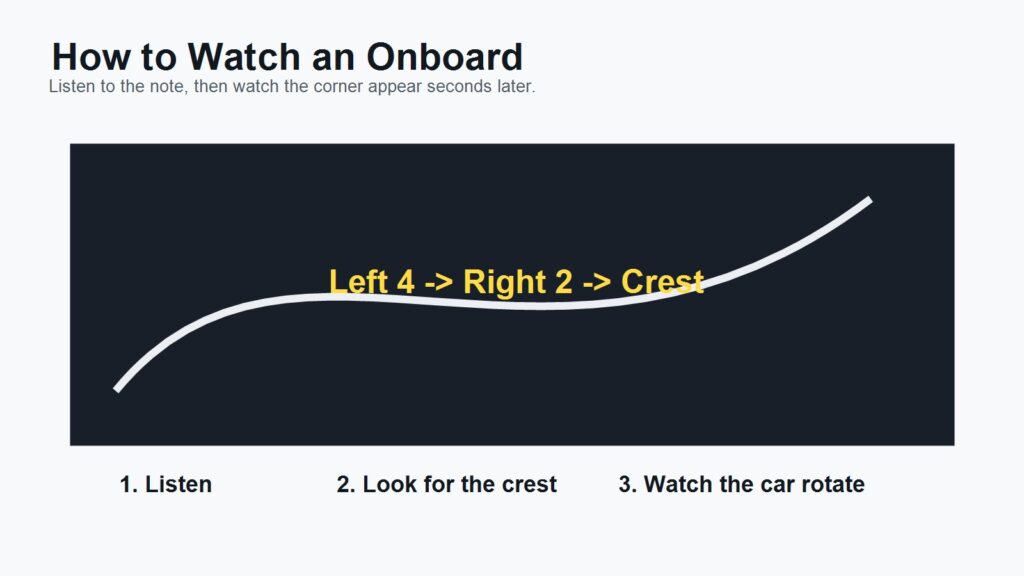
Left 4, into Right 2, 50, crest, do not cut.
In simple language, that means something like:
There is a medium-speed left corner, immediately followed by a tighter right corner, then about 50 meters to a crest, and the driver should not cut the inside of the corner.
The co-driver is not describing what is already happening.
They are describing what is about to happen.
So the driver is doing two things at once: driving the road they can see, while building a mental picture of the road they cannot see yet.
It is almost like receiving live audio data and turning it into a 3D map inside the brain.
Why Pace Notes Are So Important
Pace notes are not just directions.
They tell the driver how fast, how dangerous, and how committed the next section can be.
A simple left or right is not enough. The driver needs to know whether the corner is fast or slow, whether it tightens, whether there is a jump, whether the road drops away, whether mud is expected, or whether cutting the inside could damage the car.
This is why co-driver and driver trust is so important.
If the driver hesitates, time is lost.
If the note is misunderstood, the car can crash.
A good WRC crew is not two people sitting in one car. It is one shared system.
What Skills Does a WRC Driver Need?
A WRC driver needs more than quick hands.
They need reaction speed, but also patience.
They need bravery, but also restraint.
They need to attack, but also protect the car.
At the same time, they are processing:
Current road + next road + surface condition + tire condition + car balance + pace notes + stage time
That is a lot happening at once.
This is why WRC drivers are often seen as some of the best car-control specialists in the world. They are driving incredibly fast on roads that constantly change, while listening to instructions about corners they cannot yet see.
How This WRC Beginner Guide Helps You Watch a Rally
If you are new to WRC, do not try to understand everything at once. A good WRC beginner guide should make the first race weekend feel less chaotic, not turn rally into homework.
Start with five things.
First, watch the stage time. After each special stage, compare how many seconds separate the drivers. Sometimes a huge fight across tens of kilometers is decided by just one or two seconds.
Second, watch the split times. These show how a driver is performing during the stage. A driver might be slower at the first split but faster near the end.
Third, watch the surface. Gravel, tarmac, snow, mud, and ice all change how the car behaves. The same driver can look completely different depending on the road.
Fourth, watch car management. If a road is full of rocks, the fastest-looking line may not be the smartest line. Protecting the tire and suspension can matter more than one perfect corner.
Fifth, listen to the pace notes. Watch an onboard video and notice how the co-driver’s words match what appears a few seconds later. Once that clicks, WRC becomes much easier to understand.
WRC Terms Beginners Should Know
Special Stage means a timed section of road where crews race against the clock.
Road Section means the non-timed public-road route between stages.
Pace Notes are the co-driver’s written and spoken instructions describing the road ahead.
Recce means reconnaissance. Before the rally, crews drive the stages at controlled speed to create or check pace notes.
Service Park is where teams repair and prepare the cars between groups of stages.
Power Stage is the final stage of the rally that awards bonus championship points.
Split Time is an intermediate time check during a stage.
Super Sunday is the Sunday-only classification that can award extra points.
Hairpin is a very tight corner, often requiring heavy braking and rotation.
Crest means the top of a hill where the road ahead may be hidden.
Do not cut means the driver should not drive too far inside the corner, usually because of rocks, ditches, or hidden hazards.
Road Order means the order in which cars run on the stage. On gravel, running first can be difficult because the first car may clean loose stones from the road for others.
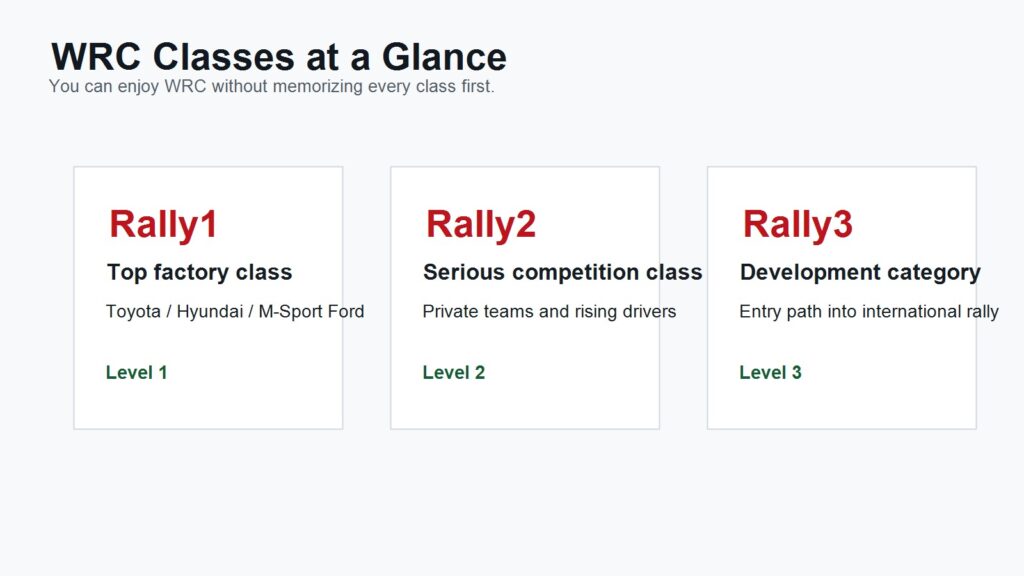
WRC Classes: Rally1, Rally2, and Rally3
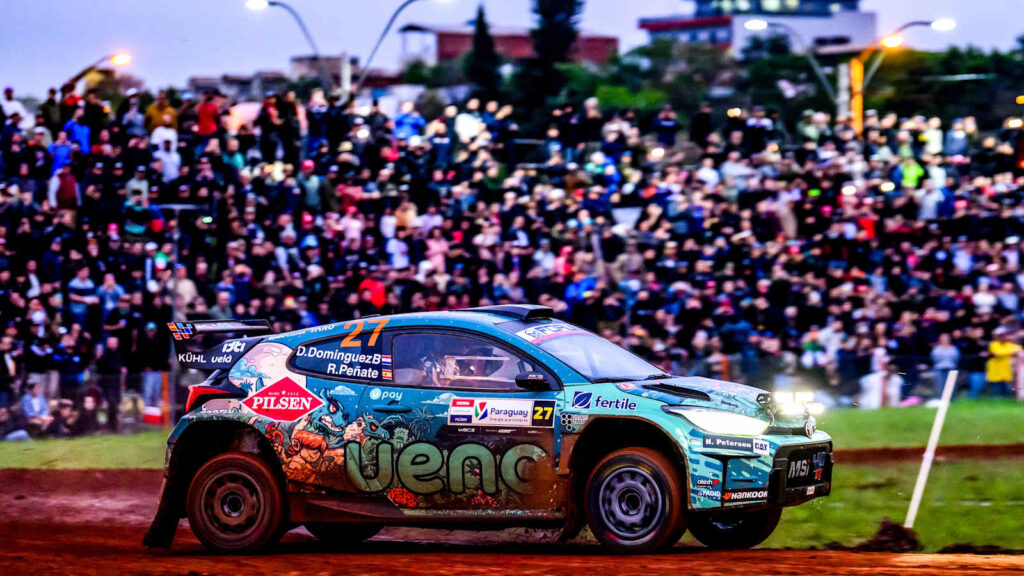
At the top of WRC is Rally1.
Rally1 cars are the fastest cars in the championship and are used by factory-level teams such as Toyota, Hyundai, and M-Sport Ford.
Below that, Rally2 and Rally3 cars create important support categories. These cars are still serious rally machines, but they are generally more accessible and are used by private teams, developing drivers, and different championship classes.
For beginners, you do not need to memorize every class immediately.
Just remember this:
Rally1 is the top class.
Rally2 and Rally3 are where many drivers build careers and where rally competition stays broad.
Common Misconceptions
WRC is just drifting on dirt.
Not really. Sliding can happen, but rally driving is about controlled rotation, grip, timing, and survival. A beautiful slide that destroys the tires is not useful.
The fastest driver always wins.
Not always. The winner is the crew that combines speed, consistency, tire management, car preservation, and smart risk control across the whole rally.
The co-driver is just reading directions.
The co-driver is much more important than that. They provide the information that allows the driver to commit to blind corners, crests, jumps, and hazards at speed.
Rally cars only race off-road.
WRC includes many surfaces. Some rallies are gravel, some are asphalt, some are snow and ice, and some events can mix conditions.
If a driver is not first overall, the rally is over.
No. Sunday points and Power Stage points can still matter for the championship, even when the overall win is out of reach.
Real-world Examples
Rally Finland is famous for speed, jumps, and commitment. The roads are fast, flowing, and often lined by trees. It is one of the best rallies for understanding bravery and rhythm.
Safari Rally Kenya is famous for endurance, dust, rocks, mud, and survival. It reminds you that WRC is not only about speed. It is also about keeping the car alive.
Rally Monte-Carlo is famous for changing conditions. One section can be dry, another can be icy, and tire choice becomes extremely difficult.
Rally Japan often brings narrow asphalt roads where precision matters more than huge slides.
This variety is one of WRC’s biggest strengths. Every rally feels different.
Cariary Thoughts
At first, I thought WRC was simply cars going very fast on rough roads.
That is true, but it is also too simple.
The more I looked into it, the more WRC started to feel like a different kind of intelligence. F1 is incredibly precise, but WRC has this raw uncertainty that feels almost unreal. The driver does not get a perfect circuit. The road is narrow, dirty, broken, wet, icy, or blind. And still, the car has to be placed exactly where it needs to be.
What surprised me most was the role of restraint.
From the outside, rally looks like maximum attack all the time. But actually, the best drivers are constantly choosing how much risk to take. They are not just asking, Can I go faster here? They are asking, Can I go faster here without killing the tire, breaking the suspension, or losing the rally tomorrow?
That makes WRC feel deeply human.
It is not just speed. It is judgment.
And once you start listening to the co-driver’s pace notes, watching split times, and noticing how the car rotates before a corner, WRC becomes much more than a highlight video.
It becomes a conversation between road, machine, and crew.
That is the moment when rally starts to make sense.
One-line Summary
WRC is a battle against time on real roads, where speed, tire management, co-driver trust, car control, and survival all matter as much as raw pace.
FAQ
What does WRC stand for?
WRC stands for World Rally Championship, the top international rally championship organized under the FIA.
How is WRC different from F1?
F1 races happen on circuits with cars racing together. WRC happens on real roads, with cars starting one by one and competing against the clock.
What is a special stage in WRC?
A special stage is a timed section of road. The total time from multiple stages decides the rally result.
Does WRC have a season like F1?
Yes. WRC has multiple rally events across the season. In 2026, the championship has 14 rounds.
How do WRC points work?
The top 10 overall finishers score 25 / 17 / 15 / 12 / 10 / 8 / 6 / 4 / 2 / 1 points. Extra points are also available from the Sunday classification and the Power Stage.
What does a co-driver do in rally?
The co-driver reads pace notes, which tell the driver what corners, crests, hazards, and distances are coming next.
Why are WRC tires so important?
WRC tires must survive rough surfaces while still providing grip. Tire damage can cost a driver minutes or even end the rally.
What is a Power Stage?
The Power Stage is the final stage of the rally and awards bonus championship points to the fastest crews.
Is this WRC beginner guide enough to start watching rally?
Yes. You can start by following stage times, split times, tire choices, surface changes, and pace notes. The deeper technical details become easier once those basics feel familiar.
Is WRC harder than F1?
They are difficult in different ways. F1 focuses on circuit precision, aerodynamics, tire strategy, and wheel-to-wheel racing. WRC focuses on real-road adaptation, pace notes, surface changes, and car control under unpredictable conditions.
Related Thoughts
Sources

