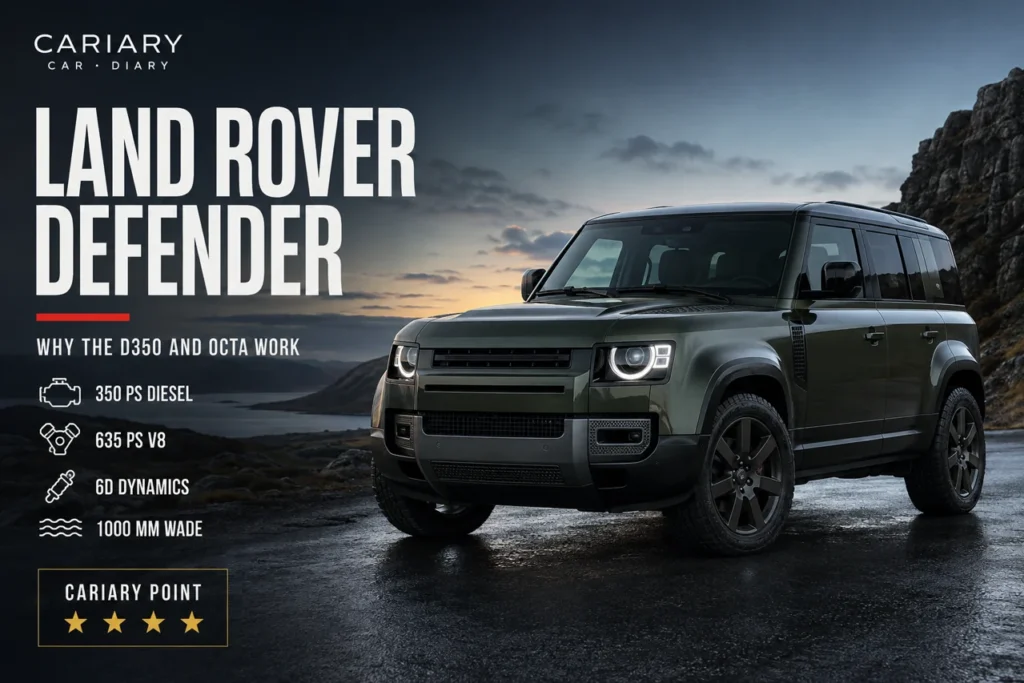
Cover: AI-generated Cariary editorial illustration, checked against the current L663 Defender 110.
This Land Rover Defender review examines why the sensible D350 diesel and the outrageous OCTA reach the same conclusion from opposite directions. One makes a large luxury 4×4 feel effortless every day; the other adds supercar acceleration without discarding the space, comfort and terrain ability that created the appeal.
The central question in this Land Rover Defender review is breadth. A vehicle this tall and visually serious should feel clumsy on an ordinary road, yet independent reviewers repeatedly praise its composure and refinement. It should also be too precious for mud, but the hardware still includes low range, substantial ground clearance and serious wading capacity. The D350 makes that range of ability easy to use. The OCTA tests how far it can stretch.
This is a research-based buyer review of the current UK-market Defender 110 D350 and Defender OCTA. Cariary has not road-tested either vehicle. Manufacturer figures are identified as official claims, and independent measurements retain their test year and market.
Land Rover Defender Review: Quick Verdict
CARIARY POINT: ★★★★ — 4/5. The Defender earns four stars because the D350 combines excellent torque, real long-distance refinement, family usefulness and authentic off-road hardware more convincingly than most luxury SUVs. The OCTA proves the platform has exceptional dynamic range. The missing star reflects its width, weight, cost and complexity, plus the care required when choosing wheels, tyres and seating.
- Best all-round choice: Defender 110 D350 on a comfort-friendly wheel and tyre package.
- Choose OCTA for: extraordinary pace, body control and high-speed off-road ability while keeping a usable five-seat cabin.
- Think twice if: most trips are short urban journeys, parking is tight, or operating cost matters more than capability you may rarely use.
Table of Contents
- Why the Defender formula works
- Why the D350 may be the sweet spot
- What OCTA changes
- How 6D Dynamics works
- Is OCTA better than a G 63?
- Space, seating and body choice
- Running costs and specification
- Cariary Perspective
- Buyer questions

The Defender Formula Works Because the Contradictions Feel Natural
The present Defender uses a unitary body and fully independent suspension rather than copying the ladder-frame construction of its ancestor. Our body-on-frame versus monocoque guide explains why neither structure is universally superior. That decision explains much of its road behavior. The structure can provide the stiffness required for controlled suspension movement, while air suspension on relevant Defender 110 specifications adjusts ride height and helps the vehicle absorb long waves without the separate shudder often associated with traditional heavy-duty 4x4s.
None of that removes the utility brief. A two-speed transfer case remains available across the engines discussed here, and the official specification lists a 3,500 kg maximum braked towing capacity for both the D350 110 and OCTA. Maximum wading depth reaches 900 mm on air-suspended regular Defenders and 1,000 mm on OCTA. Those are capability limits under prescribed conditions, not an invitation to enter unknown water.
The driving position is equally important. The low dashboard, near-vertical pillars and clear body corners make the size easier to judge than the exterior measurements suggest. Cameras help in a parking space and on a trail, but visibility begins with the shape itself. The cabin then balances exposed-looking structural elements and washable surfaces with the refinement expected of an expensive family SUV.
This is why the Defender can make sense without a single off-road trip. Its capability influences the view out, the sense of security, the storage solutions and the way the suspension deals with poor roads. The buyer still pays for hardware, mass and fuel, so the value depends on whether those qualities improve real journeys rather than merely decorating the specification sheet.
The D350 Is the Engine That Explains the Defender
The D350 is a 3.0-litre inline-six diesel mild hybrid producing an official 350 PS and 700 Nm from 1,500 to 3,000 rpm. In the Defender 110, Land Rover quotes 0–60 mph in 6.1 seconds and 0–100 km/h in 6.4 seconds. Those numbers are quick enough to remove any sense that the diesel is a compromise, but the more relevant advantage is the broad torque plateau.
A tall vehicle gathers speed best when the transmission does not need to chase revs. The D350 can move the Defender’s mass with a low-effort surge, settle into a high gear and retain useful response for overtaking. An inline-six layout also supports the smooth, evenly spaced firing character expected in a premium long-distance vehicle. Independent reviews of the D350 consistently describe it as refined and muscular rather than agricultural.
The official 2025 UK technical sheet lists a WLTP combined range of 30.6–33.3 mpg for a five-seat Defender 110 D350, equivalent to roughly 8.5–9.2 L/100 km, depending on equipment. Real use can be worse with short trips, cold starts, accessories, heavy wheels or towing. Even so, the difference from OCTA’s official 20.4–21.7 mpg is large enough to shape ownership.
Diesel also brings a duty-cycle question. The D350 has a diesel particulate filter and uses diesel exhaust fluid. A buyer whose routine consists mainly of short, cold urban trips should ask whether a petrol or plug-in hybrid version better suits that pattern. For frequent motorway travel, towing or long rural distances, the D350’s torque and range make a more coherent case.
For this Land Rover Defender review, the recommendation is specific: choose the D350 because it makes the whole vehicle feel calmer, not because the badge promises maximum output. Keep wheel size sensible, drive it over the rough roads you know, and listen for tyre noise at your normal motorway speed. A Defender can ride beautifully, but the tyre package decides how much of that engineering reaches the cabin.
OCTA Turns Breadth Into the Main Event
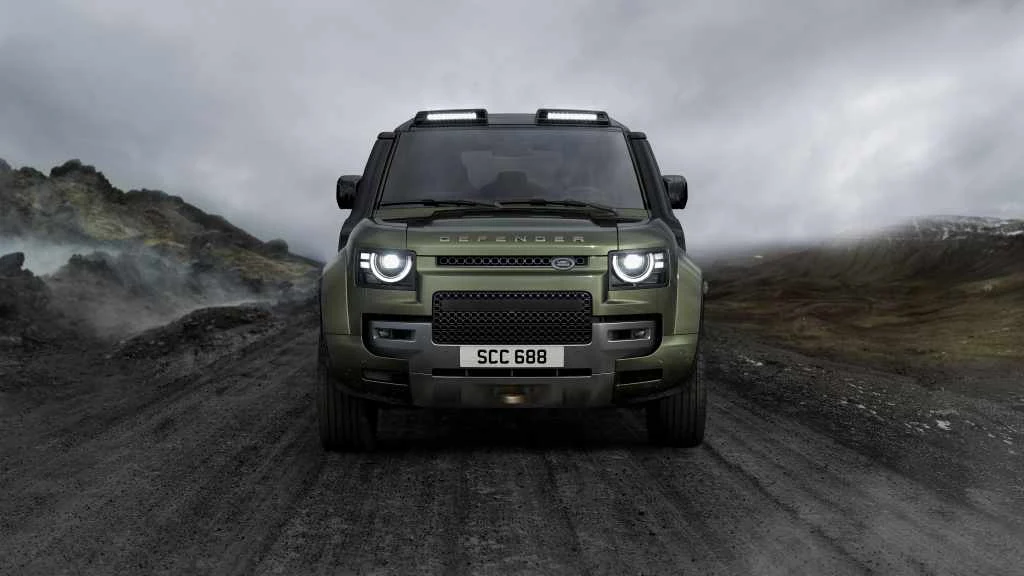
OCTA uses a 4.4-litre twin-turbocharged V8 mild hybrid producing 635 PS and 750 Nm. Land Rover claims 0–60 mph in 3.8 seconds, 0–100 km/h in 4.0 seconds and a top speed of 155 mph on the appropriate road tyre. For a vehicle with a 2,585 kg EU unladen weight, that acceleration is remarkable. It is also only part of the engineering.
The body sits 28 mm higher and the overall stance is 68 mm wider than a regular Defender 110. Dedicated suspension hardware increases wheel travel, 400 mm front brakes handle the additional performance, and OCTA Mode relaxes the electronic controls for loose-surface driving. Buyers choose between road-biased 22-inch tyres, 20-inch all-terrain tyres and more aggressive off-road rubber, each changing the vehicle substantially.
MotorTrend’s instrumented U.S. test illustrates the trade. Its 2026 OCTA reached 60 mph in 4.2 seconds on the road tyre and 4.5 on the off-road tyre. The road-tyre car stopped from 60 mph in 110 feet, versus 124 feet for the off-road version. The numbers do not discredit either tyre; they show why the tyre must match the intended use.
The surprise is that OCTA remains a family vehicle. Auto Express rated the 2026 OCTA Black four stars and found it comfortable and sensible where daily use matters. Top Gear emphasized the same range: the vehicle can cover distance, carry a family and work on difficult terrain while adding a much more playful dynamic character. Those are independent impressions, not Cariary test findings.
The current UK list price begins at £147,245 before options, compared with £74,270 for the Defender 110 X-Dynamic HSE body-style listing. The exact D350 configuration can alter that gap, but OCTA is plainly a different financial decision. It is compelling because the engineering changes are comprehensive. It is rational only when the owner values those changes often enough to justify nearly doubling the starting point.
6D Dynamics Controls Roll and Pitch Without Conventional Anti-Roll Bars
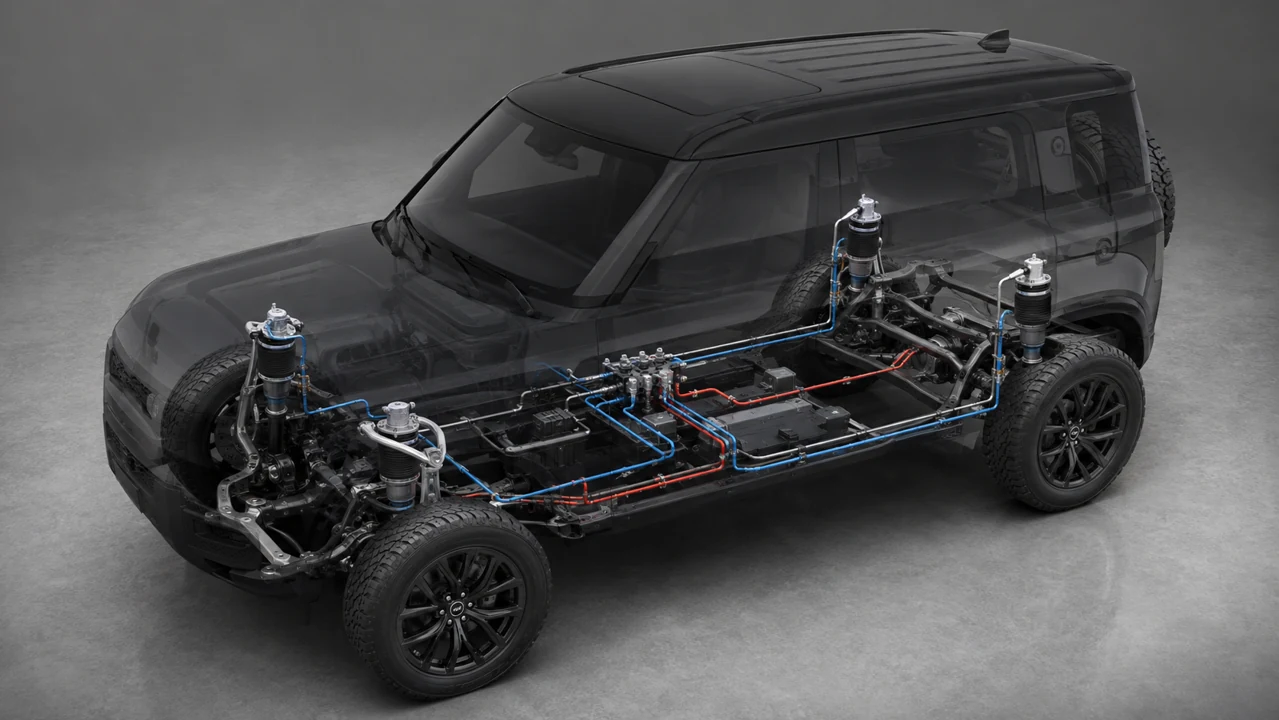
OCTA replaces conventional anti-roll bars with hydraulically interlinked, continuously variable semi-active dampers and air springs. Each damper can control compression and rebound, while the hydraulic network moves pressure across the vehicle. In a corner, the system can resist the outside body compression and inside lift that create roll. Under braking or acceleration, front-to-rear control reduces pitch.
The important distinction is between body control and wheel freedom. A rigid anti-roll bar links left and right wheel movement mechanically, which can limit articulation when one wheel rises on an obstacle. A hydraulic system can build strong roll resistance on road while permitting more independent wheel movement when the terrain requires it. Software and valves vary the response instead of imposing one fixed relationship.
The illustration is intentionally simplified. It does not reproduce pipe paths, valve bodies or component dimensions and must not be used for repair. Its purpose is to show why OCTA can feel unusually flat during fast road driving yet retain the articulation and compliance expected off road.
Is Defender OCTA Better Than a Mercedes-AMG G 63?
The G-Class comparison sharpens this Land Rover Defender review because “better” depends on the job. Our Mercedes-AMG G 63 review explains why the Mercedes is as much a cultural object as a luxury SUV. On official European figures, OCTA has the acceleration advantage: 4.0 seconds to 100 km/h versus 4.4 seconds for the current G 63. The Mercedes counters with 850 Nm against the Defender’s 750 Nm and uses a ladder frame, three selectable differential locks and a more overtly theatrical AMG identity.
For road comfort and mixed-surface speed, the Defender has the more modern conceptual starting point. Its unitary structure, independent suspension and hydraulic roll-and-pitch control allow it to behave more like a contemporary luxury SUV. The G 63 preserves more of the mechanical feel, upright ceremony and status value that define the G-Class. Those differences matter more than a four-tenths claim.
Practicality also favors a careful Defender look. OCTA retains five seats, a broad cabin and up to 2,277 litres of wet loadspace measured behind the first row. Its official 1,000 mm wading depth exceeds the normal situations most owners will attempt. The G 63 remains highly capable, but its appeal is inseparable from design continuity and cultural presence.
The fair conclusion is that OCTA may be the better tool for a buyer who prioritizes ride, high-speed composure, cargo use and serious travel away from smooth roads. The G 63 may be the better object for someone who wants its V8 character, triple-lock hardware, cabin atmosphere and unmistakable social signal. Drive both on broken pavement and at parking speed before using acceleration as the verdict.
The 110 Is the Default Body, but Seating Needs a Decision
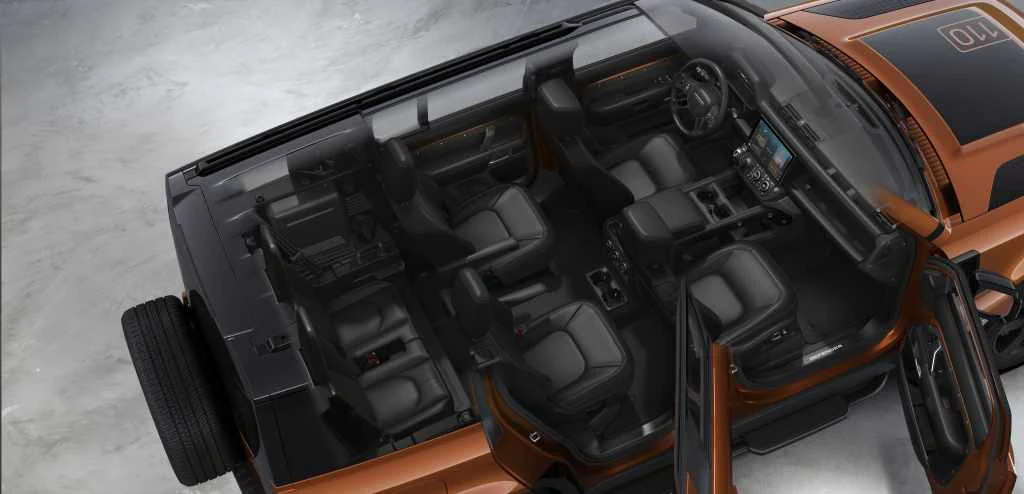
The 110 is the center of the range because it avoids the 90’s access compromise without reaching the 130’s length. The current UK lineup offers five-, six- and seven-seat configurations on relevant 110 versions, although engine and trim combinations vary. For 27MY, a six-seat arrangement with second-row captain chairs adds a clear aisle to the rear pair.
Count usable seats rather than advertised seats. The front jump seat available on some configurations can be clever for occasional use, while a third row changes luggage space and access. Bring child seats, place the front seats correctly and make every regular passenger enter and exit. A photograph cannot establish knee room for your family.
The side-hinged tailgate creates another real-world check. It carries the spare wheel and needs clearance behind the vehicle. In a short garage or tight parallel space, a powered upward-opening tailgate can be easier. The benefit is a full-size spare mounted outside the cargo area and a square aperture once the door is open.
Width is the daily cost of the stance. OCTA is wider again, and its turning and tyre dimensions deserve a parking test. Use the actual entrance ramp, garage opening and narrow road that the vehicle will encounter. Cameras reduce stress; they do not reduce the body.
Buy the Tyres and Warranty Before the Horsepower
Start with the use case. A D350 that regularly covers long distances can exploit its economy and relaxed torque. A diesel used only for short errands may struggle to complete the conditions helpful for particulate-filter regeneration. Ask the retailer to explain the required driving pattern and warning procedure in writing.
Then price the consumables. Large wheels can make the stance more dramatic while increasing tyre cost, noise and damage exposure. OCTA’s road tyre delivers its best braking and lateral performance; the off-road tyres add traction and sidewall but give away measurable road performance. There is no universally correct option.
Obtain insurance quotations for the exact registration and driver before placing a deposit. Also price a full set of tyres, front brake service and the manufacturer’s extended-warranty options. The Defender combines air suspension, cameras, sophisticated driveline electronics and, in OCTA, a complex hydraulic damper network. Complexity does not prove unreliability, but it increases the value of clear coverage and documented maintenance.
This Land Rover Defender review does not have enough controlled long-term evidence to predict reliability, depreciation or repair frequency for a current 27MY build. A used purchase needs a diagnostic scan, complete service records, a check that every camera and height setting works, and an inspection for off-road or towing damage. Reputation should prompt due diligence, not replace it.
Cariary Perspective: The Diesel Gives the Answer, OCTA Adds the Exclamation Mark
Recommended: the Defender 110 D350 for drivers who travel, tow, carry people or simply value a quiet reserve of torque and excellent poor-road comfort. It delivers the qualities that make the modern Defender special without asking the owner to turn every journey into an event.
OCTA recommendation: buy it when the unusual combination itself is the goal. Few vehicles offer this acceleration, suspension control, wading depth and family usefulness in one shape. Its engineering is more interesting than a loud exhaust and faster launch, but the price requires frequent enjoyment of that breadth.
Not recommended: either version for someone who needs an easy city car, dislikes high running costs or cannot accommodate the width and tailgate. The D350 also makes little sense when nearly every drive is short and cold.
The Defender’s achievement is that it does not ask the buyer to pretend. The D350 can be a superb road car because the off-road structure and visibility help it deal with the real world. OCTA can be absurdly fast because its suspension was redesigned to control the body rather than merely stiffened. One is the sensible explanation; the other proves how deep the idea goes.
One-line verdict: The D350 is the Defender most people need, while OCTA is the rare performance flagship that strengthens the original vehicle instead of disguising it.
Land Rover Defender Review: Buyer Questions
Is the Defender D350 fast enough?
Yes for normal road use. Land Rover claims 0–100 km/h in 6.4 seconds for the 110, and the 700 Nm torque peak arrives from 1,500 rpm. Its main advantage is effortless response with passengers or luggage rather than launch performance.
How fast is the Defender OCTA?
The official claim is 0–100 km/h in 4.0 seconds. MotorTrend measured 0–60 mph in 4.2 seconds on road tyres and 4.5 seconds on off-road tyres in its 2026 U.S. test.
Does OCTA ride worse than a regular Defender?
Independent reviewers describe strong comfort and exceptional body control, but tyre choice matters. The road tyre is the best starting point for normal use; aggressive off-road rubber changes braking, noise and steering response.
Is OCTA genuinely better than a G 63?
It is quicker on the manufacturers’ European acceleration figures and may suit buyers who value ride, space and mixed-surface speed. The G 63 offers a different ladder-frame character, three locking differentials and stronger status appeal. Neither wins every criterion.
Is the 6D Dynamics image an exact technical diagram?
No. It is a simplified AI-generated concept based on verified descriptions of air springs, hydraulically interlinked semi-active dampers and roll-and-pitch control. It does not show exact production routing or service geometry.
Which Defender body should most buyers choose?
The 110 is the most balanced starting point. It offers easier rear access and more seating flexibility than the 90 without the additional length of the 130. Confirm the exact five-, six- or seven-seat arrangement before ordering.
Data reference date: September 6, 2026. Current UK-market pricing and specifications unless a source or test is identified as U.S.-market. Prices, equipment and availability may change. Manufacturer performance and capability figures were not independently verified by Cariary.

