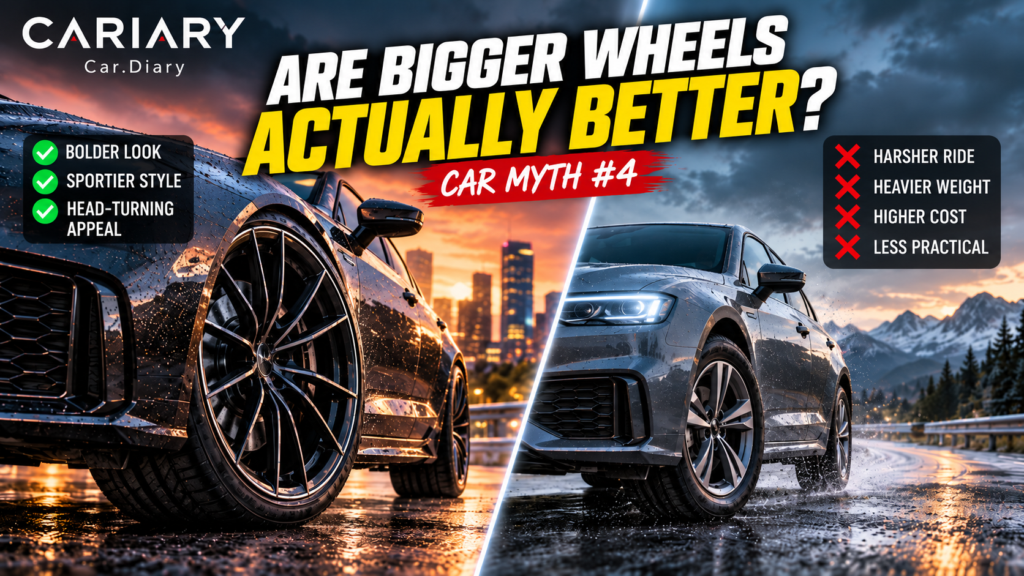
Bigger Wheels can make an ordinary car look like the version we really wanted. The spokes stretch toward the edges, the tire looks leaner, and suddenly the smaller factory option seems a little apologetic. But does that visual upgrade make the car better to drive?
I used to treat wheel size almost like horsepower: more must mean more performance. Studying what actually changes reveals a much more interesting story. A wheel upgrade can sharpen one part of a car’s behavior while quietly making another part worse.
This is Car Myths Part 4. We are not here to declare large wheels bad. We are here to separate the attractive metal circle from the tire, brake and suspension system that has to work around it.
Quick Summary
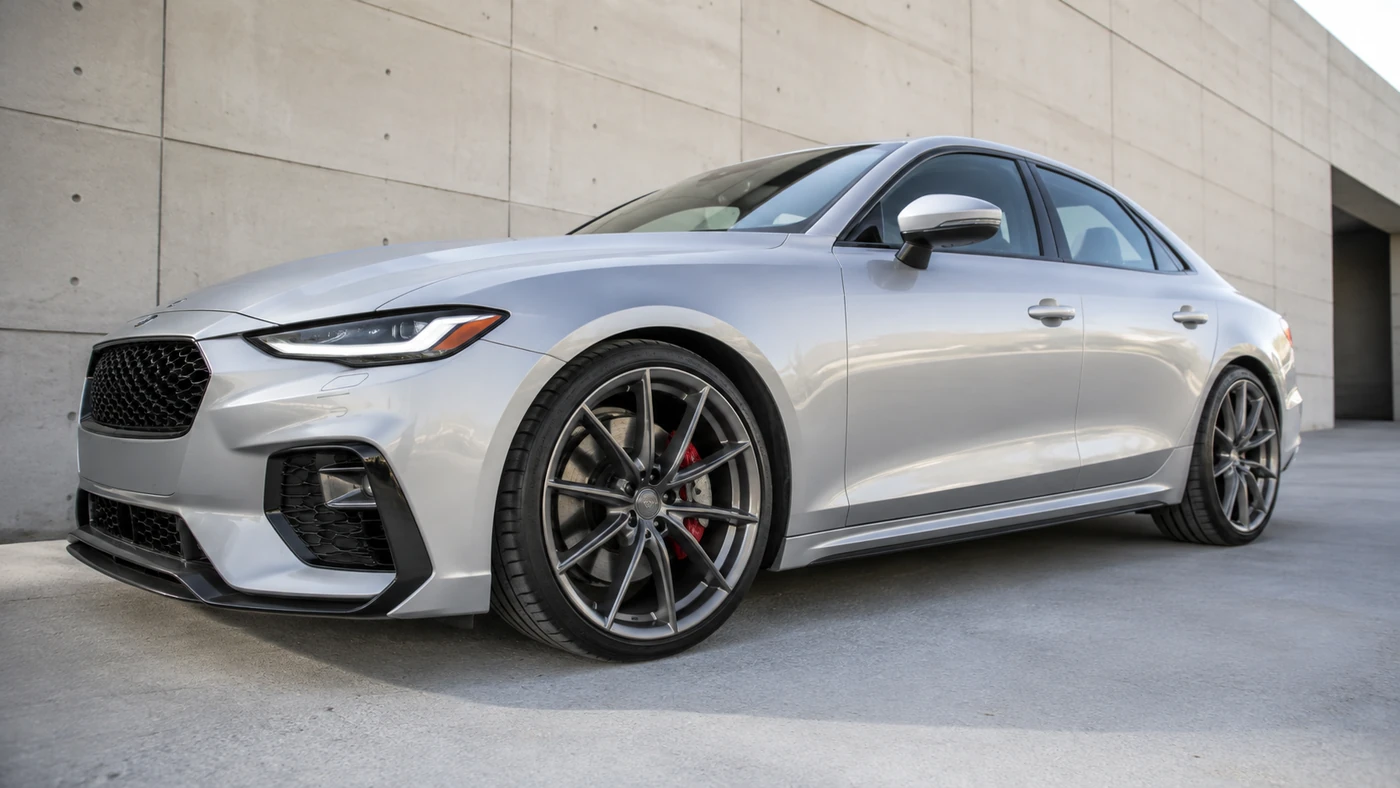
- A larger rim does not necessarily mean a much larger tire on the outside. It often means less sidewall instead.
- Steering can feel more immediate without the tires providing more ultimate grip.
- Brake clearance is a genuine reason to use a larger wheel. Diameter alone still does not guarantee clearance.
- Weight, construction, tire specification and the roads you drive matter more than the inch number by itself.
- The best setup is a compatible wheel-and-tire package with worthwhile benefits, not automatically the largest or smallest available option.
1. Why Bigger Wheels Look Like an Upgrade
A large wheel changes a car’s proportions. More of the visible circle becomes metal, with a thinner black band around it. Designers can use that relationship to make a sedan appear more purposeful or a large SUV less visually heavy.
There is an important distinction hiding in the phrase “fills the wheel arch.” If the tire’s outside diameter stays the same and the suspension height does not change, a larger rim does not actually reduce the gap above the tire. It fills more of the tire’s silhouette with wheel, which changes what our eyes notice.
Large wheels also appear on many expensive trim levels alongside upgraded tires, brakes or suspension. We see all those improvements together and credit the most obvious one. That is understandable, but it is not a controlled comparison.
There is nothing wrong with choosing a look we enjoy. The mistake is calling every styling preference a performance improvement. Before asking whether 20 inches is better than 18, we need to know what else changes.
2. Rim Diameter, Tire Width and Sidewall Are Different Things
The wheel is the metal structure. The tire is the flexible, air-filled assembly around it. In everyday conversation we often call the complete assembly a wheel, but separating them makes this topic much easier.
Consider 225/50R17. The 225 is nominal tire section width in millimeters, not an exact measurement of the tread touching the road. The 50 means the nominal sidewall height is 50% of that width. R indicates radial construction, and 17 is the rim’s bead-seat diameter in inches.
The key is that the middle number is a percentage, not a millimeter measurement. A 40-profile tire is not automatically the same height as every other 40-profile tire. Its width matters too. Michelin’s tire-size explanation is a useful reference for reading the markings.
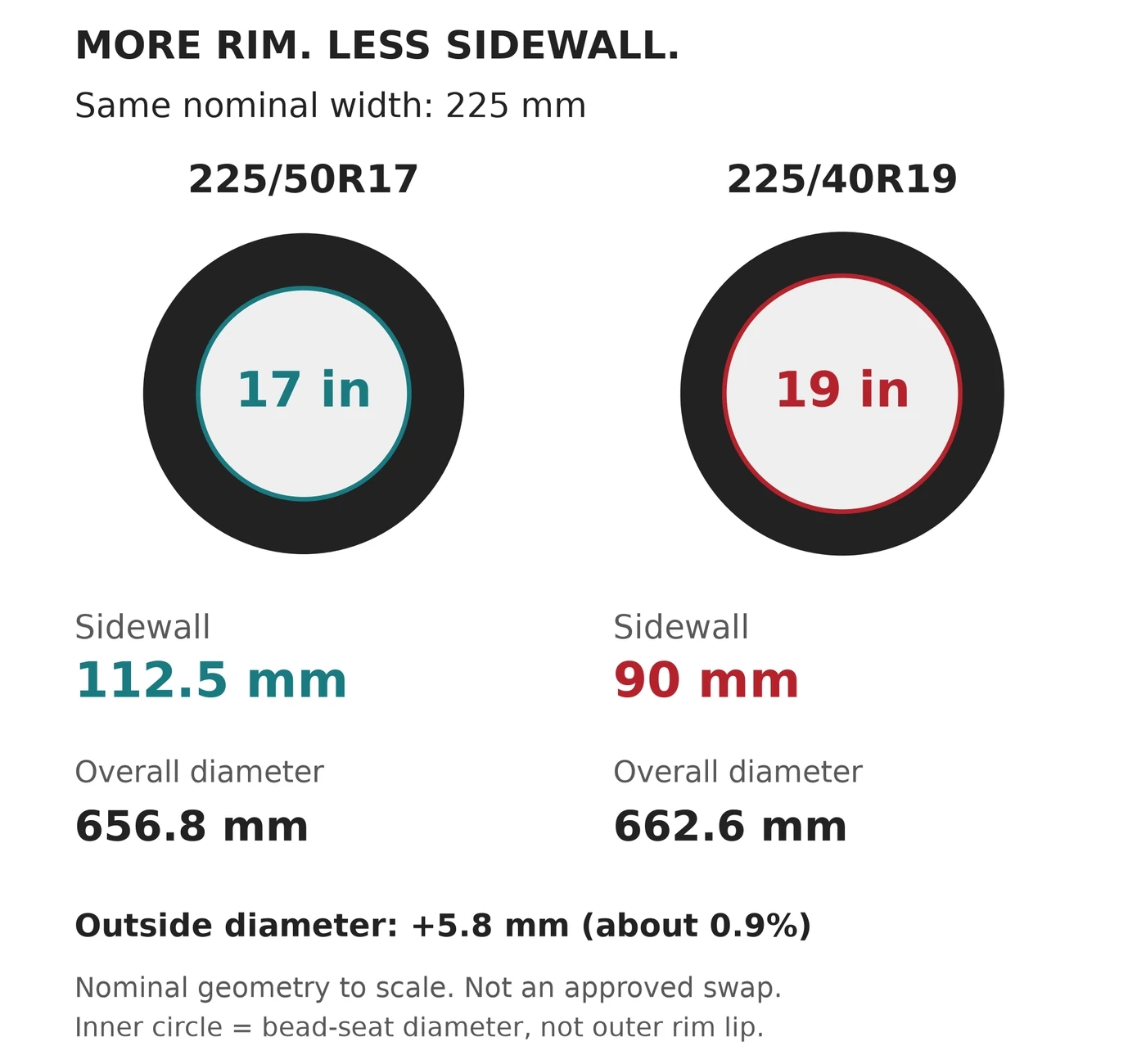
A 17-inch versus 19-inch example
| Nominal dimension | 225/50R17 | 225/40R19 |
|---|---|---|
| Section width | 225 mm | 225 mm |
| Sidewall height | 225 x 0.50 = 112.5 mm | 225 x 0.40 = 90 mm |
| Rim bead-seat diameter | 17 x 25.4 = 431.8 mm | 19 x 25.4 = 482.6 mm |
| Overall tire diameter | 656.8 mm | 662.6 mm |
The metal diameter increases by 50.8 mm, but each sidewall loses 22.5 mm. The overall diameter therefore rises by only 5.8 mm, or approximately 0.9%.
These are nominal calculations, not measured rolling dimensions. Real tires vary with model, approved rim width, pressure, load and wear. The example demonstrates the geometry; it does not establish that the two sizes are interchangeable on your car.
Replacing a rim with a larger one while choosing a lower-profile tire to keep overall diameter close is commonly called plus sizing. Making a tire wider is a separate change. The two examples above are equally wide on the label, even though one uses a much larger rim.
Why overall diameter matters
Change the tire’s rolling circumference substantially and it travels a different distance per revolution. That can alter effective gearing, speedometer accuracy and how the car’s control systems interpret wheel speed. A taller overall tire can act like taller gearing; merely increasing rim diameter while preserving rolling circumference is not the same thing.
Neither change guarantees a higher top speed. The car must still overcome aerodynamic resistance within its available power, gearing and operating limits. An 18-to-20-inch rim change is not a shortcut to a faster maximum speed.
Fitment also includes wheel width, offset, bolt pattern, center bore, fasteners, load capacity and clearance throughout steering and suspension travel. Offset describes where the mounting face sits relative to the wheel’s centerline. It can change where the wheel sits and how forces act through the steering.
A close diameter calculation is only a screening step, not approval. Check vehicle-approved alternatives with a qualified tire specialist, including load and speed requirements, tire-pressure monitoring and any axle-specific sizes. Do not rely on a universal percentage rule. Michelin’s performance-upgrade guidance likewise warns that changes affect more than appearance.
3. Sharper Steering Is Not the Same as More Grip
A tire does not instantly become rigid when we turn the steering wheel. Its structure deforms as cornering force develops. A lower-profile, appropriately constructed performance tire can reduce some of that delay, giving a more immediate initial response.
That is a real benefit. But response describes how promptly the car reacts; grip describes how much force the tire can ultimately transmit. A more direct-feeling tire is not automatically a tire with a higher limit.
Compound, temperature, tread, pressure, road surface and construction all influence grip. Width can change the shape of the contact patch and the tire’s operating behavior, but a wider label does not guarantee a proportionately larger contact area or better wet performance. Rim diameter is an even weaker shortcut.
Imagine a compatible 18-inch setup with excellent tires and a heavier 20-inch setup with less capable tires. There is no engineering reason to award the second car victory from the wheel size alone. The outcome needs an actual comparison under relevant conditions.
On broken pavement, a setup that keeps its tires following the surface can be more useful than one that feels very crisp on a smooth test road. This is where wheel decisions meet the ideas in Suspension and Handling Basics.
Where larger wheels genuinely help: brake packaging
A large brake rotor and caliper need room. Increasing wheel diameter can create the radial space required by a high-capacity brake system, especially one intended to tolerate repeated hard stops.
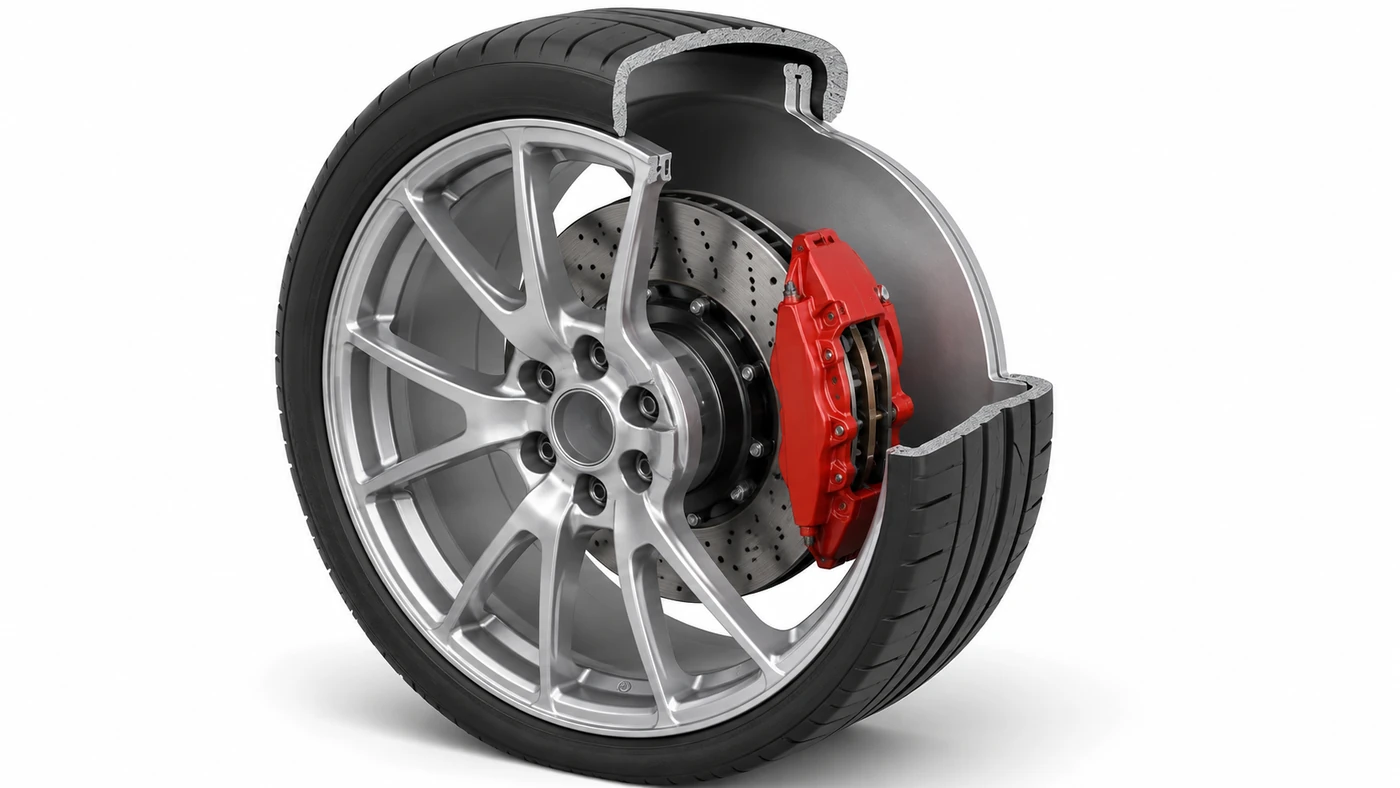
However, a caliper must also clear the spokes. Two wheels with the same nominal diameter can have different inner-barrel shapes and spoke profiles, so one may fit a brake that the other cannot. Race Technologies, a Brembo partner, explains why brake-to-wheel clearance needs the correct profile template, not just an inch measurement.
The distinction matters: the wheel accommodates the brake; it does not supply the brake’s thermal capacity. Fitting larger rims around unchanged brakes does not automatically shorten stopping distances. If a stop is already limited by tire-road traction, more brake hardware alone cannot create extra grip.
Larger brake systems can offer benefits such as heat capacity and resistance to repeated-stop fade, subject to their design. Those are different claims from “a larger wheel brakes better.” Brakes and Tires Basics connects the two systems in more detail.
4. Weight Can Matter More Than the Inch Number
We need to consider the complete assembly: wheel plus tire, not just a bare-wheel catalog weight. Changing diameter, width, load rating or tire construction can change the total in unexpected ways.
As a deliberately fictional example, suppose one 19-inch wheel weighs 10 kg and one 20-inch wheel weighs 14 kg. Four of the second wheels add 16 kg before considering any tire-weight difference. These are teaching numbers, not typical weights for every 19- or 20-inch design.
There are two related reasons that mass deserves attention: the assembly rotates, and it follows the road underneath the suspension springs.
Rotating mass: where the weight sits matters
Accelerating a car also means spinning up its wheels and tires. The resistance to changing rotational speed depends on both mass and its distance from the axis. Moving a given amount of mass farther outward increases its contribution to rotational inertia.
Think of the difference between spinning a weight close to your hand and swinging it at the end of a longer handle. The same mass can be harder to start and stop. This is the principle described by OpenStax’s explanation of rotational inertia.
That does not mean an extra kilogram at a wheel always equals some fixed number of kilograms in the trunk. The comparison depends on radius, mass distribution and the maneuver. Nor does rotational inertia itself continuously consume energy at a perfectly steady speed; it matters when rotational speed changes. Rolling resistance and air drag are separate losses.
Unsprung mass: the hardware following the road
Most of the body is supported by the suspension springs. The wheel, tire, hub and wheel-mounted brake move more directly with bumps. Engineers refer to this road-following portion as unsprung mass.
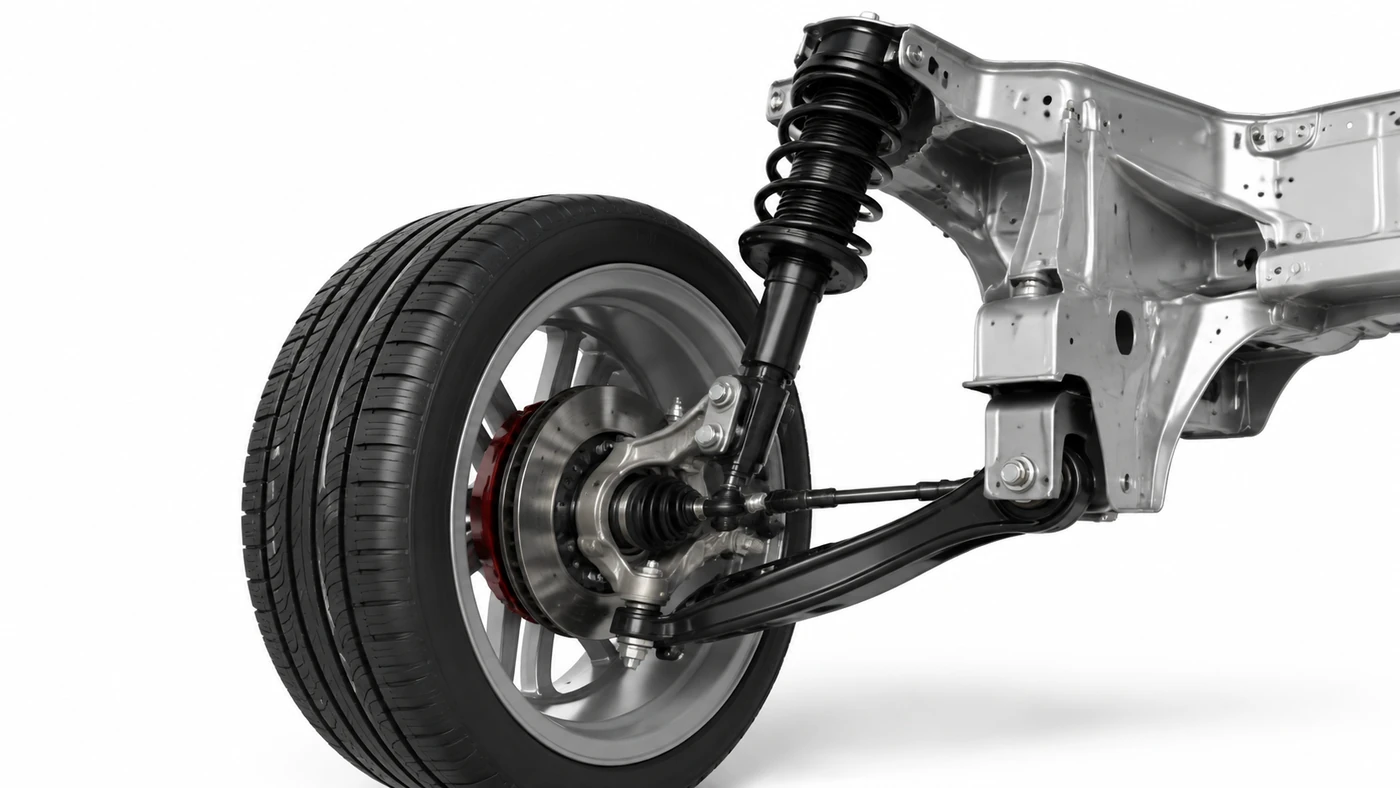
Suspension arms, springs and dampers complicate the boundary because parts of them move by different amounts. It is not simply “everything physically below the spring,” and the brake caliper does not rotate just because it contributes to unsprung mass.
Other things equal, less unsprung mass makes it easier for the suspension to manage wheel movement over uneven ground. The actual result still depends on spring rates, damping and the tire. BMW highlighted reductions in both unsprung and rotating mass when explaining the optional compound wheels for its M4 GTS in its technical press material.
Cast, flow-formed and forged are not the same
Cast wheels are formed from molten metal in a mold. Flow forming starts with a cast wheel blank and mechanically forms the barrel; it does not turn the entire wheel into a fully forged one. Forging shapes solid metal under pressure before further forming and machining.
These processes offer different opportunities to achieve the required strength at a given weight. BBS describes its wheel-manufacturing processes, including flow forming and weight-focused machining.
Forged wheels commonly cost more because demanding forming equipment, processing and machining add expense. Flow forming can offer a useful middle ground. Those are general manufacturing tendencies, not a reliable price or weight ranking between any three products.
A well-engineered larger wheel can therefore be lighter than a smaller wheel built differently. But “forged” is not a promise that every design is light, appropriate or indestructible. Compare actual weight, size, width, load rating and validated fitment. A bigger wheel is not automatically heavy; a premium manufacturing label is not a substitute for specifications.
5. Comfort, Potholes and the Costs We Notice Later
The tire is part of the suspension system. Its air and flexible structure provide compliance before a bump reaches the springs and dampers. A shorter sidewall can reduce the margin available to absorb a sharp road impact, although construction and operating conditions matter greatly.
That helps explain why a larger-wheel option can feel busier over expansion joints and rough city streets. Adaptive dampers may improve body control, but they cannot recreate missing tire sidewall or remove the mass of a heavier assembly.
Consider a luxury SUV offered with compatible 20- and 22-inch packages. If comfort is the goal, the less dramatic 20-inch option may be the more luxurious experience on damaged roads. That is a reason to compare both, not a promise that every smaller package is lighter or quieter.
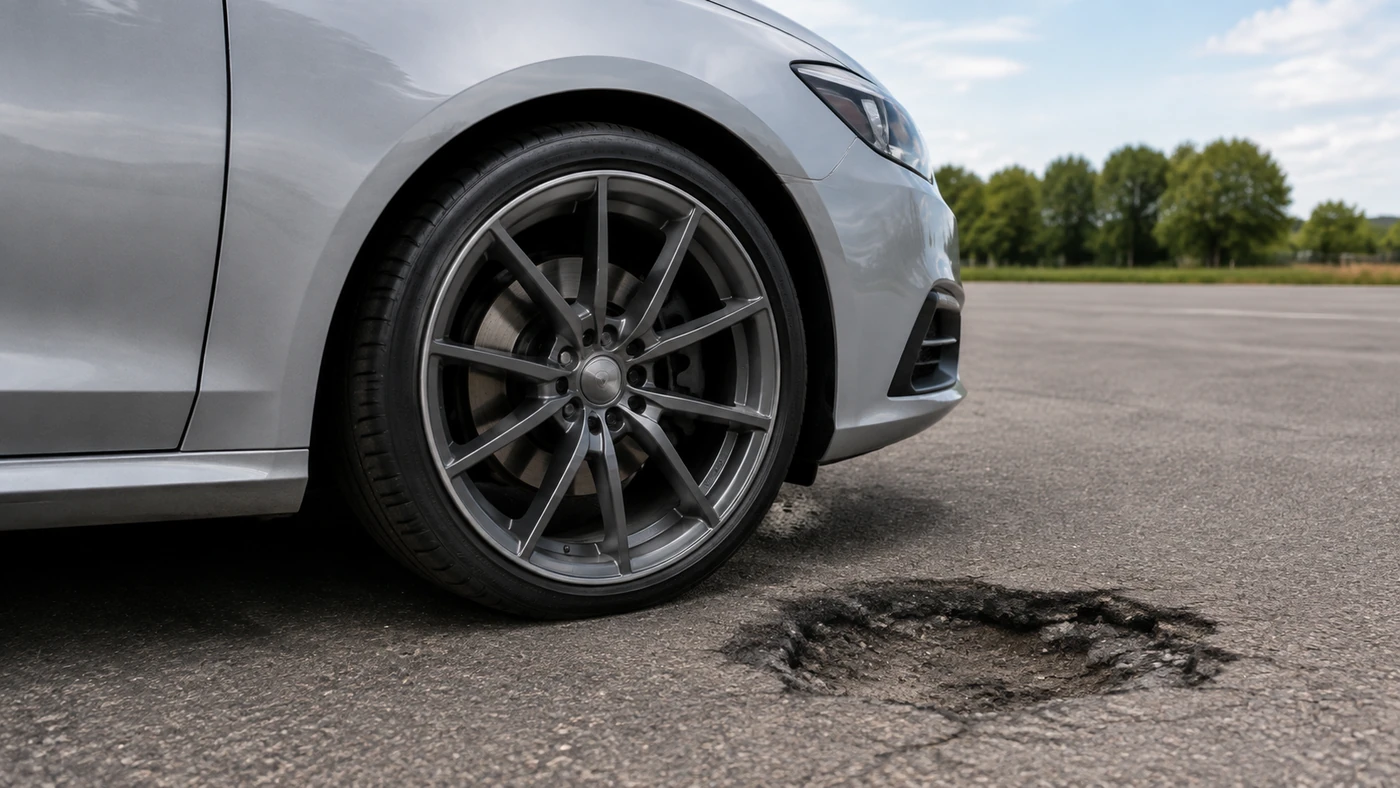
Damage is a risk, not a guaranteed outcome
A sharp impact can damage a tire internally, create a sidewall bulge or deform a wheel. Speed, obstacle shape, pressure and load all influence what happens. A low-profile tire is not guaranteed to fail, and a tall one is not immune.
Do not compensate by deliberately reducing pressure below the vehicle’s requirements. Follow the specified cold pressures for the approved setup and load. After a severe impact, a bulge, pressure loss or new vibration needs prompt professional attention, not reassurance based only on the tire still holding air. Continental’s tire-damage guide explains why impact damage can be more than cosmetic.
Noise and tramlining need separate explanations
A low-profile package may transmit more impact harshness, but road noise also depends on tread design, compound, pavement and the cabin. Larger diameter alone does not predict how loud a tire will be.
Some performance setups are more inclined to follow longitudinal grooves, a behavior called tramlining. Tire characteristics, width, pressure, alignment and wheel offset all contribute. As Tire Rack’s technical explanation makes clear, this is more complex than blaming a particular rim size.
Replacement cost and winter use
Price a complete replacement set before judging the upgrade cost. Larger performance sizes can be expensive, but tire model, availability and specification can reverse a simple small-versus-large price comparison. Wheel repair or replacement is another separate expense.
For winter, some vehicles allow a smaller-diameter wheel with an appropriately sized winter tire, providing more sidewall while retaining the required outside dimensions. This is useful only when the alternative is approved and clears the brakes. A performance model may not accept the smaller wheel fitted to the ordinary version of the same car.
Winter compound and tread are more important than making the rim smaller. A narrower approved tire may suit some snow conditions, but there is no universal rule that narrower is better on every winter surface. Use a matched, vehicle-compatible package rather than inventing a size from appearance. Michelin’s sizing guidance directs owners toward manufacturer-recommended sizes or approved alternatives.
6. Efficiency, EV Range and the Racing Comparison
Several changes can arrive with a larger-wheel option: heavier assemblies, different tires, greater width and different airflow around the wheel. Their effects are not interchangeable. Tire rolling resistance and wheel aerodynamics can matter even when cruising steadily, whereas added rotational inertia is particularly relevant during speed changes.
This is why an efficiency-focused aero wheel can look relatively closed or plain. Its shape can be doing useful work even if a more open-spoke design looks sportier. Brake cooling and other design requirements still have to be considered.
A real package comparison: Hyundai Ioniq 6
The US government’s 2025 Fuel Economy Guide lists the following Hyundai Ioniq 6 rear-wheel-drive configurations, both identified with a 168 kW motor:
| 2025 EPA configuration | EPA-rated range |
|---|---|
| Ioniq 6 RWD, 18-inch wheels | 342 miles |
| Ioniq 6 RWD, 20-inch wheels | 291 miles |
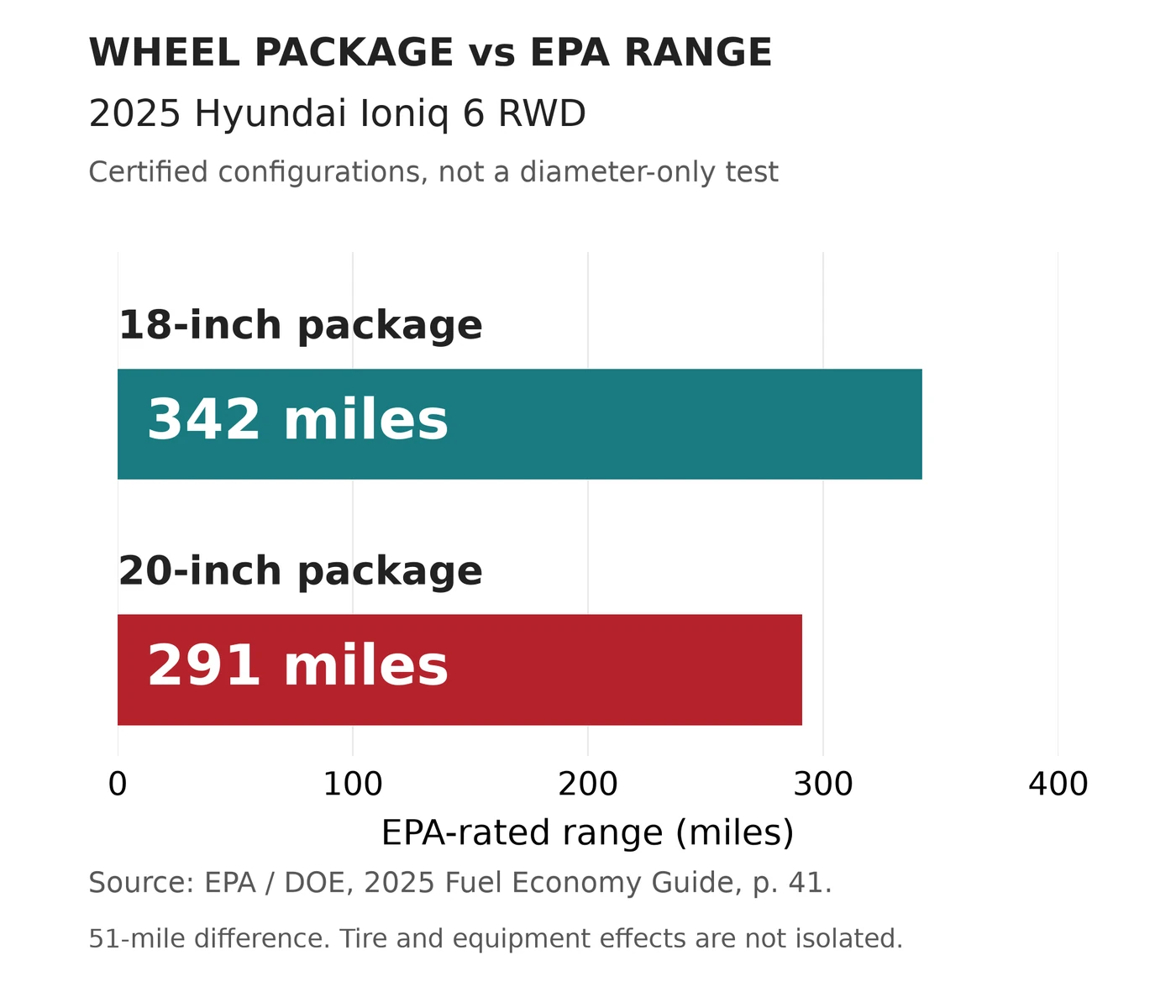
That is a 51-mile difference, roughly 15% relative to the 342-mile figure. It is large enough to show why the wheel-and-tire package deserves attention on an EV. The figures come from the EPA and DOE 2025 Fuel Economy Guide, printed page 41.
But this is not proof that adding two inches to any wheel reduces range by 15%. These are complete certified configurations, not the same car with only rim diameter isolated. Tire specifications, aerodynamic details and associated equipment can contribute. Real-world range also varies with speed, weather and use.
An EV may recover some kinetic energy through regenerative braking, but that does not make additional mass or road and air resistance irrelevant. The sensible question is what the complete package costs in efficiency, not whether electric motors can hide its weight during acceleration.
Why Formula 1 does not settle the argument
F1 changed from 13-inch to 18-inch rims for 2022 as part of a wider technical transition. Pirelli’s explanation includes changes in sidewall, tire behavior and road relevance, not a claim that endlessly increasing diameter makes cars faster. Pirelli’s introduction to the 2022 tires describes the package.
For 2026, the rim diameter remains 18 inches while other tire dimensions change, according to Pirelli’s 2026 announcement. Racing engineers work within regulations and optimize the whole car around its tires, brakes and suspension. A race-car specification is not an instruction to fit the largest wheel available to a road car.
7. What Makes a Better Wheel-and-Tire Package?
Start with the job you want the car to do. Then check whether the proposed package provides a benefit you will actually use.
| Your priority | What deserves attention | What the diameter cannot promise |
|---|---|---|
| Daily comfort on rough roads | Suitable sidewall, tire construction, pressures and suspension | A premium trim will ride better |
| More responsive steering | Tire specification, compatible width and wheel weight | More ultimate grip |
| Repeated hard braking on a circuit | Brake clearance, heat management and suitable tires | Shorter stops from rims alone |
| EV range or fuel economy | Tested configuration, rolling resistance, mass and aerodynamics | A fixed percentage change per inch |
| Winter practicality | Approved winter fitment, tread, compound and brake clearance | Smaller or narrower always wins |
| Appearance | Proportion, finish and personal preference | A measurable performance gain |
A useful comparison keeps the tire category, load requirements and intended use as similar as possible. Otherwise, we may be comparing a touring tire with a track-oriented tire and giving the wheel all the credit or blame.
Ask for complete assembly weights where available. Confirm fitment properly. Compare replacement-tire costs and, when possible, experience the approved alternatives on the kinds of roads you actually use. For the wider relationship between these systems, return to Car Basics for Enthusiasts.
The smallest compatible wheel is not automatically the best either. It might not support the tire response or brake package the car was designed around. There is a sensible middle ground between “bigger is better” and “small wheels are the only intelligent choice.”
Common Misconceptions
“A larger rim always means a wider tire.” No. Width and rim diameter are separate specifications; our 225 mm examples make that visible.
“A stiffer feeling means more grip.” It can mean quicker response or more harshness. The actual traction limit needs evidence.
“A forged wheel cannot be heavy or damaged.” Construction method creates design opportunities, not immunity from load, impact or poor fitment.
“The largest factory option is the engineering winner.” A manufacturer may offer different packages for appearance, response, brake requirements and comfort. Factory availability does not make their tradeoffs disappear.
“A smaller wheel automatically ruins a sporty car.” A lightweight, approved setup with the right tires may suit the job very well. What matters is the complete system.
Cariary Thoughts
The part that changed my thinking was not discovering a downside to large wheels. It was realizing how many different things I had been calling “wheel size.”
I had bundled together the rim, the tire’s width, its sidewall, its compound and sometimes even the brakes. Once those pieces are separated, an upgrade stops being a single upward step. It becomes a set of choices.
I still understand the appeal of a beautifully proportioned wheel. Cars are not spreadsheets, and enjoying how a car looks is a legitimate part of ownership. But I would rather recognize that preference honestly than invent extra grip to justify it.
For an everyday car, the interesting question is no longer “How big can I go?” It is “What would this change improve, and what am I willing to give up?” That question leads to a more thoughtful car, even if the eventual answer is the larger wheel.
One-line Summary
Choose the wheel-and-tire system that suits the car and the road, not the largest number that fits the brochure.
FAQ
Are bigger wheels better for handling?
They can be part of a more responsive package, particularly with suitable lower-profile tires. That does not automatically increase grip or improve behavior over rough roads. Tires, mass, geometry and suspension tuning must be considered together.
Do larger wheels make a car slower?
They can if the complete assembly becomes heavier or its rotational inertia increases significantly. But a larger, lightweight wheel can weigh less than a smaller design, and tire or gearing changes can also affect the result. Diameter alone cannot predict acceleration.
Do 20-inch wheels ride worse than 18-inch wheels?
On the same vehicle with similar outside tire dimensions, the 20-inch package usually has less sidewall and may feel firmer over sharp bumps. Tire construction, pressure and suspension calibration can alter that comparison substantially.
Will larger wheels improve braking?
Not by themselves. They may provide space for a larger brake package, but the wheel must clear the caliper and spokes correctly. Stopping distance also depends on tires and road conditions; repeated-stop heat resistance is a separate benefit.
Can I fit smaller wheels for winter?
Only with a compatible, approved package that meets the vehicle’s requirements and clears its brakes. Keep the specified load capacity, required rolling dimensions and other fitment constraints. Proper winter tires matter more than the smaller rim itself.
Will changing wheel size affect the speedometer?
Changing rolling circumference can. Increasing rim diameter while selecting a suitable lower-profile tire may keep circumference close, but nominal arithmetic does not establish compatibility or calibration accuracy. Check the approved specification.
Are forged wheels always better than cast wheels?
No manufacturing label answers every question. Forging can enable excellent strength-to-weight performance, but actual design, weight, load rating, quality and fitment still matter. A properly engineered cast wheel can be entirely appropriate for its intended use.
What should I check before buying a wheel upgrade?
Confirm approved tire sizes, load and speed requirements, wheel dimensions and mounting hardware, brake and body clearance, pressure guidance and TPMS compatibility. Then assess complete assembly weight, replacement costs and the intended benefit with a qualified specialist.
Related Thoughts
- Brakes and Tires Basics: understand what really creates stopping force
- Suspension and Handling Basics: how tires and suspension follow the road
- Car Basics for Enthusiasts: connect the complete vehicle
References
- Michelin: reading tire sizes
- Michelin: performance upgrades and plus sizing
- Michelin: changing tire size or specifications
- Race Technologies: measuring brake-to-wheel clearance
- OpenStax: rotational inertia and kinetic energy
- BMW: M4 GTS technical press material
- BBS: wheel-manufacturing processes
- Continental: identifying tire damage
- Tire Rack: understanding tramlining
- EPA and DOE: 2025 Fuel Economy Guide, printed page 41
- Pirelli: introduction of 18-inch F1 tires for 2022
- Pirelli: 2026 F1 tire dimensions and compounds
Research checked September 7, 2026. Dimensional examples use nominal arithmetic; the weight example is fictional. EPA figures describe 2025 US configurations. Generated images are educational illustrations, not product photographs, fitment templates or Cariary test evidence.

