Does Stiffer Suspension really mean better handling? It is easy to think so. The car leans less, reacts sharply and sends every change in the asphalt through the seat. After a few corners, “this feels sporty” can quietly become “this must have more grip.”
That was the assumption we wanted to unpack. A suspension can be too soft for its task, but it can also be too stiff to let the tires work well. The goal is not the least visible movement. It is useful, predictable control of the car and its contact with the road.
Quick Summary
- Springs support the vehicle and resist displacement; dampers control the speed of suspension movement. They are not interchangeable ways of making a car hard.
- A flat-looking body does not prove high grip. Lateral load transfer still occurs even when body roll is almost invisible.
- Excessive stiffness, unsuitable damping or inadequate travel can make rough-road tire loads less consistent. Excessive softness can also compromise control and use up travel.
- Anti-roll bars change cornering balance as well as body roll. Stiffening the front and rear can have different effects.
- The right setup depends on the tires, geometry, vehicle load and surface. Comfort and capable handling are not automatically opposites.
Why Stiffness Is So Convincing
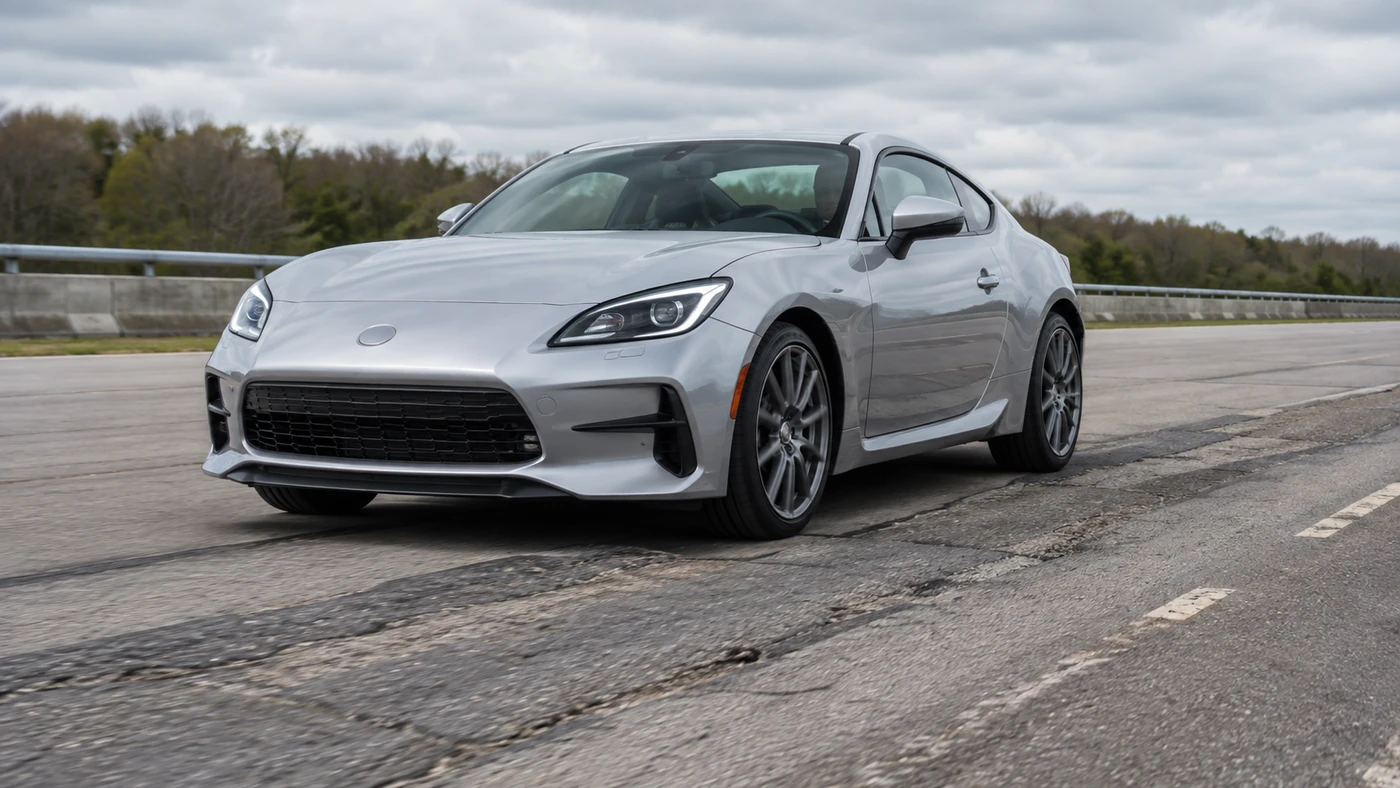
A firmer car often changes direction with less delay and less visible lean. It may also pitch less under braking and squat less under acceleration. Those changes are immediately noticeable, so it is understandable that we associate them with control.
Grip is harder to judge from the driver’s seat. A brief impact tells you the car is firm; it does not tell you how much cornering force the tires can produce. A chassis that feels busy can be communicating road texture, struggling to absorb it, or both.
This is why the myth survives. Stiffness is obvious during an ordinary drive, while the difference between reassuring response and higher limits requires much more careful evaluation. You do not need to explore those limits on public roads to understand the distinction.
1. Stiffer Suspension Must Still Let the Tires Follow the Road
Suspension has several jobs: supporting the vehicle, controlling wheel alignment as it moves, isolating some road disturbances and managing body motion. For handling, the key is to keep the tires usefully loaded and oriented, not merely touching the surface.
Think about a wheel meeting a bump. It needs room to move upward relative to the body, then extend again as the surface falls away. If the whole car had to copy every small movement of the road, both the occupants and the tires would have a much harder job.
Engineers therefore work on two related problems. Body control means managing roll, pitch, squat and vertical movement. Wheel control means allowing the wheel to follow the surface without unnecessary bouncing or large fluctuations in tire load.
Neither can be maximized in isolation. A soft setup with inadequate control can feel delayed and run out of travel. An excessively resistant setup may jolt over disturbances and struggle to let a wheel recover between them. The Suspension Basics guide introduces the parts behind that balance.
Firm, Harsh and Bouncy Are Different Descriptions
| Feeling | What it may describe | What it does not prove |
|---|---|---|
| Firm | Noticeable but controlled movement, with a predictable response | Maximum cornering grip |
| Harsh | Abrupt impacts transmitted into the body | High-quality damping |
| Bouncy | Repeated movement after a disturbance | A spring that is necessarily too stiff |
| Compliant | Willingness to accommodate road irregularities | Poor handling or weak body control |
A well-developed sports car can be firm without being needlessly harsh. A comfortable car can also settle neatly after a bump. These are outcomes of a complete design, not guarantees attached to a price, badge or suspension label.
2. Springs Resist Movement; Dampers Control Its Speed
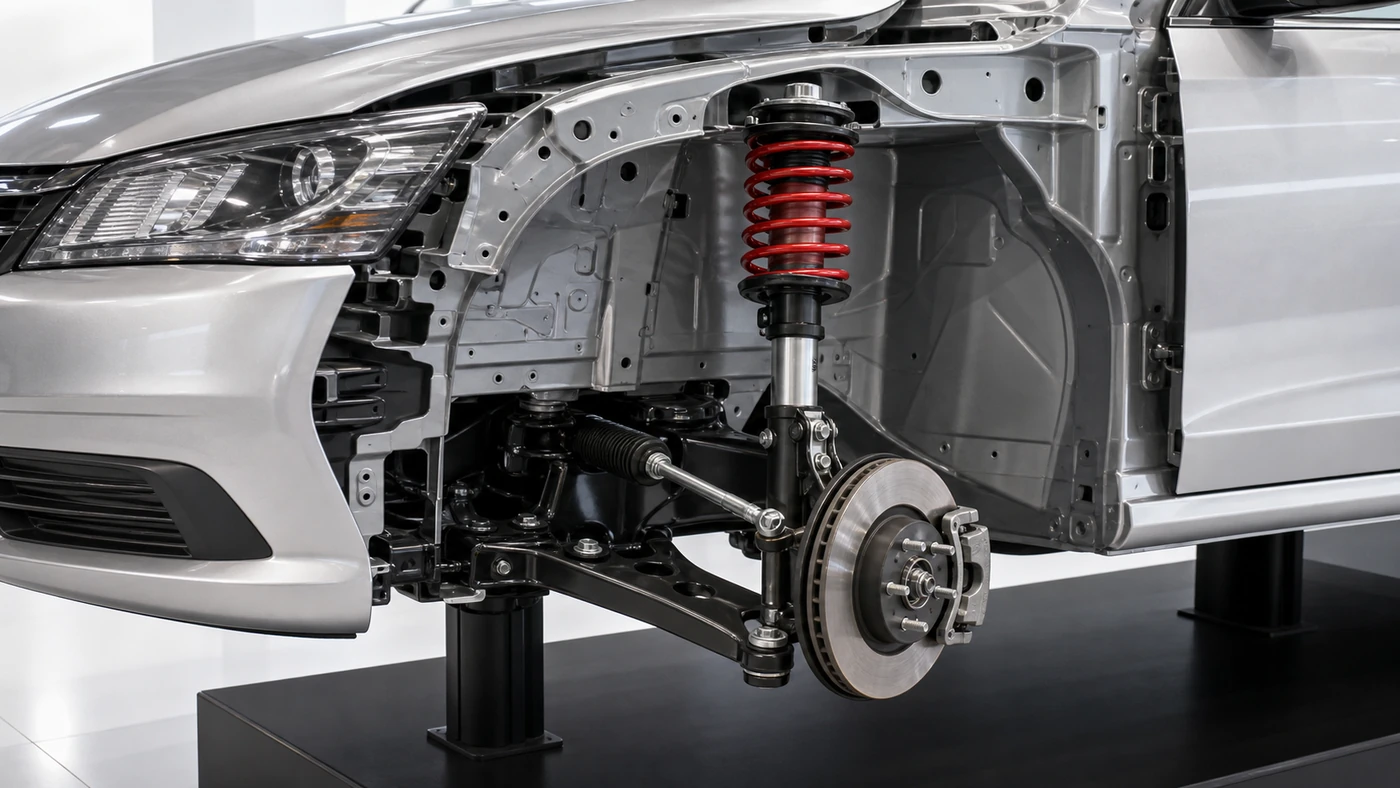
A spring stores energy as it compresses and returns energy as it extends. Its spring rate tells us how much extra force is needed for a given additional compression. A linear 30 N/mm spring needs another 30 newtons for each extra millimeter; a 60 N/mm spring needs twice that.
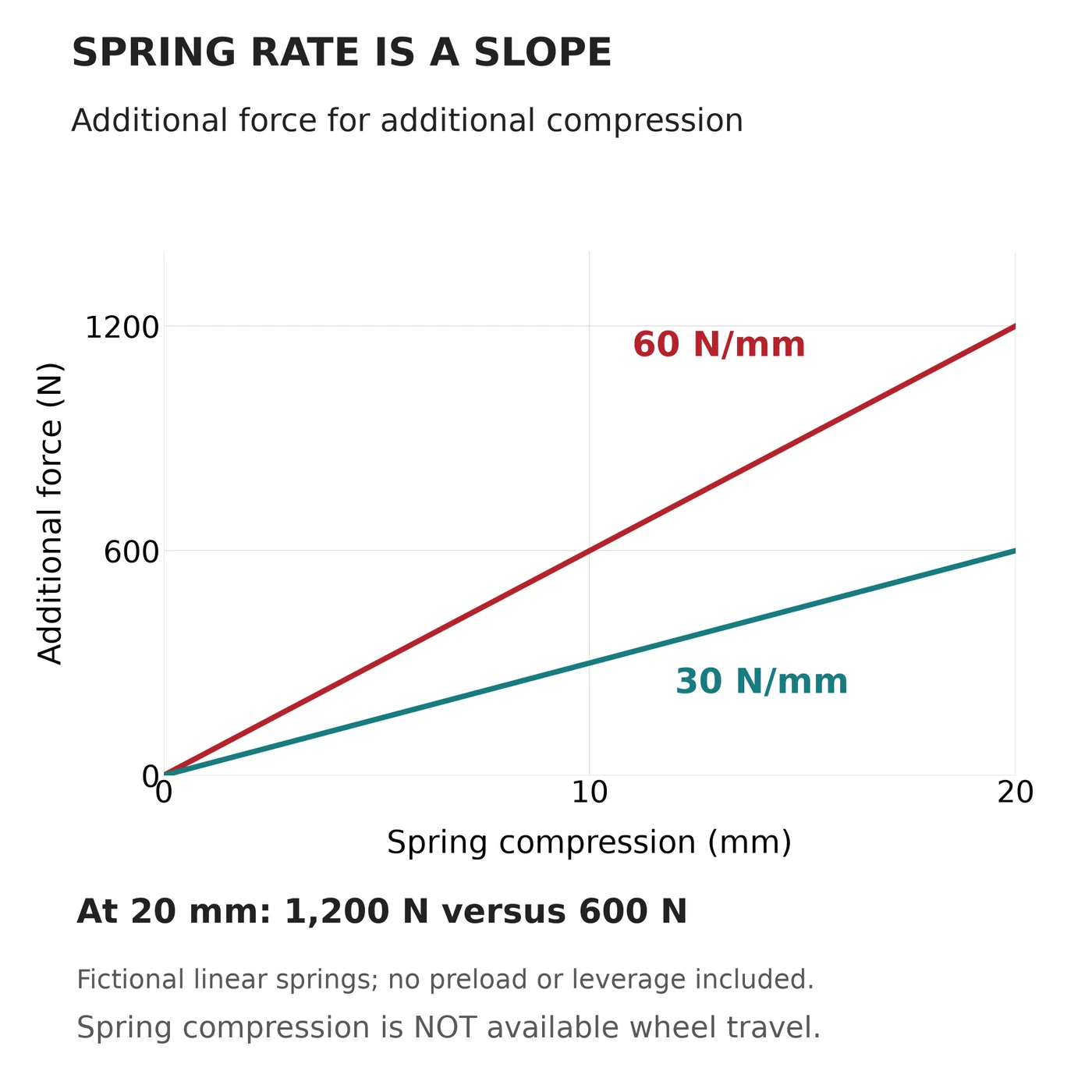
Under an additional 600 N, the first spring compresses another 20 mm and the second another 10 mm. That is a comparison of force and displacement, not a statement that one suspension has half the available travel.
Wheel movement also depends on where the spring attaches to the suspension arm. This leverage means spring rate and wheel rate are not necessarily the same. Comparing two coil springs without their installation geometry can mislead us before the car has moved an inch.
Progressive springs change rate as they compress. Air springs and elastomer bump stops can also have changing force characteristics. There is no single stiffness number that describes every suspension in every position.
Why the Spring Needs a Damper
Without enough damping, energy can keep moving between the spring and the vehicle, producing repeated oscillation. A damper resists relative motion and dissipates energy, largely as heat in its fluid. Its behavior depends on motion speed, valving, temperature and other design details.
Compression damping acts while the damper shortens. Rebound damping acts while it extends. Penske’s damper-tuning manual treats both as part of keeping the tire working with the spring, rather than simply making the suspension harder.
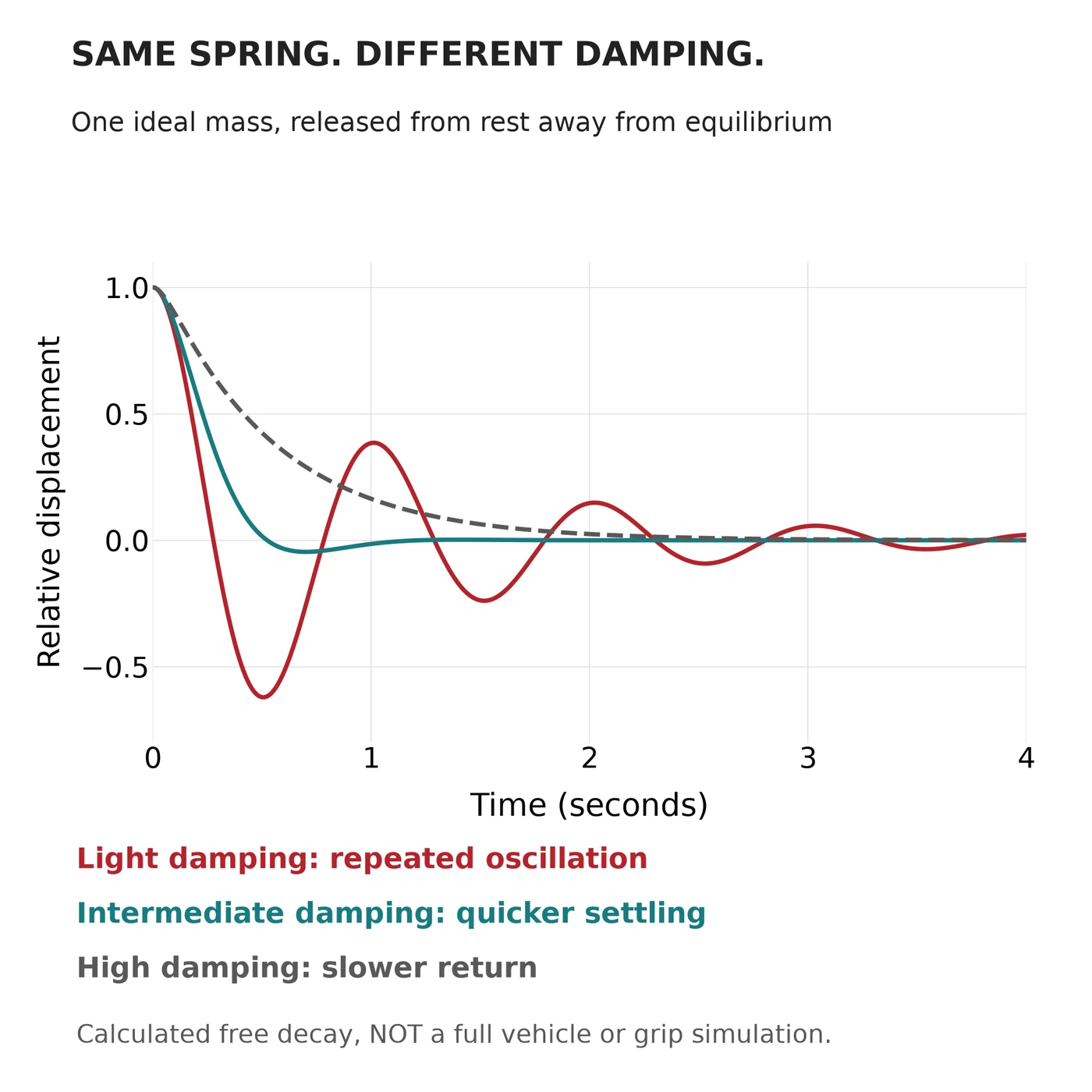
Our calculated illustration holds the ideal mass and spring constant and changes only damping. Light damping allows repeated movement; a higher intermediate level settles the model more quickly; very high damping makes its return slow. The underlying idea is explained in OpenStax’s damped-oscillation chapter.
This is not a full suspension simulation. Real cars have moving wheels, tires, road inputs and nonlinear dampers, so the curve is not a recipe for a particular adjustment. It simply shows why “more damping” cannot be treated as “better” without asking what movement we are trying to control.
Too Much Control Can Become Resistance to Recovery
Excessive rebound damping can prevent the suspension from extending sufficiently between repeated bumps. It can then work progressively lower in its travel, leaving less room for the next compression. Too little damping can let it continue moving when we want it to settle.
Likewise, excessive compression resistance can make sharp disturbances feel harsh. Öhlins’ automotive owner’s manual explicitly distinguishes bouncy behavior from hard, bumpy responses. We should not diagnose either from spring stiffness alone.
One terminology trap is worth remembering: high-speed and low-speed damping refer to damper-shaft speed, not vehicle speed. A sharp road edge can create a fast damper movement even when the car is traveling slowly. Turning every adjuster to its firmest position is not an engineering strategy.
3. Travel Is Working Space, Not Wasted Space
Suspension travel is the movement available between its extension and compression limits. From normal ride height, it needs room both to compress over raised surfaces and to extend into depressions. The amount used during one event is different from the total movement physically available.
Lowering a car on unsuitable hardware can reduce its remaining compression margin. If a large bump uses that margin up abruptly, the effective resistance rises and the tire load can change sharply. A car can look beautifully settled in a photograph yet have too little working room on a real surface.
Bump-Stop Contact Is Not Automatically a Failure
A bump stop is not necessarily a solid block that appears only after everything has gone wrong. Many designs use a compressible elastomer as a progressive secondary spring near the end of travel. Eibach describes that purpose in its bump-stop explanation.
Properly managed engagement can be part of the intended suspension behavior. Repeatedly striking the end of travel harshly, coil binding or an unsuitable bump-stop relationship is a different issue. The problem is uncontrolled or inappropriate loading, not the mere existence of a bump stop.
That distinction matters when someone proposes removing or cutting parts to make a lowered car feel softer. Do not treat bump stops as disposable obstacles. Vehicle-specific instructions and qualified assessment matter, because spring retention, damper stroke, clearances and geometry all interact.
Coilovers Are a Layout, Not a Quality Certificate
A coilover places a coil spring around a damper; aftermarket kits often add adjustable height and damping. Those features can be useful, but adjustment range does not prove that the operating range suits the car.
An ill-matched kit can have unsuitable rates, inadequate damping, insufficient travel or problematic geometry at its chosen height. Low price alone does not establish those faults, and a high price does not guarantee a good installation. The meaningful question is whether the complete package is designed, installed and set up for the application.
Bilstein’s lowering guidance emphasizes matching springs and dampers. A shorter spring on an otherwise unchanged suspension is not automatically the same proposition as a properly engineered lowered system.
4. A Flat Body Still Transfers Load
This is the part where we had to separate what the car looks like from what the tires experience. During cornering, the outside tires generally carry more vertical load and the inside tires less. Making the body roll less does not make that redistribution disappear.
For a simplified vehicle on a flat road, the amount transferred from the inside side to the outside side depends on mass, lateral acceleration, center-of-gravity height and track width. Track width is the sideways distance between the wheel centers. Body-roll angle is not needed in the simplest relationship.
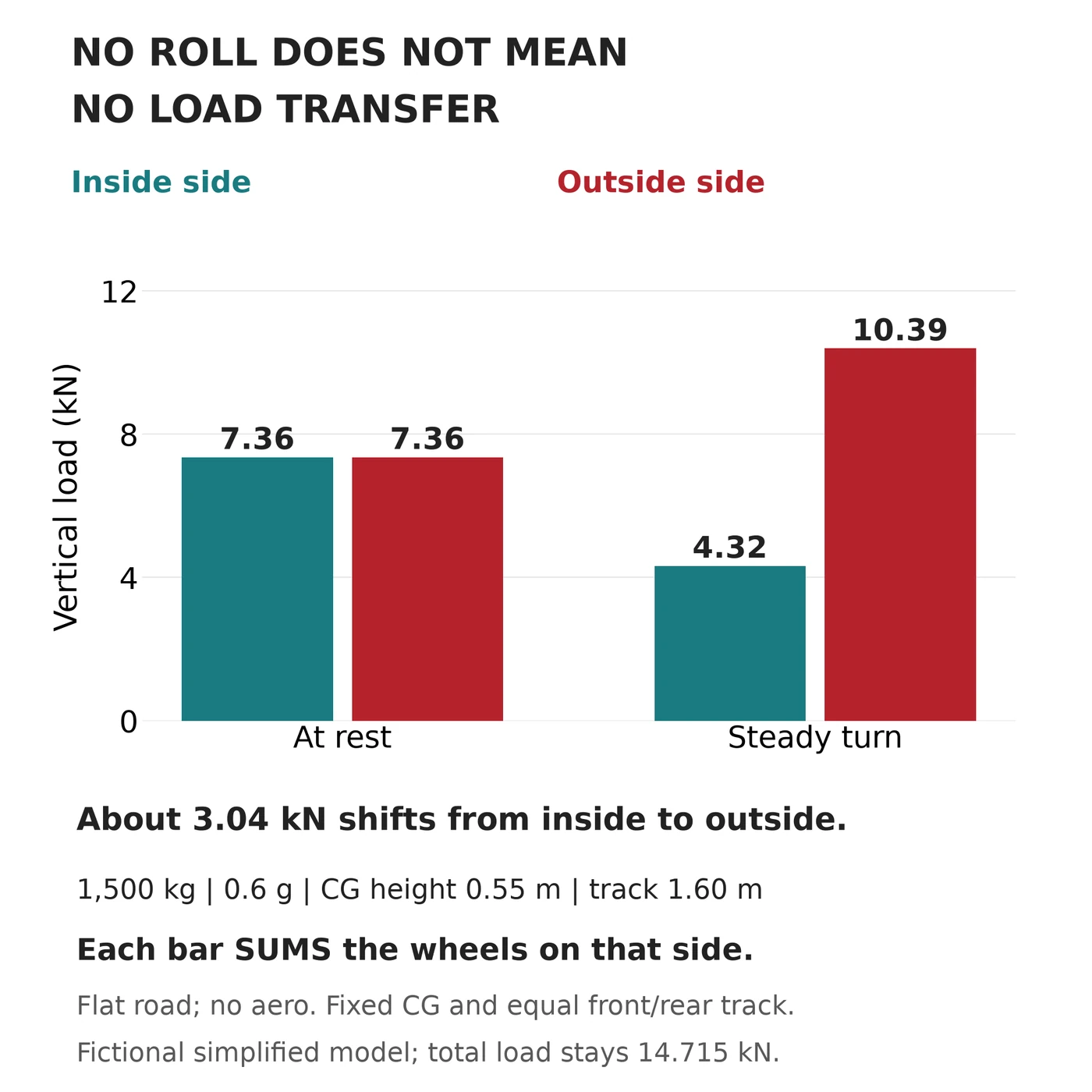
Our fictional example uses 1,500 kg, 0.6 g lateral acceleration, a 0.55 m center-of-gravity height and 1.60 m track. About 3.04 kN shifts from the inside side to the outside side: approximately 4.32 kN remains inside and 10.39 kN acts outside. Each value is the sum for that side, not a single tire load.
The calculation assumes a steady turn, equal front and rear track, no banking or aerodynamic load, and no movement of the center of gravity relative to the chosen geometry. Real suspension adds detail, including how load is distributed between axles and how the response develops. OptimumG’s load-transfer analysis explains why roll and load transfer must not be treated as synonyms.
What Stiffness Actually Changes
Springs and anti-roll bars influence how the suspension resists roll and how elastic load transfer is shared between the front and rear. Dampers influence the transient response while the car is moving into its new attitude. Suspension geometry provides another route through which forces act.
Consequently, “softer suspension causes more weight transfer” is too broad. It can produce more body motion, but at the same steady lateral acceleration and fixed overall geometry it does not simply create extra total transfer. In a real car, roll can shift the center of gravity and change geometry, so the exact result still needs a fuller model.
Lowering the center of gravity itself has a more direct benefit in this comparison: it reduces the moment that must be resisted. But lowering the body without preserving travel and geometry can sacrifice other advantages. The Car Structure Basics guide explains why low mass placement and a rigid structure matter.
Why Unequal Tire Loads Can Cost Grip
A more heavily loaded tire usually produces more cornering force, but generally not in direct proportion to the extra vertical load. This is called tire load sensitivity. Doubling its load does not usually double its maximum lateral force under otherwise comparable conditions.
That means the outside tire may gain less capability than the inside tire loses. The exact relationship depends on the tire and operating conditions, not a universal percentage. OptimumG’s tire comparison study shows why different tires respond differently to load redistribution.
Body roll can provide useful feedback, but more roll is not itself a source of grip either. We need to know what happens to tire load, camber, travel and timing during the movement. A car that leans visibly may still work extremely well; a nearly flat one may not.
5. Anti-Roll Bars Tune Balance, Not Just Appearance
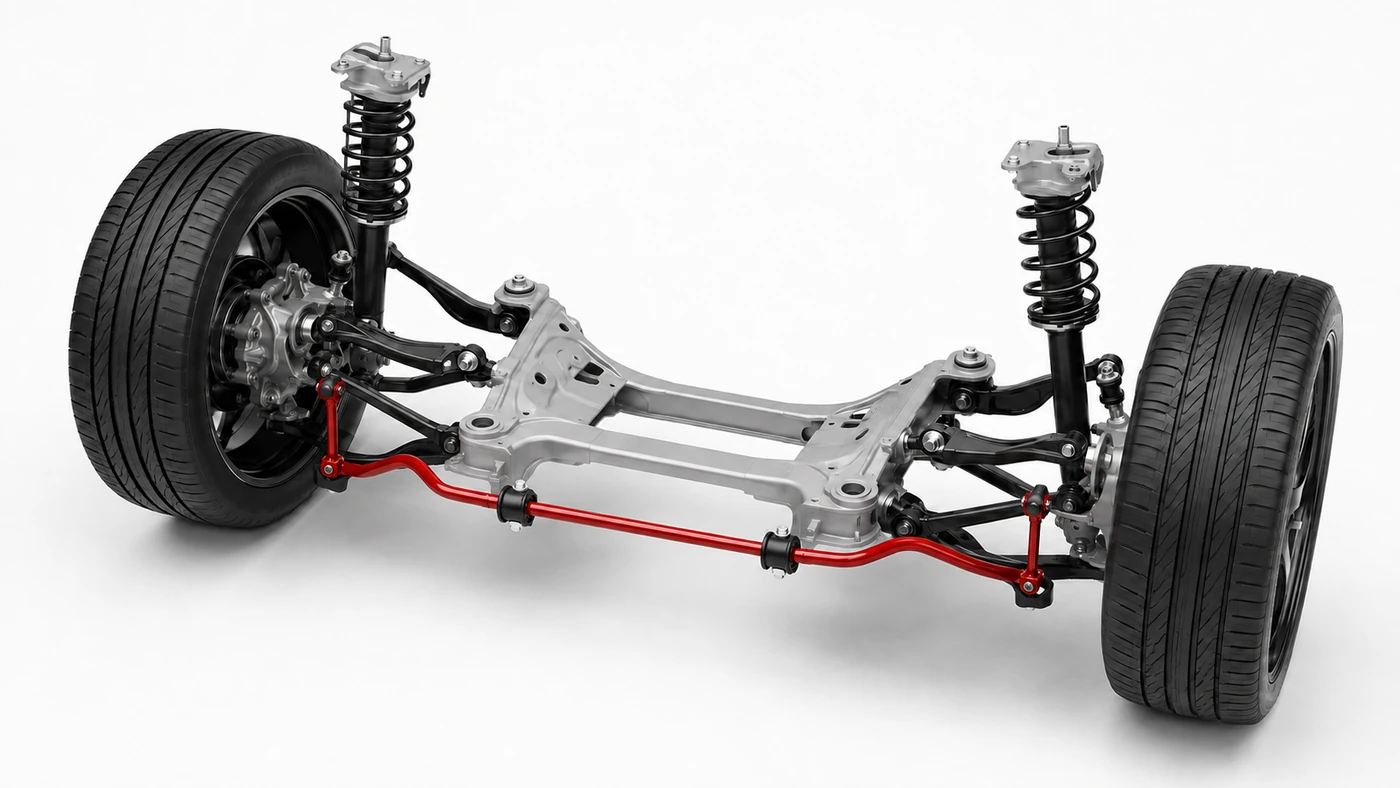
An anti-roll bar connects the left and right suspension through a spring-like twisting element. It resists differences in their movement, adding roll resistance. During approximately equal two-wheel compression it twists much less than during opposite left/right movement.
That coupling also matters over a one-wheel bump. The two sides are no longer completely independent in their response, even if the suspension is described as independent. A very stiff bar may therefore change rough-surface behavior as well as flatten the body.
Why Front and Rear Changes Can Feel Opposite
Increasing front roll stiffness relative to the rear generally shifts more of the elastic lateral load transfer to the front axle. With load-sensitive tires, that can reduce the front axle’s combined cornering capacity relative to the rear, encouraging understeer: the car turns less than the driver is asking.
Increasing the rear share can encourage rotation or oversteer, where the rear reaches its limit earlier. These are tendencies, not guaranteed outcomes. Camber behavior, differential action, tire characteristics, suspension geometry and whether a wheel unloads can alter the result.
OptimumG’s setup and kinematics Q&A treats anti-roll bars as a balance adjustment. That is much more useful than assuming the stiffest available bar must be the best one.
Alignment Can Undo a Good Spring-and-Damper Combination
Camber is the wheel’s inward or outward tilt viewed from the front. Toe describes whether the wheels point slightly inward or outward viewed from above. Caster is the steering-axis tilt viewed from the side.
Those angles affect how the tire meets the road and how the steering behaves. As suspension moves, the geometry also changes them. Bump steer is an unwanted steering-angle change associated with suspension movement; it is not simply the driver feeling a bump.
Lowering can move the suspension away from its intended geometric range. More aggressive alignment is not automatically better, either: an unsuitable setting can hurt straight-line behavior, braking contact or tire life. Spring rate cannot compensate for every geometry problem.
6. The Surface Changes What a Good Setup Looks Like
A smooth circuit can reward additional platform control, particularly with high-grip tires or substantial aerodynamic loading. Limiting excessive movement can help preserve alignment, clearance and ride height. But even a circuit has kerbs and bumps, and not every racetrack is smooth.
On a rough surface, allowing useful wheel movement may produce more consistent tire loads than resisting every disturbance. This is why compliance is part of performance, not just a concession to comfort. OptimumG’s analysis of tire-load variation connects varying vertical load with the lateral force a tire can deliver.
Wet or low-grip conditions can also favor a more progressive response, but “wet means use the softest setting” is another shortcut. Tires, water depth, temperature, surface texture and the particular suspension all matter.
Rally Makes the Point Visible
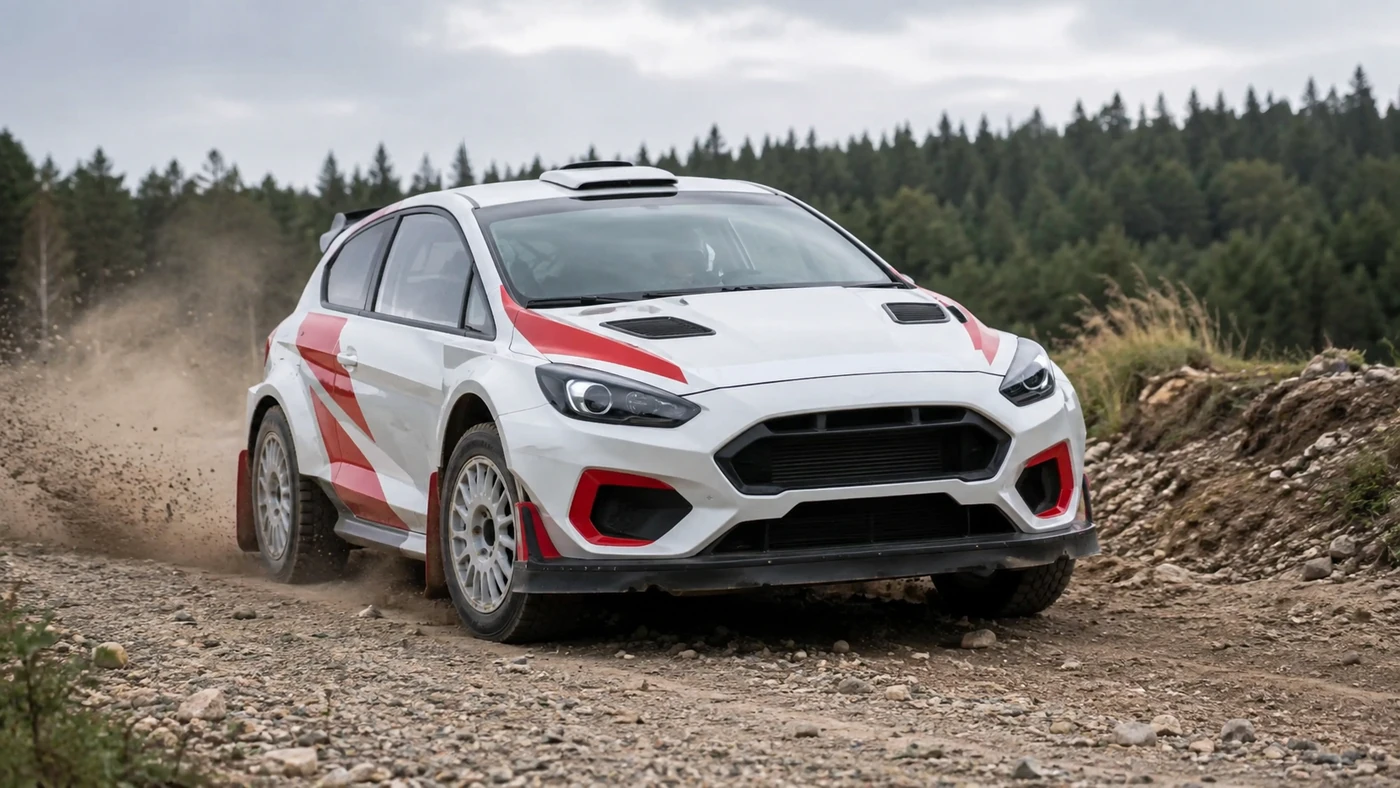
Gravel rally cars need clearance and working movement to cope with uneven ground, crests and landings. They are not simply road cars with loosely controlled soft springs: damping, strength and end-of-travel control are important parts of the package.
Toyota’s 2025 GR Yaris Rally1 explanation describes lower vehicle height for smooth tarmac and greater clearance for rough gravel, with suspension changes for the event. Rally1 travel is also constrained by its technical package, so “rally car” should not imply unlimited travel or the same setup on every surface.
The lesson is not that soft wins. It is that a car prepared for rough gravel has different needs from one prepared for smooth asphalt. A spectacular rally image cannot tell us the actual spring rate.
NASCAR and F1 Optimize Different Constraints
NASCAR setups must account for the particular track, including banking, surface and tire loading. A useful real example came in NASCAR’s April 2026 Kansas setup report: teams discussed suspension limiter use and the resulting demands on tire sidewalls. Less suspension movement is not automatically a free advantage.
F1 adds strong aerodynamic requirements. Ride height and pitch affect how its aerodynamic package works, so controlling the platform is crucial. Mercedes’ explanation of its W10-era suspension describes those demands alongside mechanical loading. That historical example is not a specification for every current F1 car.
For any ride-height-sensitive aerodynamic car, engineers still need to consider bumps and kerbs. Maximizing stiffness without regard to the tire or surface is not the objective, even when the resulting setup is much firmer than a road car’s.
7. Modern Systems Can Widen the Useful Range
An adaptive damper changes its resistance in response to sensors and control commands. A comfort setting may permit more motion in some situations, while a sport setting may prioritize body control. Neither should be understood as one unchanging force applied everywhere.
In a conventional semi-active system, the damper varies how it resists motion; it does not create arbitrary lifting forces like a fully active actuator. Changing damping also does not automatically change the rate of a steel coil spring.
Air Springs and Active Suspension Are Different Again
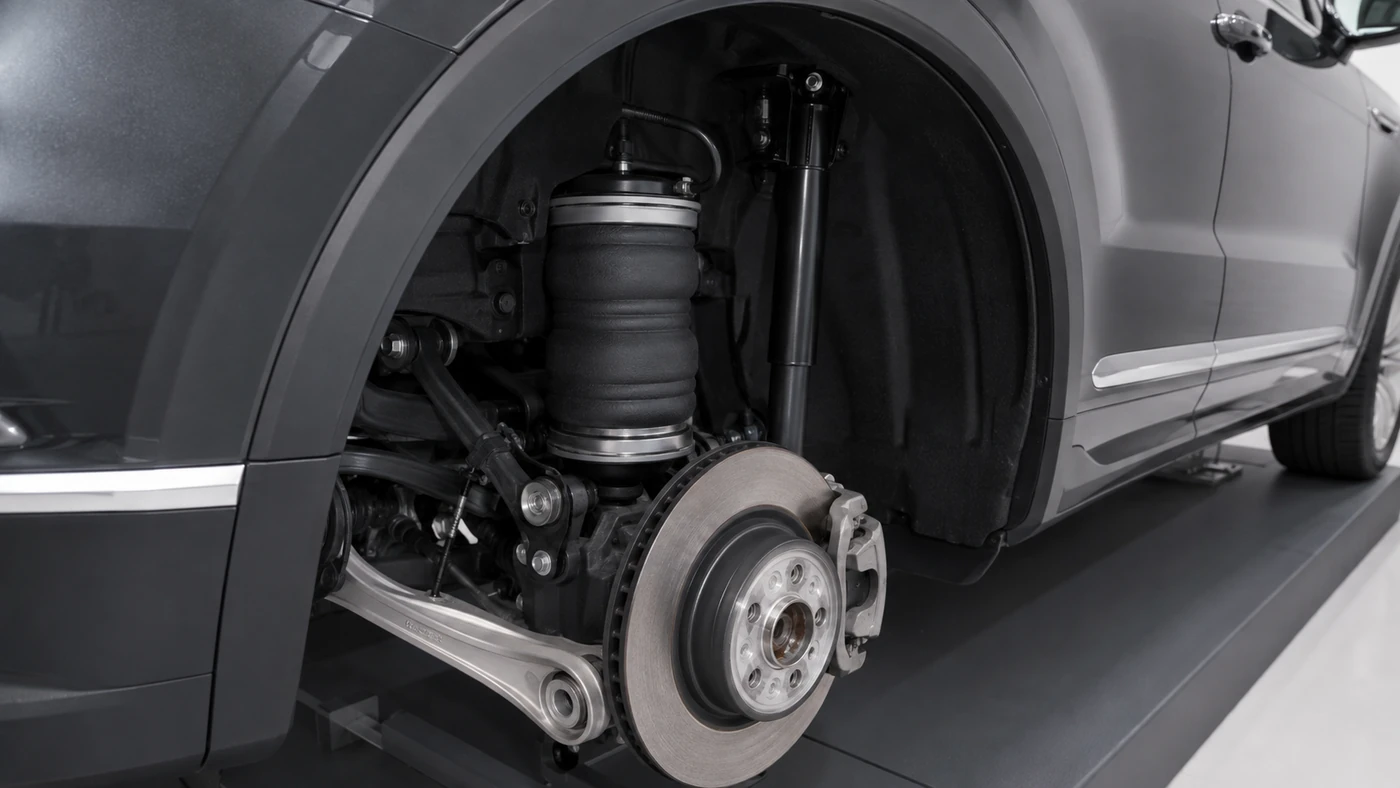
An air spring uses compressed gas to support load. Depending on the design, an air-suspension system can adjust ride height, maintain level under changing load and alter spring behavior through pressure and effective air volume. Dampers are still needed to control movement.
Fully active suspension can apply forces using an external energy supply. Active anti-roll systems target roll; more comprehensive hydraulic or electromechanical arrangements can control other body motions too. Those systems can reduce some traditional compromises, but they add equipment, energy demand and complexity.
Porsche’s 2024 Active Ride explanation for the Panamera describes electrically powered hydraulic control working with air springs. It is a specific system, not evidence that every air-suspended SUV or adaptive damper can do the same thing.
The Tire Is Part of the Suspension Experience
Change to a larger rim and lower-profile tire while retaining a similar overall diameter, and impacts or steering response may feel different even if the springs are untouched. Sidewall construction, pressure, load and wheel mass matter too; aspect ratio alone does not define stiffness.
The tire must also suit the conditions. A capable chassis cannot make an unsuitable compound ideal for cold, wet or rough use. Our Brake and Tire Basics guide explains the dimensions and contact-related details behind this part of the system.
A stiff body structure can help the suspension work consistently by limiting unwanted flex at its mounting points. That is different from stiff springs: structural rigidity and suspension compliance can be useful together. Good bushings, suitable geometry and controlled damping help distinguish firmness from impact harshness.
A Practical Comparison: Same Car, Different Priorities
Imagine two fictional setups on the same sports sedan, with the same tires, pressures and load. Setup A has very stiff springs, poorly matched damping and little remaining compression travel. Setup B uses more moderate rates, well-matched damping and adequate travel.
On a smooth low-speed maneuver, A might initially feel sharper. Over a repeated-bump test section, B could keep its tire loads more consistent and feel more predictable. That is a plausible engineering comparison, not a measured result or proof that moderate rates always win.
Several variables changed in this example. To isolate stiffness in a proper test, the other relevant conditions would need to be controlled, and the effect of matching the damping considered separately. We should be especially cautious about a before-and-after claim that also changes tires, alignment and ride height.
Driver confidence matters as well. A progressive, repeatable response helps a driver understand what the car is doing; nervous reactions can make it harder to use the available capability. Public roads add passengers, potholes, changing loads and wet surfaces, not an invitation to compare maximum pace.
The useful distinction is stiff enough for control, compliant enough for the task. That operating window is different for a track-focused car, a gravel rally car and a sedan that must handle ordinary roads every day.
Cariary Thoughts
At first, the attractive part of a firm suspension is how little explanation it seems to need. You feel the response immediately. The harder part is learning not to mistake every extra sensation for an improvement.
The most useful change in our thinking was separating three things: visible body motion, load transfer and the tire’s ability to work. They influence one another, but none is a substitute for the other two. A car can lean and remain well controlled; it can also stay flat while asking too much of one end’s tires.
That makes a good suspension more interesting, not less. Its achievement is not simply holding the body still. It is allowing the right movements, controlling them and making the result predictable over the surface the car actually encounters.
We will still enjoy a firm, responsive car. But the question we want to ask now is not “how hard does it feel?” It is “what are the tires being allowed to do?”
One-line Summary
Better handling comes from matching stiffness, damping and travel to the tires and surface, not from making the suspension as hard as possible.
FAQ
Does stiffer suspension improve cornering?
It can help when additional body or aerodynamic-platform control is needed. It can hurt when it compromises useful wheel movement, tire-load consistency or cornering balance. The complete setup and surface decide the result.
Can suspension be too stiff?
Yes. Excessive spring, bar or damping resistance for the task can make rough-surface behavior less consistent. The cause needs to be identified; a harsh ride does not by itself identify which component is wrong.
Why do sports cars often have firm suspension?
They may prioritize response, alignment control and managing loads from high-grip tires or aerodynamics. That does not mean the firmest available setting is best on every surface.
Is body roll always bad?
No. Some roll is compatible with capable handling. Excessive motion can affect geometry and travel, but reducing roll does not eliminate lateral load transfer.
Does lowering a car automatically improve handling?
No. A lower center of gravity can help, but reduced travel, unsuitable damping or unfavorable geometry can offset the benefit. The hardware and installed height must work together.
What is suspension travel?
It is the movement available between extension and compression limits. The remaining room from normal ride height matters when the wheel encounters a bump or depression.
Are coilovers better than the original suspension?
Not automatically. Coilover describes an arrangement, and adjustment features do not guarantee suitable rates, damping, travel or geometry for a particular vehicle.
Why do gravel rally cars need working travel?
Uneven surfaces and landings demand clearance, wheel movement and controlled recovery. They still need strong damping and end-of-travel management, and their setup changes with the event.
Is firm the same as harsh?
No. Firm can describe controlled, predictable movement. Harsh describes abrupt impacts; repeated bouncing is another behavior again. None alone is a measured grip result.
Do adaptive dampers remove every compromise?
No. They widen the available damping behavior, but still depend on springs, tires, travel and geometry. Fully active systems can do more, with additional hardware and energy requirements.
Related Thoughts
- Suspension Basics: springs, dampers, anti-roll bars and alignment in one introductory guide.
- Car Structure Basics: center of gravity, weight placement and structural rigidity.
- Brake and Tire Basics: tire dimensions and the contact that suspension must support.
References
Data Reference Date: September 7, 2026. Historical vehicle and motorsport examples retain their stated dates. Charts are calculated teaching models, not vehicle test results. Generated images illustrate component relationships and contexts; they are not manufacturer photographs or exact installation drawings.
- Penske: adjustable damper technical manual and Öhlins: automotive shock absorber owner’s manual.
- OpenStax: damped oscillations.
- Eibach: progressive bump stops and Bilstein: lowering and spring-damper matching.
- OptimumG: load transfer and roll, tire comparison, tire-load variation and setup and kinematics Q&A.
- Toyota Gazoo Racing: 2025 Rally1 car and event-specific preparation.
- NASCAR: April 2026 Kansas setup and tire loads and Mercedes-AMG F1: W10-era suspension explanation.
- Porsche: 2024 Panamera Active Ride technology.

