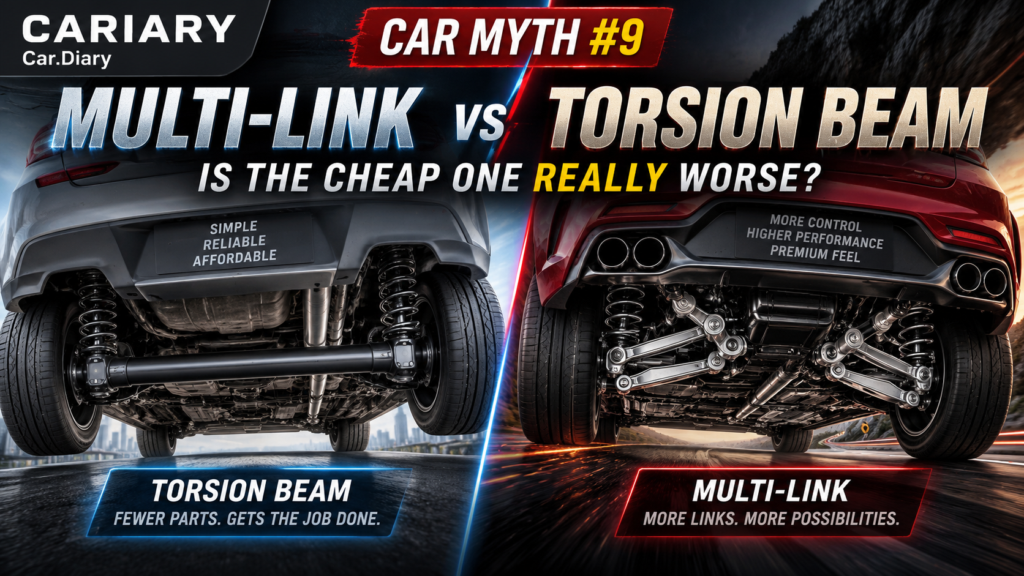
The Multi-Link vs Torsion Beam debate can make a specification sheet feel like a report card. See several separate suspension arms, and the car seems sophisticated. See one beam between the rear wheels, and it suddenly looks as though someone in accounting won an argument.
I understand that reaction. Premium cars often have the more elaborate arrangement, so it is tempting to give the suspension name credit for everything we like about them. But does counting links tell us how the rear seat will feel over a broken road, or how confidently the car will settle into a corner?
Multi-link offers more tuning freedom. It does not automatically guarantee better tuning. That is the distinction worth exploring in Car Myths Part 9. This is not an argument that torsion beams are secretly superior; it is a closer look at what each structure allows, what it restricts, and what the rest of the car contributes.
Quick Summary
- A torsion beam joins two trailing arms with a crossmember that twists when their movements differ. It is usually described as semi-independent.
- An independent multi-link rear suspension uses separate links to guide each wheel, giving designers more freedom over its path and orientation.
- Springs, dampers, bushings, tires, body stiffness and alignment determine how either architecture behaves in a complete vehicle.
- Multi-link has genuine advantages for demanding ride and handling targets. A well-developed beam can still deliver a very capable compact car.
- Architecture is useful information, not a comfort score, a grip measurement or a repair-cost quotation.
1. Why Multi-Link vs Torsion Beam Is Not a Quality Score
The myth begins with a reasonable observation: complicated rear suspensions are common in expensive cars. Those cars may also receive quieter cabins, carefully developed dampers, better-isolated subframes and substantial development budgets. We experience the combined result, then attribute it to one line in the brochure.
The opposite shortcut is just as tempting. If a lightweight hatchback with a beam feels lively and composed, we might decide the extra links were unnecessary all along. That also mistakes one successful combination for a universal rule.
It helps to separate three questions. Architecture asks which parts locate the wheel. Tuning asks how those parts move and react to forces. Execution asks whether the complete system consistently achieves its targets, including durability and production tolerances.
Think of two kitchens. More equipment lets a cook attempt more things, but does not guarantee a better meal. The analogy has a limit: suspension also has physical constraints that skill cannot wish away. Good tuning cannot make a welded beam become fully independent.
Our Suspension Basics guide introduces the springs, dampers and wheel movement underneath this discussion. Here, we are concentrating on how the rear wheels are located, rather than repeating the whole suspension story.
2. How a Torsion Beam Works: Connected, but Able to Twist
A typical rear twist-beam has two trailing arms. Each pivots from a mounting point ahead of its wheel, rather like a short lever following the car. A welded crossmember joins the left and right arms. Separate springs support the body, while dampers control how quickly the suspension moves.
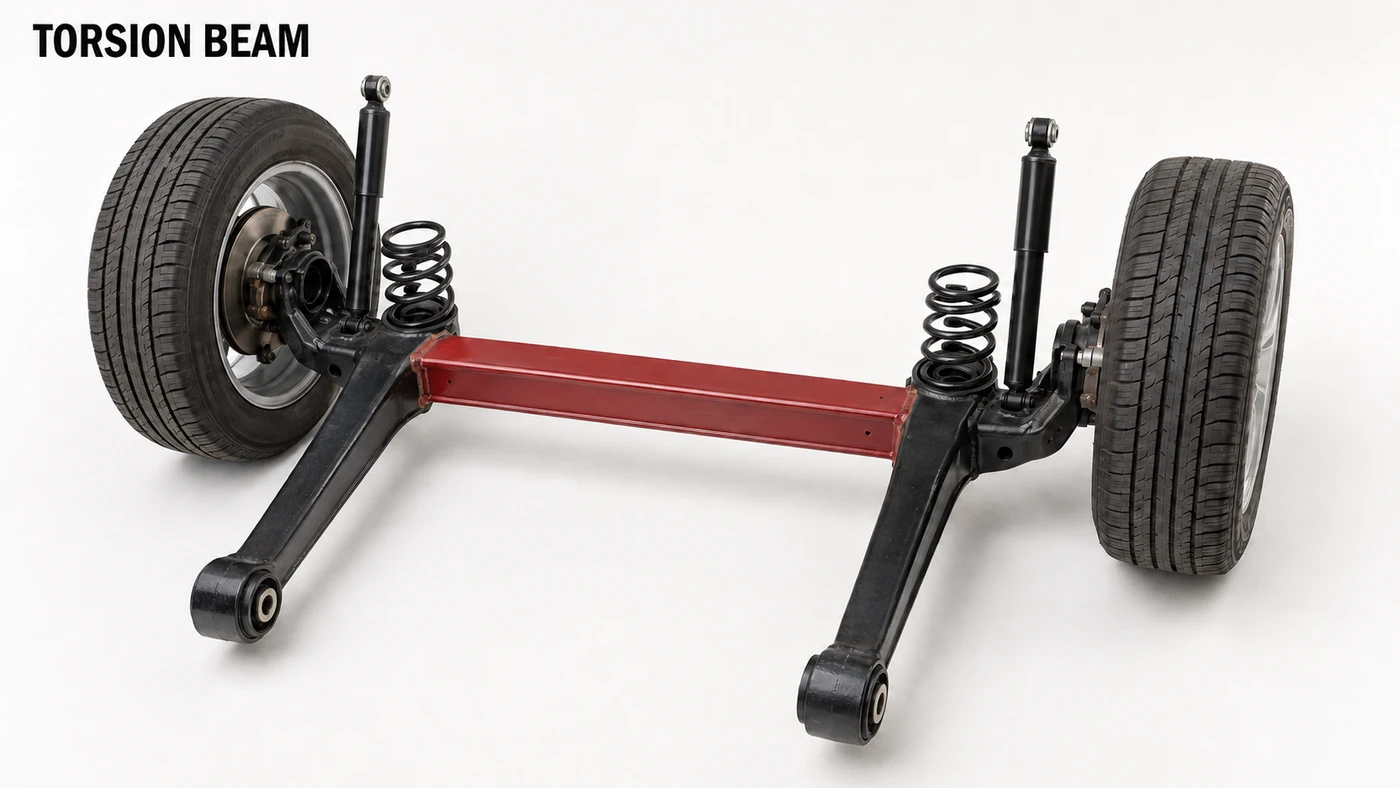
When both arms rotate upward by a similar amount, they can move together with little relative twisting of that crossmember. When one rotates more than the other, the crossmember twists. That flexibility allows different wheel movements while resisting the difference between them.
This is why a twist-beam is not simply a solid axle, but is not fully independent either. Nor does its name mean the crossmember necessarily replaces the main springs. The common coil-sprung beam shown here is different from a suspension that uses torsion bars as its principal springing elements.
What happens at a one-wheel bump?
Imagine the left rear tire meeting a raised road repair while the right rear tire remains on level pavement. The left arm moves, the beam twists, and forces pass through the connected structure. The opposite wheel and the body can therefore feel an influence.
That does not mean the right wheel must rise by the same distance, or that every beam delivers a sideways kick. The response depends on beam stiffness, the mounts, springs, dampers, tires and the motion of the body. A drawing that shows the other tire automatically jumping off the road would be misleading.
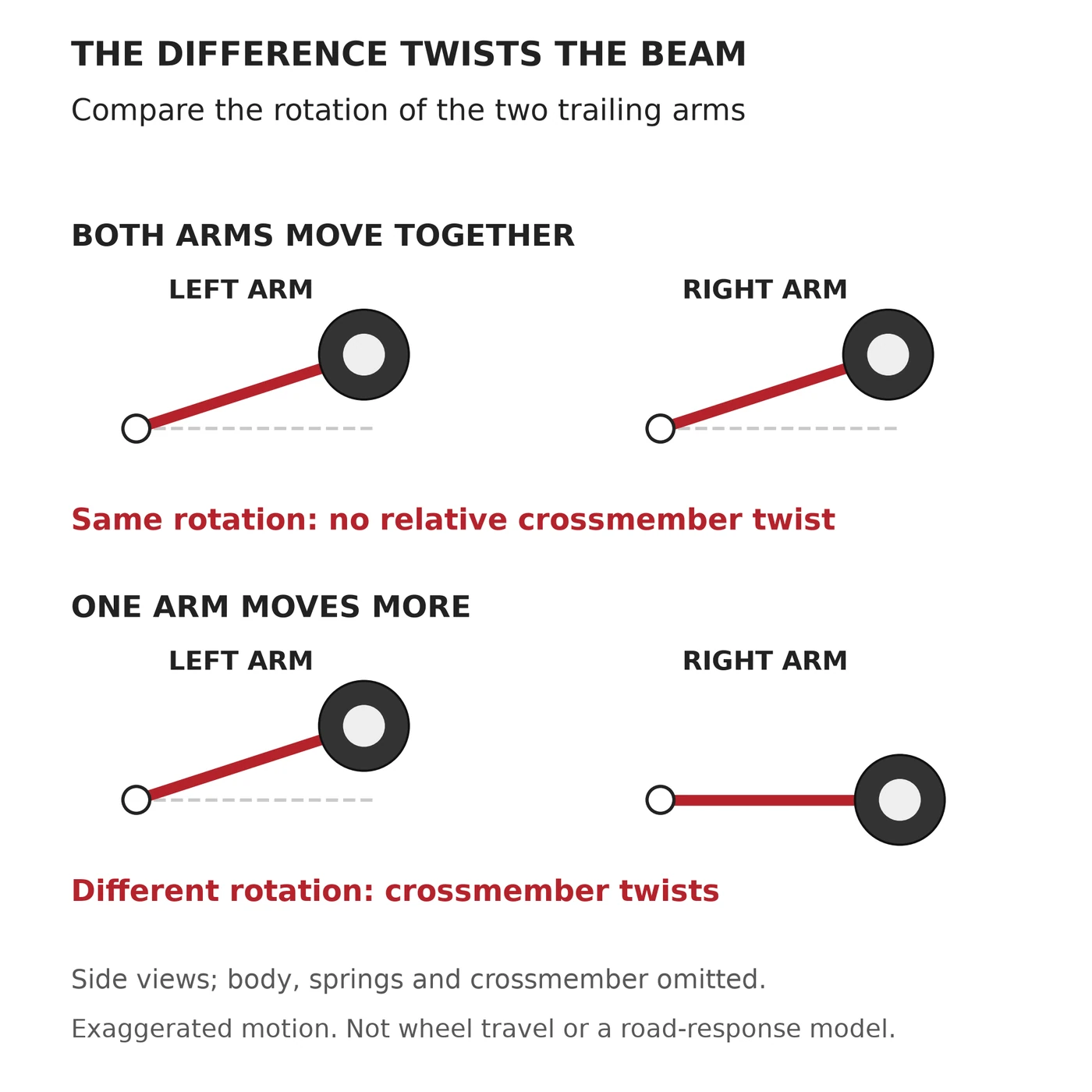
The same connection contributes resistance to body roll, the sideways lean in a corner. Designers cannot treat wheel guidance, beam twist and roll behavior as completely separate decisions. That coupling is one of the layout’s real compromises.
Simple does not mean untunable
The crossmember’s section, position and wall thickness matter, as do the orientation and stiffness of the mounting bushes. These choices influence roll resistance and the small wheel-direction changes produced by forces. Volkswagen’s historical Golf running-gear explanation describes changing insert-plate lengths inside the beam to obtain different torsion rates.
There is engineering in that apparently ordinary piece of steel. The limitation is not that nothing can be tuned; it is that fewer aspects can be varied independently without affecting something else.
3. What Multi-Link Adds: More Control of the Wheel’s Path
In the independent rear arrangements discussed here, several separate links connect each wheel carrier to the body or a subframe. A wheel carrier holds the hub; a subframe is a supporting structure attached to the body. Their connections guide the wheel as it rises, falls and takes cornering or braking forces.
Different link lengths, angles and mounting positions let engineers choose the wheel’s path more freely. The links work together, however. It is too neat to say one arm does only camber, another only toe and a third only braking. Changing one mounting point can affect several behaviors.
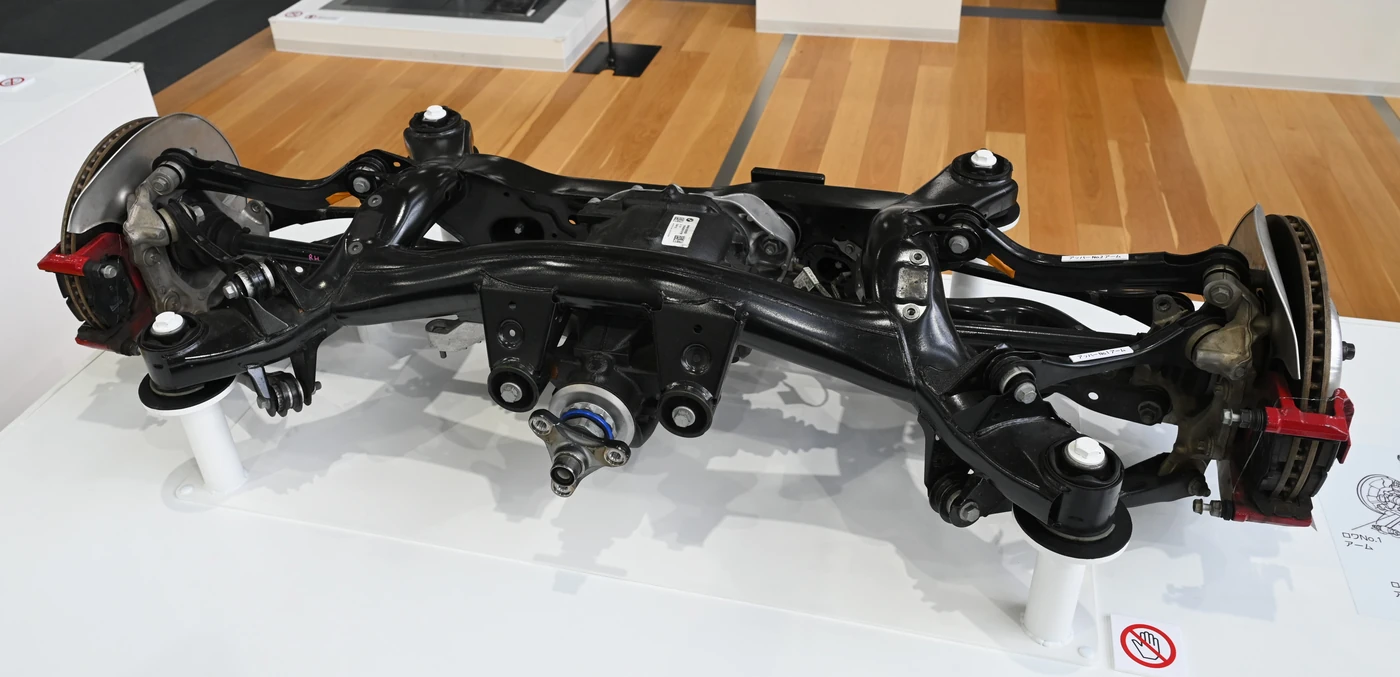
The real Toyota Supra A90 display above is useful because it shows the distinction between a shared support and a shared locating beam. A subframe can span the car while separate links guide each wheel relative to it. A central differential is part of the drivetrain, not proof that the suspension is a beam axle.
Also, the word multi-link is used broadly. Several links can locate other axle arrangements too. In this article, it means the independent passenger-car rear suspension normally contrasted with a twist-beam, not every axle with several rods attached.
Camber, toe and compliance, without the jargon
Camber is the wheel’s lean when viewed from the front or rear. When the top leans inward, that is negative camber. Toe is the direction the wheels point when viewed from above: toe-in means their front edges point slightly toward each other.
Camber gain means the lean changes as the wheel moves. Compliance is the small, intended flex in components and mounts under force. If that flex changes a wheel’s pointing direction, it produces compliance steer. These effects exist beyond multi-link, but separate links give designers more ways to shape them.
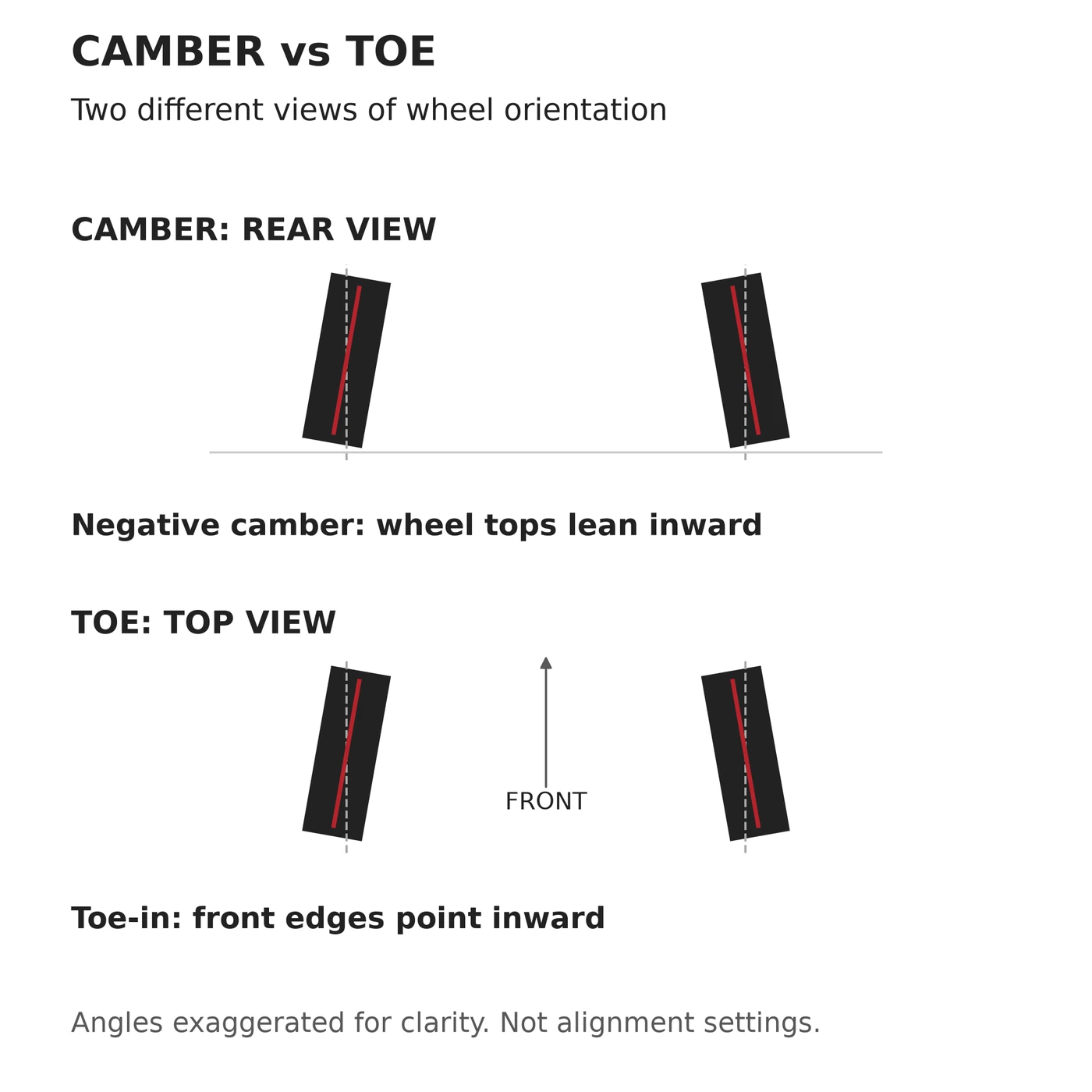
This freedom matters when a loaded outside tire must work through a corner while the body rolls. Designers can aim for a useful tire orientation rather than simply holding the wheel at its parked angle. More negative camber is not automatically better; the appropriate behavior depends on the tire, loads and intended use. OptimumG’s kinematics example illustrates how moving mounting points changes cornering behavior, along with other trade-offs.
Independent does not mean isolated
Multi-link wheels still share a body. Many systems also have an anti-roll bar, which deliberately connects left and right suspension movements elastically. Consequently, a one-wheel disturbance can influence the opposite side even when the wheel-locating mechanism is independent.
The advantage is greater freedom to manage these influences, not a magical firewall between the wheels. Multi-link also does not guarantee unlimited travel or adjustable rear camber and toe. Space, link geometry and the manufacturer’s service provisions still set the limits.
4. Why Tuning Can Matter More Than the Name
A suspension is not finished when its architecture is chosen. The wheel must meet the road with appropriate orientation and load, while the occupants need the body to remain reasonably calm. Those goals depend on parts that a simple specification table may never mention.
Bushings are not just cheap rubber
Bushings form compliant connections between components. Their shape and material influence how forces and vibration reach the body. Some designs are relatively yielding in one direction and firm in another, so the trade-off is more sophisticated than choosing rubber that is universally soft or hard.
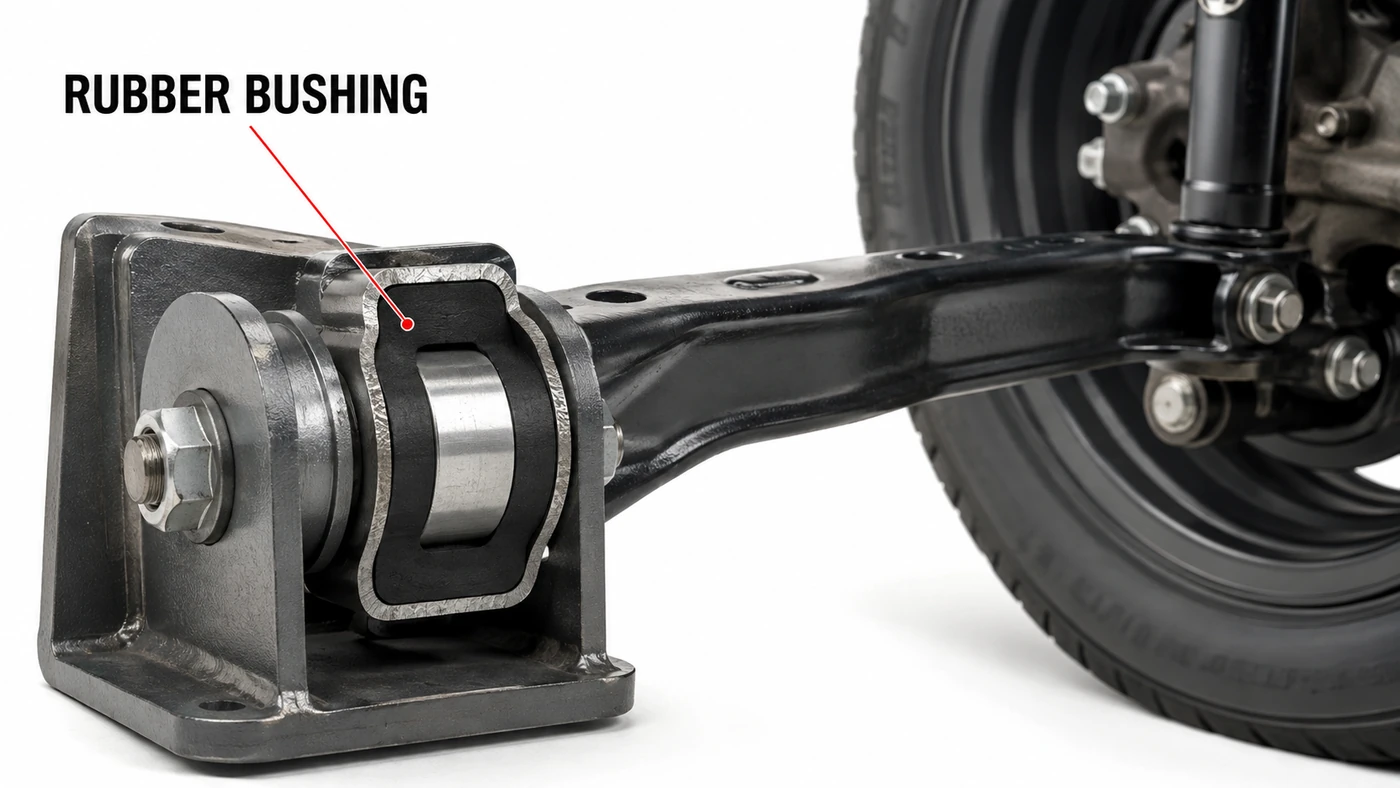
A deliberately compliant bush can improve isolation without representing poor quality. An excessively rigid substitute can spoil refinement; excessive movement, damaged rubber or the wrong characteristics can compromise wheel control. Softness, price and condition are different things. ZF’s rubber-to-metal component guidance explains why these small connections influence both vibration transmission and driving behavior.
Passive rear steering is part of this discussion. Geometry and elastic deflection can produce a small, planned toe change as loads build. That differs from active rear-wheel steering, where an actuator deliberately steers the wheels. A beam can have designed compliance-steer behavior too; it is not reserved for an elaborate independent suspension.
Springs, dampers and tires finish the job
Springs resist displacement and support the vehicle. Dampers resist motion, controlling compression and extension rather than simply holding the body up. Their behavior must suit the springs, wheel leverage, travel and intended loads. A sophisticated linkage cannot compensate for every poorly matched damper characteristic.
The tire is the next part of that system, not a separate accessory. Construction, pressure, dimensions, compound and condition influence both road isolation and available grip. Compare a beam-equipped car on suitable tires with a multi-link car on unsuitable tires, and you are comparing two complete setups, not isolating rear architecture.
For the tire side of the question, our Brake and Tire Basics guide is a useful companion. The lesson here is to notice the tire specification before crediting every difference to the links hidden behind it.
The body is part of the suspension system
The mounts need a sufficiently stable foundation. If the structure supporting them moves in unintended ways, the carefully chosen geometry also changes. At the same time, designers may intentionally isolate a subframe through its mounts; planned compliance should not be confused with uncontrolled body flex.
Our Car Structure Basics guide explains the surrounding structure. Mazda’s 2019 body-development paper is another reminder that suspension inputs and the body’s response are developed together.
Front suspension, steering, weight distribution and differential behavior also help shape a corner. Electronic stability control can intervene when necessary, but cannot erase physical grip limits. No rear suspension label describes that entire chain.
5. Space, Weight and Maintenance Are Engineering Questions Too
A compact car has a demanding brief: carry people and luggage, remain affordable to build, keep mass under control and survive years of use. Choosing a simpler rear suspension can be a rational response to those requirements, not merely an attempt to hide missing equipment.
Where does everything fit?
A beam commonly needs fewer separate locating arms and mounting points, and may avoid a dedicated rear subframe. That can simplify the space around the rear floor. Multiple links and their movement envelopes can make an independent layout more difficult to package.
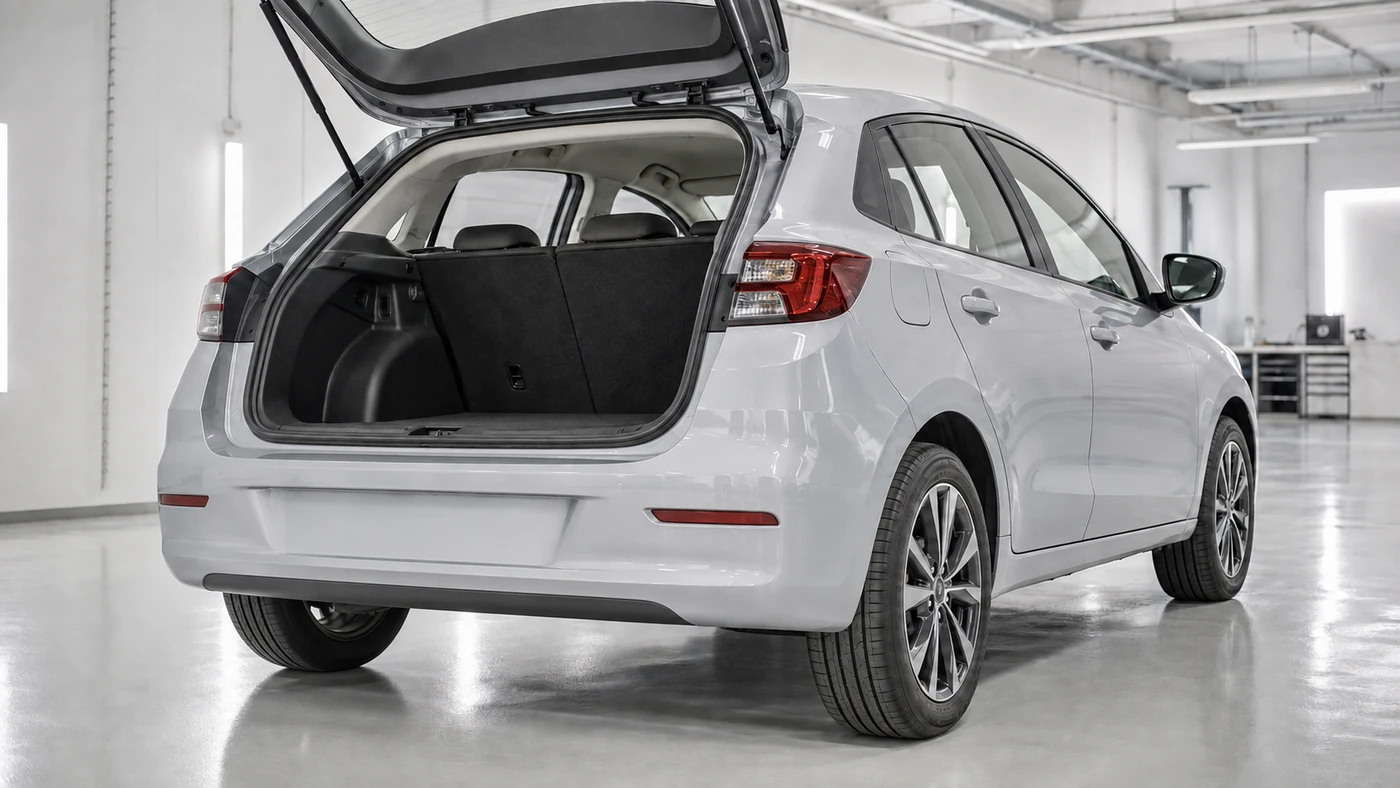
But neither arrangement promises a particular trunk width or floor height. Spring and damper positions, wheelhouses, crash structure, exhaust and fuel storage also compete for space. A beam still sweeps through an area as it moves, so it does not leave every cubic centimeter between the wheels free.
Hybrid batteries add another packaging demand; an EV may need room for a battery enclosure and rear drive unit. Those requirements can favor different architectures on different platforms. It would be wrong to conclude that electrification always favors a beam, or always demands multi-link.
A generation change can therefore be driven by cost, manufacturing, packaging or a revised refinement target. Without evidence from the specific development program, we should not pretend to know the ranking of those motives. Nor can we calculate the change in comfort simply by counting the deleted links.
Total mass is not the same as unsprung mass
Fewer components can help a beam keep total mass and manufacturing complexity low. Yet material choice and the detailed design matter: several optimized lightweight links can compare differently with a substantial steel assembly.
Unsprung mass is the mass that moves with the wheel rather than being carried entirely by the body’s springs. Wheels, tires and brakes are obvious contributors. Arms and beams contribute an effective portion because different parts of them move by different amounts; a body-mounted subframe should not simply be counted as all unsprung.
More moving mass makes it harder to accelerate that assembly over a disturbance for a given force. But the axle name gives no actual figure, and total suspension weight is not a substitute for that figure. We cannot confidently rank two cars’ road-following ability from parts count alone.
More joints can mean more inspection points
Multi-link often brings more bushes, joints and individual arms to inspect. Some designs also provide more service adjustment, but factory geometry freedom and workshop adjustability are not the same thing. Even an elaborate arrangement may lack a normal adjustment for one angle.
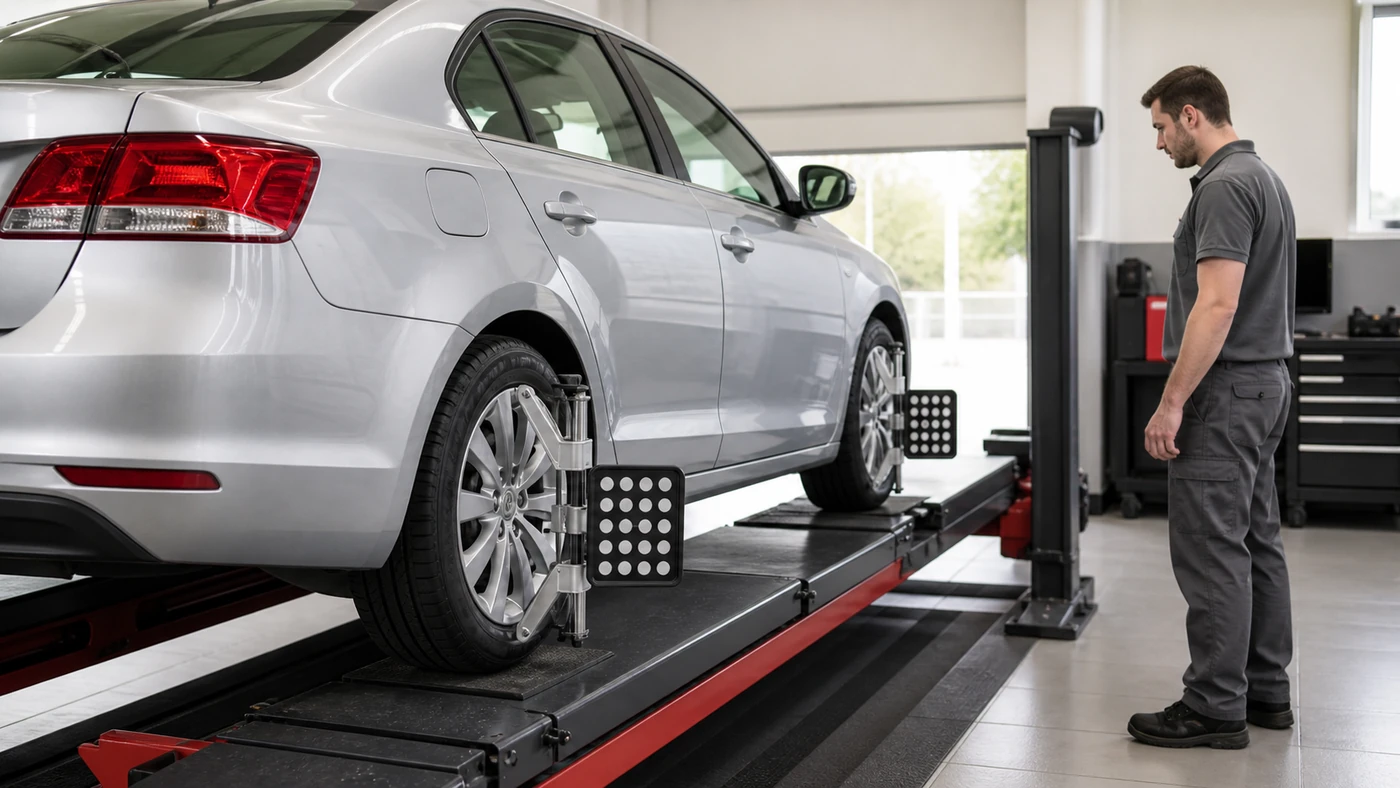
A beam can have fewer wear points, yet a bent or badly corroded assembly may require substantial replacement. Conversely, replacing one damaged link may be relatively straightforward on a particular independent system. Neither name supplies a universal repair bill or lifespan.
ZF’s multi-link service overview emphasizes component interaction and geometry checks. For a real car with uneven wear, pulling or new noises, inspection is more useful than blaming the architecture. Michelin’s alignment explanation also distinguishes alignment from wheel balancing; they address different problems.
6. Real Cars Show Both the Potential and the Limits
Historical examples are helpful if we keep the generation and market clear. They demonstrate engineering choices, not a controlled contest between otherwise identical cars.
Honda Civic Type R: two generations, two approaches
The European 2015 Civic Type R, FK2, used an H-shaped torsion-beam rear suspension. Honda’s launch technical material describes a specially developed beam alongside adaptive dampers, a distinctive front suspension and model-specific tires. It was not an ordinary rear axle working alone to create a performance car.
The 2017 Civic Type R, FK8, adopted a multi-link rear arrangement. Honda’s 2017 Japanese launch announcement also describes changes to the platform, rigidity, dimensions and controls. That broader redesign is precisely why its performance cannot be reduced to the rear axle switch.
Taken together, these generations make a fairer point than either one alone: a beam can belong in a serious hot hatch, while multi-link can give a later program useful additional freedom. Neither fact cancels the other.
European Ford Fiesta ST: sophistication in the details
Ford’s 2018 European Fiesta ST technical release describes a twist-beam working with directionally wound force-vectoring springs and application-specific dampers. The springs were developed to influence how lateral forces are handled, rather than functioning as interchangeable generic coils.
The same release discusses an optional front limited-slip differential. That device helps manage drive torque between the front wheels; it is not a rear suspension part. Its inclusion underlines how a hot hatch’s cornering behavior emerges from the complete vehicle.
This example refers to that European generation, not every Fiesta ST sold under a similar model year in other markets. It shows thoughtful development around a simple layout, not proof that the layout wins every comparison.
Mazda3: what a beam choice does and does not prove
Mazda’s 2019 Mazda3 press material describes a newly developed rear torsion beam as part of an effort to shape how forces reach the occupants. The wider program included changes beyond the rear axle.
That is evidence of the manufacturer’s stated development aim, not independent proof that every road input feels better than in the preceding generation. Readers can reasonably disagree about a car’s ride while still recognizing that its design brief involves more than a cost label.
Volkswagen Golf: the badge may not identify the axle
In its 2019 eighth-generation Golf presentation, Volkswagen described a beam for lower-output front-drive variants and multi-link for higher-output or all-wheel-drive applications. Those are historical launch specifications, not a rule to apply to every current Golf worldwide.
The useful lesson is to check the exact year, engine, drivetrain and market. A vehicle name can cover more than one rear suspension, while a rear suspension name can cover many different calibrations.
7. How to Notice the Difference Without Chasing a Label
On a smooth, straight road, either layout may feel entirely composed. The demands become more revealing when a surface disturbance affects one side, when the car is loaded, or when the suspension has to manage several inputs together. Those are situations, not permission to seek the limit on public roads.
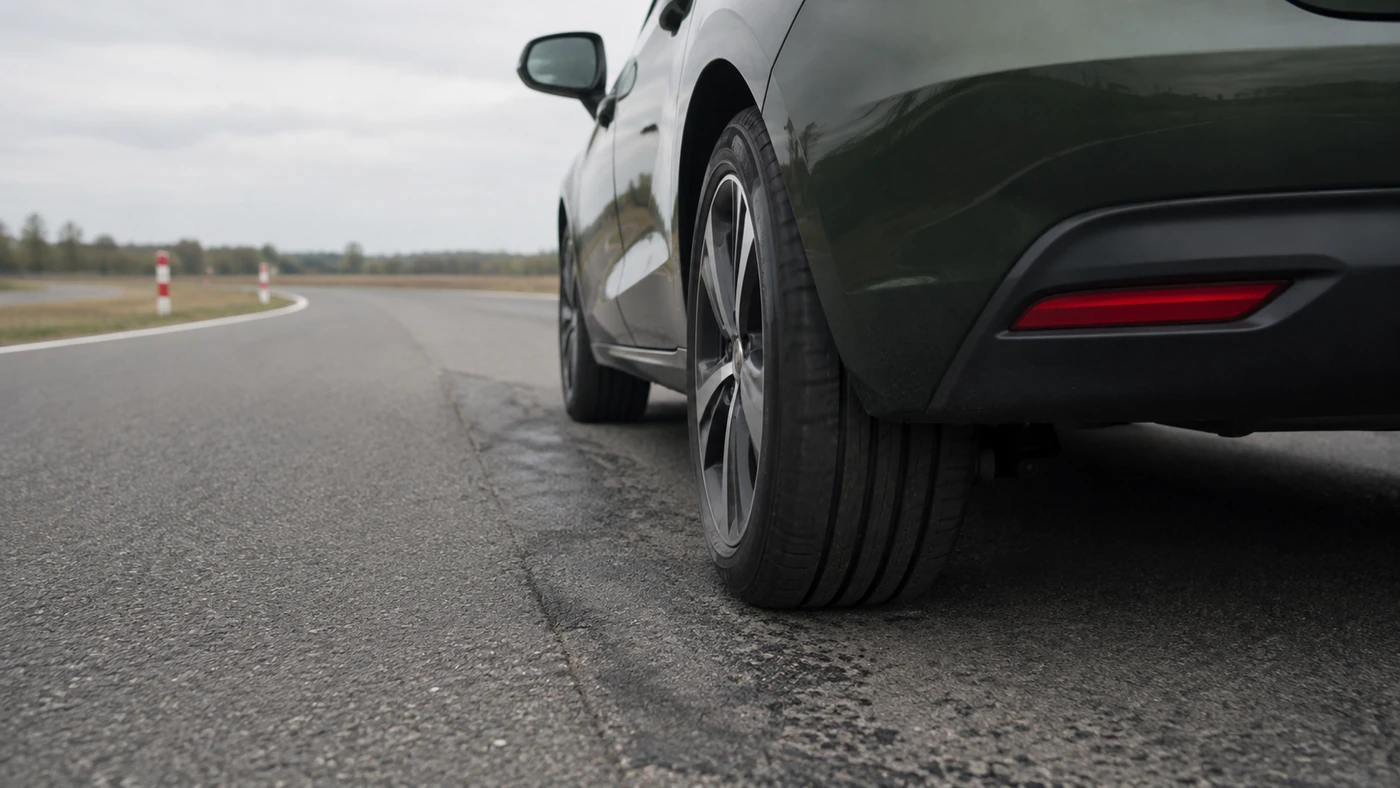
During an ordinary, lawful drive, notice what already occurs along a familiar route. Does a small road joint produce one controlled movement or repeated settling? Does the rear seat feel a sharp impact that barely registers up front? A passenger’s impression may reveal something the driver’s seat hides.
Use normal tire pressures specified for the load, and account for wheel size, damper mode, passengers and tire condition. Do not deliberately hit potholes or disable stability systems to expose a difference. Identifying which component caused a sensation requires more evidence than a short drive.
A thought experiment, not a test result
Imagine Car A has a beam, well-matched damping, suitable tires and sound body mounts. Car B has multi-link but poorly matched damping and unsuitable tires. Car A could feel more settled and predictable even though Car B offers more geometric freedom.
That example changes several variables on purpose. It explains why a label cannot guarantee the outcome; it does not isolate the beam as the reason Car A feels better. With strong execution on both sides, multi-link’s extra control can provide a real advantage as ride and handling targets become more demanding.
| Question | Torsion beam | Independent multi-link |
|---|---|---|
| How are the wheels located? | Trailing arms joined by a twisting crossmember | Separate links guide each wheel relative to the body or subframe |
| Main opportunity | Simplicity, compact packaging and cost-effective development | More freedom to shape wheel paths and responses to forces |
| Main constraint | Several behaviors are coupled through the beam and mounts | More parts, interfaces and development variables to coordinate |
| One-wheel disturbance | Beam twist transmits an influence across the assembly | No shared locating beam, but body and anti-roll-bar coupling remain |
| Workshop adjustment | Often limited; model-specific | Can offer more adjustment, but it is not guaranteed |
| What still needs checking? | Tires, damping, geometry, condition and the whole vehicle | Exactly the same system-level questions |
Multi-link is a powerful tool for combining precise wheel control with demanding comfort targets. A beam can be a strong fit for a compact vehicle whose brief values space, low mass and simplicity. Neither description is a recommendation to overlook what the actual car does.
Cariary Thoughts
What changed my thinking was separating potential from execution. I would still pay attention if two otherwise comparable cars used different rear architectures. The extra design freedom is real, and pretending it never matters would simply replace one myth with another.
But I would no longer let that specification finish the conversation. I would want to know what the suspension has been asked to achieve, how the tires and mounts support it, and what happens when the surface stops being perfect.
There is something satisfying about discovering intelligence in an ordinary-looking beam. It is equally interesting to see how much care is needed to make a collection of links work well together. Good engineering is not always the most elaborate solution; it is a well-executed response to a clear problem.
One-line Summary
Multi-link gives engineers more tools; good suspension depends on how well those tools, tires and the rest of the car work together.
FAQ
Is multi-link suspension always better than a torsion beam?
No. It provides greater freedom over wheel movement and force response, but ride and handling also depend on tuning and the surrounding vehicle. That potential is valuable, especially for demanding targets, without guaranteeing every outcome.
Why do affordable cars use torsion beams?
They can reduce parts count, manufacturing complexity and packaging demands. Those benefits suit many compact cars. Lower manufacturing cost is not the same as low-quality development or guaranteed poor comfort.
Can a torsion beam handle well?
Yes. The 2015 European Civic Type R and 2018 European Fiesta ST demonstrate serious performance applications. Their complete chassis, tire and drivetrain packages matter; the beam alone does not explain their character.
Is a torsion beam always uncomfortable over bumps?
No. Its crossmember couples the two sides, but the resulting sensation depends on the particular beam, mounts, springs, dampers and tires. Independent suspension also transmits forces through the body and may use an anti-roll bar.
Does multi-link mean rear camber and toe are adjustable?
Not necessarily. Designers may have considerable geometric freedom while the finished car offers limited workshop adjustment. Check model-specific service information instead of assuming every angle has an adjuster.
Is multi-link more expensive to maintain?
It often has more joints and bushes to inspect, but actual costs depend on the vehicle, part availability and damage. A beam has fewer pieces yet can still require expensive assembly replacement. Parts count is not a repair estimate.
Is a softer bushing a sign of cheap suspension?
No. Controlled compliance can improve isolation and help shape wheel response. Quality, stiffness in different directions and wear condition must be distinguished; the hardest substitute is not automatically an improvement.
What should I pay attention to in everyday driving?
Observe rear-seat comfort, controlled settling and behavior over ordinary uneven surfaces at lawful speeds. Account for tire pressure, load and condition. New pulling, noises or uneven wear warrant inspection, not a conclusion based only on architecture.
Related Thoughts
- Suspension Basics: springs, damping and handling foundations
- Car Structure Basics: the foundation around the suspension
- Brake and Tire Basics: understanding the road contact
References
Technical examples are tied to the named year and market. Manufacturer development aims are not treated as independent comparative test results. Generated illustrations are identified beneath each image; the Supra exhibit is an attributed real photograph.
- Volkswagen: eighth-generation Golf running gear
- OptimumG: suspension kinematics and performance trade-offs
- OptimumG: vehicle setup and kinematics Q&A
- ZF: rubber-to-metal chassis components
- ZF Aftermarket: multi-link system inspection
- Michelin: wheel alignment and balancing
- Honda: 2015 European Civic Type R technical release
- Honda: 2017 Civic and Type R launch, Japan
- Ford: 2018 European Fiesta ST technical release
- Mazda: 2019 Mazda3 press kit
- Mazda Technical Review: 2019 Mazda3 development
- TTTNIS: Toyota Supra A90 rear suspension photograph, CC0
Data Reference Date: September 7, 2026.

