Heavy Car Handling sounds like a contradiction when we first get interested in sports cars. Surely a car that weighs more must be worse in a corner? Then a large electric sedan or performance SUV goes through a bend with remarkable composure, and the simple rule begins to wobble.
I wanted to understand how both observations can be true. Lightness really is valuable. Yet a curb-weight figure cannot tell us where the mass sits, how the tires work or what the chassis is doing to help the car change direction.
The useful answer is not that technology has defeated physics. It is that engineers have several ways to work within it, and each solution has a cost.
Quick Summary
- More mass requires more force for the same acceleration and more energy to slow down from the same speed.
- A low center of gravity helps manage lateral load transfer. It does not make the car lighter.
- Tire design, mass distribution and suspension behavior matter alongside the weight figure.
- Rear steering, torque vectoring and active roll control can improve response, but cannot provide unlimited grip.
- A fast lap, a comfortable ride and a playful driving feel describe different qualities. One weight number cannot rank them all.
1. Heavy Car Handling Starts with Real Physics
The myth has a sensible starting point. Push an empty shopping cart, then a loaded one, and the difference is immediate. Changing motion requires effort, whether that means speeding up, slowing down or taking a different direction.
In a car, the tires provide the forces that change its path. Inertia is the resistance to changing motion. It is not a mysterious extra force pulling the car straight; it describes why a force is needed to change what the mass is doing.
On a level bend, the required inward force increases with vehicle mass. At the same speed and corner radius, adding 40% more mass means asking for 40% more inward force. This follows the familiar relationship between force, mass and acceleration, discussed in OpenStax’s explanation of centripetal force.
There is an important qualification. The heavier car also presses harder on the road. In an ideal textbook model with a fixed friction coefficient, those effects cancel when calculating maximum cornering acceleration. Real tires do not behave with such convenient simplicity, which is why we will return to tire load sensitivity.
What lightness gives us
Holding the other relevant variables constant, less mass reduces the forces needed to follow the same maneuver. Less kinetic energy also has to be removed when slowing down. That gives the tires, brakes and supporting hardware an easier assignment.
Lightness can therefore help with acceleration, repeated braking and rapid transitions. However, a lighter vehicle with unsuitable tires, poor damping or an awkward mass layout does not automatically respond better than every heavier one. The advantage is a starting condition, not a complete chassis specification.
What are we calling good handling?
Before comparing cars, it helps to separate several questions:
- Steady cornering grip: How much sideways acceleration can the tires sustain in a given condition?
- Turn-in: How promptly and progressively does the car respond when steering begins?
- Balance: Does the front or rear approach its grip limit first, and how does that change with inputs?
- Transitions: How does the car settle when changing from one direction to another?
- Feedback and predictability: Can the driver understand what the car is doing?
A car can score highly in one area without leading in all the others. A single skidpad result measures something useful, but it is not an overall rating for enjoyment or confidence.
2. Heavy Does Not Automatically Mean Top-Heavy
The center of gravity, or CG, is the point through which we can treat the vehicle’s total weight as acting. It depends on everything carried by the vehicle, including passengers and luggage, not just the engine or battery.
Moving significant mass lower changes the leverage involved in cornering. With other conditions held constant, a lower CG reduces the overturning tendency and the amount of vertical load shifted from the inside tires to the outside tires. A wider track, meaning the distance between the left and right wheel centers, also reduces this load shift in a simple model.
Body width and track width are not interchangeable. Wide bodywork alone does not establish where the tires contact the road, and a high-roof SUV does not have the same CG height as its roof. The actual positions of the masses matter.
Why an EV can feel planted
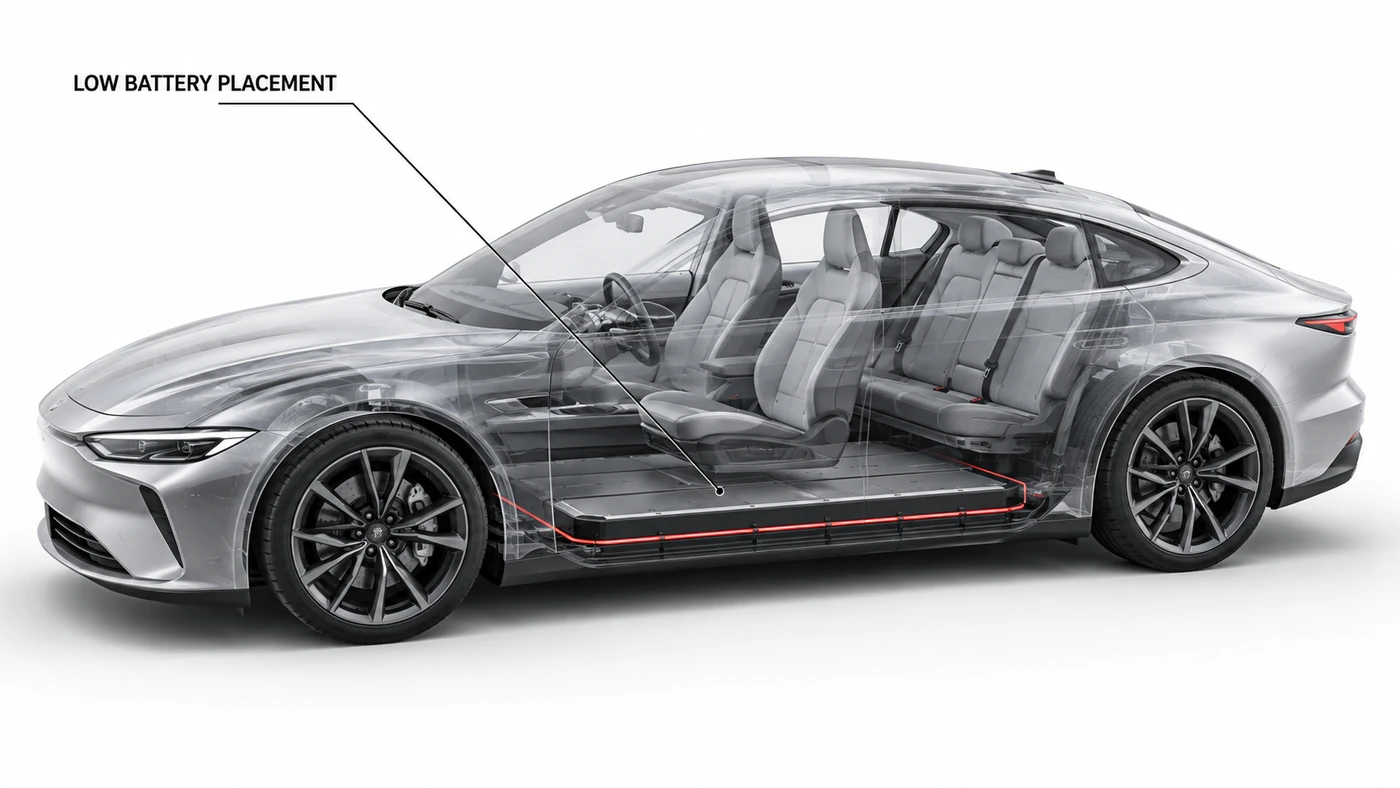
Many purpose-built electric cars carry a substantial battery under the passenger compartment. That can put a large share of their mass relatively low. Porsche’s Taycan packaging explanation identifies the underbody battery as a contributor to its low center of gravity.
This helps explain why a heavy EV can feel settled rather than top-heavy. It does not mean every EV has a lower CG than every combustion car. Battery position, body height, seating, cargo and the rest of the platform all matter.
Nor does a broad floor battery guarantee low rotational inertia in every direction. Low vertical placement and central placement when viewed from above are different questions. A long battery can sit low while still spreading substantial mass along the vehicle.
A small numerical example
Imagine two versions of a fictional 2,000 kg vehicle, each cornering at 0.6 g with a 1.6 m track. On a level road, neglecting aerodynamic forces and small geometry changes, the load shifted from the inside side to the outside side is approximately mass multiplied by lateral acceleration multiplied by CG height, divided by track.
At a 0.60 m CG height, that shift is about 4.41 kN. Lower the CG to 0.40 m and it becomes about 2.94 kN. The total weight has not changed; the difference in how it is shared left to right has.
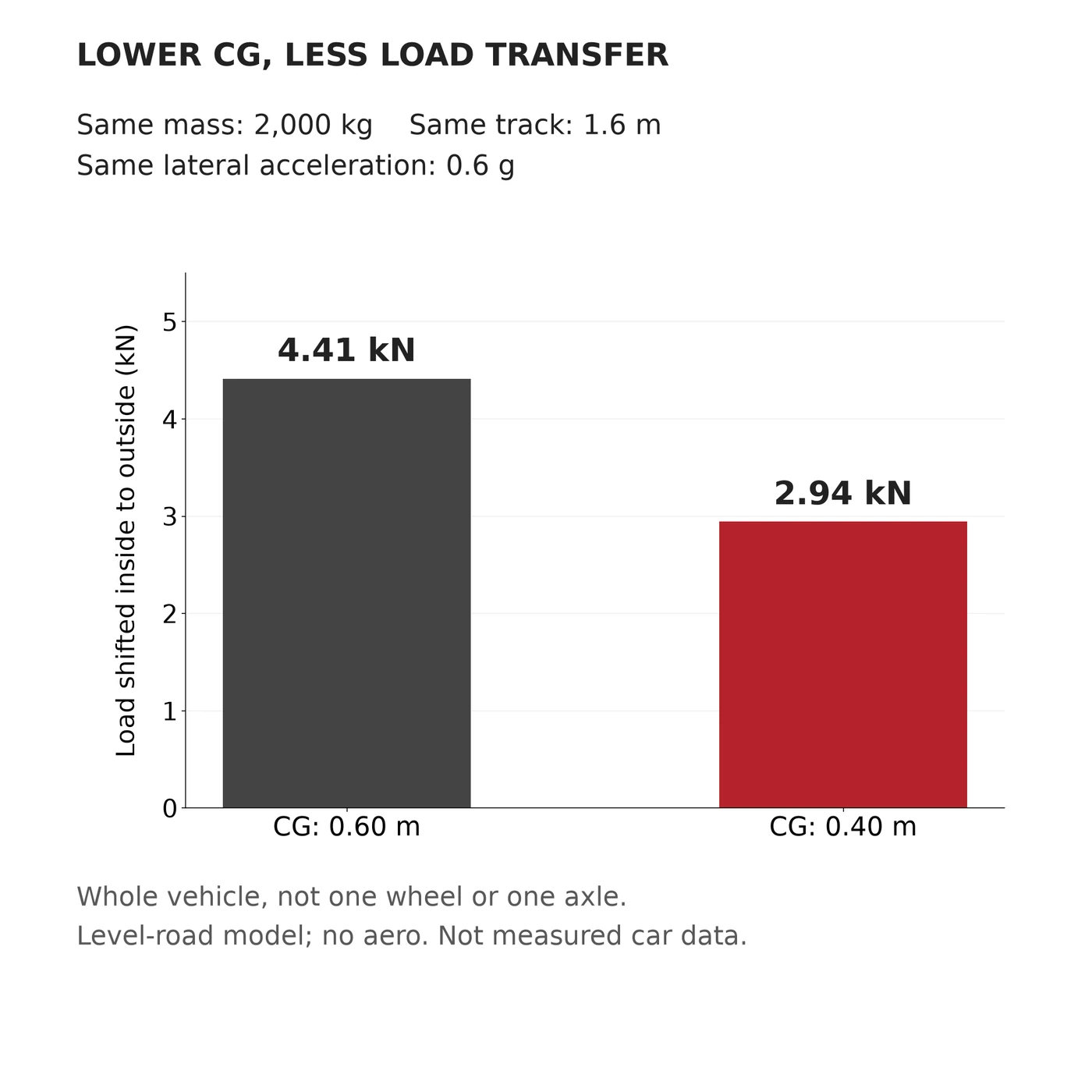
These are whole-vehicle teaching calculations, not loads for an individual wheel. Splitting the transfer between front and rear involves suspension geometry, roll stiffness and other details. The simplified relationship is useful because it isolates why height and track matter.
OptimumG’s load-transfer analysis also distinguishes total load transfer from the different paths through which it develops. We should not mistake a flat body for equal tire loads.
3. Tires Decide What the Chassis Can Use
The tires are where this discussion becomes less like a shopping-cart analogy and more like a real car. They must carry vertical load while creating braking, acceleration and cornering forces, often in combination.
Tire load sensitivity means that a tire’s performance changes with the load on it. Over a typical working range, peak lateral force increases as vertical load increases, but usually less than proportionally. Twice the vertical load does not reliably buy twice the cornering force from the same tire.
This is why concentrating too much load onto the outside tires can be costly. The extra grip gained outside may be smaller than the grip lost as the inside tires unload. The exact behavior depends on the tire, pressure, temperature, camber and surface; it is not one universal percentage. OptimumG’s tire-comparison paper shows why measured tire curves matter.
Wider is a tool, not a guarantee
A heavy performance car may use wider tires, a more suitable construction or a performance-focused compound to handle its demands. That is a genuine engineering response, not evidence that mass no longer matters.
But the number on the sidewall does not tell the whole story. At a similar load and inflation pressure, making a tire wider changes the shape of its contact patch; it does not automatically multiply the patch’s area in proportion to width. Carcass behavior, temperature control and rubber properties also influence grip.
Likewise, a hypothetical 285 mm front and 305 mm rear setup does not establish a cornering limit. Those numbers describe nominal section widths, not compound quality or performance in cold rain. More tire can bring cost, packaging, wheel-mass and efficiency compromises, but none can be calculated from width alone.
Our Brakes and Tires Basics guide is useful background for understanding why the contact between tire and road remains the final constraint.
Suspension and structure support the tires
Camber is the wheel’s lean when viewed from the front or rear. Toe describes where it points when viewed from above. Suspension geometry controls how those orientations change as a wheel moves, while springs, dampers and bushings shape the response to forces and road inputs.
The body must also provide a sufficiently stable mounting structure. If mounting points move in uncontrolled ways, the intended geometry becomes harder to maintain. Strong and stiff are not identical concepts: strength concerns resisting failure, while stiffness concerns deformation under load.
A heavy car can benefit from careful control of both. So can a light car. Simply making every spring or bushing harder is not a substitute for a coherent design, especially on uneven roads. See Suspension and Handling Basics and Car Structure Basics for the pieces behind that statement.
4. Where the Mass Sits Changes Rotation
Two cars can weigh the same and still respond differently when asked to rotate into a bend. This is where front-to-rear balance and rotational inertia enter the story.
Weight distribution describes how the static load is shared between the axles. A front-heavy layout asks more of the front tires, but it does not automatically determine understeer. Tire sizing, suspension behavior, braking, power delivery and the maneuver itself influence which axle reaches its limit first.
Is 50:50 the perfect answer?
It can be a useful design target, but it is not a law of good handling. A rear-biased sports car can work extremely well when its tire sizes, geometry and control systems match that layout. Chasing an isolated percentage misses how the complete vehicle uses its tires.
Also, the same front-to-rear split can hide different mass arrangements. Put two identical weights near the center, or move them equally toward opposite ends: the front-to-rear balance can stay the same while the resistance to rotation changes substantially.
Yaw inertia, without the intimidating name
Yaw is the rotation that changes where the car’s nose points when viewed from above. Yaw moment of inertia measures resistance to changing that rotation. It is sometimes described in car discussions as polar moment of inertia.
For a simple point mass, the contribution grows with the square of its distance from the rotation axis. Moving the same mass twice as far away makes that contribution four times larger. This is the relationship explained in OpenStax’s rotational-inertia chapter.
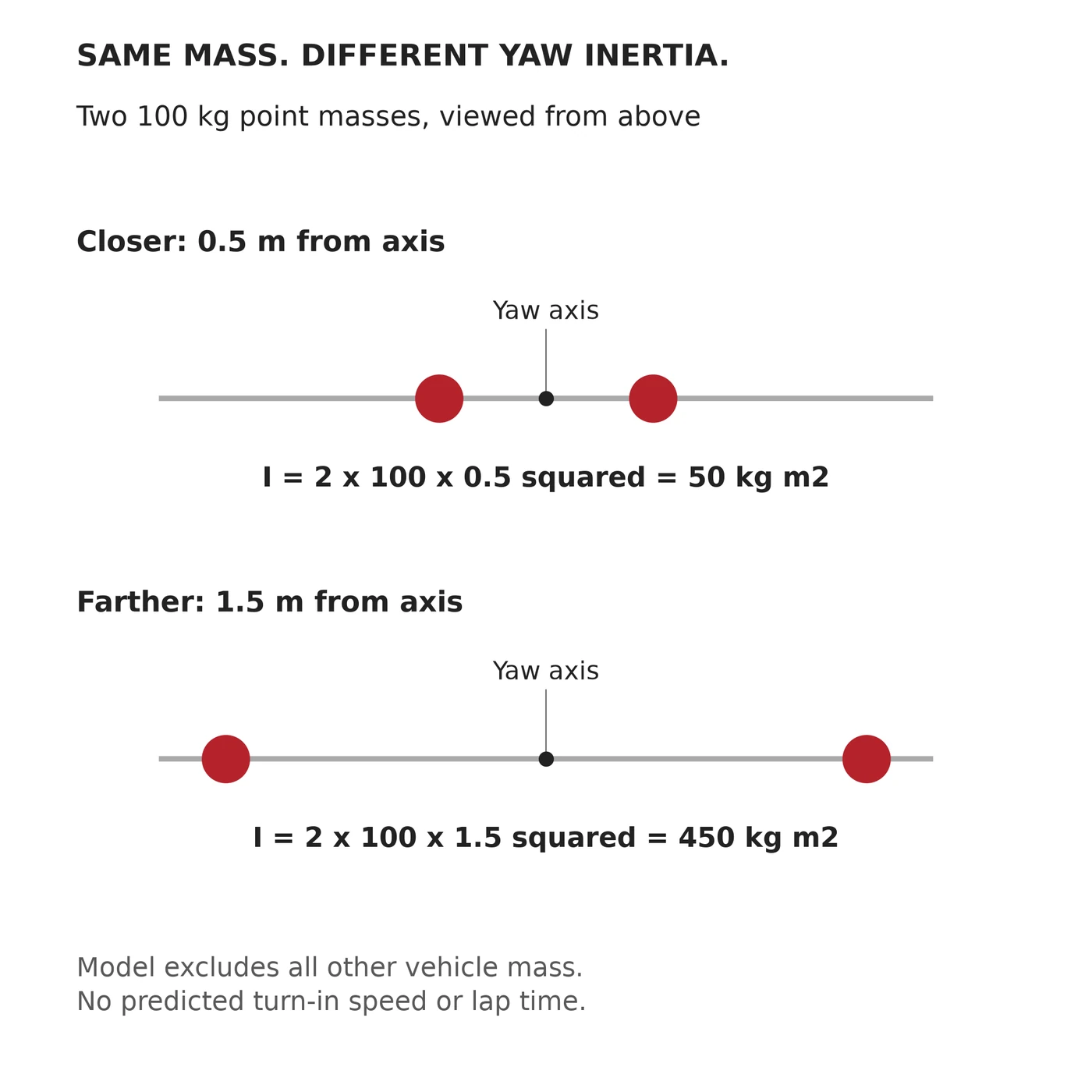
Centralizing major masses can therefore make a vehicle easier to rotate for the same applied turning moment. A mid-engine layout can help, but the engine is only one part of the vehicle. Fuel, occupants, battery modules and crash structures also contribute.
The illustration compares two pairs of fictional 100 kg point masses. At 0.5 m from the axis their combined contribution is 50 kg m2; at 1.5 m it is 450 kg m2. That is not a ninefold difference in a complete car, because the drawing excludes the rest of its mass.
A long luxury sedan can have substantial yaw inertia, but wheelbase alone does not measure it. Tire forces act through lever arms too. Designers have to manage both the resistance to rotation and the forces available to produce it.
5. Active Chassis Systems Help, Within Limits
Modern chassis systems do more than hide movement from the occupants. Some actively influence the forces and moments that turn the vehicle. Their effects depend on the hardware and calibration, not just the name of a dashboard mode.
Rear-wheel steering
At low speeds, many systems turn the rear wheels opposite to the fronts. This helps the car follow a tighter path, rather like shortening its wheelbase without physically moving the axles.
At higher speeds, the rear wheels may turn in the same direction as the fronts to support stability and coordinated response. The crossover speed and steering angles vary by vehicle and situation; they are not a universal parking-versus-motorway switch.
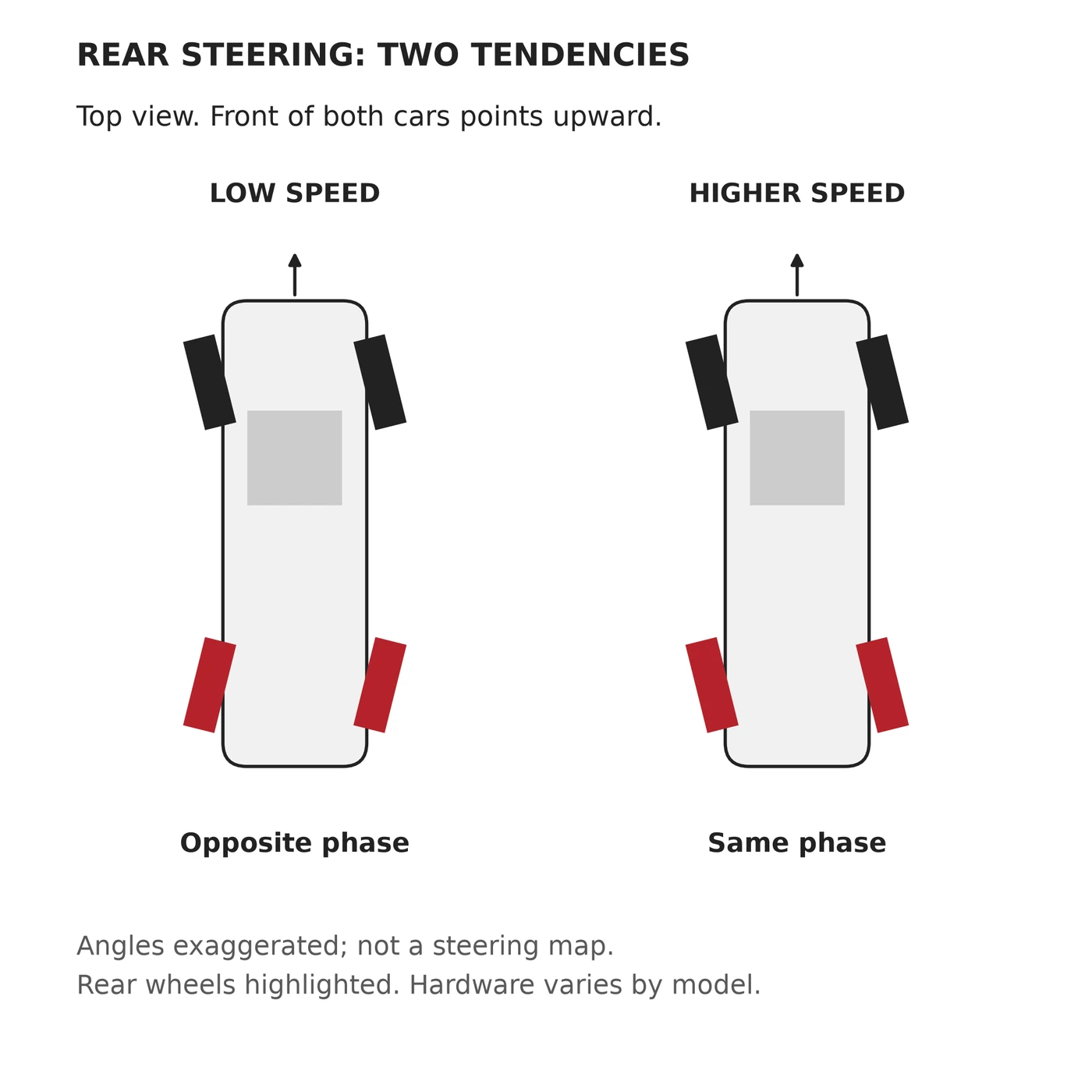
Porsche’s original Taycan chassis description provides a concrete example of these two operating tendencies. The same source describes electromechanical roll stabilization and a rear differential control system. Equipment and implementations vary across model years and versions.
Rear steering changes the response of the vehicle, not its mass or physical wheelbase. A large car may feel more willing to turn, but its tires still have to generate the required forces.
Active roll control
Electromechanical anti-roll bars can apply a controlled twisting action between the sides of an axle. Hydraulic active suspension can also generate forces to influence body attitude. These are not necessarily the same mechanism, and neither should be confused with a damper that only varies its resistance to movement.
Reducing body roll can help preserve useful wheel orientations and improve the sensation of control. However, keeping the body level does not remove the load transfer required by cornering. It changes how the system reacts, and potentially how transfer is shared between axles, rather than making the car weightless.
There can be smaller effects from changes in body position or ride height. Those do not justify the claim that a flat-looking car has no lateral load transfer. This is the same distinction that makes roll stiffness alone an incomplete measure of handling quality.
Torque vectoring
Torque vectoring uses differences in wheel forces to influence rotation or traction. In one powered-corner example, more forward force at the outside rear wheel can create a moment that helps turn the car into the bend. Other systems use selective braking, controlled differential locking or a combination of methods.
That distinction matters. An electronically controlled limited-slip differential is not automatically a device that can command arbitrary torque at each wheel. AWD by itself does not imply active left-to-right vectoring either.
Electric motors offer fast, precise torque control, but the motor layout determines what can be controlled independently. One motor per axle does not provide separate left and right motor commands. A system with separate wheel-driving motors has different possibilities, still constrained by the tires, motors, battery and software.
Using more grip to accelerate also leaves less available for turning when a tire approaches its combined-force limit. Vectoring can manage the available capacity intelligently; it cannot create an unlimited extra supply.
Aerodynamics also belongs in the picture
Useful downforce increases the normal load on the tires without adding the same amount of inertial mass. It can improve high-speed cornering capability, though tires remain load-sensitive and the aerodynamic package brings drag and balance considerations.
Its contribution depends strongly on speed and design. A large spoiler is not proof of useful downforce, and aerodynamic help on a fast circuit says little about low-speed agility in an ordinary turn.
6. The Weight Bill Arrives as Heat and Wear
The engine or motors may make a heavy car startlingly quick, but every acceleration has an energy cost. Slowing down requires that energy to go somewhere again.
Translational kinetic energy is one-half of mass multiplied by speed squared. At the same speed, a fictional 2,100 kg car carries 40% more of that energy than a 1,500 kg car. At twice the speed, either one carries four times as much. OpenStax’s kinetic-energy chapter explains the relationship.
Why larger brakes often appear
Braking duty is one reason heavy performance vehicles may need larger rotors, suitable calipers and substantial cooling. Thermal capacity and heat rejection matter, particularly when hard stops are repeated.
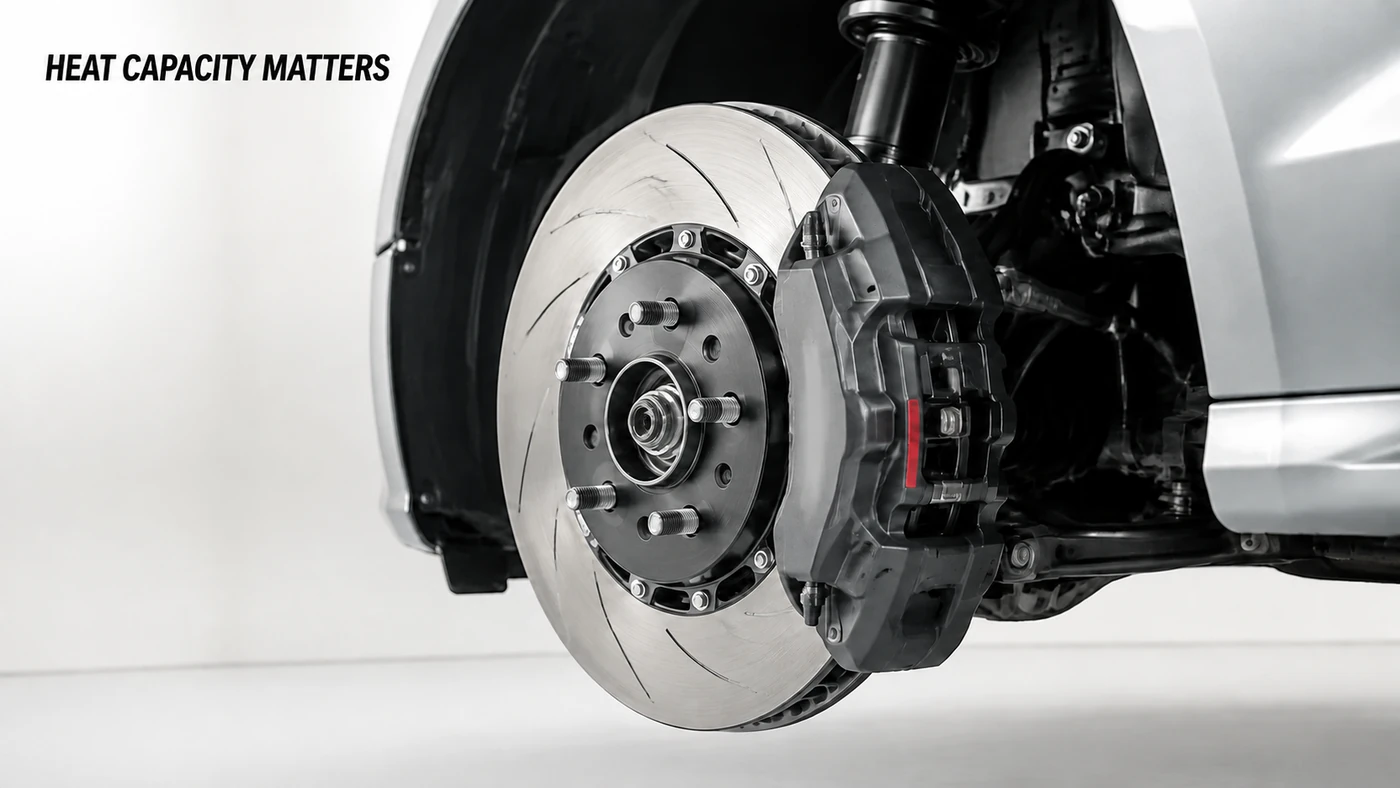
But 40% more energy does not automatically mean a 40% longer stop. Available tire force, ABS operation, brake capability and road conditions all influence stopping distance. A system with sufficient torque and thermal capacity can still stop a heavy car effectively.
Regenerative braking can recover some energy into an EV battery. Its availability depends on charge level, temperature, speed and system limits, and it does not make friction brakes unnecessary. During demanding use, the whole braking system must be considered.
Tires and repeated performance
Mass increases tire loading for otherwise comparable vehicles, and aggressive torque delivery can add further work. Michelin’s EV tire explanation discusses the construction and wear demands involved.
However, predicting tire life from weight alone would repeat the original mistake. Compound, alignment, pressure, roads and driving style can change the outcome substantially. A gentle driver in a heavy car may get a different result from an aggressive driver in a light one.

There is a similar distinction between one impressive lap and sustained performance. Tires, brakes and powertrain cooling have operating windows. Once temperatures leave those windows, the car may no longer deliver the same response.
Bearings, joints and suspension components must also be engineered for their loads. This does not mean every heavy car is unreliable; it means achieving durable performance requires appropriate design capacity.
Acceleration does not settle the handling debate
High power, suitable gearing and AWD traction can make a heavy EV launch extremely quickly. That result does not establish its transient response, steering feedback or tire endurance.
At higher speeds, available wheel power and aerodynamic drag become increasingly important. Mass remains part of acceleration, but aerodynamic drag is not caused by mass itself. Frontal area and drag coefficient help determine it. A heavy, aerodynamically efficient sedan and a tall, broad SUV should not be treated as identical cases.
7. Real Cars Show Different Ways to Solve the Problem
Examples are useful if we keep the question honest. We are looking at different engineering approaches, not pretending that a street photograph or unrelated lap time provides a controlled comparison.
The performance SUV: Audi RS Q8 performance
In its June 2024 announcement, Audi reported a 7:36.698 Nordschleife lap for the RS Q8 performance. The described package combined all-wheel steering, performance tires and other chassis measures; active roll stabilization was part of the development story. See Audi’s archived launch report.
That historical result is a useful counterexample to the claim that a large SUV cannot be fast on a circuit. It is not a current-record claim, a tire-independent result or proof that every heavy vehicle handles well.
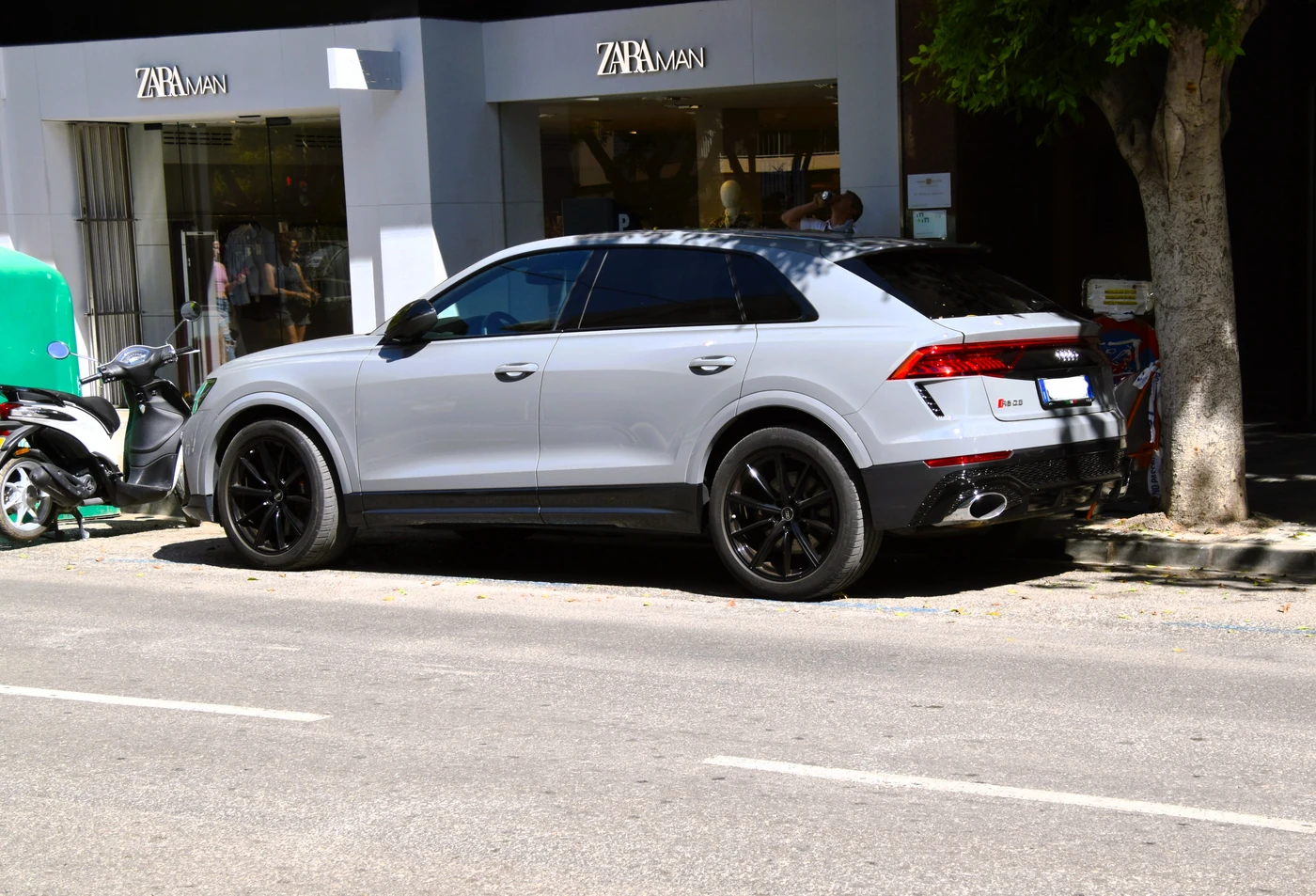
Nor can we attribute the lap entirely to one system. Power, tires, braking, driver, setup and conditions all contributed. A lap time shows the performance of that package under those conditions, not a clean measurement of the penalty associated with each kilogram.
The electric performance car: Taycan Turbo GT
Porsche’s 2024 Taycan Turbo GT introduction is revealing for a different reason. Even while emphasizing electric power and chassis capability, it describes weight-saving measures and a Weissach package intended for track use.
That is the important lesson: sophisticated electric performance has not made weight reduction obsolete. Engineers continue to pursue it alongside tires, aerodynamics and control systems. We should not read an impressive heavy-car result as evidence that the same team would welcome unnecessary additional mass.
The lightweight roadster: Mazda MX-5
Mazda’s fourth-generation MX-5 press material describes weight reduction as part of its effort to improve response and agility. Its compact two-seat format allows a different set of compromises from a family SUV or large electric sedan.

This does not establish that an MX-5 wins every corner or feels better to every driver. It illustrates another route to involvement: begin with fewer kilograms and a smaller vehicle rather than compensate for a much larger package.
A thought experiment, not a specification-sheet race
Consider a fictional 1,500 kg car with a high CG and modest tires, and a 2,100 kg car with a lower CG, well-matched performance tires and carefully calibrated chassis systems. The heavier one could have higher steady cornering capability. We cannot calculate the winner from that list alone.
Now improve the lighter car’s tires and chassis while keeping its mass advantage. The comparison changes again. The useful lesson is to identify which variables changed, not declare that weight is irrelevant or that electronics always win.
| Question | What we need beyond curb weight |
|---|---|
| Which car holds a faster steady bend? | Tire behavior, surface, load transfer, alignment and aerodynamic forces |
| Which responds better in a quick transition? | Yaw inertia, tire response, damping, steering and control calibration |
| Which repeats hard laps more consistently? | Tire temperatures, brake capacity, cooling and powertrain limits |
| Which feels more enjoyable? | Feedback, predictability, preferred balance and the driver’s priorities |
| Which launches faster? | Wheel power and force, gearing, traction and total mass |
Why Motorsport Still Values Lightness
Racing does not treat weight reduction as an outdated idea. Reducing unnecessary mass can ease acceleration and thermal demands, while giving engineers more freedom to position permitted ballast when the rules require a minimum mass.
Ballast is weight deliberately installed to meet regulations or a balance target. Placing allowable mass low and close to the desired center can help, but teams cannot always put it wherever they like. Rules may specify mass distribution, mounting strength and particular locations.
For example, the FIA’s 2026 Formula 1 technical regulations, Issue 20 include separate provisions for minimum mass, distribution and ballast. This is a dated example, not a claim that every racing series uses the same requirements.
Minimum-weight rules also serve broader competition and safety-related design objectives; they are not simply an instruction to build the lightest possible machine at any cost. Their practical effect nevertheless reinforces the point: total mass and its placement both deserve careful attention.
Cariary Thoughts
The part I find most interesting is how easily we confuse three different things: a car that looks composed, a car that is objectively fast and a car that feels light on its feet.
A low, stable body can make a heavy vehicle feel reassuring. Strong tires and sophisticated controls can produce real speed, not merely an illusion. Yet reducing inertia still changes the job those systems have to do.
I do not think we need to choose between admiring an impressive performance SUV and appreciating a small roadster. They demonstrate different engineering priorities. What matters is understanding how the result was achieved, rather than using weight as a one-number verdict.
Studying Heavy Car Handling has made the question more interesting for me: not simply how much the car weighs, but where that mass sits, what the tires can deliver and how the response develops when the driver asks for a change.
This closes the tenth myth with a useful habit for the whole series. A specification usually tells us something real. Trouble starts when we ask it to tell us everything.
One-line Summary
A lighter car starts with a physical advantage; a well-engineered heavy car can still corner exceptionally well without escaping the costs of its mass.
FAQ
Are lighter cars always better at handling?
No. Lightness reduces the force and energy demands for a given maneuver, but handling also depends on tires, mass placement, geometry and calibration. A poorly matched light car can be less capable or less predictable than a well-developed heavy one.
Why can heavy EVs feel so stable?
A low-mounted battery can reduce CG height, while tires and chassis control shape the response. That can create a settled feel, but does not remove the mass or guarantee that every EV handles better than a combustion car.
Does adding weight give a tire more grip?
Usually it increases the tire’s absolute lateral-force capacity over its working range, but not in direct proportion to the added vertical load. This load sensitivity is one reason extra mass and uneven loading can reduce efficiency in cornering.
Can active suspension eliminate weight transfer?
No. It can influence body movement, geometry and the distribution or timing of load changes. Holding the body flat does not cancel the equilibrium forces associated with cornering on the road.
What is polar moment of inertia in a car?
In this context it usually means yaw rotational inertia: resistance to changing the rotation of the car’s nose around a vertical axis. Mass farther from that axis contributes more, so placement matters as well as the total.
Does rear-wheel steering make a heavy car lighter?
No. It changes wheel orientations to help maneuverability or dynamic response. A tighter turning circle and improved stability can be valuable without changing the vehicle’s mass.
Can a heavy car beat a light car on a circuit?
Yes. Power, tires, aerodynamics and chassis systems can outweigh its mass disadvantage in a particular comparison. A meaningful result still needs context such as circuit, driver, conditions, setup and repeated-lap performance.
Is the fastest car necessarily the most fun?
No. Enjoyment also depends on feedback, predictability and the kind of response a driver likes. Neither low weight nor a fast lap guarantees a personally satisfying experience.
Related Thoughts
- Suspension and Handling Basics: body movement, wheel control and the complete chassis.
- Car Structure Basics: mass placement, rigidity and the structure around the suspension.
- Brakes and Tires Basics: the grip and thermal limits behind performance.
References
- OpenStax: centripetal force
- OpenStax: kinetic energy
- OpenStax: moment of inertia
- OptimumG: load transfer and suspension force paths
- OptimumG: comparing measured tire behavior
- Porsche: Taycan battery packaging
- Porsche: original Taycan chassis systems
- Porsche: Taycan Turbo GT introduction, 2024
- Audi: RS Q8 performance announcement, June 2024
- Mazda: 2017 MX-5 press kit
- Michelin: understanding EV tire demands
- FIA: 2026 F1 technical regulations, Issue 20
- Wikimedia Commons: Audi RS Q8 photograph
- Wikimedia Commons: Mazda MX-5 ND photograph
Data Reference Date: September 7, 2026. Vehicle examples are identified historical publications, not a current equipment list. Numerical diagrams are simplified calculations, not instrumented vehicle tests.

