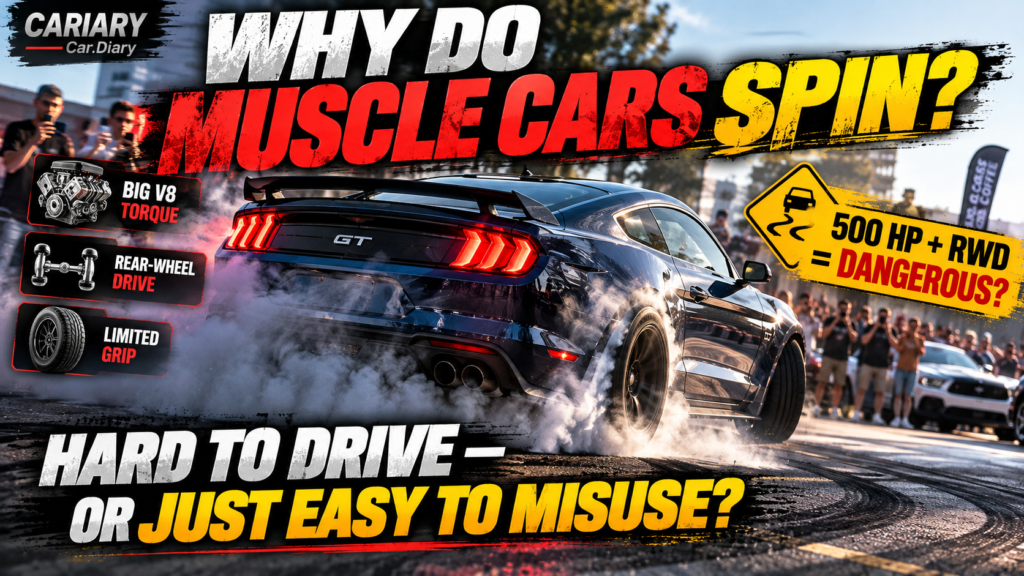
Muscle cars can look terrifying in short videos: a loud departure, spinning rear tires, a sudden sideways movement, and a correction that seems to make everything worse. Watch enough of those clips and it is easy to imagine that an American V8 coupe is constantly trying to escape its driver.
Yet ordinary driving and driving near the limit are very different tasks. A well-maintained modern example, on suitable tires with its normal stability systems active, can be straightforward to operate. That does not make its full performance straightforward to manage.
I wanted to understand the gap between those two experiences. The answer is less about a car being unable to turn and more about how quickly the driver can ask too much of its rear tires.
Quick Summary
- Modern muscle cars are generally manageable in ordinary driving, but high output can magnify abrupt inputs.
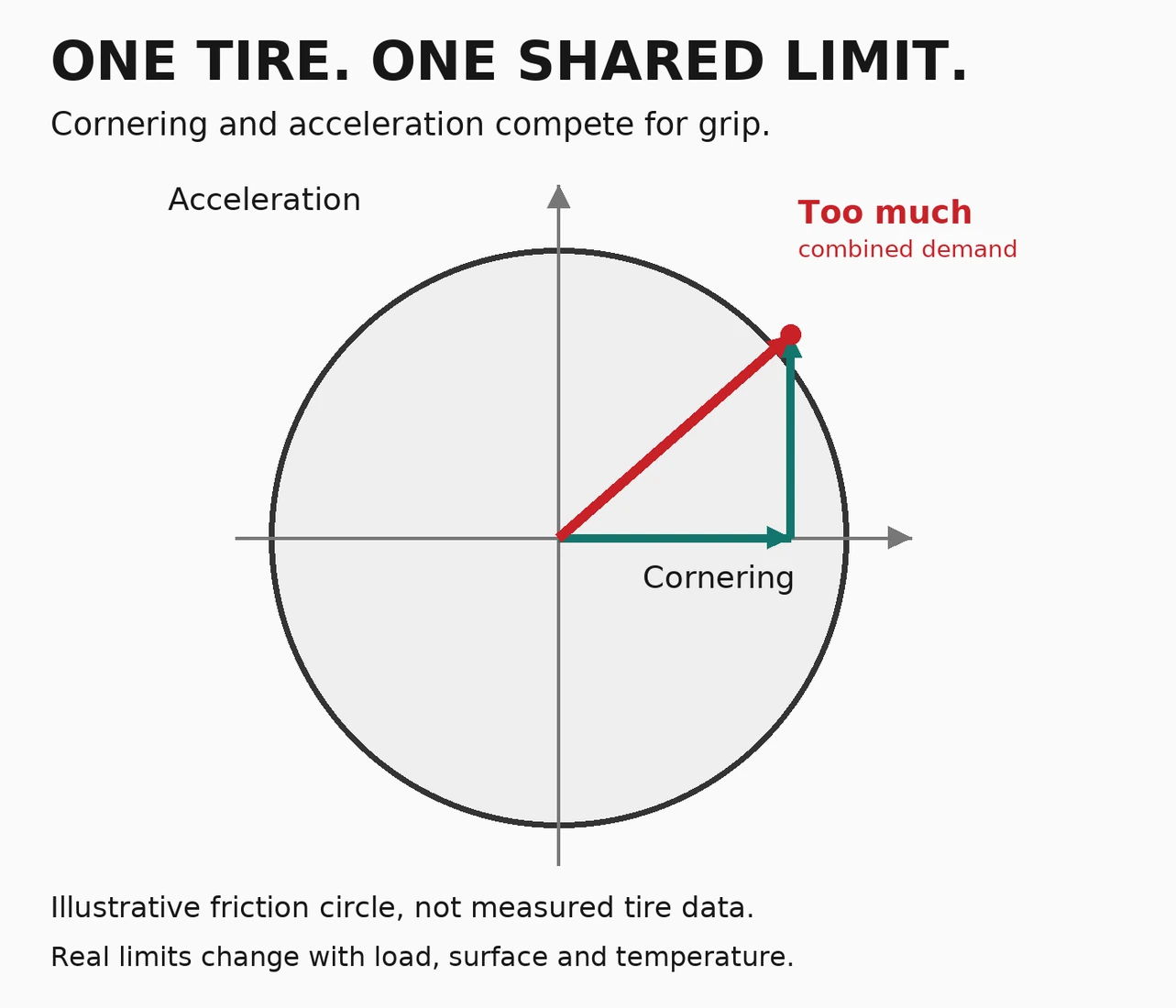
- A rear tire shares its available grip between accelerating and cornering; it does not have separate unlimited reserves for each.
- Oversteer means the rear of the car rotates outward more than intended. A rapid reversal after a correction is a related but distinct event.
- Tires, weather, gearing, differential calibration and electronic settings matter alongside horsepower.
- Keep road-driving assistance active, leave generous margins, and learn limit behavior with an instructor in a controlled environment.
1. Muscle Cars Are Not One Handling Formula
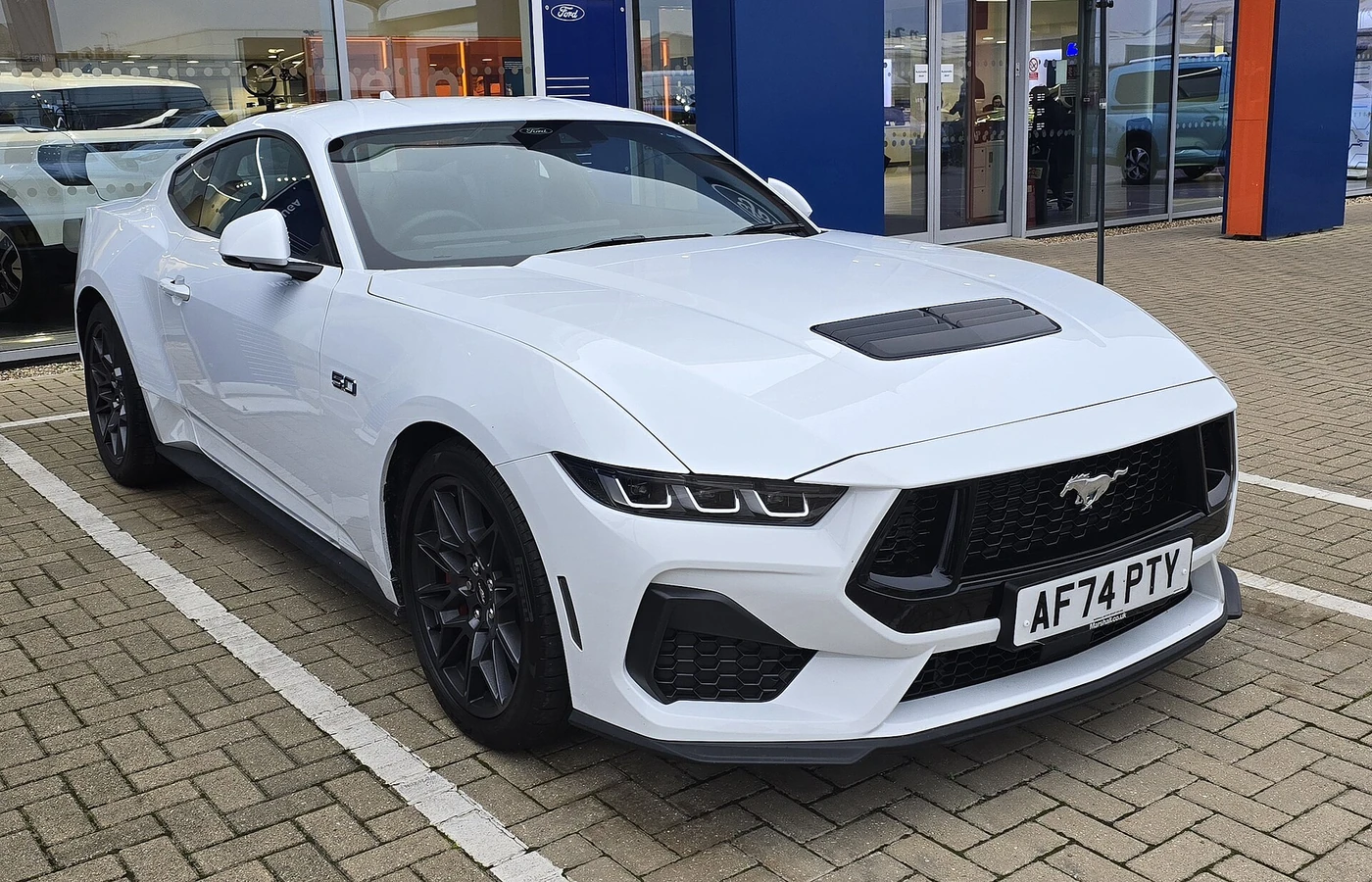
First, a terminology note. Ford’s history of the Mustang identifies it with the pony-car category. In everyday discussion, powerful American rear-wheel-drive coupes are often grouped under the wider muscle-car label. That is how we are using the term here.
It does not mean every Mustang has a V8, every American performance car has the same chassis, or every muscle car behaves alike.
A traditional image emphasizes a large engine and straight-line performance. Modern examples can also have sophisticated suspension, capable brakes and extensive electronic control. The boundary with a sports car is not a hard engineering wall.
For example, Ford’s 2015 Mustang technical specifications list an independent rear suspension. Rear-wheel drive does not require a crude rear axle, and a big engine does not prevent engineers from developing a capable cornering chassis.
The more useful distinction is between operating the car and managing its limits.
Parking, commuting and gentle acceleration do not require a racing driver’s reactions. Asking for maximum acceleration while the car is still turning is another matter. Familiar controls can conceal a much larger range of possible responses.
Think of a powerful car as a high-gain amplifier. A modest input can produce a substantial output. The analogy is imperfect because electronic throttle calibration changes the relationship, but it captures why a familiar pedal can deserve unfamiliar restraint.
2. The Rear Tires Have One Shared Grip Budget
A tire must transmit forces through its contact with the road. Longitudinal force acts along the direction of travel, for acceleration or braking. Lateral force acts sideways to help the car turn.
Those demands interact. Continental’s tire guidance explains that using traction for braking reduces the amount available for cornering. The same combined-force principle matters when a driven tire accelerates through a bend.
The familiar friction circle is a simplified picture of that relationship. More detailed tire-dynamics research models the actual response to combined motion; a real tire is not a perfectly circular, fixed-limit device.
Why straight-line confidence can mislead
Imagine a rear tire that can cope with a particular acceleration demand on a dry straight. Put the car in a bend, and that tire is already contributing a sideways force.
Adding the same drive demand can now exceed its combined capability. The engine has not become more powerful. The tire has been given a second job.
This is not a literal rule that 60% cornering leaves exactly 40% acceleration. The forces combine as directions, not as a simple household expense total. Surface, vertical load, temperature and tire behavior all change the boundary.
Nor is this one fixed grip circle for the whole car. Each tire has its own loading and demands. Our brake and tire basics guide provides the foundation for understanding that contact with the road.
Wheelspin is not automatically a spin
Wheelspin means a driven tire is rotating faster than the road speed would require. It can occur without a dramatic change of direction, particularly in a straight line.
In a bend, however, losing rear lateral support can allow the rear to move outward. The vehicle then rotates more than the driver intended. That is the familiar power-oversteer problem.
The lesson is not that every touch of the accelerator causes a drift. It is that remaining steering demand matters when acceleration is added. Straightening the steering reduces cornering demand, but even a straight road does not guarantee enough grip for full power.
3. Oversteer, Snap Reactions and Panic Inputs
Understeer means the car turns less than requested, often because the front tires cannot provide enough lateral force. Oversteer describes the opposite tendency: the rear loses relative lateral support and the car rotates more than intended.
Both can be dangerous. Understeer can carry a car out of its lane; it is not a harmless beginner setting. But unexpected rear rotation can demand particularly fast, coordinated judgment.
What “snap oversteer” actually means
The term usually describes oversteer that develops abruptly. It is not simply another name for the rear tires regaining grip.
A different event can follow an initial slide: the driver makes a large correction, the tire forces change, and the car rotates the other way. That reversal is often described as a snap-back or a fishtail. Grip recovery, steering position, yaw momentum and the driver’s timing can all contribute.
Yaw is simply the car rotating around a vertical axis, like turning a toy car on a tabletop.
An illustrative failure sequence is easy to picture: acceleration is added before a turn is finished; rear grip is exceeded; the driver reacts late and abruptly; the subsequent change in forces creates a second movement. It is not a reconstruction of every crash video.
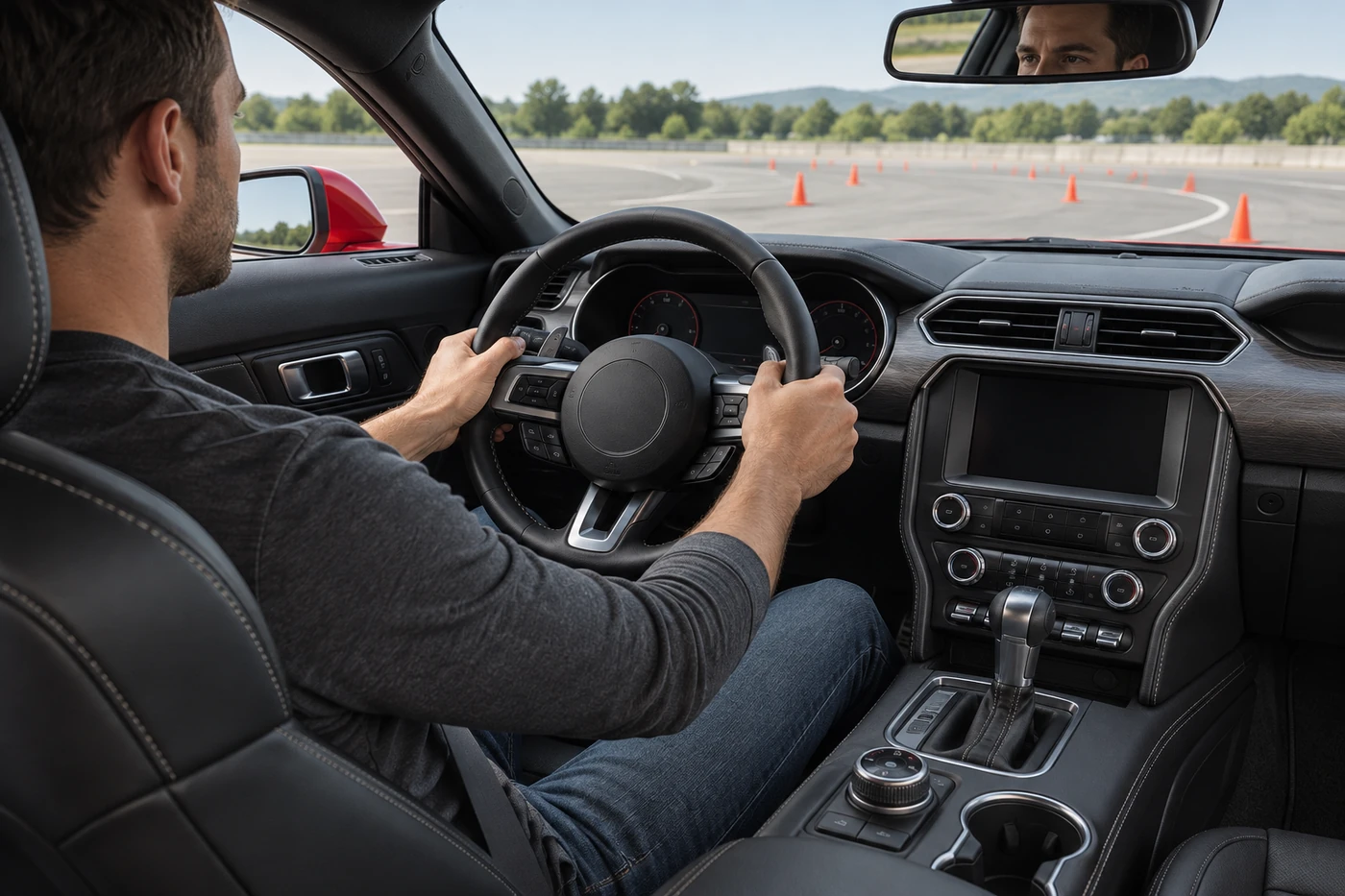
Why lifting suddenly is not a universal solution
Reducing power can reduce drive-induced wheelspin. But abruptly lifting the accelerator can also change axle loading and introduce engine braking. The Rocky Mountain BMW CCA driving-school manual discusses trailing-throttle oversteer: lifting while turning can itself contribute to rear rotation.
The equally simplistic opposite instruction, “keep your foot in it,” is not a safe universal rule either.
This article explains the physics; it is not a real-time skid-recovery procedure. Appropriate responses depend on the cause, speed, steering angle, surface and vehicle systems. Recovery is something to learn under qualified supervision, not from a pedal recipe applied on a public road.
The accelerator changes balance, not just speed
Drivers sometimes call this throttle steering: changes in drive force and load transfer influence the car’s rotation. It does not mean that more throttle always produces more yaw, or that less throttle always stabilizes the car.
Those outcomes depend on the operating state. A professional anticipating a slide on a prepared course is solving a different problem from a surprised driver trying to react beside a curb.
Our suspension and handling basics help connect these force changes to the way the body and tires respond.
4. Gearing and the Differential Change What the Tires Receive
Peak engine torque is only the beginning of the story. The transmission and final drive multiply it before it reaches the driven wheels.
For a simplified mechanical calculation:
Total driven-wheel torque = engine torque × selected gear ratio × final-drive ratio.
This omits losses and transient effects. Dividing wheel torque by effective tire radius gives the corresponding drive-force demand at the road, subject to available traction.
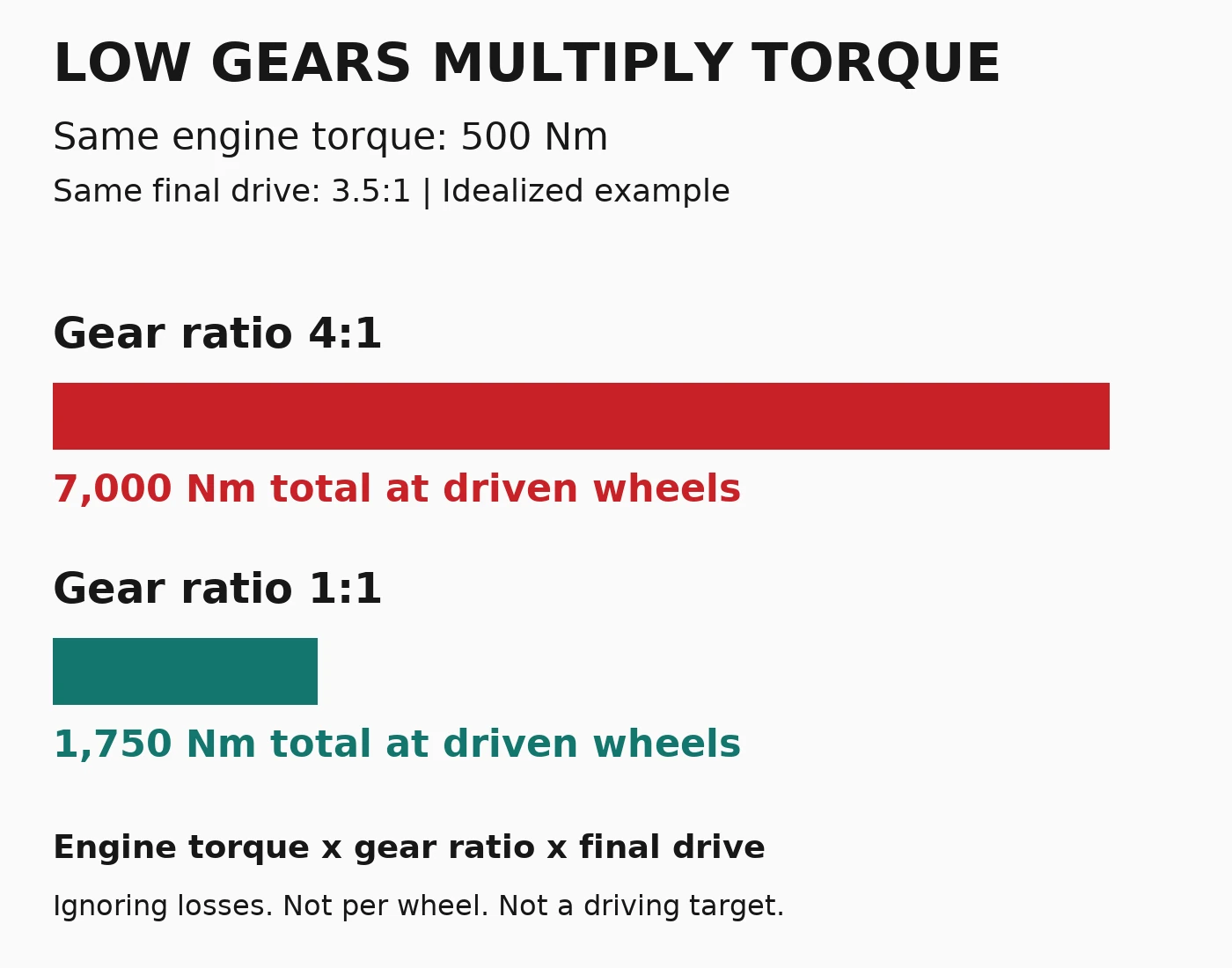
In our hypothetical example, 500 Nm through a 4:1 gear and a 3.5:1 final drive becomes 7,000 Nm in total at the driven wheels. A 1:1 gear with the same assumptions gives 1,750 Nm.
These are not values for a particular Mustang or Hellcat, and they are not figures for each individual wheel.
That multiplication helps explain why lower gears can overwhelm the tires so readily. It also explains why an acceleration run in a taller gear can feel smoother without being safer overall. Higher speed carries much greater consequences; reduced wheelspin is not permission for high-speed road testing.
Our torque and acceleration explainer develops this distinction between an engine specification and what moves the car.
Why an LSD helps, but cannot create grip
A limited-slip differential, or LSD, limits the imbalance in wheel behavior that can leave an open differential constrained by one low-traction wheel. It can make more of the available rear-tire grip usable.
Different designs do this differently. Torsen’s explanation describes its torque-biasing gear mechanism; clutch-based and electronically controlled units have their own characteristics.
If both rear tires are asked for too much, both can still lose traction. Torsen’s worked examples explicitly discuss this limit.
An LSD does not inherently guarantee sudden breakaway, and an open differential is not a safety device. Calibration, loading and tires matter. Our drivetrain basics guide explains how the differential fits into the rest of the system.
Delivery matters more than a single number
A naturally aspirated V8 can have progressive delivery, but pedal position is not a fixed percentage of torque. Modern electronic throttle maps, engine speed and transmission behavior all intervene.
Some older turbocharged cars had pronounced lag and a sharper arrival of boost. That does not mean every turbo engine is unpredictable or every naturally aspirated engine is gentle.
A manual adds clutch engagement and gear-selection decisions. An automatic can coordinate shifts with torque management, but a kickdown or an aggressive mode can still change the response. Neither transmission makes traction unlimited.
5. Modern Electronics Add a Valuable Safety Margin
The original muscle-car era did not offer today’s electronic stability-control safety net. That matters more than simply comparing old and new horsepower figures.
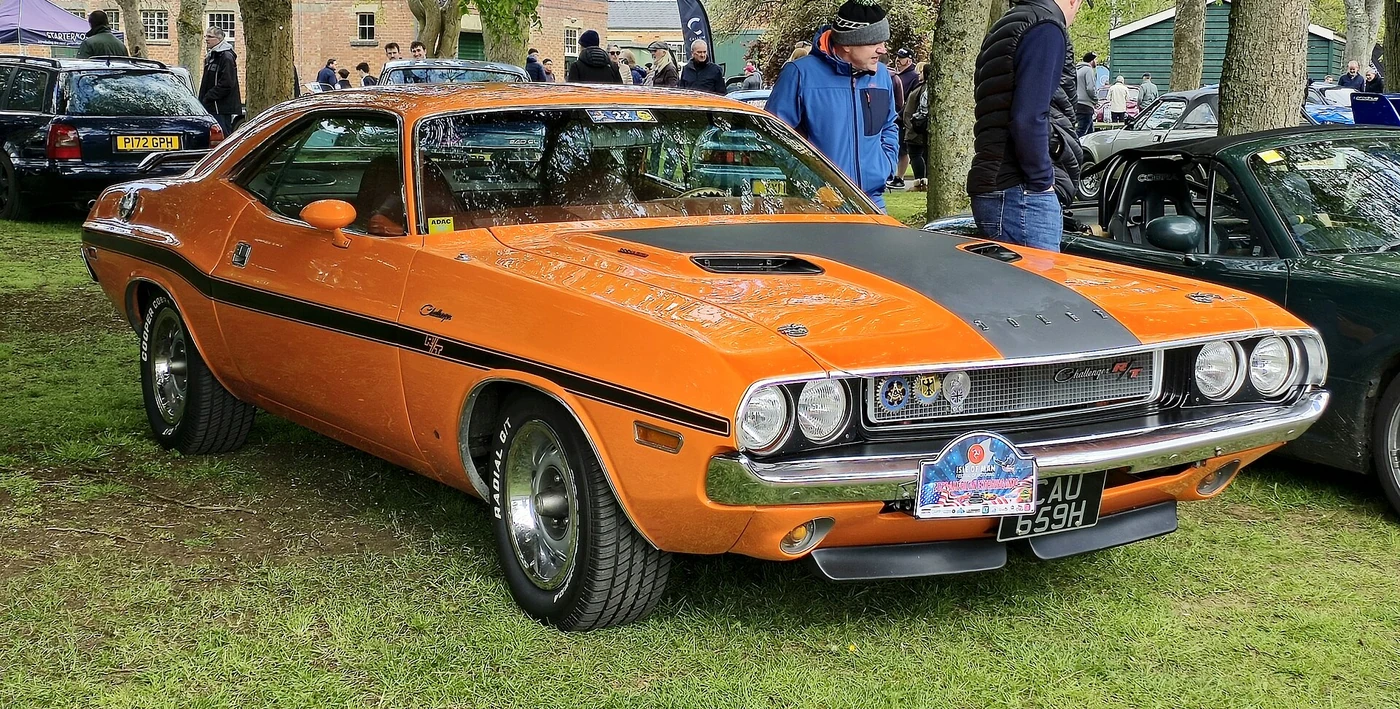
An old car’s present condition, replacement tires, modifications and maintenance also matter. The photograph above shows a surviving classic on tires fitted today, not a controlled comparison with original 1970 equipment.
Likewise, older advertised power figures may use different measurement conventions. We should not treat an old brochure number and a modern rating as a complete driving-difficulty comparison.
Traction control and ESC do different jobs
Traction control primarily addresses excessive driven-wheel slip. Electronic stability control, or ESC, also considers the vehicle’s direction and rotation.
Bosch describes how wheel-speed, steering-angle and yaw information help the system compare intended and actual movement. It can reduce engine output and brake selected wheels to oppose unwanted rotation.
That is a substantial advantage. It is not a promise that every mistake can be corrected.
If the tires cannot supply the forces needed, the road is too slippery, or there is too little space left, electronics cannot invent the missing margin. ESC helps manage available grip; it does not repeal physics.
The same car can have very different settings
Drive modes may change accelerator response, shifting and the permitted amount of slip or rotation. Suspension and differential settings may also change where the hardware supports them.
Ford’s 2025 Mustang drive-mode documentation describes reduced traction and stability intervention for track use. That is not simply a sportier display theme.
| Setting or situation | What to understand |
|---|---|
| Normal road mode, assistance active | The intended everyday safety baseline, not a guarantee |
| Sport or partial-intervention mode | May allow more slip or rotation; behavior varies by vehicle |
| Track or drag mode | May reduce assistance and assume a controlled environment |
| ESC disabled | Removes an important layer of support; not appropriate for experimenting on the road |
| Wet/snow mode, if fitted | Can soften responses, but cannot replace suitable tires or sensible speed |
Read the manual for the exact model and year. A button label or driving mode is not a universal specification across brands.
6. Wet Roads and Unsuitable Tires Can Change the Car
An engine does not automatically lose its capability just because the road gets wet. The tire-road interface, however, can offer substantially less usable grip.
That makes a previously comfortable input excessive for the new conditions.
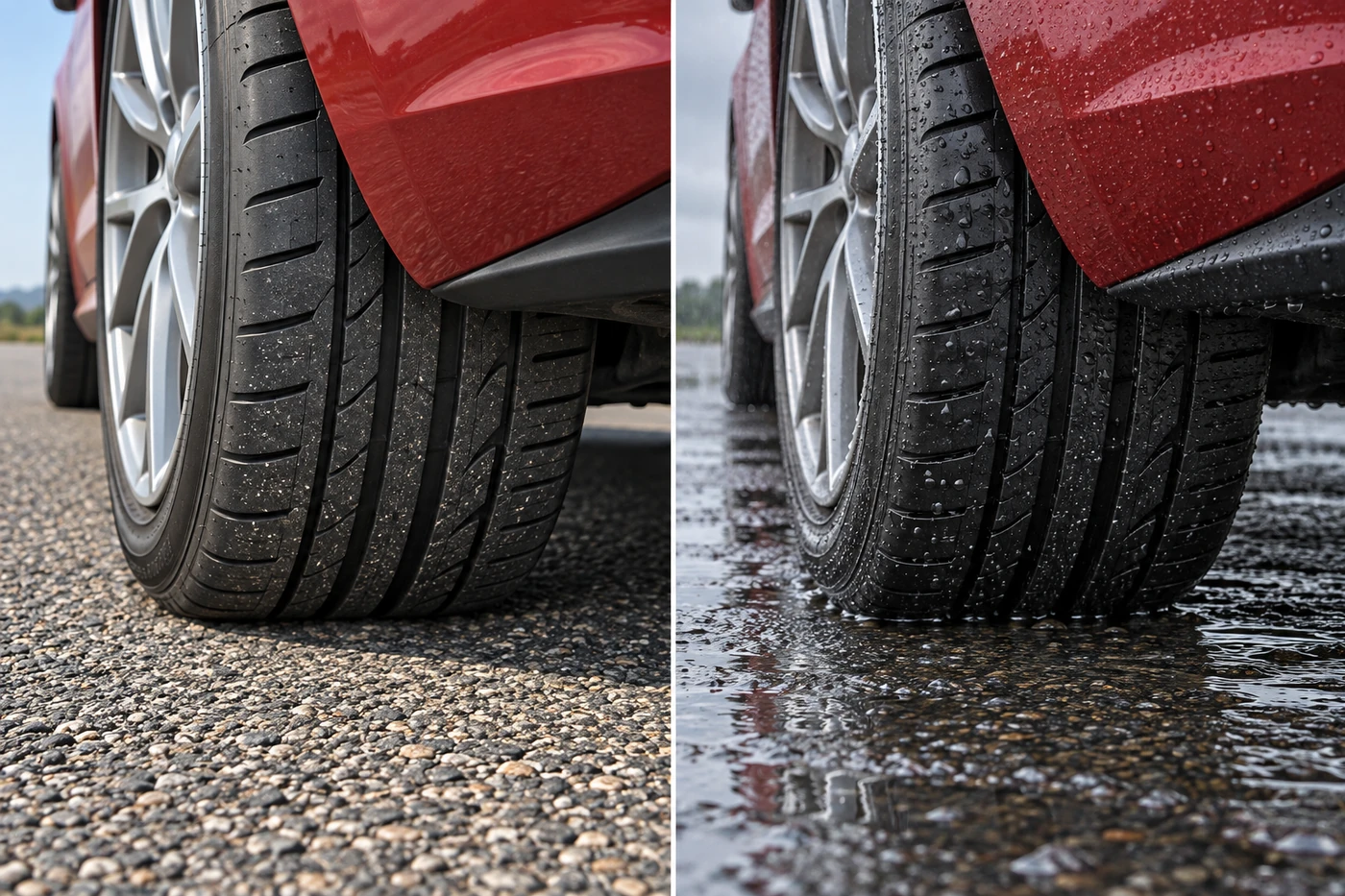
Standing water adds the possibility of aquaplaning, where water interferes with tire contact. Tire condition, water depth and speed matter; rear-wheel drive is not the only layout vulnerable to that problem.
Cold summer tires deserve particular respect
Michelin’s seasonal tire guidance explains that summer compounds lose suitability as temperatures fall. Even a cold, dry road can be a problem compared with an appropriately rated tire.
Do not treat “warm them up” as permission for weaving, burnouts or aggressive acceleration on public roads. A summer tire does not become a winter tire because the driver has spent a few minutes driving it.
Check the exact tire manufacturer’s temperature and use guidance. Any general temperature recommendation is not a sudden universal grip switch.
Width and price are not complete answers
A wide rear tire can support a capable performance package, but width alone tells us little about the compound, water evacuation, operating conditions or condition of that tire.
Inspect tread, damage and pressure, and consider age and service history. Use the vehicle’s specified cold inflation pressures and suitable approved fitment. Do not lower pressure arbitrarily to imitate a drag-racing setup.
“Fresh expensive tires” versus “old cheap tires” is not a scientifically controlled comparison. The right category and condition for the actual environment matter more than a brand stereotype.
7. The Driver and the Setting Matter as Much as the Badge
The Mustang crash meme is memorable because a sudden sideways departure makes a dramatic clip. But a collection of videos is not exposure-adjusted accident data.
It does not tell us how many miles were driven, which settings were active, what tires were fitted, or how other cars performed under comparable conditions.
A plausible risk scenario is still worth understanding: a tight exit, acceleration before steering is unwound, a surface with uncertain grip, little runoff and people nearby. A driver trying to impress an audience can add precisely the abrupt input the situation does not need.
That describes a hazardous combination, not a diagnosis of every recorded incident or every Mustang owner.
Why a Hellcat can feel different
Very high-output versions add another dimension. Stellantis listed the 2023 Challenger SRT Hellcat at 717 horsepower. That is a dated model example, not a specification for every Hellcat-badged car.

A substantial body or a long wheelbase can contribute to a settled initial impression. They do not guarantee a slow, easy-to-catch slide.
Wheelbase is only one influence on rotation. Mass distribution, yaw inertia, tires, suspension and calibration also matter. A short car is not automatically nervous, and a long car is not automatically forgiving.
Greater mass means more kinetic energy at the same speed. But it would be wrong to infer a fixed longer stopping or recovery distance from mass alone: braking force, tire loading and grip also change. In the simplest friction-limited braking model, mass cancels out.
The useful conclusion is that a calm feeling is not proof of a large remaining safety margin.
FWD is not a free pass either
An accelerating front-wheel-drive car may respond to excessive demand with wheelspin and a wider cornering path. A powerful rear-wheel-drive car can instead lose rear support and rotate.
Those are tendencies, not guarantees. Front-wheel-drive cars can oversteer under other inputs, and rear-wheel-drive cars can understeer. Both still depend on four finite tire contact patches.
This is why horsepower alone cannot define an “easy,” “expert” or “safe” category.
A Better Way to Think About Driving Difficulty
Rather than assigning a skill rating to 500 or 700 horsepower, ask what margin the situation leaves.
| Situation | What changes the demand on the driver |
|---|---|
| Ordinary driving with suitable tires and normal assistance | Modest inputs can keep tire demands comfortably below the limit |
| Accelerating while still turning | Rear tires must share acceleration and cornering forces |
| Rain, standing water or unsuitable cold-weather tires | Available grip can decrease sharply |
| Reduced electronic intervention | More of the developing imbalance is left to the driver |
| Tight public-road departure | Limited space makes even a brief loss of control consequential |
| Supervised closed-course training | Instruction and runoff support learning, but do not eliminate risk |
For road use, the sensible priorities are unglamorous: keep assistance active, choose suitable tires, respect conditions, use progressive inputs and leave room for the unexpected. Do not chase the traction limit on a canyon road or a meet exit.
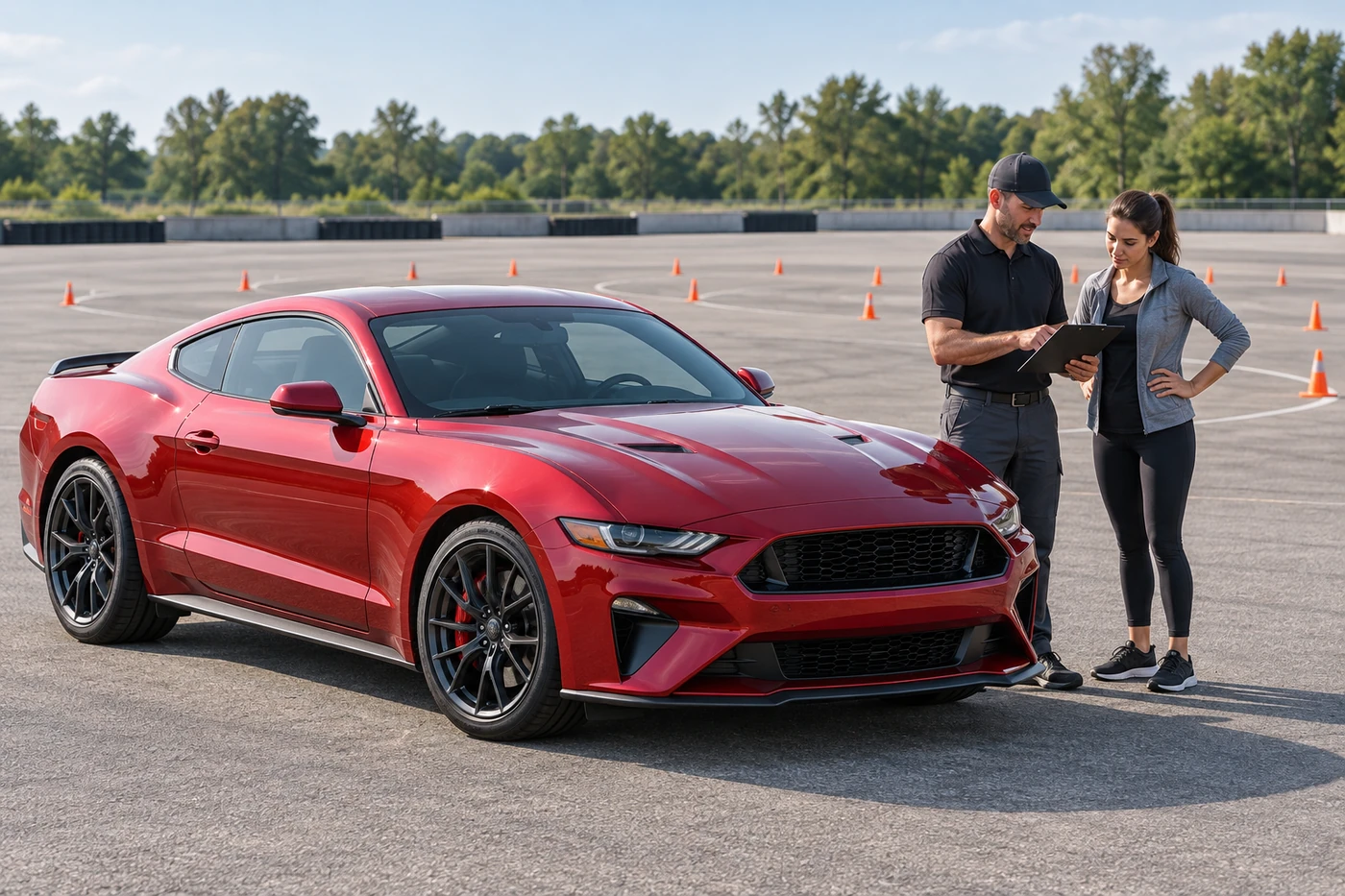
An instructor-led course or skid pad is the appropriate place to learn how a vehicle behaves near its limits. Ford itself has offered structured driving instruction for Mustang owners; current eligibility and availability should be checked directly.
Training is not a license to take those exercises onto the street. It should improve judgment about where the margin ends.
Common Misconceptions
“Muscle cars cannot turn.” Modern chassis capability and the ability to overwhelm rear grip are different questions. A capable handling car can still be misused.
“The rear tires can handle 400 horsepower, so everything above that is wasted.” A tire has no fixed horsepower capacity. Usable drive force changes with speed, gearing, loading, cornering and conditions.
“An LSD makes the car dangerous.” It helps use available traction, but cannot prevent both tires being overloaded. Design and calibration determine behavior.
“ESC guarantees a save.” It adds valuable support within physical limits, not guaranteed recovery.
“Countersteering is all I need to know.” Steering, tire-force changes and vehicle rotation interact. Memorizing one response is not equivalent to supervised practice.
Cariary Thoughts
What I found most useful was separating a powerful engine from the demand actually arriving at the tires.
The engine’s headline figure feels like the whole story because it is easy to remember. But the tire experiences a changing combination of gearing, drive force, sideways demand, surface and load.
That makes the car more interesting, not less. A modern performance coupe can be composed in normal use and still expose a poor decision very quickly. Those two qualities can coexist.
I also think the accident-video reputation can distract us from the more practical lesson. The goal is not to prove that a driver is brave enough to switch everything off. It is to understand why a familiar-feeling car may have more performance than the situation can safely accommodate.
For Cariary, the appeal of studying this is learning to respect the engineering without turning it into either a monster story or a promise that electronics will rescue us.
One-line Summary
A modern muscle car can be straightforward to drive normally, yet powerful enough to exceed the rear tires’ grip and the driver’s experience very quickly.
FAQ
Are muscle cars hard to drive every day?
Not necessarily. A suitable, maintained modern example can be manageable with normal assistance active and sensible inputs. Visibility, size, conditions and driver experience still matter.
Why do Mustangs lose control in so many videos?
Videos select dramatic events and do not establish comparative crash rates. Excessive acceleration while turning, unsuitable conditions and abrupt corrections are possible mechanisms, not facts we can infer about every clip.
Is 500 horsepower too much for a beginner?
There is no universal safe horsepower threshold. A beginner should not equate a gentle normal mode with the ability to manage the car’s full capability. Training, restraint, tires and conditions matter.
Does traction control prevent oversteer?
It can reduce excessive driven-wheel slip. ESC additionally addresses unwanted vehicle rotation. Neither guarantees that a slide or collision cannot occur.
Should I turn ESC off on a public road?
Keep the normal road-driving assistance active. Do not disable it to experiment with slides or dramatic departures. Any specific stuck-vehicle procedure should follow the owner’s manual.
Why can a car snap the other way after sliding?
The forces can change while corrective steering and vehicle rotation are still present. Grip recovery and overcorrection can contribute to a reversal; this is not the definition of every instance of snap oversteer.
Does a manual make a muscle car harder to control?
It adds clutch and gear-selection tasks that can disturb torque delivery. An automatic can coordinate shifts electronically, but abrupt throttle or inappropriate mode selection still matters.
What tires should a powerful RWD car use?
Use an appropriate specification and category for the car, climate and road use, with correct pressures and sound condition. A summer performance tire is not a year-round solution in cold or snowy conditions.
Related Thoughts
- Drivetrain Basics: follow power through the transmission and differential.
- Suspension and Handling Basics: understand loading and vehicle response.
- Brake and Tire Basics: explore the tire-road connection.
- Does More Torque Mean Better Acceleration?: separate engine numbers from usable drive force.
References
- Ford: Birth of the Mustang.
- Ford: 2015 Mustang technical specifications.
- Continental: cornering and tire grip.
- Rubber Friction and Tire Dynamics, research paper.
- Rocky Mountain BMW CCA: driving-school student manual.
- Bosch: electronic stability program.
- Torsen: how torque bias works and worked traction-limit examples.
- Michelin: summer, winter and all-season tires.
- Ford: 2025 Mustang drive modes.
- Stellantis: 2023 Challenger and Charger model announcement.
- Ford: Mustang owner driving instruction announcement.
Data Reference Date: October 20, 2026. Vehicle examples retain their stated model years. Charts are simplified teaching models, not test results; generated scenes are identified in their captions. This article explains vehicle behavior and does not replace qualified driving instruction or the vehicle owner’s manual.