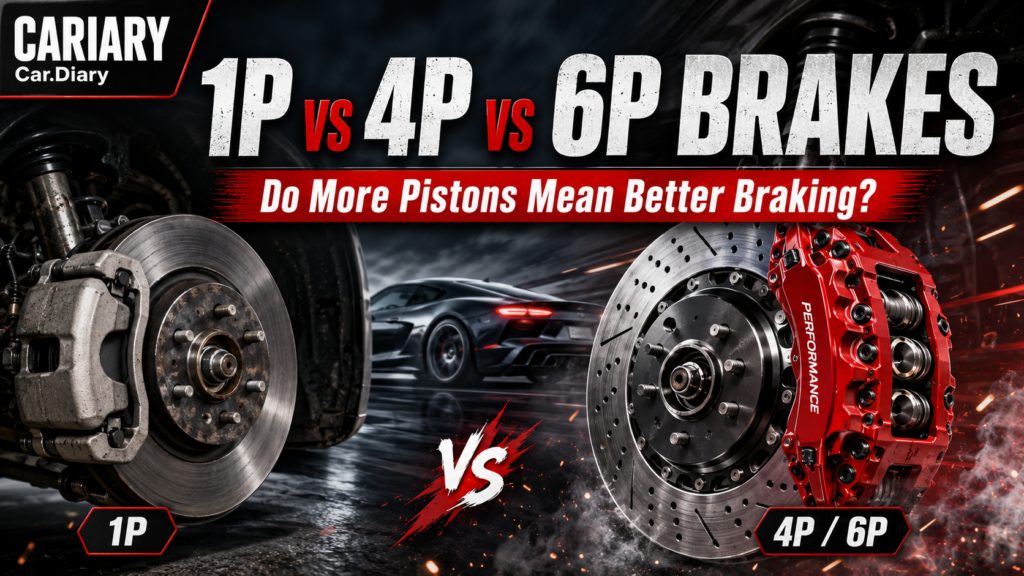
When we see a red 4P or 6P caliper behind a wheel, it is easy to think the braking system must be automatically better. But piston count is only one part of the story.
Table of Contents
- Quick Summary
- Why This Matters
- How a Brake Caliper Works
- Why Most Cars Use 1-Piston Floating Calipers
- What 4P and 6P Brakes Actually Improve
- Do 4 Piston Brakes Stop Shorter Than 1P Brakes?
- The Real Enemy Is Heat and Brake Fade
- Why 6P Is Not Automatically Better Than 4P
- Brakes Stop the Wheel, Tires Stop the Car
- A Sensible Upgrade Order for Normal Drivers
- When 4P or 6P Brakes Make Sense
- Common Misconceptions
- Real-World Examples
- Cariary Thoughts
- FAQ
- Sources
Quick Summary
4 piston brakes sound like an obvious upgrade because the number feels bigger, the caliper looks more serious, and performance brands love to show it through the wheel. But the simple answer is this: more pistons do not automatically mean better braking.
A 4P or 6P caliper can absolutely be better in the right system. It can spread pressure more evenly across the pad, improve pedal feel, handle heat better, and stay consistent during repeated hard braking. But if the original brake system can already push the tires to the ABS limit, changing only the caliper may not dramatically shorten one normal emergency stop.
The easiest way to remember it is: the brakes stop the wheel, but the tires stop the car. That one sentence changes how we should think about 1P, 4P, and 6P brakes.
.jpg)
Why This Matters
Brake upgrades are one of those car topics where the visual impression is very strong. A large red caliper behind a wheel immediately looks faster, safer, and more expensive. So it is natural to imagine a simple ranking: 1P is basic, 4P is good, and 6P is even better.
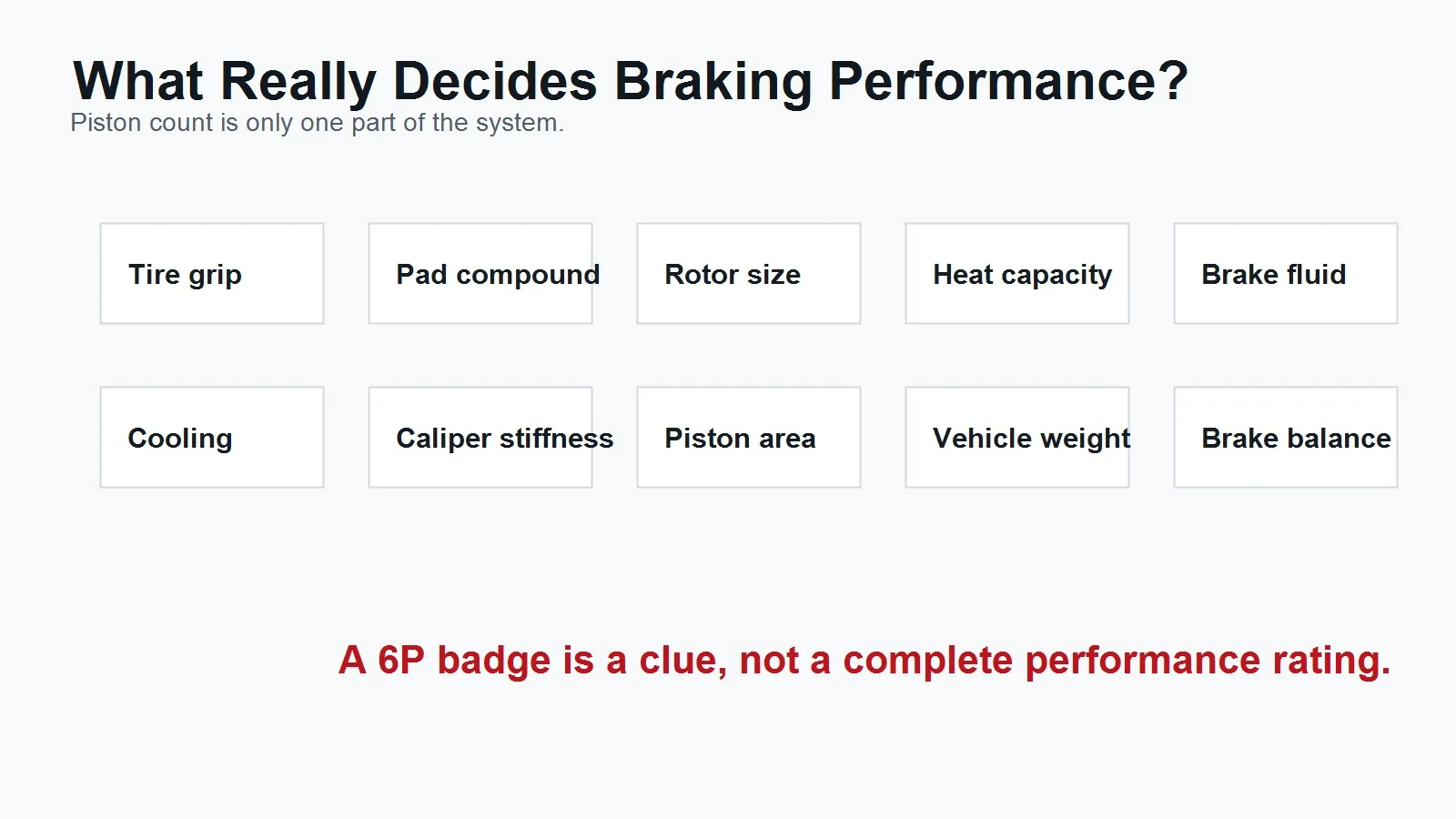
But brakes are not a badge system. A caliper is only one part of a braking system that also includes the rotor, pads, brake fluid, master cylinder, brake balance, cooling, vehicle weight, suspension behavior, and tire grip.
That is why this topic is worth slowing down for. We are not trying to say 4P and 6P brakes are useless. We are trying to understand what they actually improve, and when those improvements matter in real driving.

How a Brake Caliper Works
A disc brake works by squeezing brake pads against a spinning rotor. The rotor is connected to the wheel, so when the pads clamp the rotor, the wheel slows down.
The squeezing force starts when the driver presses the brake pedal. Hydraulic pressure travels through brake fluid, reaches the caliper, and pushes the piston or pistons outward. Those pistons press the pads against the rotor.
That sounds simple, but the details matter. How large the pistons are, how stiff the caliper body is, how big the pad is, how much heat the rotor can absorb, and how much grip the tire has all change the final result.
.jpg)

Why Most Cars Use 1-Piston Floating Calipers
Most ordinary passenger cars use a 1-piston floating caliper at the front, and sometimes at the rear as well. In this design, the piston sits on one side of the rotor. When it pushes the inner pad, the caliper body slides slightly and pulls the outer pad into the other side of the rotor.
This is not just cheapness for the sake of cheapness. A floating caliper is compact, relatively light, easy to package inside normal wheels, simple to service, and strong enough for everyday road use.
For commuting, city driving, and normal highway speeds, a well-designed 1P system can already create enough braking force to activate ABS. Once the tire is at its grip limit, extra caliper strength does not magically create more road grip.

What 4P and 6P Brakes Actually Improve
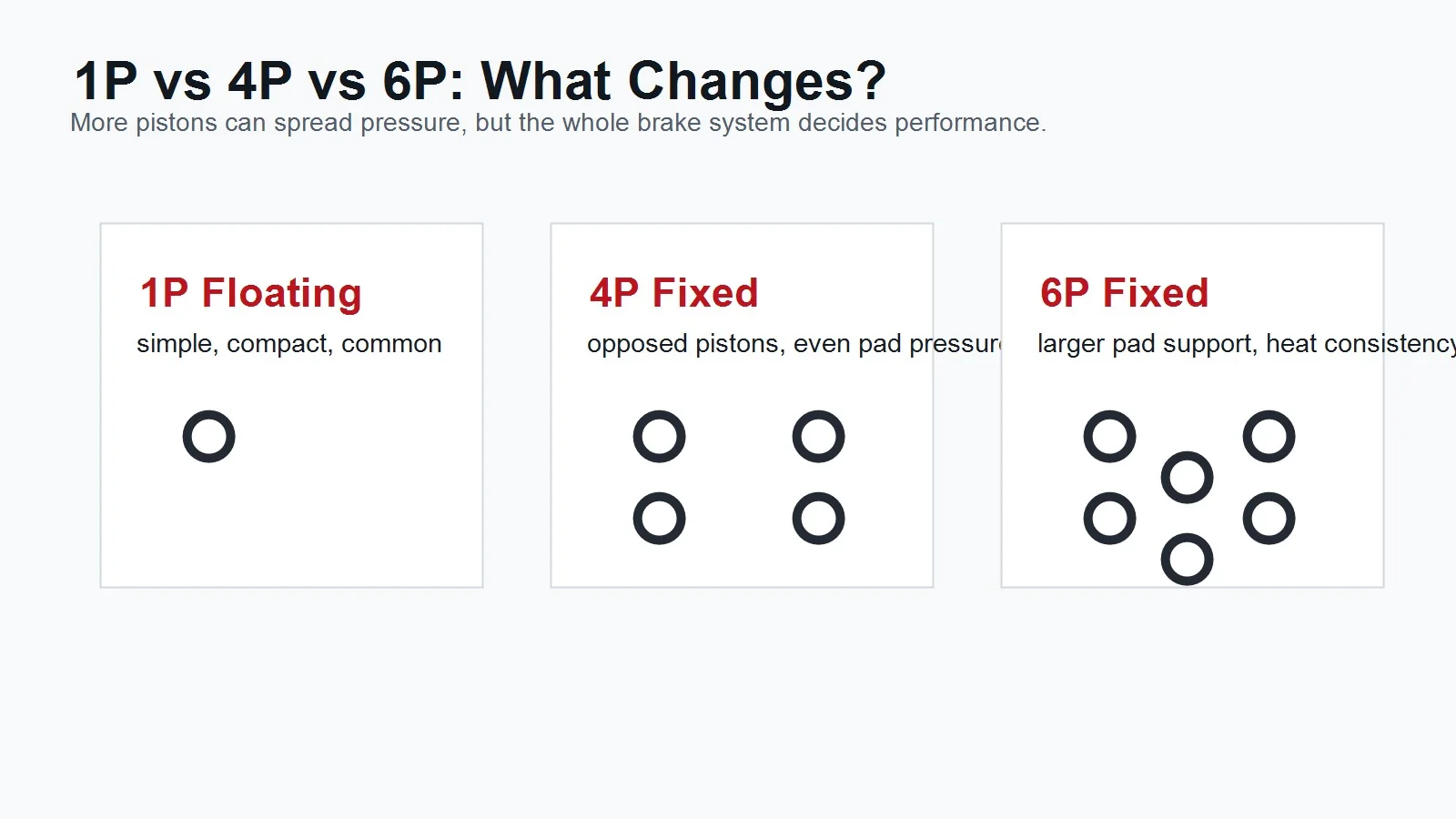
Multi-piston calipers are usually fixed calipers. Instead of sliding from one side, the caliper stays rigidly mounted and uses pistons on both sides of the rotor. A 4P caliper often has two pistons on each side. A 6P caliper usually has three on each side.
The first advantage is pressure distribution. When a pad is larger, one small piston may not press it evenly enough. Several pistons can support the pad across more of its length, which can help the pad work more consistently and wear more evenly.
The second advantage is stiffness. Performance fixed calipers, especially monoblock designs, can flex less under heavy brake pressure. Less flex can make the pedal feel firmer and more precise.
The third advantage is heat management. A big brake kit often includes larger rotors, larger pads, high-temperature pad compounds, better fluid, stronger hardware, and sometimes better cooling. That full system is what helps the brakes keep working when hard braking happens again and again.
_(cropped).jpg)
Do 4 Piston Brakes Stop Shorter Than 1P Brakes?
Sometimes, but not always. This is where the topic becomes more interesting than the piston count.
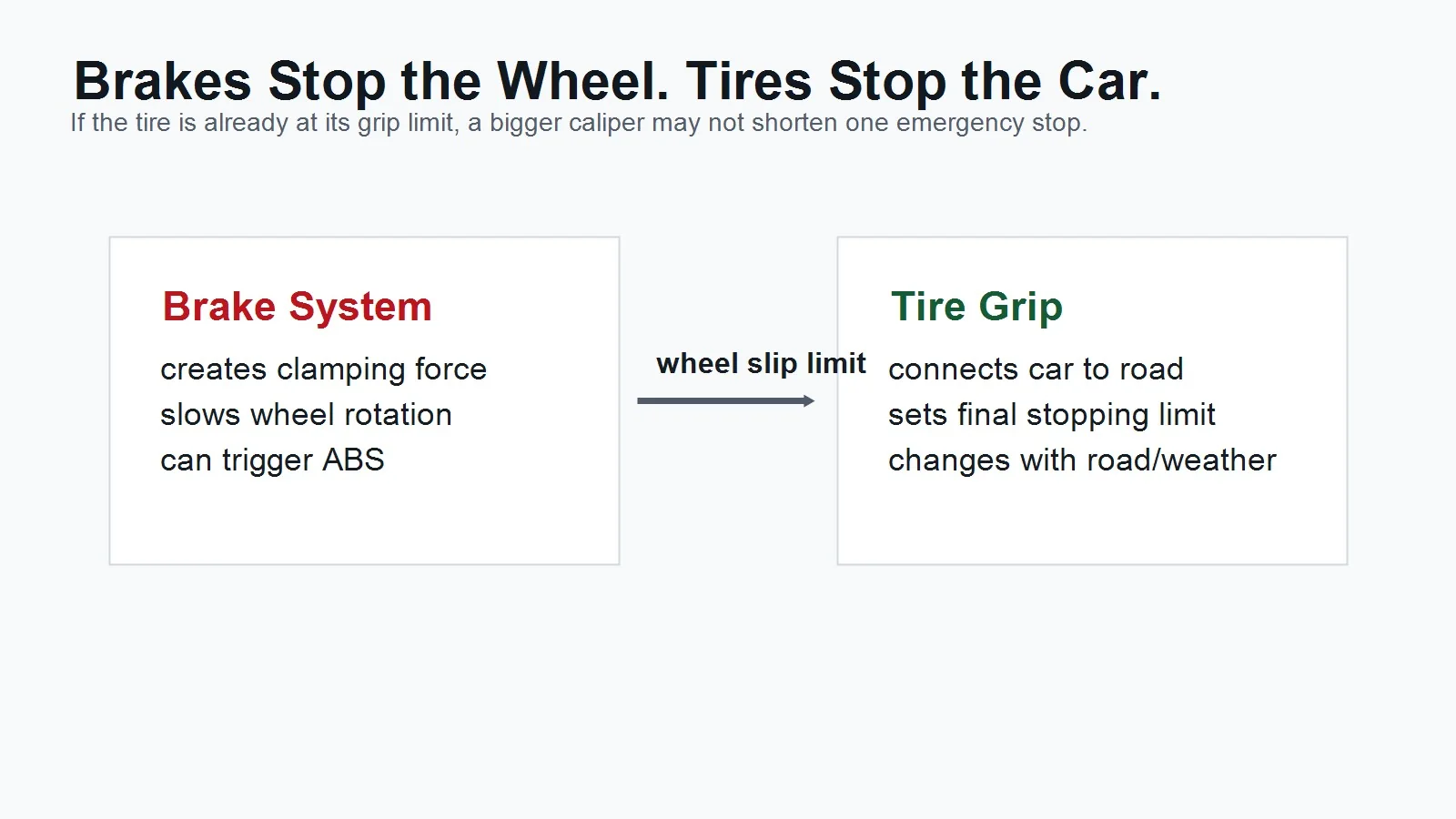
If a car's original brakes are weak, overheating, using poor pads, or unable to generate enough clamping force, an upgraded system can improve real stopping performance. But if the original brakes can already reach the tire's grip limit in a single stop, a bigger caliper may mostly change pedal feel and repeatability rather than the shortest possible stopping distance.
Imagine trying to stop on a dusty floor while wearing slippery shoes. Stronger legs help only up to the point where your shoes start sliding. In a car, the tire is the shoe. The brake can ask for more stopping force, but the tire decides how much can actually be used before sliding.
The Real Enemy Is Heat and Brake Fade
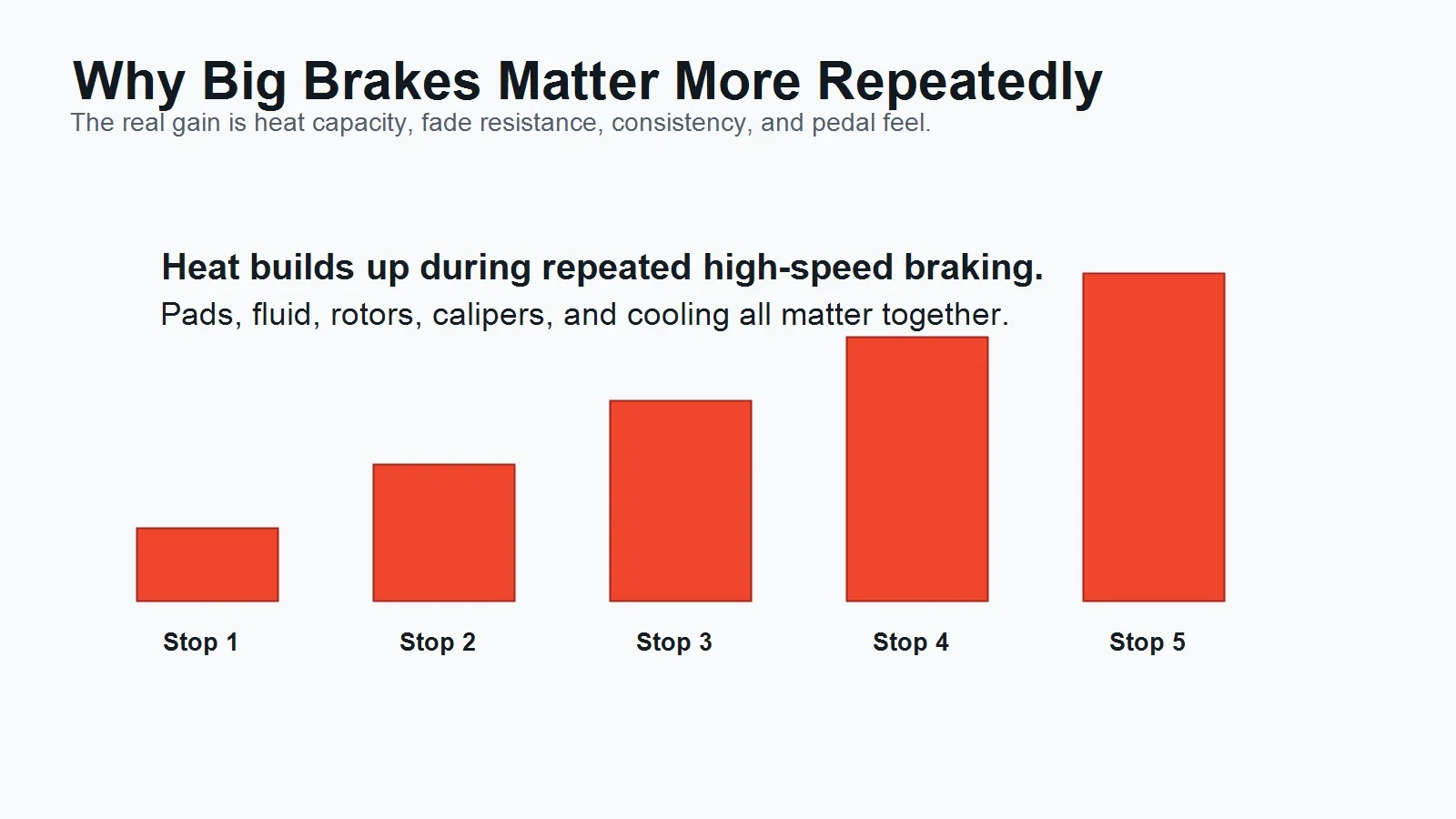
Brake fade is when braking performance drops after repeated hard use. The pedal may feel longer, the car may need more distance, or the brakes may stop feeling as sharp. This usually happens because heat has built up in the pads, rotors, fluid, or the whole system.
This is where larger performance brakes make the most sense. On a mountain road or a track, the car may brake hard from high speed, accelerate again, and brake hard again after only a short rest. The heat does not fully disappear between each stop.
A larger rotor has more thermal mass, which means it can absorb more heat. A larger pad can handle repeated load better. A stiffer multi-piston caliper can keep pressure more consistent. Better brake fluid can resist boiling at high temperature. Together, these parts help the system stay predictable.
Why 6P Is Not Automatically Better Than 4P
A 6P caliper is not automatically better than a 4P caliper. The piston count tells us how many pistons are inside the caliper, but it does not tell us the total piston area, caliper stiffness, pad shape, rotor size, brake balance, or hydraulic matching.
For example, a well-designed 4P caliper with the right piston sizes may work better for a certain car than a poorly matched 6P setup. If piston area is changed too much without considering the master cylinder and brake bias, pedal travel and balance can feel wrong.
This is why serious brake upgrades are designed as systems. Calipers, rotors, pads, lines, fluid, cooling, and vehicle setup need to agree with each other. A bigger number on the caliper is not the same thing as a better braking system.
Brakes Stop the Wheel, Tires Stop the Car
This may be the most important idea in the whole post. Brakes reduce wheel speed. Tires turn that braking force into friction against the road. Without tire grip, the best brake system in the world cannot stop the car shorter.
That is why tires often make a larger difference for ordinary drivers than caliper upgrades. Good tires improve braking, cornering, wet grip, emergency lane changes, and acceleration traction. They help the whole car, not only the brake pedal.
Continental describes tires as the vehicle's contact with the road, and that idea is exactly why braking discussions cannot ignore them. In one ADAC summer tire comparison shared by Continental, wet braking distances from 80 km/h varied dramatically between a strong premium tire and a low-cost tire. The hardware at the wheel matters, but the rubber touching the road matters just as much.
A Sensible Upgrade Order for Normal Drivers
For most road cars, the upgrade order should usually start with tires, not calipers. After that, brake pads can make a meaningful difference because pad compound affects bite, temperature range, noise, dust, and fade resistance.
Brake fluid comes next if the car sees hard mountain driving, track days, or repeated heavy braking. Old or low-grade fluid can boil under heat, making the pedal feel soft. Rotors and cooling become important when heat is the problem rather than one-time stopping force.
A caliper upgrade makes the most sense when the car is heavy, powerful, driven hard repeatedly, or already exceeding the comfortable limit of its original brake package. In that context, 4P or 6P brakes are not decoration. They are tools for consistency.
When 4P or 6P Brakes Make Sense
Multi-piston brakes make real sense on track-driven cars, heavy performance SUVs and sedans, cars with major power upgrades, and vehicles that repeatedly slow down from high speed. They also make sense when the driver wants a firmer, more consistent pedal feel under demanding use.
They are less necessary for a daily commuter that mostly sees traffic lights, normal highway driving, and occasional spirited driving. In that case, a good tire and a thoughtful pad choice may be a more noticeable improvement than a dramatic caliper change.
This connects naturally with drivetrain discussions too. In Cariary's article on FWD vs RWD vs AWD, the same theme appears: the best technology depends on how the car is used, not only what sounds most advanced on paper.
Common Misconceptions
Misconception one: 6P always stops shorter than 4P. Not necessarily. Total piston area, pad compound, rotor size, tire grip, and system balance matter more than the number alone.
Misconception two: 1P brakes are bad. Also not true. A good 1P floating caliper can be the right solution for a normal road car because it is compact, light, affordable, and sufficient for the job.
Misconception three: big brakes are only for looks. That is unfair. In repeated high-speed braking, a properly engineered big brake system can protect consistency, pedal feel, and fade resistance in a way a smaller system may not.
Misconception four: brake upgrades replace tire upgrades. They do not. If the tires are the limiting factor, the car still cannot use extra braking force effectively.
Real-World Examples
High-performance cars often use multi-piston fixed calipers because they are heavier, faster, and expected to brake repeatedly from higher speeds. A sports car on a circuit does not need only one impressive stop. It needs the tenth and fifteenth stop to feel predictable too.
Motorsport makes this easier to understand. In F1 or endurance racing, braking is a heat and consistency problem as much as a clamping-force problem. If you enjoyed our beginner guide on How to Watch F1, this brake topic adds another layer: when the car slows violently at the end of a straight, the brake system is fighting temperature, airflow, tire grip, and driver confidence all at once.
At the opposite end, a compact commuter car with modest power and normal tires may never ask enough from its brakes to justify a large 6P conversion. That does not make the car worse. It simply means the engineering target is different.
Cariary Thoughts
At first, I also understood brake upgrades in a very simple way: bigger caliper, more pistons, better braking. It is a tempting idea because the part is visible and the number is easy to remember.
But once I looked at the system, the answer became more balanced. A 4P or 6P caliper is not meaningless at all. It can be a very real performance part. The important point is that its value shows up most clearly when the car repeatedly asks the brakes to deal with heat, pressure, and consistency.
For normal road driving, I would be careful about treating piston count like a ranking chart. If the tire, pad, rotor, and fluid are not right, a beautiful caliper alone cannot carry the whole braking system. Cars become more interesting when we stop looking at one shiny part and start seeing how all the parts work together.
One-Line Summary
4P and 6P brakes can be genuinely better in demanding use, but piston count alone does not decide braking performance.
FAQ
Are 4P brakes better than 1P brakes? They can be, especially for repeated hard braking, larger pads, firmer pedal feel, and better pressure distribution. But for one normal road stop, tire grip may be the real limit.
Are 6P brakes better than 4P brakes? Not automatically. A 6P caliper needs the right piston area, pad, rotor, master cylinder matching, and brake balance to work properly.
Do bigger brakes always shorten stopping distance? No. If the original brakes already reach the ABS and tire grip limit, bigger brakes may improve consistency and feel more than one-time stopping distance.
Why do most cars use 1P floating calipers? Because they are compact, simple, light, affordable, easy to service, and sufficient for normal road driving.
What should I upgrade first for better braking? For most drivers, tires come first, then pads, then brake fluid, then rotors or cooling if heat is the problem, and finally calipers if the use case really needs them.
Related Thoughts
For a broader look at how traction changes the way a car feels, read FWD vs RWD vs AWD.
For the motorsport side of braking, tire strategy, and race watching, see How to Watch F1.
Sources
This article was written as a Cariary learning note using manufacturer and technical references from Brembo, Race Technologies, Continental, and NHTSA.
- Brembo Parts – Brake caliper technology and operation
- Race Technologies – Benefits of opposed-piston fixed calipers
- Brembo – Guide to choosing a GT Kit
- Continental – Tires are the vehicle's contact with the road
- Continental – ADAC summer tire braking comparison
- NHTSA – ABS and tire grip explanation

