NASCAR can look simple from far away: fast cars on an oval, lap after lap. But once we understand drafting, lane choice, spotters, cautions, stages and pit timing, the race starts to look completely different.
Table of Contents
- Quick Summary
- Why NASCAR Looks Simple at First
- What Stock Car Racing Actually Means
- Are NASCAR Cars Really Mustangs and Camrys?
- The Next Gen Car: Old V8 Soul, Modern Race Platform
- Why Oval Tracks Are Not Flat: Banking Explained
- Inside Line vs Outside Line
- Drafting: NASCAR Uses Air as a Tool
- Bump Drafting and Side Drafting
- Pack Racing and Temporary Alliances
- The Spotter: The Driver’s Eyes Above the Track
- What The Big One Means
- NASCAR Safety: The Car Can Break, the Driver Space Must Survive
- Tire Strategy: Fresh Grip vs Track Position
- Fuel, Pit Timing and Cautions
- Stage Racing: Why the Middle of the Race Matters
- The 2026 Chase: How the Championship Works Now
- Why Daytona 500 Is a Great Starting Point
- The 1959 Daytona 500 and NASCAR Drama
- What to Watch in the Final Laps
- F1 vs WRC vs NASCAR: Different Kinds of Thrill
- Common Misconceptions
- Cariary Thoughts
- FAQ
- Related Thoughts
- Sources
Quick Summary
How to Watch NASCAR starts with one important mindset shift: the oval may look simple, but the racing is not. NASCAR is about using air, position, timing, teamwork and strategy while surrounded by dozens of cars at very high speed.
The cars do not simply drive in circles. They draft behind each other, side draft to disturb airflow, choose lanes like chess moves, react to cautions, protect tires, save fuel, and decide whether track position is worth more than fresh tires.
Once those pieces become visible, NASCAR stops looking repetitive. It starts to look like high-speed group combat mixed with aerodynamics and psychology.
.JPG)

Why NASCAR Looks Simple at First
If you are used to F1 or WRC, NASCAR can be confusing in the opposite way. F1 looks complex immediately because the cars, circuits and strategy graphics feel technical. WRC looks extreme because the roads are narrow, loose and unpredictable.
NASCAR, especially on an oval, can look too simple. The cars keep turning left, the track shape is easy to understand, and the lap count can be huge. So a new viewer might naturally ask, “Is this really just cars going around?”
That is the trap. NASCAR hides much of its complexity inside distance, traffic and airflow. The track may be simple, but the situation around each driver changes constantly.
What Stock Car Racing Actually Means
NASCAR’s identity comes from stock car racing. Historically, the idea was that recognizable American production cars and brands could compete against each other. That created a fan culture where Ford vs Chevrolet vs Toyota still matters emotionally.
Modern NASCAR Cup cars are not showroom cars with roll cages added. They are purpose-built race cars. But they still wear manufacturer identity through body styling and branding, which keeps the old stock-car feeling alive.
That is one of the big differences from Formula 1. F1 is built around open-wheel formula cars. NASCAR is built around the feeling that familiar car brands are fighting in a very specialized racing environment.
Are NASCAR Cars Really Mustangs and Camrys?
Not in the literal road-car sense. A current Cup Series Ford Mustang Dark Horse, Chevrolet Camaro ZL1, or Toyota Camry XSE is not made by taking a showroom car and converting it into a race car.
The more accurate way to think about it is this: a NASCAR Cup car is a purpose-built race car wearing the identity of a production car. The body shape and branding connect it to the showroom model, but the chassis, safety structure and race systems are specialized.
That does not make the branding meaningless. It just means the connection is emotional and visual more than mechanical.

The Next Gen Car: Old V8 Soul, Modern Race Platform
The current NASCAR Cup Series car is the Next Gen car, introduced in 2022. NASCAR kept the familiar naturally aspirated V8 sound, but the platform became much more modern.
Key changes include a sequential gearbox, rear transaxle, independent rear suspension, rack-and-pinion steering, 18-inch center-lock wheels, larger brakes and a race-specific chassis. Those details matter because they show NASCAR is not frozen in the past.
For 2026, NASCAR announced a target horsepower increase to 750 hp for road courses and oval tracks under 1.5 miles, up from the 670-hp baseline in that rules configuration. That should make throttle control, tire management and passing opportunities even more important on those tracks.


Why Oval Tracks Are Not Flat: Banking Explained
Oval tracks are not simply flat loops. Many have banking, which means the corners are tilted upward toward the outside. Daytona International Speedway is famous for 31-degree banking in the turns.
Banking lets cars carry much more speed through a corner because part of the track shape helps support the car through the turn. It also changes racing lines. The shortest line is not always the fastest if the outside line has more momentum or a stronger draft.
This is why Daytona and Talladega can produce giant packs. The track shape lets cars stay wide open and close together for long periods, turning airflow into a central part of the race.

Inside Line vs Outside Line
The inside line travels a shorter distance around the corner. That sounds like it should always be better, but NASCAR rarely stays that simple.
The outside line has a larger corner radius, which can help cars maintain momentum. If several cars work together outside, their draft can make the longer lane faster than the shorter lane.
So when you watch NASCAR, do not only follow the leader. Watch which lane is moving. A driver may jump from one lane to another not because the road changed, but because the air and momentum changed.
Drafting: NASCAR Uses Air as a Tool
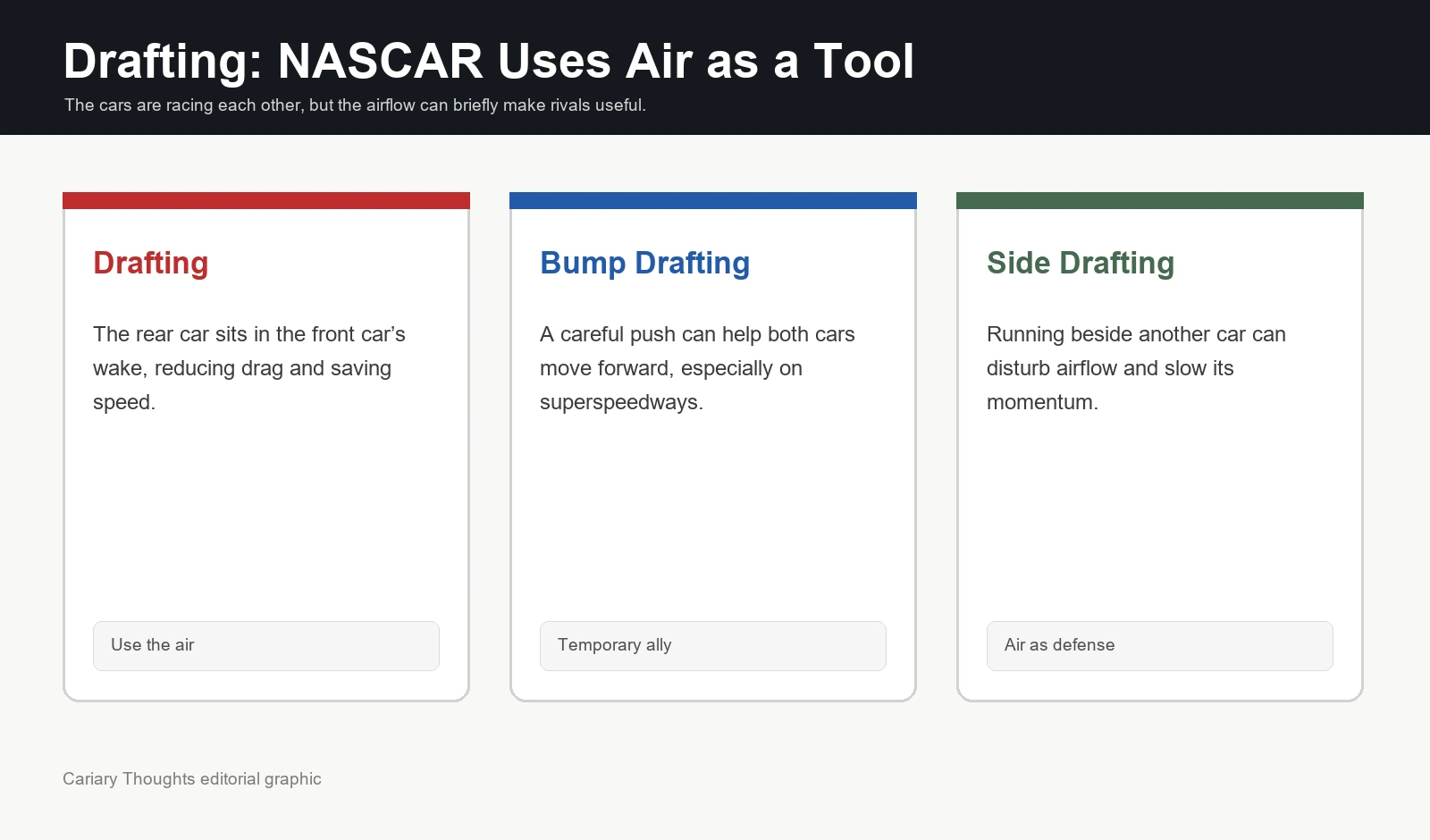
Drafting is one of the most important NASCAR concepts. At high speed, a car punches a hole through the air and leaves a wake behind it. A following car can sit in that wake and face less aerodynamic drag.
This means two cars can sometimes move faster together than either car can move alone. That creates one of NASCAR’s strangest emotions: your rival can temporarily become useful.
In the middle of a race, a driver may need another car to push the line forward. On the final lap, that same helper may become the car they need to beat.
Bump Drafting and Side Drafting
Bump drafting is when the rear car carefully pushes the front car, usually on a straight, to help both cars gain momentum. Done well, it can move a pair or lane forward. Done badly, especially off-center or in the wrong part of the corner, it can turn the front car around.
Side drafting is different. Instead of helping, a car runs close beside another car to disturb its airflow and slow its momentum. If bump drafting says, “Let us go faster together,” side drafting says, “I am going to make your air worse.”
This is why NASCAR can feel like a body fight without always being a physical fight. The cars are using air as a tool.
Pack Racing and Temporary Alliances
On superspeedways, cars often run in big packs. Position inside the pack can matter as much as raw speed. A car stuck alone in clean air can lose momentum, while a line of cars drafting together can surge forward.
This creates temporary alliances. A driver may follow one car because that lane is moving. Another driver may block a lane because they know a strong push is coming. A third driver may abandon the top lane if nobody follows.
The political question is simple: who will go with me? If a driver makes the right move but nobody follows, the move can fail immediately.
The Spotter: The Driver’s Eyes Above the Track
NASCAR drivers cannot see everything around them. When cars are inches apart at high speed, mirrors are not enough. That is why spotters are essential.
A spotter stands high above the track and tells the driver what is happening around the car. Common phrases include “inside,” “outside,” “clear,” and “three wide.” Those short words can decide whether a driver changes lanes or holds position.
The full NASCAR team is not only driver and crew chief. It is driver, crew chief and spotter working together in real time.
What The Big One Means
The Big One is the nickname for a large multi-car crash, most famously associated with Daytona and Talladega. It happens because pack racing leaves very little time and space to react.
If one car gets turned sideways near the front or middle of the pack, cars behind may have nowhere to go. A small contact can become a chain reaction involving many cars.
This is part of the tension of NASCAR. The same closeness that creates drafting and dramatic finishes also creates risk.
NASCAR Safety: The Car Can Break, the Driver Space Must Survive
Modern NASCAR safety is built around protecting the driver survival space. The car may be damaged heavily in a crash, but the driver cell, seat, belts, head-and-neck restraint and track barriers are designed to manage energy.
NASCAR’s safety evolution includes HANS devices, stronger restraint systems, reinforced chassis areas and SAFER barriers. A useful way to understand it is this: the car is allowed to break so the driver does not.
That does not make crashes casual. They are still serious. But the safety engineering behind modern NASCAR is one reason drivers can walk away from accidents that look terrifying.
Tire Strategy: Fresh Grip vs Track Position
Tires are one of the easiest NASCAR strategy pieces to understand. Fresh tires usually mean more grip and better lap time. But pitting costs track position.
So the team has to choose. Four fresh tires may make the car faster, but it takes longer. Two tires may protect track position, but the car may feel less balanced. Staying out may put the driver near the front, but on older tires.
There is no automatic answer. The correct call depends on track, tire wear, fuel, caution timing, stage points and how many laps remain.

Fuel, Pit Timing and Cautions
Fuel strategy matters because a team may try to stretch a run, save fuel in the draft, or pit earlier than rivals to gain track position later. Drafting can help fuel saving because the car may need slightly less throttle when tucked behind another car.
Cautions change everything. Under green, a pit stop can cost a lot of time because the rest of the field is still racing at speed. Under caution, the field slows and groups back together, so the relative loss is smaller.
That is why a yellow flag can rewrite the race. A team may pit, stay out, take two tires, take four, fuel only, or gamble that another caution will come.

.jpg)
Stage Racing: Why the Middle of the Race Matters
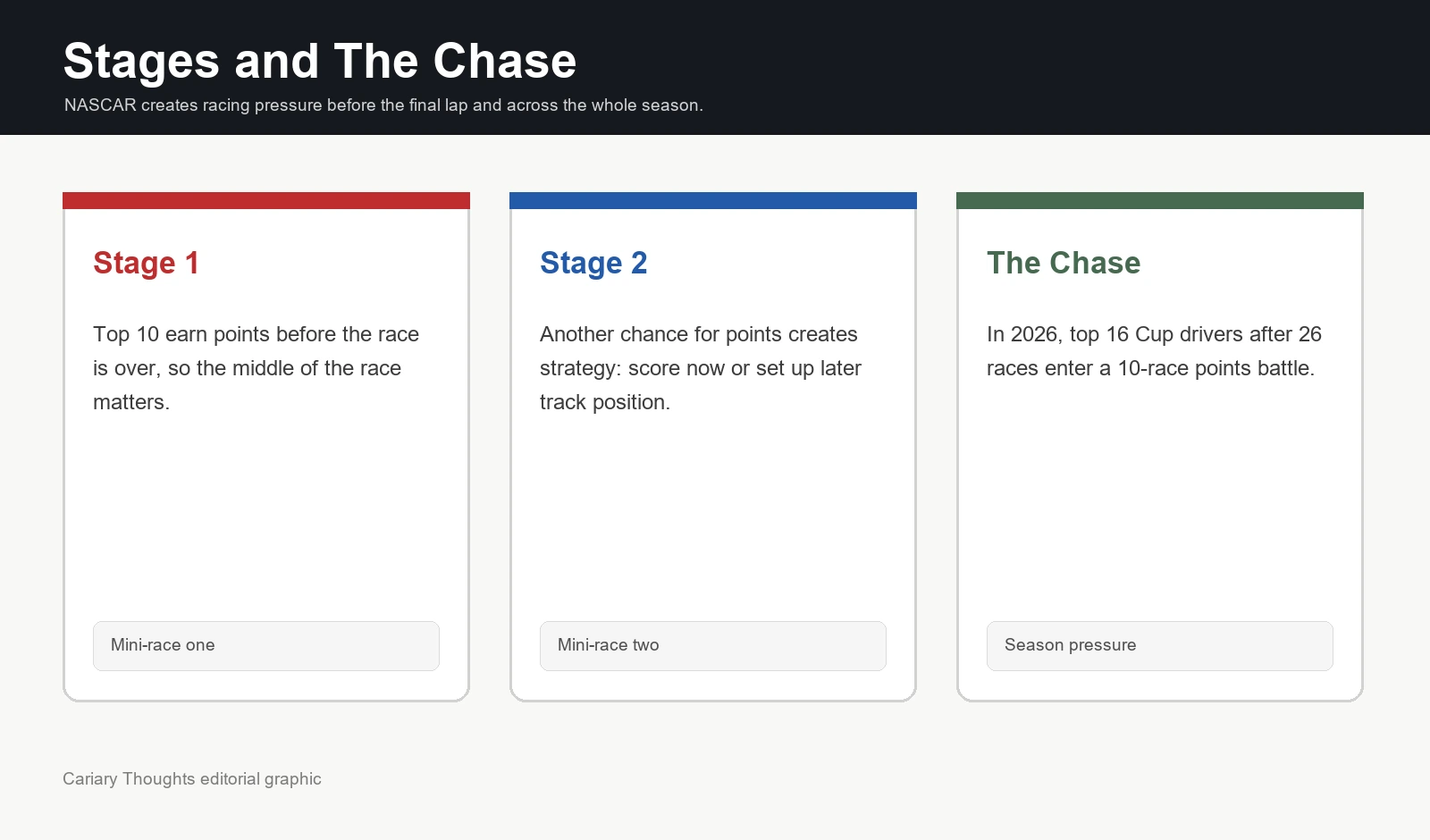
Most NASCAR Cup races are divided into Stage 1, Stage 2 and a Final Stage. At the end of Stage 1 and Stage 2, the top 10 drivers earn stage points from 10 down to 1.
This means the middle of the race is not just waiting time. Drivers have a reason to fight before the final laps because those points can matter in the season standings.
But stage strategy is not always simple. A team might give up stage points by pitting before the stage ends if that sets them up better for the next restart. So even the points system creates trade-offs.

The 2026 Chase: How the Championship Works Now
As of the 2026 season, NASCAR returned to a modernized Chase format. In the Cup Series, the regular season is 26 races, and the top 16 drivers by points qualify for The Chase. Race wins no longer create automatic Chase berths.
The Chase then runs across the final 10 races. Points are reseeded once after the regular season, and the champion is the Chase driver with the most points at the end of the season.
This matters for new viewers because NASCAR now rewards consistency more directly. Winning races is still valuable, but a driver also needs stage points, strong finishes and fewer bad days across the whole season.
Why Daytona 500 Is a Great Starting Point
The Daytona 500 is one of NASCAR’s most important races and one of the easiest places to understand the sport’s personality. Daytona is 2.5 miles per lap, and the race is 500 miles, or 200 laps.
It also arrives early in the season, which feels unusual if you come from sports where the biggest event is at the very end. NASCAR begins with one of its grandest stages.
Daytona includes almost everything: 31-degree banking, pack racing, drafting, bump drafting, lane choice, spotters, pit strategy, cautions, The Big One and last-lap timing. If you want one NASCAR race to study first, Daytona is a good classroom.
The 1959 Daytona 500 and NASCAR Drama
The first Daytona 500 was held in 1959, and it immediately produced one of NASCAR’s most famous finishes. Lee Petty and Johnny Beauchamp crossed the line in a finish that was not resolved instantly.
After a review of photos and film, Lee Petty was confirmed as the winner days later. That story is important because it shows Daytona was dramatic from the beginning, not only because of modern TV packaging.
Richard Petty later became even more closely tied to the race, winning the Daytona 500 seven times. That kind of history is why Daytona still feels larger than a normal points race.
What to Watch in the Final Laps
In the final laps of a superspeedway race, do not only watch first place. Watch the second row, the third car in line, and which lane has help.
A driver in second may push the leader until the last moment, then pull out to attempt a pass. But that move only works if another car follows. If nobody goes with them, they may fall backward immediately.
The last lap is about timing, trust and betrayal. NASCAR can be wonderfully strange that way: cooperation and competition can exist in the same corner.
F1 vs WRC vs NASCAR: Different Kinds of Thrill
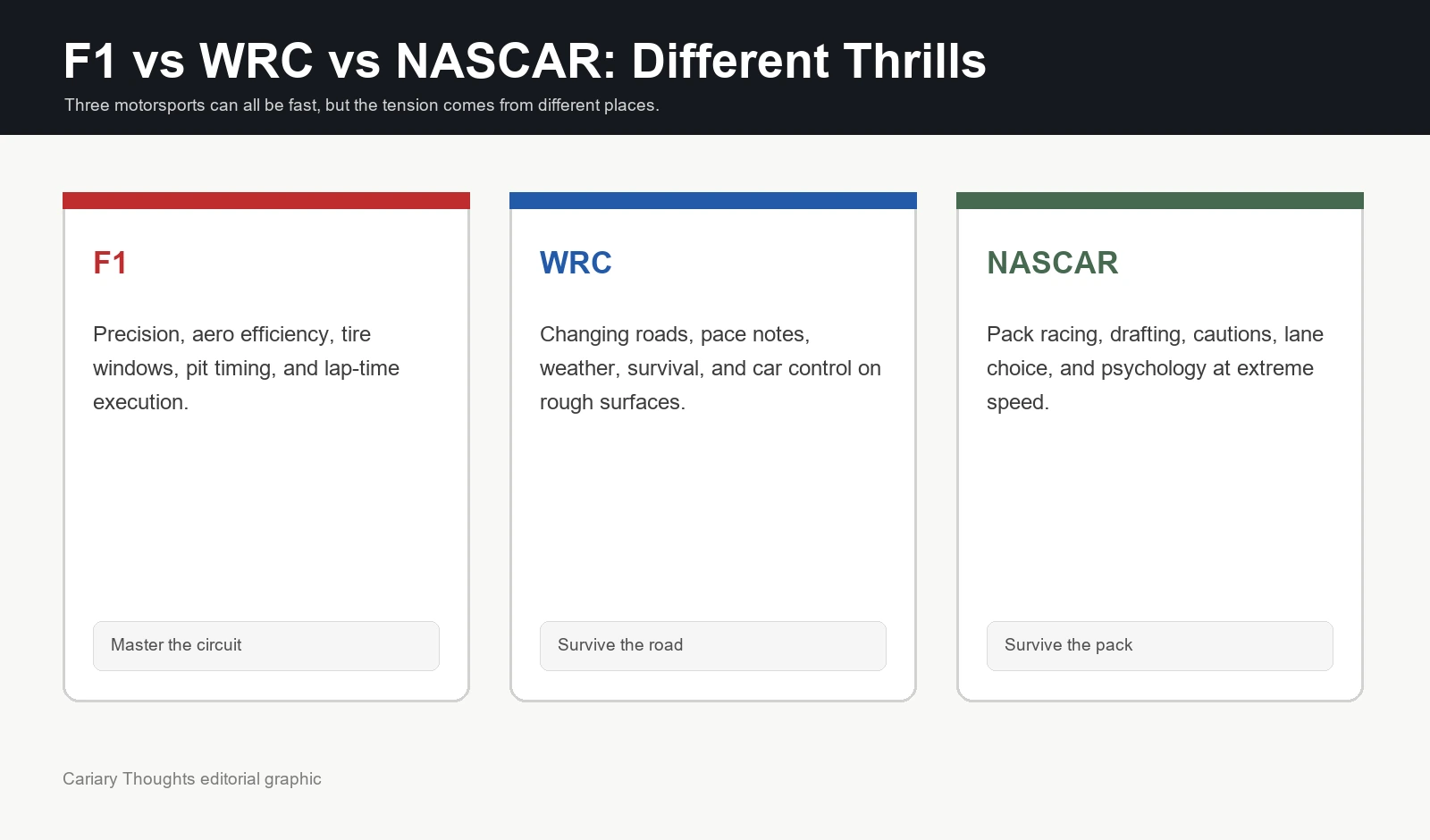
If you read Cariary’s How to Watch F1, F1 may feel like precision: aero, tire windows, pit timing and lap execution. If you read the WRC Beginner Guide, WRC feels like survival against real roads, weather and pace notes.
NASCAR is different again. It is not mainly about one car fighting the clock or one car mastering a clean racing line. It is about surviving and manipulating the pack.
A simple way to separate them is this: F1 means master the circuit. WRC means survive the road. NASCAR means survive everyone around you.
Common Misconceptions
Misconception one: NASCAR is just turning left. The track may be simple, but drafting, lane choice, pit timing, cautions and pack positioning make the racing complex.
Misconception two: NASCAR cars are just modified road cars. Modern Cup cars are purpose-built race cars with production-car identity on the outside.
Misconception three: oval racing has no strategy. Strategy is everywhere: tires, fuel, stages, cautions, pit timing, track position and draft partners.
Misconception four: the leader is always safest near the finish. At Daytona or Talladega, the leader can be vulnerable if the cars behind create a stronger run at the right moment.
Cariary Thoughts
At first, NASCAR was easy for me to underestimate because the visual language is so simple. The oval is easy to read, and the cars stay close for so long that it can look repetitive.
But once I started asking why the cars stay close, why one line suddenly moves, why a driver refuses to change lanes, and why a caution changes pit decisions, the race became much more interesting. The simplicity of the track actually makes the human and strategic parts easier to see.
The best one-line lesson for me is this: the oval may be simple, but the racing is not. NASCAR is a sport where air, trust, timing and patience can matter as much as raw speed.
One-Line Summary
NASCAR is not simply cars driving in circles; it is high-speed pack racing where air, position, strategy, teamwork and timing decide the race.
FAQ
What is drafting in NASCAR? Drafting is when a car follows closely behind another car to reduce aerodynamic drag and carry more speed.
What is bump drafting? Bump drafting is a careful push from the rear car to the front car, usually to help both cars gain momentum in a draft.
What is side drafting? Side drafting is when a car runs close beside another car to disturb airflow and slow that car’s momentum.
How many races are in the 2026 NASCAR Cup Series season? The 2026 Cup Series has 36 races: 26 regular-season races and a 10-race Chase.
How do NASCAR stage points work? The top 10 drivers at the end of Stage 1 and Stage 2 earn points from 10 for first down to 1 for tenth.
Why is the Daytona 500 important? It is NASCAR’s most famous race, run over 500 miles at Daytona International Speedway, and it contains many of the sport’s core features.
Related Thoughts
For a beginner-friendly comparison point, read How to Watch F1.
To understand why WRC feels completely different from NASCAR, see WRC Beginner Guide.
For the technology side of modern racing engines, read F1 Engines Explained.
Sources
This Thoughts article was prepared using current NASCAR.com rules and format articles, Daytona history material, safety references and selected image metadata from Wikimedia Commons.
- NASCAR – 2026 Chase championship format
- NASCAR – The Chase 101
- NASCAR – 2026 horsepower increase
- NASCAR – Next Gen car debut and technology
- NASCAR – Next Gen manufacturer reveal and technical changes
- NASCAR – points system and stage points
- NASCAR – first Daytona 500 and 31-degree banking
- NASCAR – Daytona 500 history and Lee Petty finish
- NASCAR – safety and SAFER barrier/HANS context
- Hendrick Motorsports – NASCAR flags guide