Six-piston brakes. Nineteen-inch wheels. Low-profile tires. They sound like three reasons a car should stop better and feel sharper. But learning Brake and Tire Basics changes the question from “How big are the numbers?” to “What job is each part doing?”
That is where Part 4 of our Car Basics for Enthusiasts series begins. The engine makes power, the drivetrain delivers it, and the suspension helps keep the tires working. Now we reach the place where all that engineering meets the road: the tires, and the brakes controlling their rotation.
I wanted to understand why an ordinary car can stop impressively with small calipers, yet a track car needs an enormous brake package. The answer is not that one specification is secretly meaningless. It is that grip, heat, control and the intended use have to be understood together.
Quick Summary
| Essential idea | What it tells us | What it does not guarantee |
|---|---|---|
| 1P, 4P and 6P | The number of pistons in a caliper | A ranking of stopping distances |
| Disc size | Potential braking leverage and thermal capacity | Better results regardless of weight or cooling |
| ABS, TCS and ESC | Different ways to manage wheel slip and vehicle stability | Extra grip beyond what the tires and road can provide |
| Tire aspect ratio | Sidewall height as a percentage of nominal width | A complete description of ride quality or grip |
| Wheel size | Packaging, proportions and tire choices | That a larger wheel is lighter, faster or better |
The central idea: stopping performance comes from a system, not a piston count.
Why Brake and Tire Basics Belong Together
A brake caliper squeezes pads against a disc, also called a rotor. Friction opposes its rotation. At the road, the tire’s contact patch transmits the forces that slow the car.
That makes “the brakes slow the wheels; the tires slow the car” a useful starting point. It does not mean locking the wheels is desirable. A tire needs controlled rolling slip to generate effective braking force while retaining useful directional control.
Imagine enough brake torque to overwhelm the available grip on a wet surface. Increasing that torque further cannot make the road less slippery. Equally, excellent tires cannot compensate for overheated pads that no longer generate the required friction.
The engine, drivetrain and suspension are not separate stories after all. Their performance ultimately depends on what the tire can transmit, while the braking system must remain capable of doing its job throughout the drive.
1. What 1P, 4P and 6P Calipers Actually Mean
The P means piston: the part moved by hydraulic pressure inside the caliper. In ordinary enthusiast shorthand, 6P means six pistons in one caliper, not six across the whole car and not automatically six on each side.
How One Piston Can Squeeze Two Pads
A common single-piston design is a floating caliper. The piston pushes the inner pad toward the disc. The opposing reaction moves the caliper body along its guides, bringing the outer pad against the other face.
The piston is only on one side, but both pads do work. Think of a sliding clamp: the moving mechanism and the opposite jaw cooperate to squeeze the object between them. Brembo’s caliper explanation describes this distinction between floating and fixed designs.
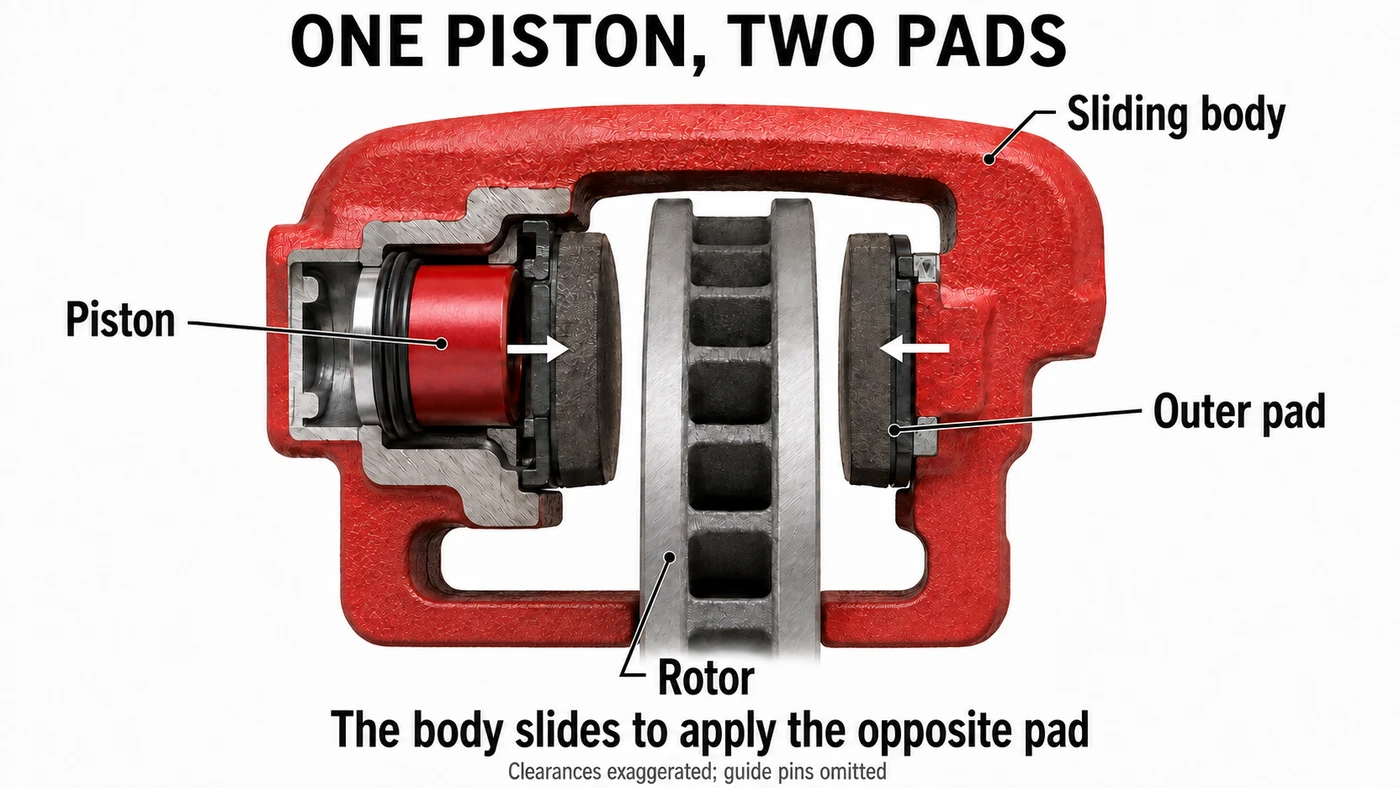
This layout is compact, economical to manufacture and widely supported for servicing. Correctly sized and maintained, it can be entirely adequate for the vehicle’s intended road use. Fewer pistons are not evidence that the engineers forgot about braking.
Nor is weight a reliable shortcut. A small floating caliper can be a compact solution, but material and construction matter; an aluminum fixed caliper need not weigh more than an iron floating one.
What a Multi-Piston Fixed Caliper Changes
A typical four- or six-piston performance caliper is fixed to its mounting. Opposing pistons push pads from both sides. A conventional 4P arrangement has two pistons per side; the 6P example below has three per side.
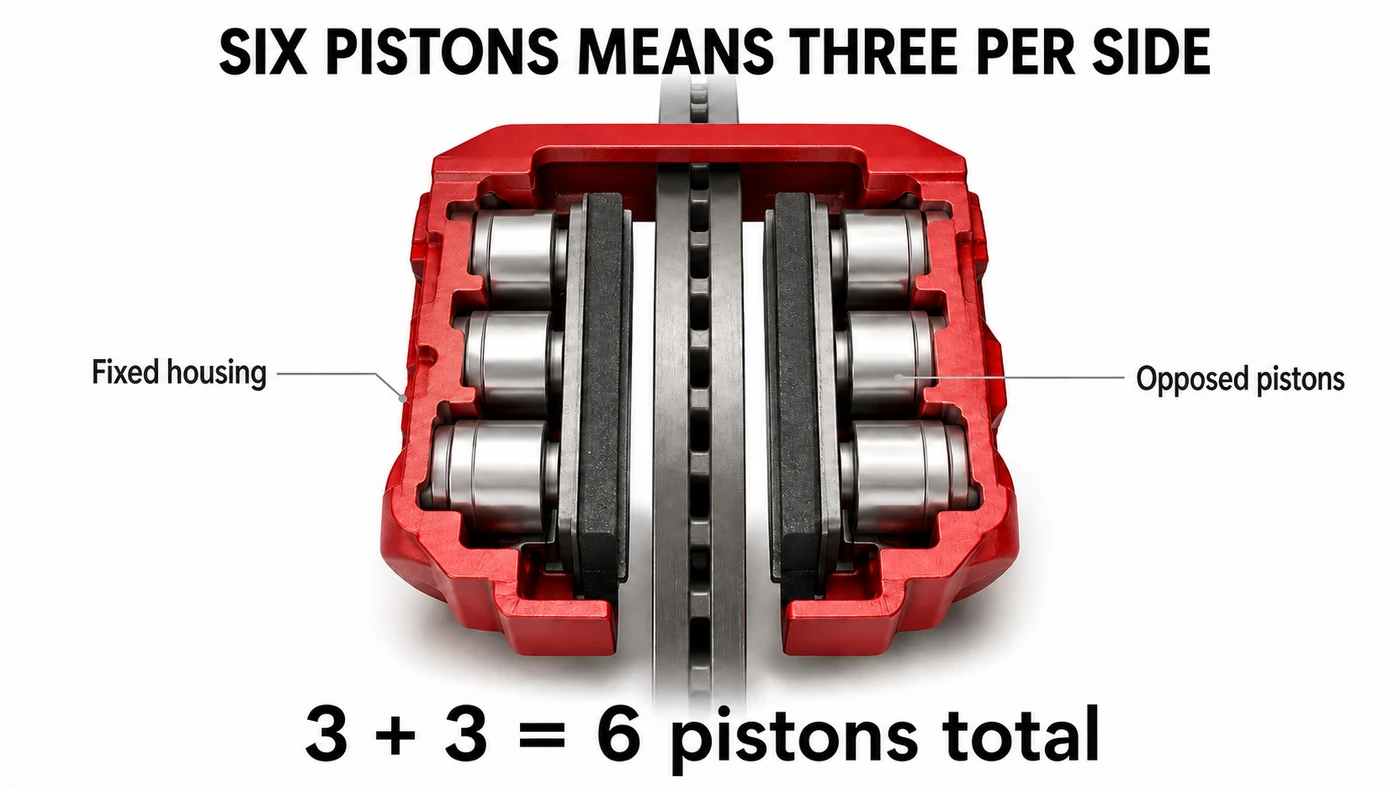
Several pistons can distribute force along a longer pad. Engineers can also choose different piston diameters to manage how the pad is loaded. A well-designed rigid housing helps limit unwanted flex and supports a consistent response.
However, “more pistons” is not a hydraulic force formula. Total effective piston area, fluid pressure, pad friction, disc radius and the rest of the hydraulic system matter. The master cylinder and front-to-rear brake balance must work with the calipers, too.
This is why performance packages combine matched parts rather than merely adding pistons. Brembo’s overview of its performance brake systems describes calipers, discs and pad characteristics as parts of a package. The meaningful lesson is the integration, not the marketing superlative.
One Emergency Stop Is Not the Same Test as Ten Hard Stops
Suppose the original brakes can already reach the available tire grip limit in a cold, one-off stop. A bigger caliper alone may produce little improvement in stopping distance. Tires, surface, temperature, load and control calibration may now be the limiting factors.
Even that needs care: feeling ABS intervene is not proof that every wheel and every component is performing ideally. It tells us the controller has detected a need to regulate wheel slip, not that a complete brake assessment has been passed.
On a circuit, the question changes. Can the system deliver another strong stop after repeated high-energy braking, without losing friction or pedal consistency? Larger suitable discs, pads, fluid and effective cooling become important together. Piston count itself is not a measure of heat capacity.
Our deeper article, Are 4P and 6P Brakes Really Better?, explores the caliper question in more detail. Here, the useful connection is what happens next: all that energy must go somewhere.
2. Bigger Brake Discs: Leverage, Heat and Trade-Offs
Why Radius Matters
Try opening a door by pushing near the hinge, then near the handle. A force applied farther from the pivot creates more turning effect.
A disc works on the same leverage principle. With the pad acting at a larger effective radius, the same tangential friction force creates more braking torque. The relevant distance is where the pad’s friction acts, not simply the disc’s outer edge.
This is one reason a larger rotor can help. But the caliper, bracket, hydraulic balance and wheel clearance must suit the complete installation. Disc diameter is not an invitation to mix unrelated components.
Why Thickness and Ventilation Matter
For similar materials, more rotor mass usually means more energy can be absorbed for a given temperature rise. Surface area and airflow influence how the energy is released to the surroundings. Diameter, thickness and internal geometry therefore answer different parts of the thermal problem.
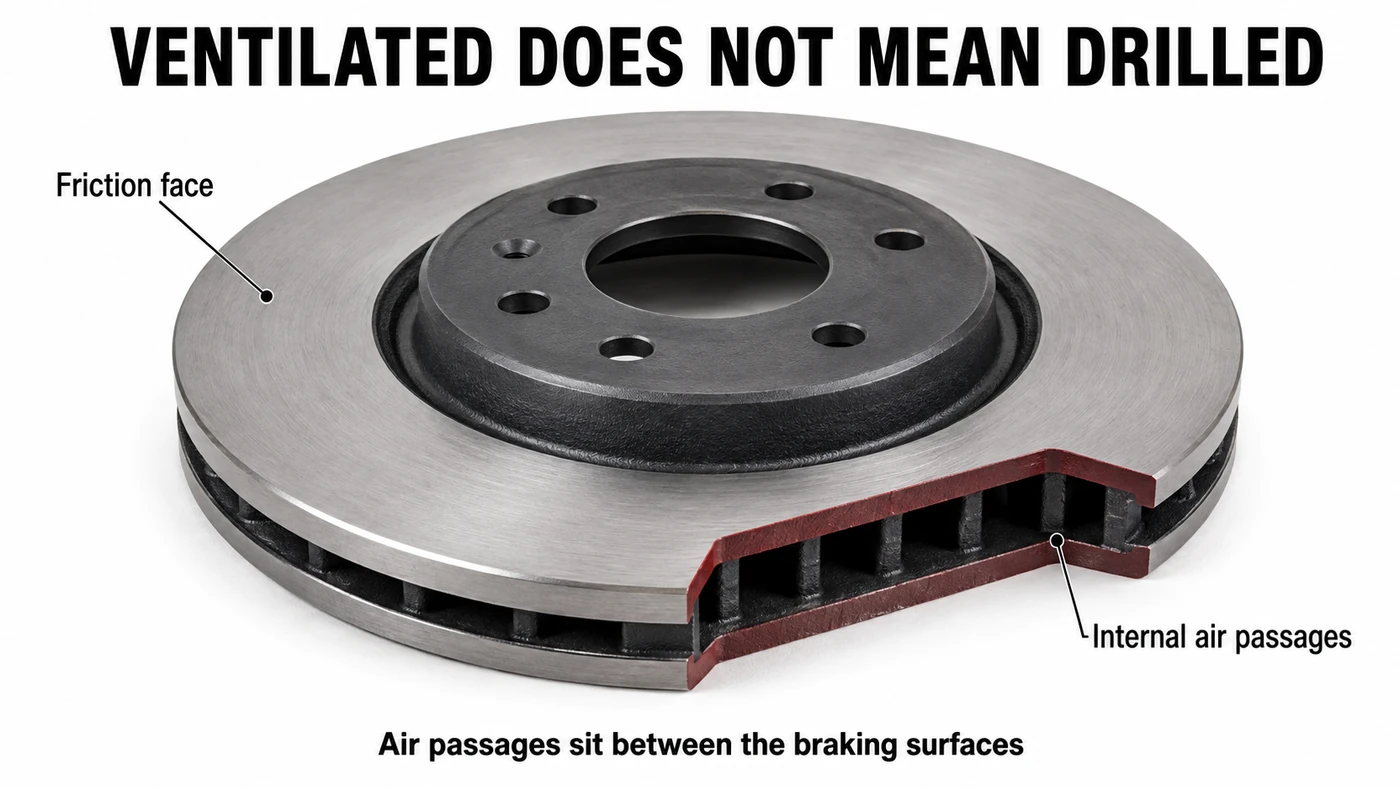
A ventilated disc contains passages between its two friction faces. A drilled disc has holes through those faces. These are not interchangeable terms, and visible holes are not required for a rotor to have internal ventilation.
AP Racing’s ventilated-disc range illustrates why discs are specified by more than diameter: thickness, configuration and application also vary. A photograph of a large rotor cannot reveal its whole thermal performance.
Double the Speed, Four Times the Energy
Translational kinetic energy follows E = 1/2 x mass x speed squared. For a hypothetical 1,600 kg car, the calculation gives about 617 kJ at 100 km/h and 2,469 kJ at 200 km/h. Double the speed means four times this energy, not twice.
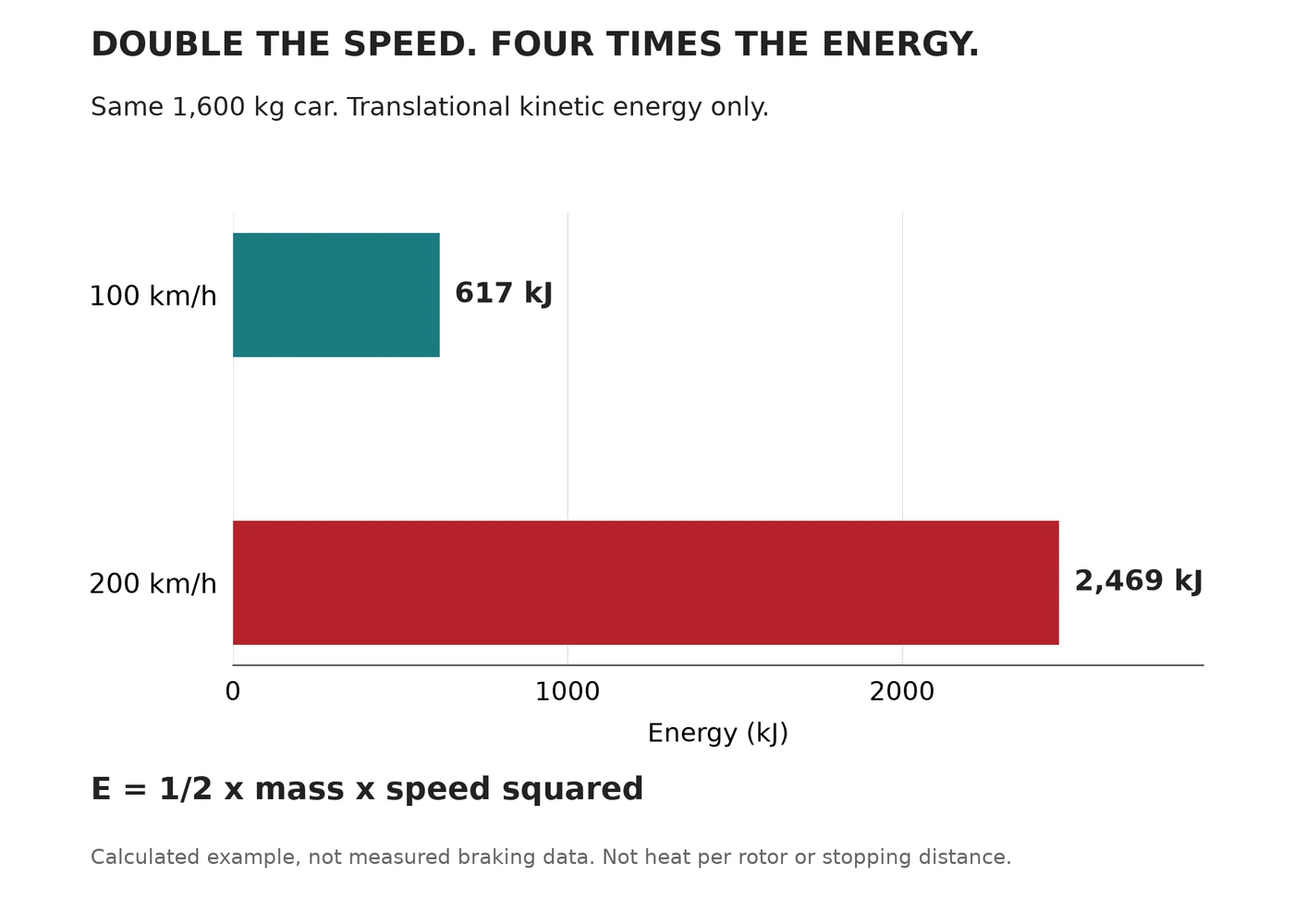
These are whole-vehicle translational energy totals. They exclude rotating parts and do not tell us the heat entering each disc. Aerodynamic drag, rolling resistance and, where available, regenerative braking take a share of the deceleration work.
In an electrified car, the motor can act as a generator, but regeneration is limited by conditions such as battery acceptance and available motor braking torque. Friction braking supplies additional braking when needed, as described in Bosch’s regenerative braking overview.
For a track car repeatedly shedding high speed, the energy calculation explains why cooling and repeatability matter so much. It is a physics illustration, not a suggestion to test high-speed braking on public roads.
What Brake Fade Actually Means
Heat can reduce a pad material’s friction, so the braking response weakens even though hydraulic pressure is being applied. A different problem occurs if brake fluid boils: vapor is much more compressible than liquid, which can increase pedal travel and undermine pressure transmission.
These mechanisms are related to heat but are not the same fault. Pedal feel alone is not a reliable remote diagnosis. A change in braking performance needs proper inspection, not an assumption that the car simply needs more pistons.
AP Racing’s technical product catalogue distinguishes brake-fluid boiling characteristics. For a road car, the practical starting point remains the manufacturer’s specified fluid and maintenance requirements, not an indiscriminate switch to something labeled “racing.”
Bigger discs have costs, too. Depending on their design and material, they can add rotating and unsprung mass, require more wheel clearance and increase replacement expense. The goal is sufficient, repeatable performance for the vehicle’s mission, not the largest disc that can be made to fit.
3. ABS, TCS and ESC: Three Different Questions
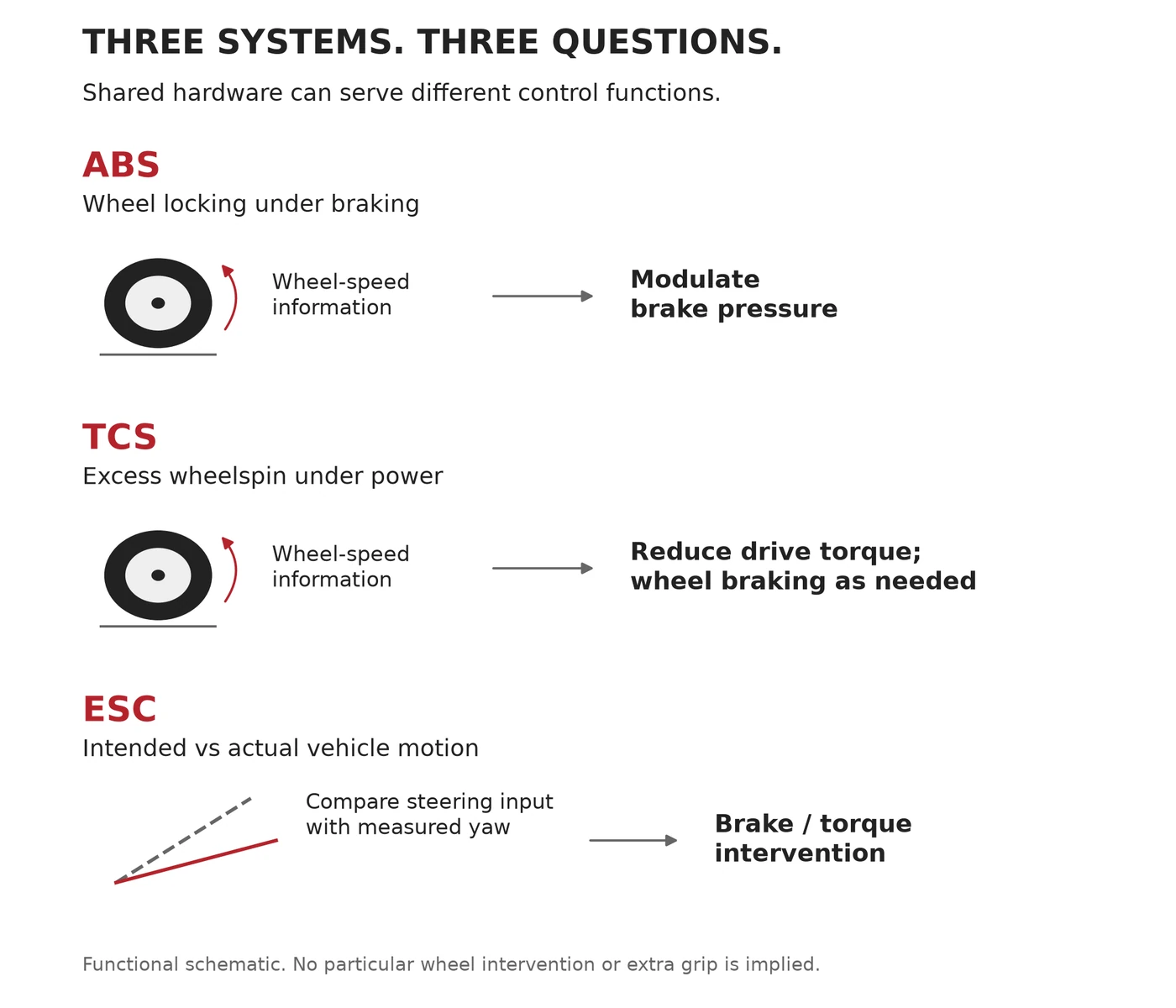
These systems often share sensors, brakes and control hardware, but their jobs are not identical. A useful distinction is braking slip, acceleration slip and the motion of the car as a whole.
ABS: Can the Wheels Keep Useful Rolling Control?
ABS means Anti-lock Braking System. It monitors wheel behavior and modulates brake pressure when locking is threatened. The purpose is controlled braking with useful steering and stability, within the grip available.
A locked tire can slide without responding to steering as a rolling tire would. That is why the ability to steer during an emergency matters, not just a single stopping-distance number.
Does ABS always produce the shortest possible distance? No. On loose gravel or deep loose snow, a locked tire can build up material ahead of itself, sometimes shortening a straight-line stop at the expense of control. NHTSA’s ABS research documents the importance of surface conditions; its historical test results should not be treated as measurements of every modern vehicle.
That exception is not a reason to disable a road car’s safety systems. Surface, tire, vehicle and controller differences make a universal stopping-distance promise inappropriate.
TCS: Are the Driven Wheels Spinning Excessively?
TCS means Traction Control System. It addresses excessive driven-wheel spin during acceleration, using powertrain torque reduction and, depending on the system, braking at a spinning wheel.
A wet-road launch is an easy example: more requested torque than the tires can transmit may produce spin instead of useful acceleration. The controller tries to bring that demand back into a usable range.
ESC: Is the Car Moving as Intended?
ESC means Electronic Stability Control, also called ESP in some naming systems. It compares intended behavior, inferred from inputs including steering, with measured motion such as yaw: the car’s rotation viewed from above.
When those disagree significantly, individual-wheel braking and powertrain intervention can help restore stability. It can respond to understeer or oversteer, but it is not restricted to leisurely cornering; a sudden avoidance maneuver can also create a stability problem. Bosch explains the shared ABS, traction and stability functions.
Part 3’s Suspension and Handling Basics explains understeer and oversteer. The connection here is that electronics can manage tire forces, but cannot make a tire-road contact patch generate unlimited force.
Why Sports Cars Have Sport and Off Modes
On a closed course, experienced drivers may want a wider permitted range of wheel slip or vehicle rotation. Some performance cars offer less restrictive modes for that purpose. The exact behavior is model-specific: a label such as “ESC Off” does not necessarily switch off ABS or every remaining intervention.
For public-road driving, keep the normal safety settings and follow the owner’s manual. A permissive mode does not provide extra skill, more road space or protection from an unexpected surface change.
4. Tire Aspect Ratio: The 40 Is Not 40 Millimeters
A tire size looks like a code until each piece has a job. Take 235/40R18:
| Marking | Meaning |
|---|---|
| 235 | Nominal tire section width in millimeters, not an exact tread-width measurement |
| 40 | Nominal sidewall height is 40% of that width |
| R | Radial construction, not radius |
| 18 | Wheel bead-seat diameter in inches, not the complete tire’s outside diameter |
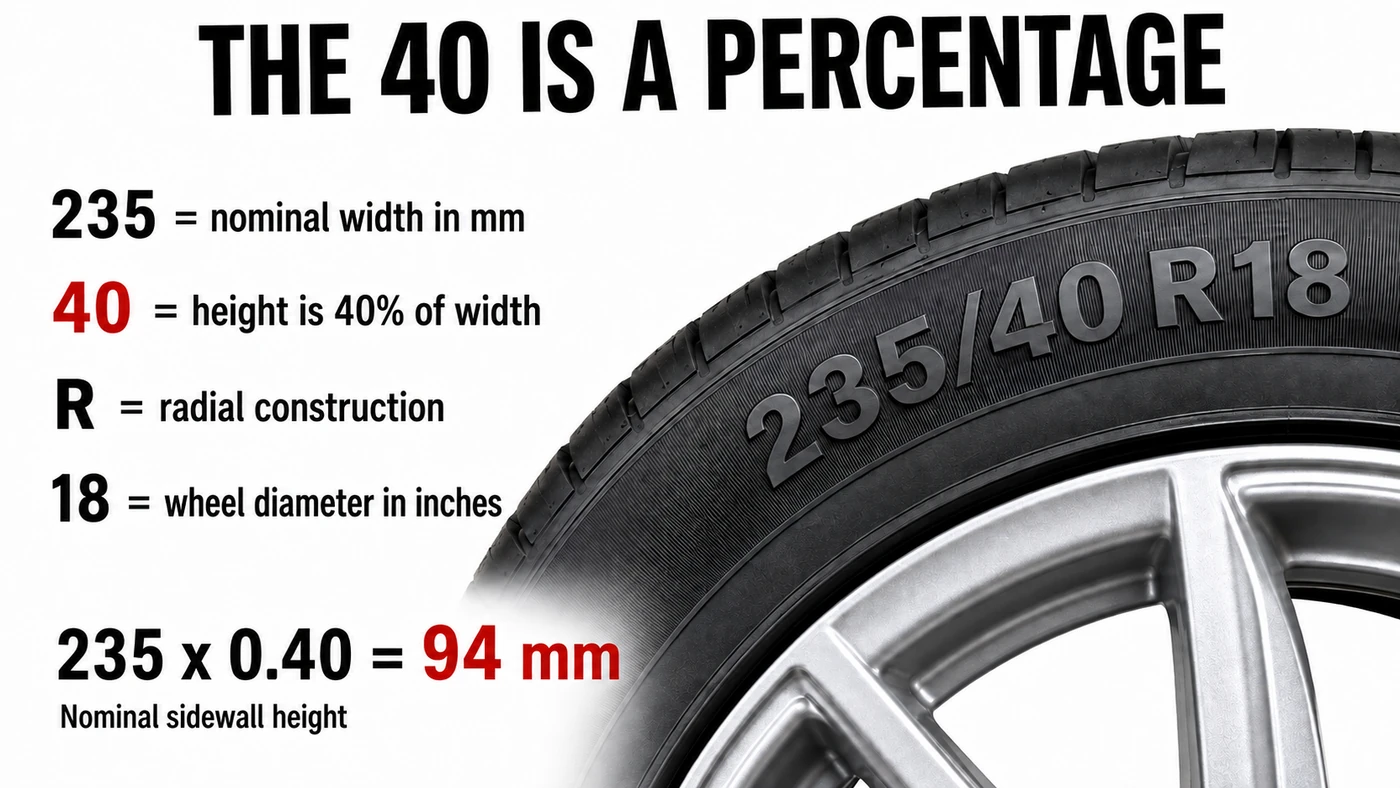
The nominal sidewall calculation is 235 x 0.40 = 94 mm. That is the height on one side of the wheel, not the combined rubber above and below it. Actual measured dimensions depend on the specific tire and measuring rim. Michelin’s tire-size guide explains the markings, including load and speed information that must not be ignored.
A lower aspect-ratio number means a shorter nominal sidewall only when the width is held constant. Comparing the number 35 with 40 while ignoring width can be misleading.
Why Low-Profile Tires Can Feel Sharper
A shorter sidewall can reduce some of the deformation between steering input and tread response. With suitable construction, that can feel more immediate. This is one reason low-profile packages are common on performance cars.
But sidewall height is not a grip rating. Compound, carcass construction, pressure, temperature, load and the road still matter. A short sidewall does not tell us that the tire brakes better in rain or provides more cornering force.
Where the Comfort and Protection Go
The tire is also part of the car’s compliance: it deforms over small irregularities before the suspension has done all its work. Reducing sidewall height can leave less impact reserve between a sharp road edge and the wheel, increasing vulnerability to tire or rim damage.
A taller sidewall can improve compliance and provide more room to absorb impacts. This helps explain its appeal on rough roads and off-road vehicles, although reinforcement, load capacity, pressure and construction remain essential. More rubber height does not make a tire puncture-proof.
Noise is similarly not determined by profile alone. Tread pattern, cavity behavior and vehicle isolation also influence what reaches the cabin. Continental’s tire-size explanation is useful context for these dimensional trade-offs, rather than a universal ranking of profiles.
5. Wheel Size: More Metal Is Not Automatically More Performance
A Bigger Wheel Can Keep a Similar Outside Diameter
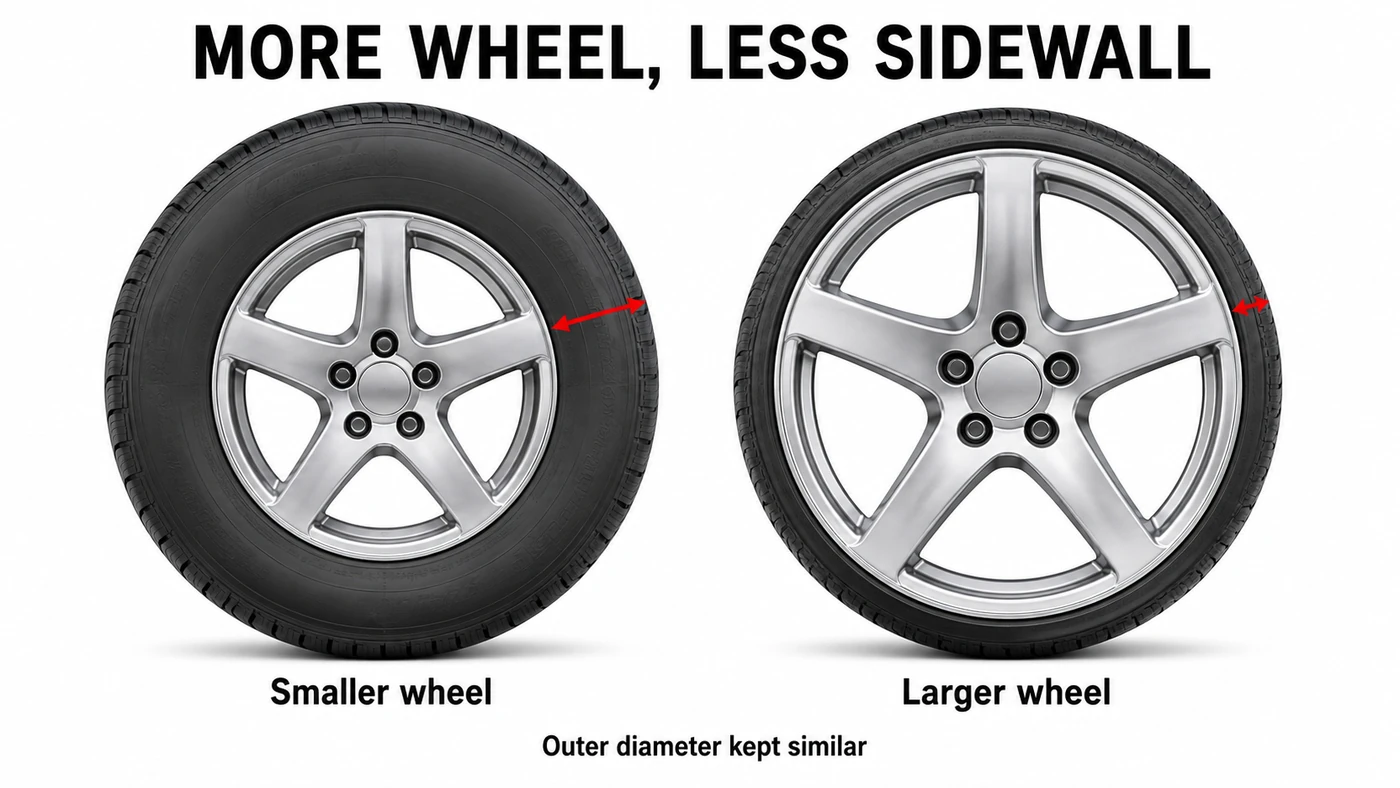
Wheel diameter and complete tire diameter are different measurements. Changing to a larger wheel is often accompanied by a shorter sidewall so that the overall rolling size stays close to the original.
For a purely nominal example, 235/40R18 gives 18 x 25.4 + 2 x 94 = 645.2 mm outside diameter. A 235/35R19 gives 19 x 25.4 + 2 x 82.25 = 647.1 mm. The larger wheel does not produce a full extra inch of overall tire diameter.
Those two calculations are not an approved interchange recommendation. Load and speed ratings, approved rim widths, offsets, clearance, pressure requirements and vehicle approval still need checking. Continental’s plus-sizing checklist explains why a similar calculated diameter is only one part of fitment.
Larger wheels can provide room for larger brakes. Yet even the diameter is not enough to confirm clearance: the barrel shape, spoke profile and offset matter as well.
Rotational Inertia: Where the Weight Sits Matters
A wheel must accelerate both down the road and around its axle. Rotational inertia describes its resistance to changes in rotational speed. Mass farther from the axis has a larger influence than the same mass close to it.
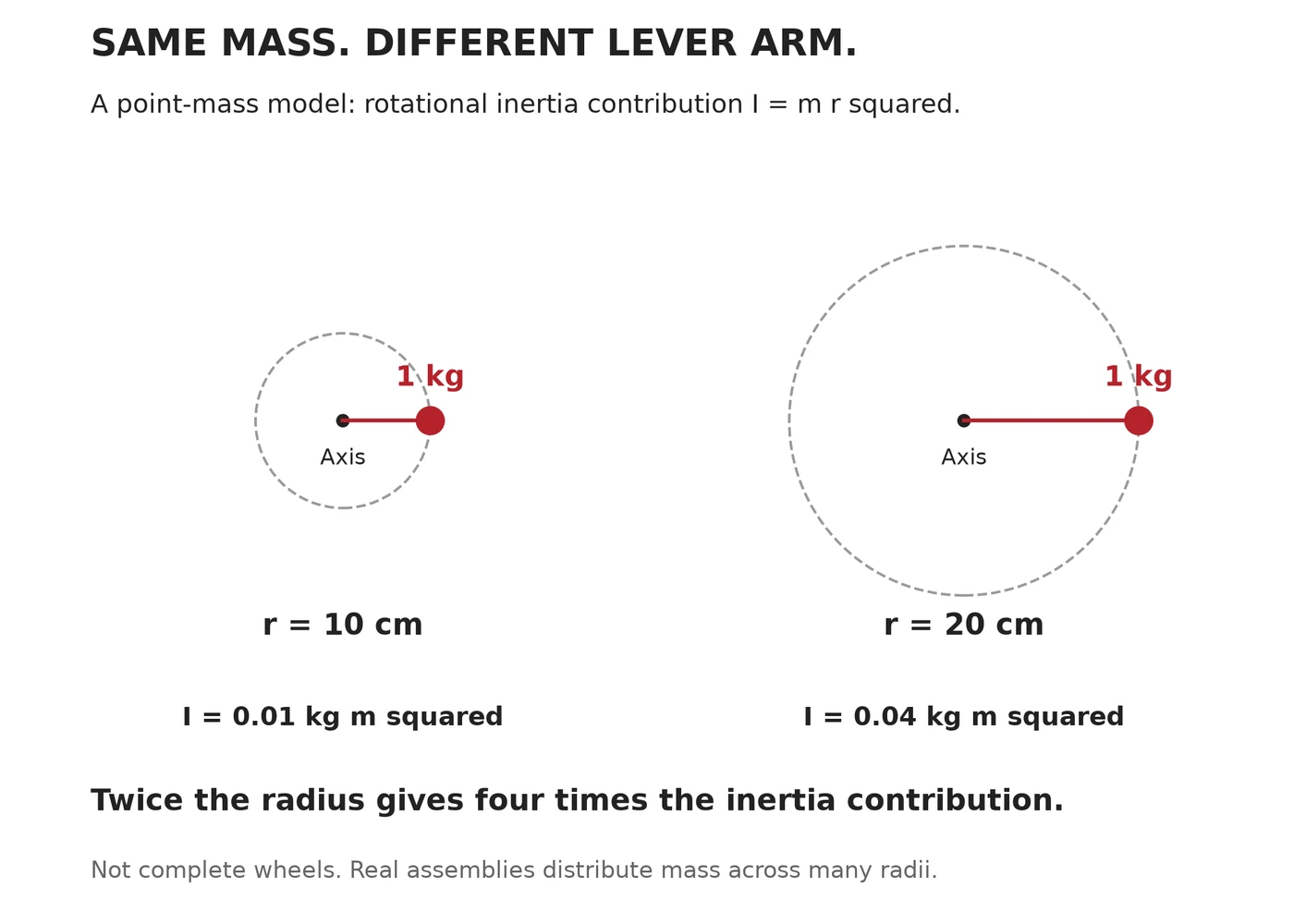
The diagram isolates one small mass so the principle is easy to see: its inertia contribution is mass multiplied by radius squared. Doubling its radius quadruples that contribution. It does not quadruple an entire car’s braking distance, nor does it describe a complete wheel as one lump at its rim.
Real assemblies have different masses and distributions, and road speed relates to angular speed through rolling radius. This is why there is no honest universal rule that one kilogram removed from a wheel equals a fixed number removed from the body.
A heavier package can add energy demand and affect response, but a large diameter is not proof of greater weight. Compare the actual wheel-and-tire assemblies, not just the inch markings.
Unsprung Mass: What the Suspension Has to Control
The wheel, tire, hub and conventional wheel-mounted brake move with the road-following assembly rather than being carried on the body side of the main suspension springs. They form much of its unsprung mass, alongside contributions from connected suspension parts.
More of this mass can make controlling rapid wheel movement over bumps more challenging. Ride and grip can suffer, depending on the springs, dampers, tire compliance and road input. It is not simply a question of making the whole car a few kilograms lighter.
Forged wheels can help reconcile size with weight. Forging changes the metal’s structure and can enable a strong design with less material; BBS describes its wheel manufacturing processes. But “forged” is not a guarantee that every example is lighter than every cast wheel. Design, dimensions and required load capacity still decide the result.
Why Manufacturers Keep Making Wheels Bigger
Sometimes there is a clear packaging requirement for larger brakes. Sometimes the reason is visual proportion: a large body, especially an SUV, can look very different with more wheel filling its arches. Customer expectations and a sporty appearance also influence the choice.
These are real product decisions, but they are not all handling improvements. A larger package may bring higher replacement costs, more impact sensitivity or an efficiency penalty if its mass and tire characteristics increase losses. The most dramatic appearance and the most comfortable everyday setup need not be the same thing.
What the Tires Change Across the Whole Car
A tire transmits accelerating, braking and cornering forces, often simultaneously. Those demands share a limited capability. Asking for more of one can leave less capacity for another; electronics help manage that budget rather than erase it.
This connects back to Engine Power Basics and Drivetrain Basics. More power or more driven wheels can only become useful acceleration when the contact patches can transmit the required forces.
The right tire for the conditions can improve several aspects of a car at once. “Right” includes condition, appropriate inflation and suitability for temperature and water, not just a performance label. A wider tire or more expensive compound is not automatically an improvement in every environment.
UHP means ultra-high performance, but even that label does not identify a season or make a tire universal. A summer UHP tire is not a winter solution. Dry-track-focused tires can make trade-offs involving temperature sensitivity, standing water, wear, comfort and noise.
Michelin’s Pilot Sport Cup 2 R technical bulletin is a useful reminder that specialized tires come with specific operating guidance. Read the actual product requirements rather than treating “closer to a racing tire” as a guarantee of better road behavior.
Reading a Specification Sheet Without Being Dazzled
Imagine a car advertised with 19-inch wheels, 245/35R19 tires, six-piston front calipers and ABS, TCS and ESC. Here is a more useful interpretation than “bigger numbers mean better.”
| Specification | What we can reasonably infer | What we still need to know |
|---|---|---|
| 19-inch wheels | A particular brake-clearance and tire-packaging envelope | Actual mass, clearance, strength and fitment |
| 245/35R19 | A nominal sidewall height of 85.75 mm | Compound, construction, load rating and behavior in the relevant conditions |
| 6P front calipers | Six pistons per front caliper, commonly in an opposed fixed layout | Disc, pad, fluid, cooling and repeated-braking performance |
| ABS / TCS / ESC | Control functions addressing locking, wheelspin and stability | Model-specific calibration and operating modes |
The specification becomes a set of clues to investigate, not a measured result. That is a much more interesting way to read a brochure.
Common Misconceptions
“Six pistons must stop shorter than one.” Not when another part of the system is the limiting factor. Piston count describes hardware, not the result of a comparable braking test.
“ABS creates grip.” It regulates braking to use available grip and preserve control. It cannot change the road surface or restore a tire’s lost condition.
“A 35-profile tire is 35 mm tall.” It is a percentage of nominal section width. Width must be included in the calculation.
“A 20-inch wheel must handle better than an 18-inch wheel.” The answer depends on the complete package, including tire construction, sidewall, mass, suspension and intended road.
“Track equipment is always better daily equipment.” A solution optimized for repeated hot laps can carry compromises that are irrelevant on a circuit but important on a cold, wet commute.
Cariary Thoughts
The part I find most revealing is that brakes can already be strong enough for one stop while still needing much more engineering for the next several stops. That changes how I look at a large caliper behind an expensive wheel. The interesting question is no longer just “How hard can it squeeze?”
It is also “How consistently can this whole system work, and under what conditions?” The same shift applies to wheels. A shorter sidewall and a lighter assembly might support a particular performance target, while a taller sidewall may better suit rough roads. Neither needs to apologize for serving a different purpose.
After these four parts, the pieces begin to connect. Power needs a route to the wheels; the suspension helps the tires remain useful; brakes manage energy and wheel rotation. The tire-road interface is where the promises must become real forces.
That is the question I want to keep asking as we study more cars together: what problem did this engineering choice solve, and what did it trade away?
One-Line Summary
Good stopping and handling come from matching brakes, tires, wheels and controls to the job, not from choosing the biggest numbers.
FAQ
Can a Single-Piston Brake Be Good Enough?
Yes. A correctly designed and maintained single-piston floating system can meet its vehicle’s road-use requirements. Its ability to stop once and to repeat hard stops should be assessed separately; the piston count alone answers neither question.
Do Bigger Discs Help Even Without More Pistons?
A larger effective friction radius can increase braking torque, and a suitable larger or thicker rotor can improve thermal capacity. Those benefits depend on the complete matched system and come with packaging, mass and cost considerations.
Is Brake Fade the Same as Boiling Brake Fluid?
No. Heat-related loss of pad friction and fluid boiling are different mechanisms. Both can undermine braking, but identifying a particular fault requires proper inspection rather than guessing from one symptom.
What Is the Easiest Way to Remember ABS, TCS and ESC?
ABS addresses wheel locking under braking. TCS addresses excessive driven-wheel spin during acceleration. ESC addresses a mismatch between intended and measured vehicle motion. Their functions can share hardware, and none can overcome the tire-road grip limit.
Does a Lower Tire Profile Always Mean Better Handling?
It can support a more immediate response, but profile alone does not establish grip or predict the whole handling balance. Tire construction, conditions and the rest of the vehicle matter, with potential comfort and impact-protection trade-offs.
Can I Choose a New Tire Size Just by Matching Overall Diameter?
No. Similar calculated diameter is only a starting observation. The vehicle’s approved fitments, load and speed ratings, rim compatibility, clearances and pressure requirements must also be satisfied.
Are Forged Wheels Always Lighter?
No. Forging can enable a favorable strength-to-weight design, but actual mass depends on size, geometry and load requirements. Compare like-for-like specifications and verified compatibility rather than relying on a manufacturing label.
Related Thoughts
- Part 1: Engine Power Basics connects torque, RPM and the power an engine can produce.
- Part 2: Drivetrain Basics follows that power through transmissions and differentials to the tires.
- Part 3: Suspension Basics explains how wheel guidance, alignment and load changes affect handling.
- 4 Piston Brakes: Are 4P and 6P Calipers Really Better? takes the caliper comparison further.
References
Technical references checked September 7, 2026. Numerical examples are Cariary calculations, not measured vehicle tests. The illustrations explain generic principles and are not component drawings or installation instructions.
- Brembo: brake caliper technology and operation
- Brembo: elements of a performance braking system
- AP Racing: ventilated brake discs
- AP Racing: technical product catalogue
- NHTSA: light-vehicle ABS research report
- Bosch: electronic stability program
- Bosch: regenerative braking systems
- Michelin: understanding tire size
- Continental: tire dimensions
- Continental: requirements when increasing tire and wheel size
- BBS: wheel manufacturing technology
- Michelin: Pilot Sport Cup 2 R technical guidance

