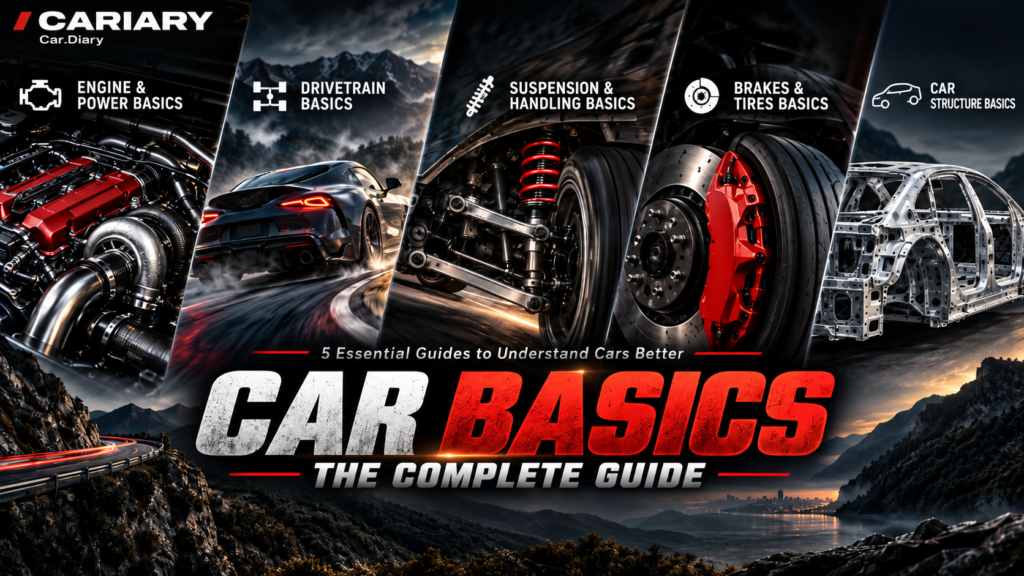
Car Basics for Enthusiasts is for that familiar stage of loving cars but still wondering what the specifications really mean. You recognize turbo, AWD, multilink and six-piston brakes. Yet explaining why a manufacturer chose them is harder than remembering their names.
You do not need to be an engineer to get past that stage. Cars become more interesting when the separate terms start to connect: the engine produces power, the drivetrain delivers it, suspension manages wheel movement, tires transmit forces to the road, and the structure supports the whole arrangement.
This guide brings our five-part series together. Each original thumbnail opens its full article, while the explanations below show how the parts relate. Our aim is not to memorize more impressive words. It is to look at a car and ask a better question: why was it built this way?
Quick Summary
- Start with the connection: power, delivery, control, grip and structure form a useful learning path.
- Choose a question, then a part: follow all five in order or begin with the detail that has been puzzling you.
- Read specifications as decisions: each component solves a problem and introduces compromises.
- Separate potential from proof: a sophisticated component does not guarantee a better complete car.
- Keep the vehicle’s purpose in view: a family car, track car and working pickup need different balances.
Car Basics for Enthusiasts: The Five-Part Learning Path
- Engine & Power Basics: How does a car make power?
- Drivetrain Basics: How does that power reach the road?
- Suspension & Handling Basics: How does the car keep its tires working over bumps and through turns?
- Brakes & Tires Basics: How are the forces for accelerating, turning and stopping managed?
- Car Structure Basics: What supports those systems and determines how the vehicle carries its mass?
Power → Delivery → Control → Grip → Structure is the reading order, not a literal route through which engine power passes. In the real vehicle, these systems work together continuously. The structure is the foundation from the beginning, and tires matter long before we reach Part 4.
The engine chapters focus on combustion engines. Electric cars produce torque differently, but many of the lessons about gearing, tires, suspension, mass and structures still apply. This is a foundation for understanding engineering choices, not a repair manual or a complete catalog of every automotive technology.
Part 1: Engine & Power Basics
The question: How does a car make power?
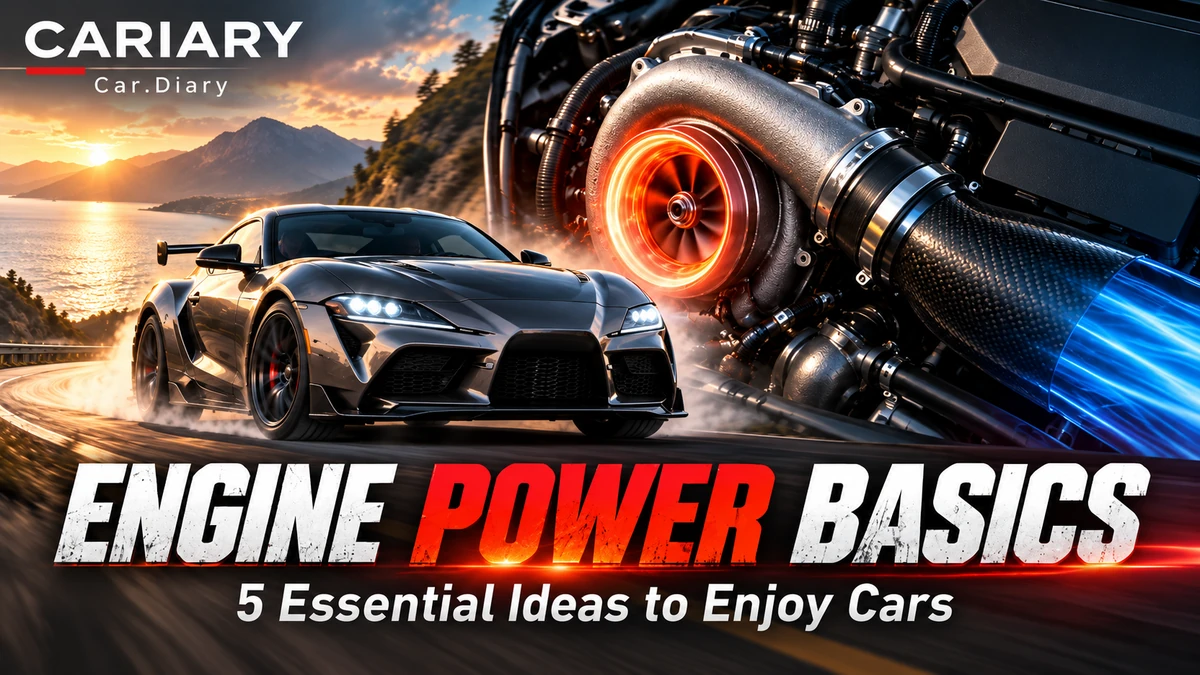
Part 1 follows what happens between air entering an engine and useful output reaching its crankshaft. It connects turbocharging, response, charge-air cooling, torque and power. The useful shift is from asking only how much output an engine makes to asking how, and under which conditions, it delivers it.
Five ideas to take away
- Turbocharger: Exhaust gas drives a turbine connected to a compressor. The compressor helps supply more air mass to the cylinders, allowing more fuel to be burned for greater output when the rest of the system supports it. That is how a relatively small engine can produce substantial power.
- Turbo lag: After a change in demand, the turbo system may need time to build the requested response. This delay is different from boost threshold, the operating conditions needed to produce useful boost. Not every pause after pressing the accelerator comes from the turbo alone.
- Intercooler: Compressing air raises its temperature. A charge-air cooler removes heat; at comparable pressure, cooler air is denser, and cooling can help reduce knock risk. It is part of the complete intake and thermal-management system, not a device that creates oxygen.
- Horsepower vs torque: Torque is a twisting moment; power is the rate of doing work. Rotational power equals torque multiplied by angular speed, with the appropriate unit conversion when using RPM. A torque figure needs an engine-speed range, and a horsepower figure does not tell us the whole response curve.
- Naturally aspirated vs turbocharged: Without a turbocharger or supercharger, an engine draws its charge without that forced-induction system. Some naturally aspirated engines are prized for predictable response and high-rev character; many turbo engines provide broad midrange torque. Neither description applies identically to every design, and turbocharging adds heat and complexity alongside its output and efficiency potential.
Garrett’s basic turbocharger explanation is a useful external reference for the turbine, compressor and charge-air cooler working together.
What a specification starts to tell you
Consider 2.0-liter turbo / 300 hp / 400 Nm. We know the displacement, the use of forced induction and two peak output figures. We do not yet know where the 400 Nm arrives, how broad its plateau is or how the car responds in a particular gear.
Instead of assuming strong low-RPM performance, look for the torque curve, gearing and vehicle mass. That is the difference between an informed expectation and a guess dressed as certainty.
Read the full guide: Engine Power Basics
Once the engine makes power, the next question is where it goes.
Part 2: Drivetrain Basics
The question: How does that power reach the road?
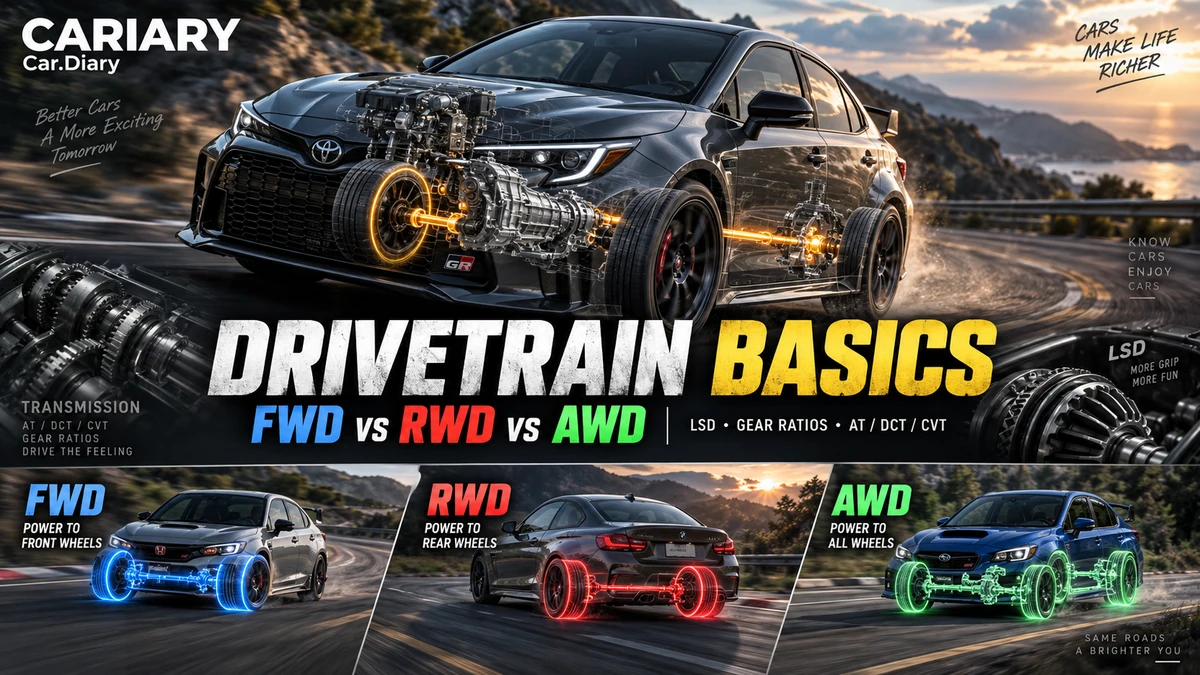
Part 2 traces the route through the transmission, final drive, differentials and driven wheels. It explains why cars with similar engine output can put that output to use very differently. Traction, ratios and control strategy are as important to this story as the driven-wheel badge.
Five ideas to take away
- FWD, RWD and AWD: Front-wheel drive asks the front tires to steer and deliver propulsion, often with useful cost and packaging advantages. Rear-wheel drive separates front-wheel steering from rear-wheel propulsion and can benefit from rearward load transfer under acceleration. All-wheel drive can distribute driving effort across both axles, improving traction when two driven tires would be limiting, but adds hardware, mass or energy losses depending on the system.
- Differential: The outside wheel travels farther than the inside wheel through a corner. A differential permits different left-right wheel speeds while transmitting torque, avoiding the need to force both wheels to rotate identically.
- Limited-slip differential: An LSD can limit differential action or bias torque within its design limits, helping use available traction when an open differential would be constrained. Mechanical and electronically controlled versions work differently. It does not simply send all power to whichever tire has grip, and a brake-based imitation is not identical hardware.
- Gear ratios: Shorter gearing multiplies more torque at the wheels for a given engine torque, while producing less wheel speed per engine revolution. Taller gearing reduces engine speed at a given road speed. It may help cruising efficiency, but neither stronger acceleration nor a higher top speed follows from a ratio change in every situation.
- AT, DCT and CVT: A conventional automatic can combine smooth operation with fast shifts. A dual-clutch transmission uses two clutch-controlled gear paths, supporting quick preselected shifts. A conventional belt- or chain-type continuously variable transmission varies its ratio smoothly; a hybrid power-split e-CVT uses a different mechanism despite the similar name. Calibration and application matter more than treating these labels as fixed rankings.
What the combination suggests
2.0-liter turbo / FWD / DCT / LSD suggests a package that must manage considerable drive demand at the front axle. The differential may help corner-exit traction, and the transmission can help keep the engine in a useful operating range.
That interpretation still needs qualification: which LSD, which tires, what shift behavior and how much mass? AWD likewise does not give the tires a new supply of braking grip merely because all four can receive drive torque. Two-wheel-drive cars also brake at all four wheels.
Read the full guide: Drivetrain Basics
Now the tires are being asked to propel the car. What keeps them working as the road changes direction and height?
Part 3: Suspension & Handling Basics
The question: Why can one car feel precise and another reluctant, nervous or unsettled?
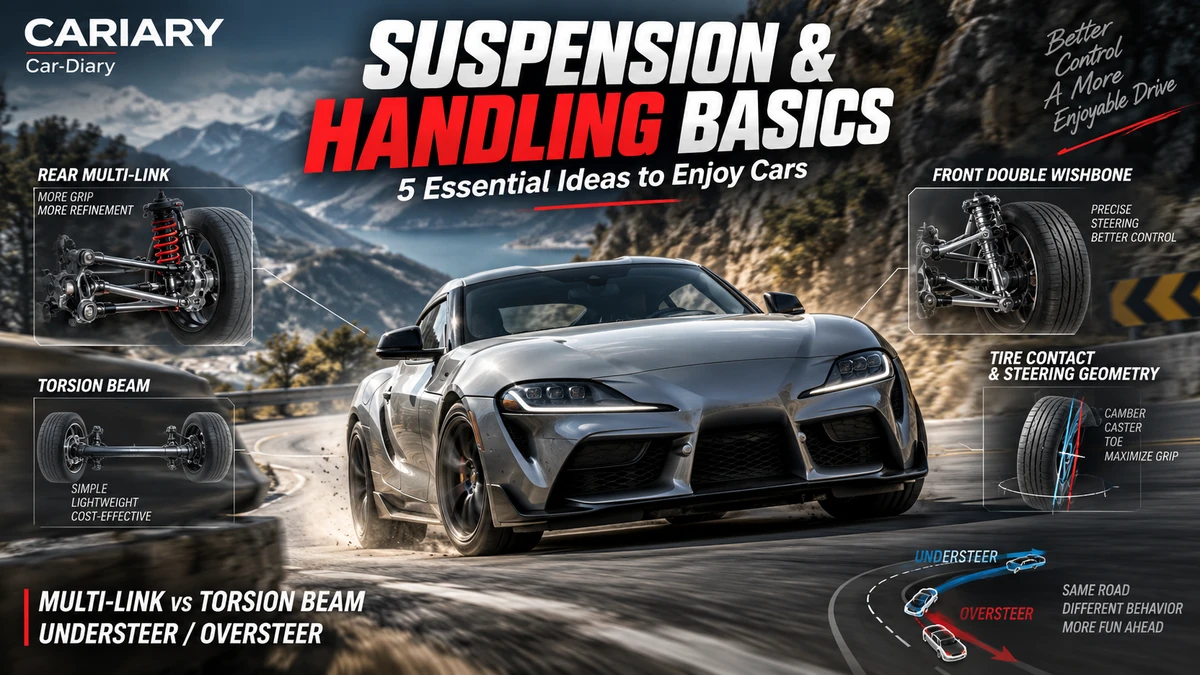
Part 3 looks at how wheels move relative to the body and how that movement affects the tires. It covers suspension layouts, roll control, handling balance and alignment. The central idea is that suspension does more than soften bumps or make a car look flat in corners.
Five ideas to take away
- Torsion beam vs multilink: A torsion-beam rear arrangement is compact and relatively simple, with a twisting crossmember that couples the wheel assemblies. Multilink designs use several locating links to give engineers more freedom over wheel movement, camber and toe. More freedom can help ride and handling, but it brings packaging and cost trade-offs; a well-tuned torsion beam can serve its vehicle very well.
- Double wishbone: Upper and lower control arms guide the wheel assembly. Their geometry provides useful freedom to manage camber as the suspension moves. That can support tire behavior during cornering, but the result depends on the actual geometry, compliance and tire, not the name alone.
- Stabilizer bar: Also called an anti-roll bar, it resists differences in suspension movement between the two sides. It can reduce body roll, while also changing load-transfer distribution and the way one-wheel bumps affect the other side. Increasing stiffness indefinitely is not a recipe for unlimited grip.
- Understeer and oversteer: Near the limit, the everyday distinction is whether the front tires or rear tires run out of cornering capability first. The car may run wider than intended or rotate more than intended. Engineers also describe these tendencies below outright sliding, so visible skids are not required for the terms to be useful.
- Camber, toe and caster: Camber is wheel tilt viewed from the front or rear. Toe is wheel direction viewed from above. Caster is steering-axis tilt viewed from the side. These are different angles with different effects on response, wear and steering behavior; they are not interchangeable ways of saying a wheel is tilted.
Keeping the tires working
The tire needs suitable contact and loading to transmit forces. If suspension cannot manage rough surfaces well, a car that feels firm on smooth asphalt may become less effective on a bumpy road.
Body roll is therefore a clue, not a complete verdict. A good suspension does not simply keep the car flat. It helps the tires keep doing their jobs while balancing comfort, control and packaging.
Read the full guide: Suspension Basics
Those tires also have to slow the car. This is where impressive-looking hardware can be particularly misleading.
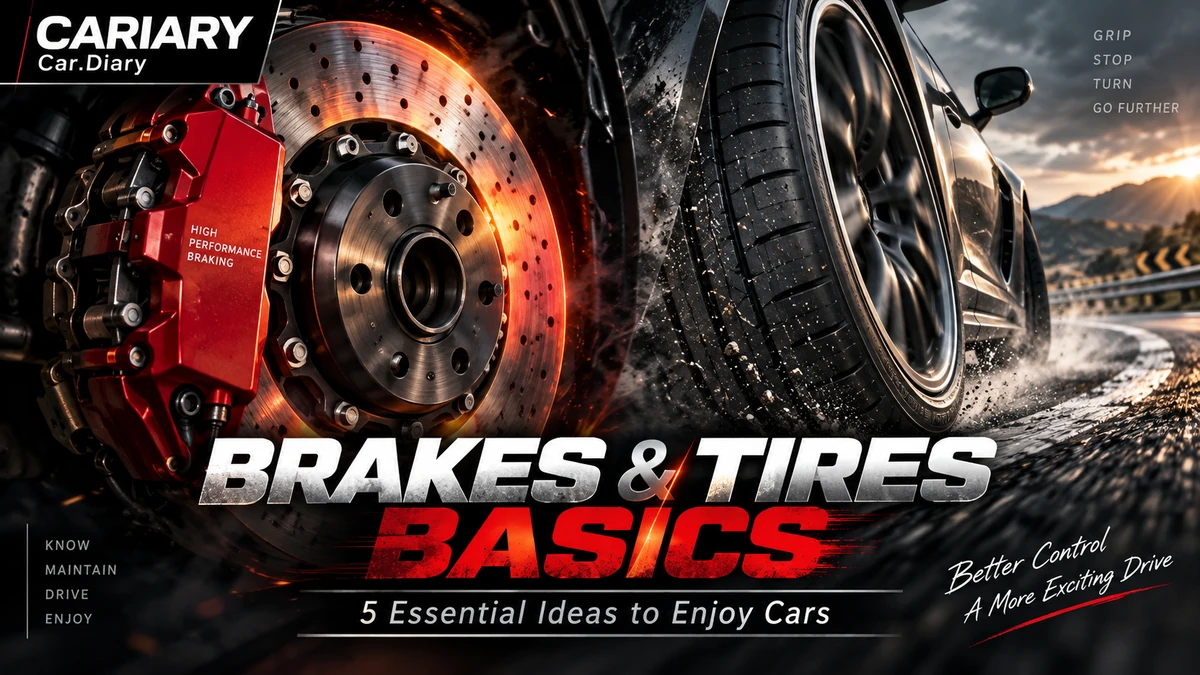
Part 4: Brakes & Tires Basics
The question: What actually makes a car stop?
Part 4 separates the brake system’s ability to produce torque and manage heat from the tires’ ability to transmit forces to the road. It explains caliper pistons, rotor size, electronic controls, tire markings and wheel dimensions. A short emergency stop and repeated hard braking are related challenges, but they are not the same test.
Five ideas to take away
- 1P, 4P and 6P brakes: These labels count caliper pistons. Multiple pistons can support pressure distribution across longer pads, but clamp force depends on hydraulic pressure and piston area, not count alone. A complete performance system may improve stiffness and heat endurance; six pistons by themselves do not establish any of those results.
- Brake disc size and fade: A larger effective radius increases leverage for the same pad force. Disc mass, thickness, material and ventilation influence heat capacity and cooling. When heat reduces braking effectiveness, we call it fade; larger diameter alone does not settle thermal performance. Added disc mass may also increase unsprung mass, the mass moving directly with the wheel, and rotational inertia, resistance to changes in rotational speed.
- ABS, TCS and ESC: ABS modulates brake pressure to control wheel locking. TCS addresses excessive driven-wheel spin. ESC compares intended and measured vehicle motion and can intervene through individual-wheel braking and drive-torque control. These systems help manage available grip; they cannot remove its physical limits. Bosch explains the combined stability-control functions.
- Tire aspect ratio: In 235/40 R18, the 40 means nominal sidewall height is 40 percent of the 235 mm section width, not 40 mm. That gives a calculated nominal 94 mm sidewall. The R identifies radial construction, and 18 is the wheel diameter in inches. Michelin’s tire-marking guide explains the format.
- Wheel size: Larger wheels can provide brake clearance and support certain tire packages. With a similar overall tire diameter, they generally leave a shorter sidewall, which may sharpen response but reduce impact cushioning. Mass, construction and tire choice influence the outcome; a larger wheel is not automatically heavier or better.
Tires are the final road connection
The brakes apply torque that resists wheel rotation. The tire-road contact transmits the forces that decelerate the vehicle. It is a useful correction to the idea that fitting the biggest visible caliper must produce the shortest stop.
Tires also transmit acceleration and cornering forces, sharing a finite capability between demands. More propulsion, more braking and more steering are not independent requests that the road must always satisfy.
Read the full guide: Brake and Tire Basics
There is one more foundation beneath all this hardware: the vehicle’s structure and the mass it carries.
Part 5: Car Structure Basics
The question: What holds the systems together, and where does the car carry its mass?
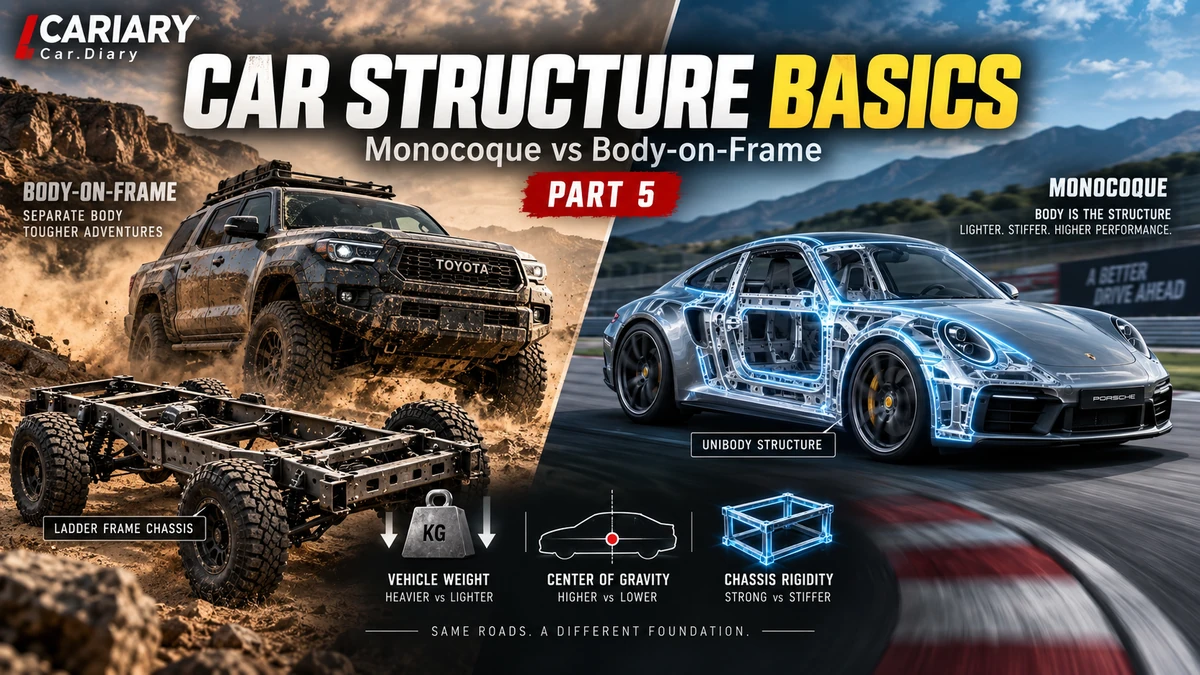
Part 5 connects body construction with vehicle behavior. It explains why structural stiffness, material strength, weight and crash protection are different ideas. This is where the previous four parts meet: every component needs mounting points and a structure designed around its loads.
Five ideas to take away
- Body-on-frame vs unibody: A separate frame suits many heavy-duty loads and modular body arrangements. A unibody, often called monocoque in everyday automotive language, uses an integrated load-bearing shell. It can offer structural and packaging efficiency. Neither architecture automatically wins on durability, handling or crash safety; capable off-road unibodies and refined frame vehicles both exist.
- Vehicle mass: More mass resists acceleration and increases kinetic energy at the same speed. It affects loads, energy use and thermal demands, but does not automatically dictate a longer single emergency stop. Size, comfort equipment, safety requirements, driven axles and electrification can add mass; better materials and design can reduce it, so newer does not inevitably mean heavier.
- Center of gravity: Its height depends on where the mass is located. A low underfloor battery can give a heavy EV a relatively low center of gravity without making it light. Lower placement helps reduce lateral load transfer under otherwise equal conditions; actual body roll also depends on suspension geometry and roll control. Static 50:50 axle loading is not a universal guarantee of handling balance.
- Chassis rigidity: Resistance to unwanted structural twisting gives suspension a more consistent foundation. A stiff body can work with compliant suspension; it does not have to ride harshly. Removing a load-bearing roof may require convertible reinforcement, while carbon structures can offer useful stiffness for their mass at the cost of demanding production and repair processes.
- Crash structures and subframes: Crash zones manage deformation while the passenger cell helps preserve survival space, working with restraints. A subframe is a local cradle that can support suspension or powertrain loads and provide tuned mounting connections. It does not turn an integrated body into a full body-on-frame chassis.
The mission decides the priorities
A work vehicle may emphasize repeated heavy loads. A sports car may prioritize mass placement and predictable suspension geometry. A family EV must accommodate its occupants, battery, protection and comfort requirements together.
Those are useful questions about purpose, not proof that a particular badge or material solves everything. The Department of Energy’s lightweight-materials overview discusses reducing mass while retaining performance and safety. For crash protection, the IIHS explanation of vehicle size and weight adds context that a stiffness number cannot provide.
Read the full guide: Car Structure Basics
Bring It Together: Read a Performance Car Specification
Here is a fictional specification, not a disguised test of a particular model:
3.0-liter turbo / RWD / eight-speed automatic / electronically controlled LSD / double-wishbone front suspension / multilink rear suspension / six-piston front brakes / 275/35 R19 tires / aluminum-intensive unibody.
It is tempting to conclude that the engineers fitted a collection of expensive parts. A more useful reading asks what those parts are intended to do and which evidence is still missing.
| Specification | Engineering question it helps answer | What we still need to know |
|---|---|---|
| 3.0-liter turbo | How is air supplied for the intended output? | Torque curve, response, cooling and calibration; displacement and boost alone do not prove low-RPM strength |
| RWD | Which tires provide propulsion? | Axle loads, tires, suspension and control strategy |
| Eight-speed automatic | How are engine speed and wheel speed related across driving conditions? | Ratio spread, shift quality, software and losses |
| Electronically controlled LSD | How can differential action and torque bias be managed? | Actual hardware, control logic and operating limits |
| Double wishbone front | How can front-wheel position and camber be controlled? | Geometry, compliance and behavior through suspension travel |
| Multilink rear | How much freedom exists to tune rear-wheel movement? | The actual tuning, packaging and tire interaction |
| Six-piston front caliper | How can force be applied across the brake pad? | Piston area, disc and pad specification, cooling and repeat-stop results |
| 275/35 R19 tires | What are the nominal width, profile and wheel size? | Compound, construction, load rating and suitability for conditions |
| Aluminum-intensive unibody | How are material and structure combined to manage mass and stiffness? | Complete vehicle mass, joints, load paths and crash performance |
For the tire example, nominal sidewall height is 275 x 0.35 = 96.25 mm. That arithmetic decodes the marking; it does not prove the tire’s grip or approve a replacement fitment.
The specification now suggests a design direction, not a guaranteed road-test result. We can see why the parts might belong together while recognizing that their implementation determines whether they work well.
There Is Almost Always a Trade-Off
A larger wheel may clear a brake package but leave less tire cushioning. A stiffer suspension may control body movement on one surface while being less compliant on another. Turbocharging can support high output from limited displacement while increasing thermal-management demands.
AWD can improve power delivery when traction is limiting, but additional hardware has consequences. A separate frame can serve particular loading and body-configuration needs while presenting mass and packaging challenges. A low-profile tire can support quick response without necessarily being the most forgiving choice over sharp road damage.
There is rarely a free performance upgrade. The interesting part is identifying what a design gains, what it gives up, and whether that exchange suits the vehicle’s job.
Common Misconceptions: One Specification Is Not a Verdict
“Multilink means better suspension.” It describes an arrangement with useful tuning freedom, not the quality of every setup using it.
“Six pistons mean a shorter stop.” They describe part of a caliper. Tires, hydraulic design, friction materials and the rest of the system still matter.
“AWD means faster cornering everywhere.” Drive traction is only part of cornering. Tire characteristics, mass, balance and the phase of the corner matter too.
“Twenty-inch wheels are an upgrade by definition.” Size may serve brakes, styling or a particular tire package. Its benefits must be weighed against the complete assembly’s behavior.
“50:50 weight distribution means perfect handling.” A static axle split does not describe the height or concentration of mass, or the loads during a maneuver.
“Body-on-frame means safer.” Crash protection depends on controlled deformation, survival space, restraints and the collision conditions, not the architecture name alone.
The Reader’s Checklist: Better Questions to Ask
When a new car catches your attention, try these questions before deciding what its specifications mean:
- Engine: How does it make power, and where is that output available?
- Drivetrain: Which wheels receive drive torque, and when?
- Differential: What happens when traction differs between the driven tires?
- Transmission: How do ratios and shifting keep the power source in a useful range?
- Suspension: How does each wheel move as the road and body move?
- Handling: How do the front and rear tires share the cornering demands?
- Brakes: Can the system sustain the relevant thermal workload?
- Tires: What conditions and compromises does their design prioritize?
- Wheels: Does the size serve brake clearance, tire behavior, appearance or several goals?
- Structure: What loads and packaging requirements was it designed around?
- Mass: How much is there, where is it placed, and how was it measured?
- Rigidity: Does the supporting structure let the intended moving parts do their work consistently?
You do not need an immediate answer to every question. Knowing what to investigate is already more useful than treating an unfamiliar term as a quality score.
Cariary Thoughts
What I wanted from this series was the moment when a specification sheet stops looking like a collection of unrelated promises. Learning what an LSD does becomes more interesting when you connect it to the engine’s torque, the driven axle and the tire trying to use that torque at a corner exit.
The same applies to brakes. Once we separate piston count, leverage, heat and tire-road grip, it becomes harder to judge a system from a photograph alone. We have not made cars less exciting by adding qualifications. We have given ourselves more things to notice.
I also like that understanding more leaves room for different answers. A family car and a track-focused car should not have identical priorities. An off-roader and a sports car may take different structural routes, yet some designs cross those familiar boundaries successfully.
The question I hope we carry forward is no longer simply, “Is this specification good?” It is, “Why did the engineers choose it, and does the complete design support that choice?” That feels like a much more enjoyable way to learn about cars together.
One-line Summary
Good engineering is rarely about maximizing one number. It is about balancing everything.
FAQ
Who is this car basics guide for?
It is for people who are interested in cars and recognize common technical terms but want to understand what they mean in practice. You do not need engineering training. The emphasis is on connections and trade-offs rather than memorizing a dictionary.
Should I read the five parts in order?
The sequence is useful because it starts with producing power and ends with the structure supporting the complete vehicle. You can also begin with a question about brakes, suspension or another topic, then follow the related parts when those connections become useful.
Can a specification sheet tell me how a car drives?
It can reveal design choices and help form sensible questions. It cannot fully describe calibration, response, tire behavior or performance in specific conditions. Treat it as a starting point, then look for engineering detail and relevant testing.
Do these lessons apply to electric vehicles?
Many do. An electric motor replaces the combustion engine’s method of producing torque, but driven-wheel layouts, differentials, tires, suspension, mass placement and structural design remain important. Battery and motor technologies deserve additional study beyond this series.
Does more expensive hardware always improve a car?
No. Additional complexity can provide capabilities that a particular vehicle may not need. A simpler arrangement can be a thoughtful choice for space, mass, cost or the intended driving environment. Implementation and purpose decide whether the trade-off is worthwhile.
Is this a guide to modifying or repairing my car?
No. It explains principles, not workshop procedures or approved replacement specifications. Changes to tires, wheels, suspension, brakes or structural parts require vehicle-specific compatibility information and appropriate professional assessment.
Related Thoughts: Choose Your Next Part
- Part 1: Engine Power Basics for boost, response and output.
- Part 2: Drivetrain Basics for drive layouts, differentials and ratios.
- Part 3: Suspension Basics for wheel control and handling balance.
- Part 4: Brake and Tire Basics for braking, heat and tire markings.
- Part 5: Car Structure Basics for foundations, mass and crash design.
References
The five linked Cariary installments contain the detailed explanations, illustrations and topic-specific references behind this learning path. Additional primary-source checks for this overview include:
- Garrett Motion: How a Turbo Works, Basic Guide
- Bosch Mobility: Electronic Stability Program
- Michelin: Tire Markings Explained
- U.S. Department of Energy: Lightweight and Propulsion Materials
- IIHS: Vehicle Size and Weight
Data Reference Date: September 7, 2026. The performance-car specification is fictional. Existing Cariary thumbnails are editorial illustrations identifying each installment, not measured tests or exact mechanical drawings.
The more you understand how a car works, the more interesting every car becomes.

