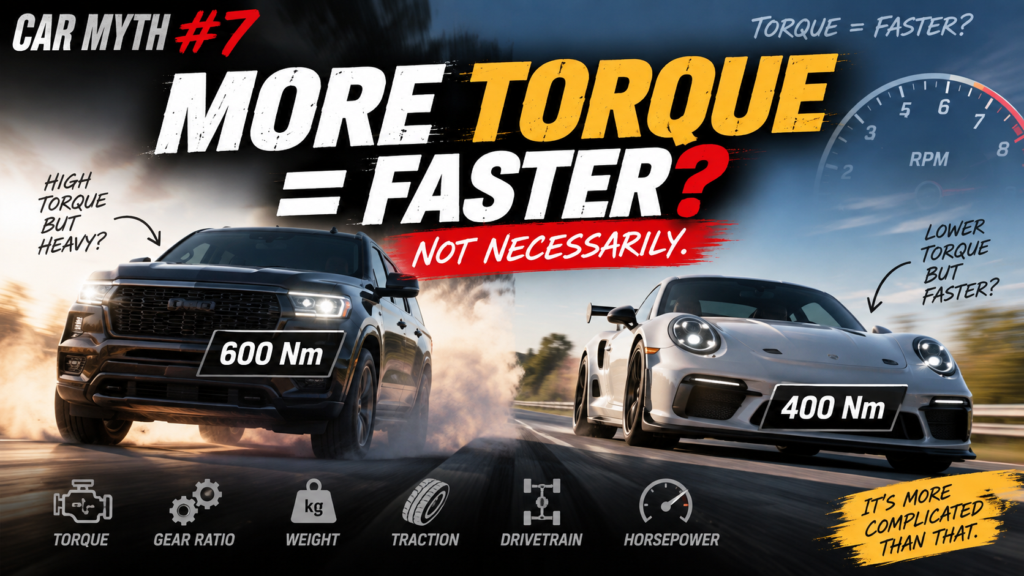
Does More Torque always mean better acceleration? It feels like it should. A diesel surges forward without much noise, a turbo engine suddenly pushes you into the seat, and an electric car responds before you have finished thinking about the pedal. Then a sports car with a smaller torque figure turns out to be quicker. What happened to the bigger number?
The missing detail is surprisingly simple: the torque printed in an engine specification is not the same thing as the force accelerating the car. Between the two sit gears, tires, vehicle mass and the limits of the road surface. Understanding that journey makes the specification sheet much more useful.
Quick Summary
- Torque describes a turning effect, usually quoted in newton meters, or Nm. It is not an acceleration measurement.
- Gears multiply torque by reducing rotational speed. A lower engine figure can therefore produce a larger figure at the wheels.
- Power combines torque with rotational speed. Strong low-RPM pull and strong high-speed acceleration are related, but not identical experiences.
- The car accelerates according to the force it can actually put into the road, minus resistance, relative to its mass.
- Diesel engines, turbocharged gasoline engines and EVs can feel especially responsive in everyday use for different reasons. None wins every comparison by default.
Why This Matters: The Shove Is Real, but the Explanation May Be Wrong
We often call a car “torquey” when it responds comfortably without needing many revs or a downshift. That is a useful description of its character. The mistake is turning that feeling into a universal rule about performance.
A sharp increase in acceleration can feel dramatic even if it does not last long. Pedal calibration, gearbox decisions, seat movement and sound also shape the impression. Your body feels the car’s motion; it is not directly measuring twisting effort at the crankshaft.
In this seventh Car Myths installment, the question is not whether torque matters. It absolutely does. The question is which torque, at what speed, through which gears, moving how much car?
1. More Torque Starts with a Turning Force
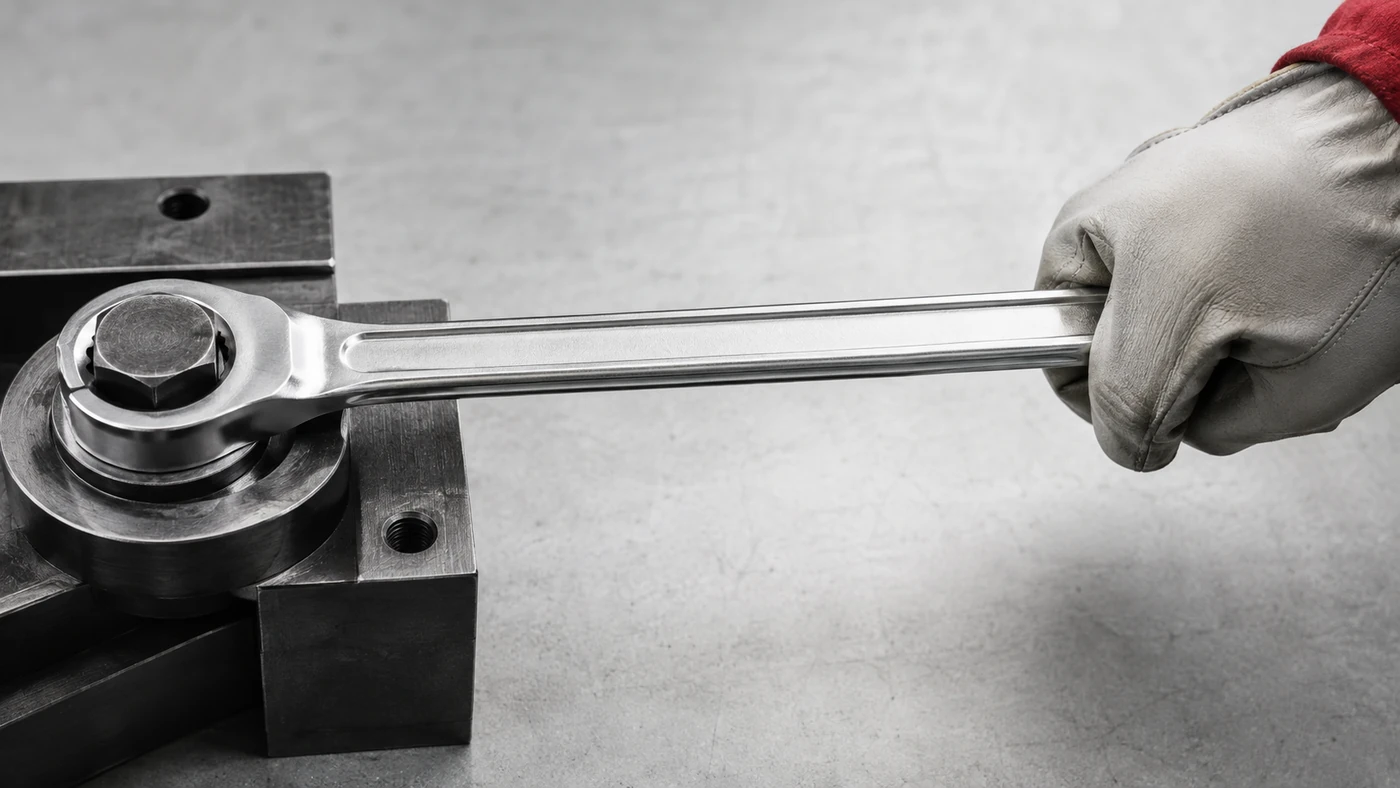
Imagine loosening a stubborn bolt. Pushing farther from its center with a longer wrench gives the same force a greater turning effect. The relevant distance is the perpendicular lever arm, not simply the length of any object you happen to be holding. This is the basic idea behind torque in rotational mechanics.
One newton meter represents the turning effect of one newton applied perpendicular to a one-meter lever arm. A newton measures force; a newton meter measures torque. You may also encounter lb-ft or kgf·m. These are other torque units, so compare like units before comparing numbers.
An engine develops torque at its crankshaft as combustion pushes pistons and the connecting rods turn that shaft. An electric motor creates a turning effect electromagnetically. Neither definition tells us, by itself, how quickly the complete vehicle will gain speed.
Engine Torque Is Only the Starting Point
A quoted maximum is usually the highest available engine torque under specified conditions. It does not mean the engine produces that amount at every RPM, every pedal position or in every gear.
Nor does a statement such as “500 Nm” specify the size of the car, the tire radius or the transmission ratio. Those omissions are not small details when the question is acceleration.
2. The Gearbox Changes the Number Before It Reaches the Road
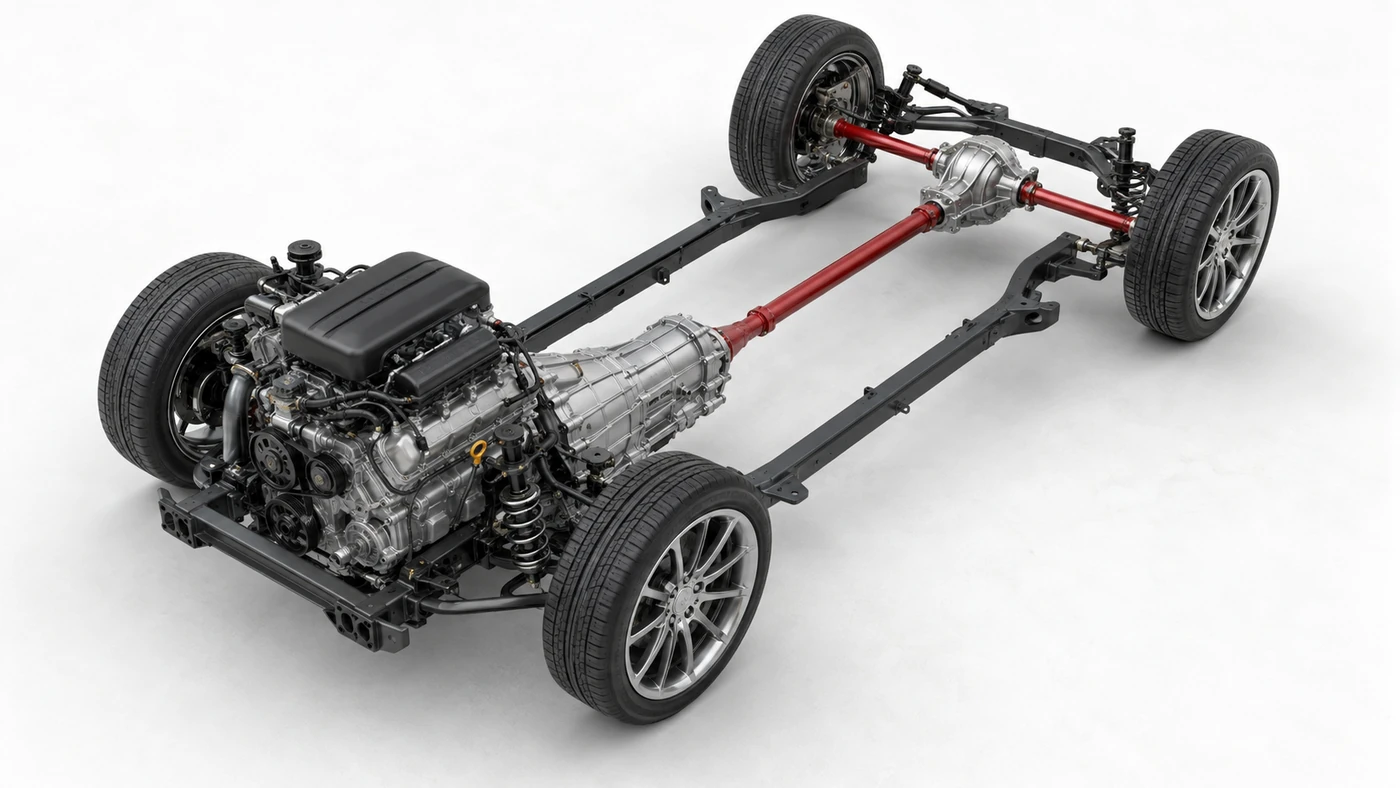
In a conventional longitudinal rear-wheel-drive layout, the route runs from engine to transmission, through the propeller shaft to the final drive and differential, then along axle shafts to the wheels. Front-wheel-drive cars package parts of this route together in a transaxle. Other layouts rearrange it again; the principle of gearing still applies.
The final drive is the reduction near the driven axle. The differential allows the left and right wheels to turn at different speeds in a corner. They are often housed together, but those are different jobs. Our Drivetrain Basics guide explains the wider system.
A Small Engine Number Can Become a Large Wheel Number
Take an idealized example:
- Engine torque: 300 Nm.
- Selected transmission ratio: 4:1.
- Final-drive ratio: 4:1.
- Overall reduction: 16:1.
The result is 300 × 4 × 4 = 4,800 Nm at the driven-wheel side, summed across the driven wheels. It is not 4,800 Nm at each wheel. In an ideal equal left/right split on one driven axle, each side would receive 2,400 Nm.
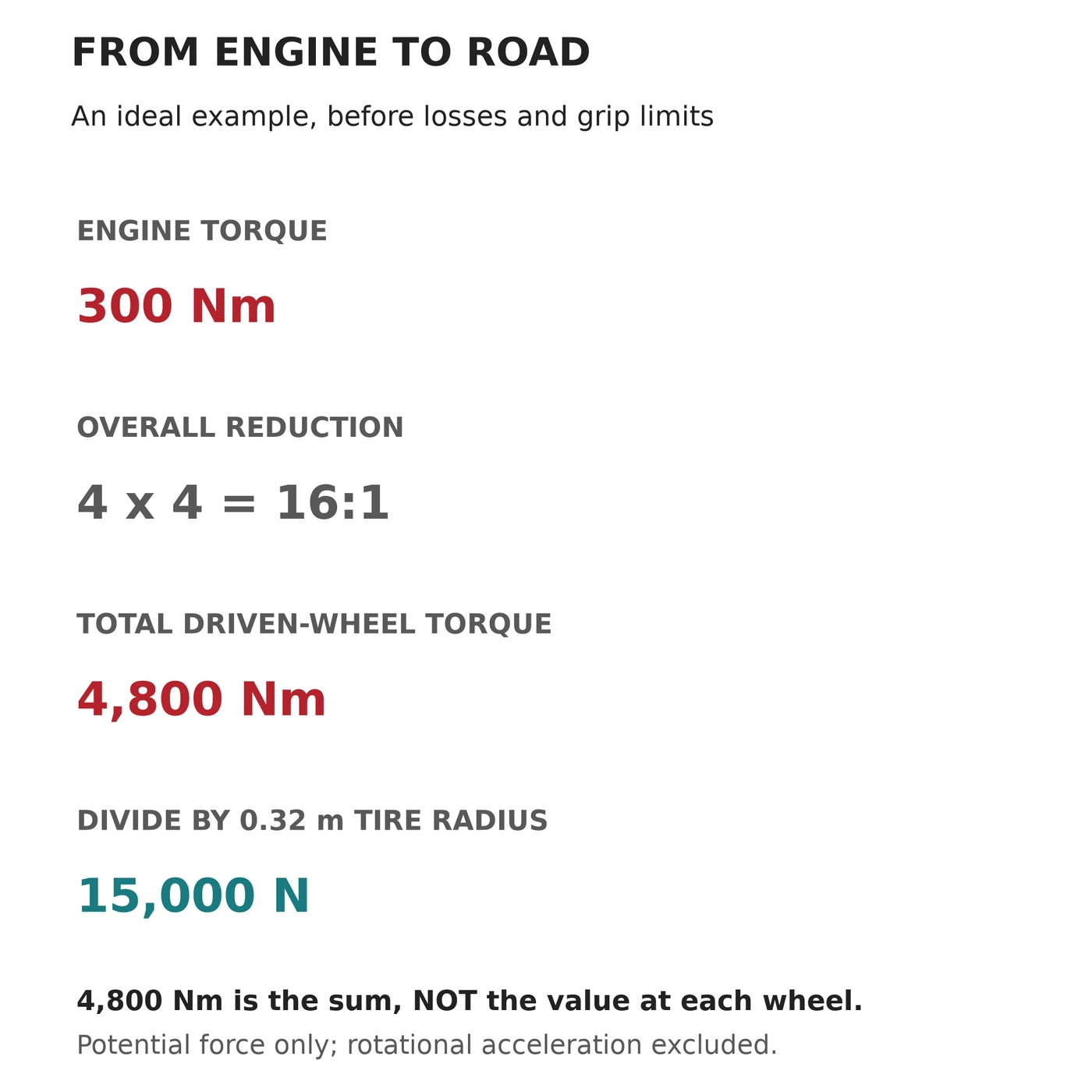
To turn that output torque into a potential forward force, divide by the tire’s effective rolling radius. With a 0.32 m radius, 4,800 Nm divided by 0.32 m gives 15,000 N, not 15,000 Nm.
This teaching calculation excludes driveline losses, torque-converter effects and the torque needed to accelerate rotating parts. Real tires must also find enough grip to transmit the result. It is a way to follow the units, not a prediction of a launch time.
There is another useful consequence: at the same wheel torque, a larger overall tire radius gives less force at the road. That refers to the complete tire’s rolling size, not the alloy wheel diameter alone. A larger rim with a lower-profile tire can retain much the same overall radius.
Why Gearing Is Not Free Power
More reduction means the output turns more slowly for a given input speed. A low gear feels stronger because it trades wheel speed for wheel torque. You cannot keep adding reduction and expect unlimited acceleration at every road speed: eventually the engine reaches its usable RPM limit.
Think of a bicycle climbing a hill. A low gear helps the rider apply useful force, but the pedals turn many times for a relatively short distance. The gearing changes the relationship, not the rider’s energy supply.
3. Compare Torque at the Same Road Speed
Here is where a fair comparison becomes interesting. Instead of comparing two peak figures in isolation, let two fictional engines drive identical-size tires at the same 500 RPM wheel speed.
| Operating point | Engine A | Engine B |
|---|---|---|
| Engine torque at this point | 500 Nm | 400 Nm |
| Engine speed | 3,000 RPM | 6,000 RPM |
| Overall reduction | 6:1 | 12:1 |
| Wheel speed | 500 RPM | 500 RPM |
| Total ideal driven-wheel torque | 3,000 Nm | 4,800 Nm |
| Power at this engine operating point | About 157 kW | About 251 kW |
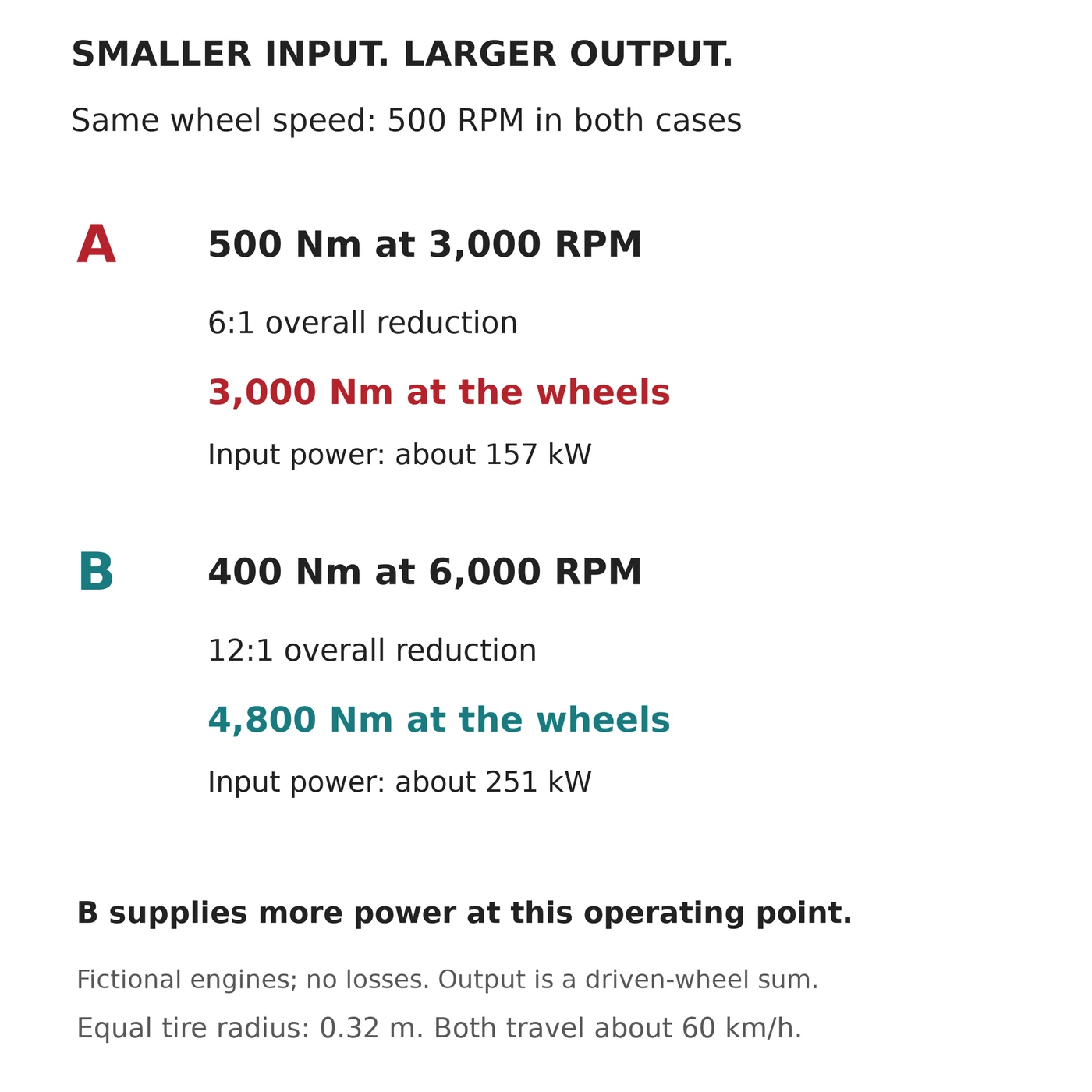
Engine B has the smaller input torque yet produces the larger output torque. Its higher operating speed allows a greater reduction at the same wheel speed. With the same 0.32 m effective tire radius and no slip, both cases correspond to about 60 km/h.
The catch is not hidden: B is producing more power at this operating point. The gearbox has not created it. The higher-revving engine is supplying it, and the ratio makes it usable at this road speed.
These figures are invented to isolate the principle. Assume both engines can sustain their stated operating points, with no driveline losses. Equal mass, sufficient traction and comparable resistance would favor B at this instant; the table does not establish an entire 0-100 km/h result.
Torque and Horsepower Are Not Rival Teams
Power is torque multiplied by rotational speed in the appropriate units. In everyday specification units:
Power in kW = torque in Nm × RPM ÷ approximately 9,549.
You cannot simply multiply Nm by RPM and call the result horsepower. The conversion matters. OpenStax explains the torque-speed relationship; the examples here are our own calculations using it.
This also explains why some sports engines rev to 8,000 RPM or beyond. An engine that maintains useful torque at high rotational speed can make substantial power without a huge peak Nm figure. Its character may ask you to use more of the rev range, rather than producing its strongest response just above idle.
Why Shifting at Peak Torque Is Not a Universal Rule
Maximum acceleration is not always achieved by shifting at the RPM where engine torque peaks. The important comparison is the available wheel force in the current gear versus the next gear at the same road speed, including the time and interruption involved in shifting.
A downshift raises engine speed and increases reduction. An automatic with eight or ten ratios has more choices, but its response, ratio spacing and control strategy still matter. More gears do not automatically mean a faster car, and a manual gearbox does not automatically mean a slower one.
4. The Torque Curve Explains Character Better Than a Single Peak
Suppose a turbocharged engine is described as producing 400 Nm from 1,800 to 5,000 RPM. That plateau means its available full-load torque stays approximately constant across that engine-speed window under the stated conditions. It does not mean the engine delivers maximum torque whenever the tachometer enters it.
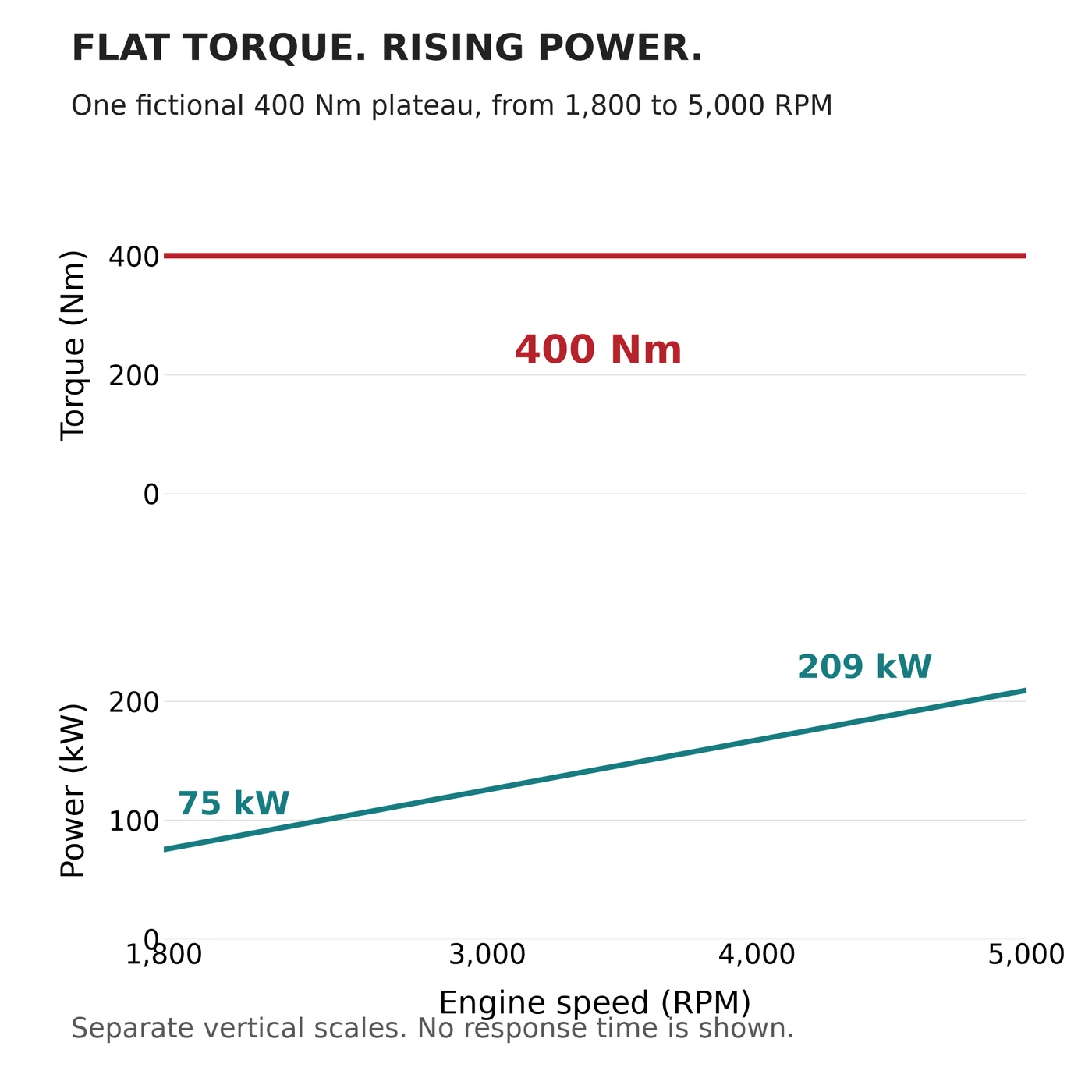
In our fictional plateau, power rises from about 75 kW at 1,800 RPM to about 209 kW at 5,000 RPM. The turning effort stays the same while the shaft is turning faster. That is why a flat torque line is compatible with a rising power line.
The graph also has an important limit: its horizontal axis is RPM, not elapsed time. A wide plateau does not tell you how long boost takes to build after a pedal movement. That delay is a transient response question. Garrett describes turbo lag as a delay between throttle input and torque delivery.
Nor is the raw area beneath a torque-versus-RPM graph an acceleration score. A car does not spend equal time at every RPM, and its gearing decides which part of the curve is available at each road speed.
Why a Diesel Can Feel So Strong
Many turbo-diesels offer substantial torque at relatively low RPM. Everyday acceleration can therefore feel relaxed: a modest increase in engine speed produces a useful response without a dramatic soundtrack. Turbocharging, displacement and calibration all contribute; diesel fuel alone does not assign a performance personality.
A narrower usable rev range also means the transmission must shift sooner than a high-revving gasoline engine might. Strong low-speed response is valuable, but it is not proof of stronger acceleration through every higher-speed interval.
Two Real Engines, Two Different Emphases
Consider these specific historical specifications, rather than treating either badge as a permanent rule:
| Published specification | 2020 BMW 530d Sedan | 2019 Porsche 718 Cayman GT4, six-speed manual |
|---|---|---|
| Engine type | 3.0-liter turbo-diesel inline-six | 4.0-liter naturally aspirated flat-six |
| Maximum torque | 650 Nm at 1,500-2,500 RPM | 420 Nm at 5,000-6,800 RPM |
| Maximum power | 210 kW at 4,000 RPM | 309 kW at 7,600 RPM |
The BMW has the larger peak torque number. The Porsche has the larger peak power number and develops it at much higher engine speed. Those facts come from BMW’s 2020 5 Series specifications and Porsche’s 2019 manual GT4 technical sheet.
This is an engine-character comparison, not a controlled head-to-head acceleration test. Different cars, transmissions, masses and tires surround those engines. It does, however, make the problem with ranking cars by Nm alone very clear.
5. EV Response Is About Delivery as Well as Torque
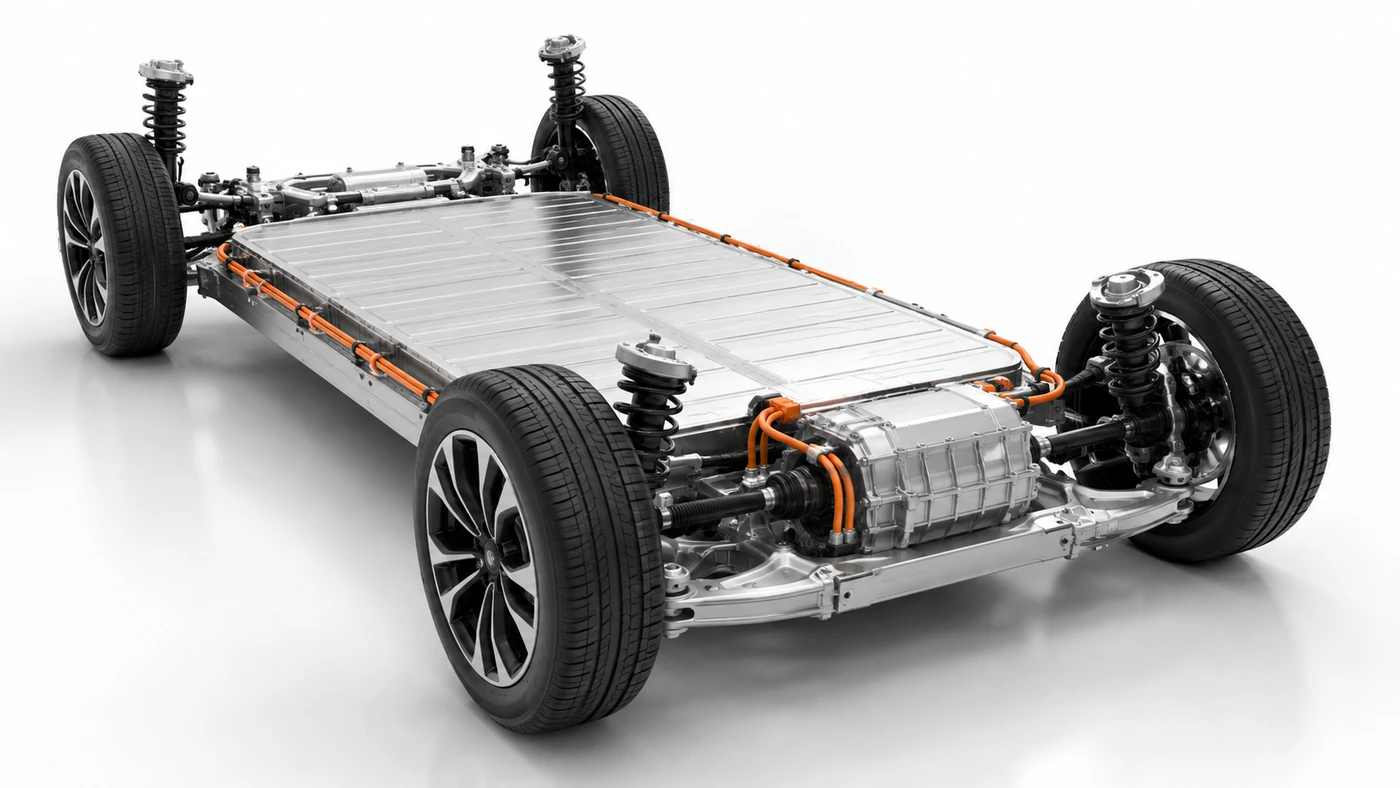
An electric motor can produce substantial torque from very low speed without waiting for exhaust flow to build boost or a combustion engine to climb into its working range. Combined with fast electronic control and, in many EVs, no multi-speed shift during acceleration, that can create a particularly immediate response.
But “instant torque” is shorthand, not a promise of maximum acceleration everywhere. Motor current, battery power, temperature, state of charge, traction and software limits still shape the result. At exactly zero shaft speed, a motor can exert torque while delivering zero mechanical shaft power: nothing is rotating yet.
Many EVs use a single fixed reduction, but not all. The original Porsche Taycan used a two-speed rear-axle transmission. Electric propulsion does not make the torque-speed trade disappear.
Before Comparing EV Numbers, Ask Where They Were Measured
Motor-shaft torque, axle output torque and total wheel torque are not interchangeable. With multiple motors, even adding their peak numbers may be misleading if gearing, peak operating points or system limits differ. A manufacturer-defined combined figure needs its definition, not an improvised sum.
For example, GMC’s July 2021 introduction to HUMMER EV’s launch function described a GM-estimated up to 11,500 lb-ft at the wheels after front and rear drive-unit gearing. That is not an engine-crankshaft figure. The measurement location is explicit in GMC’s original explanation.
Converting that number to Nm would not make it directly comparable with the BMW or Porsche figures above. The units would match, but the locations in the drivetrain still would not.
Grip and Mass Still Have the Final Say
Available wheel torque must become usable tire force. If it exceeds what the driven tires can transmit, wheelspin or traction-control intervention follows. AWD can distribute propulsion across more contact patches, but its benefit depends on the tires, surface, load distribution and control system.
It does not grant an equivalent advantage in ordinary braking or prevent hydroplaning. That distinction is the focus of Car Myth 1: Is AWD Really Safer in the Rain?.
A heavy vehicle also needs more net force to achieve the same acceleration. A fictional 700 Nm, 2,600 kg SUV is not automatically quicker than a 450 Nm, 1,450 kg sports car. Even torque divided by mass cannot settle it unless the gearing and operating conditions are accounted for.
In a powerful front-wheel-drive car, unequal forces and steering geometry can also create torque steer: an unwanted tug through the steering. It is not an unavoidable verdict on every FWD design. Honda’s dual-axis Civic Type R front suspension separates steering and damper axes to help reduce the effect.
6. Towing, Crawling and Tuning Ask Different Questions
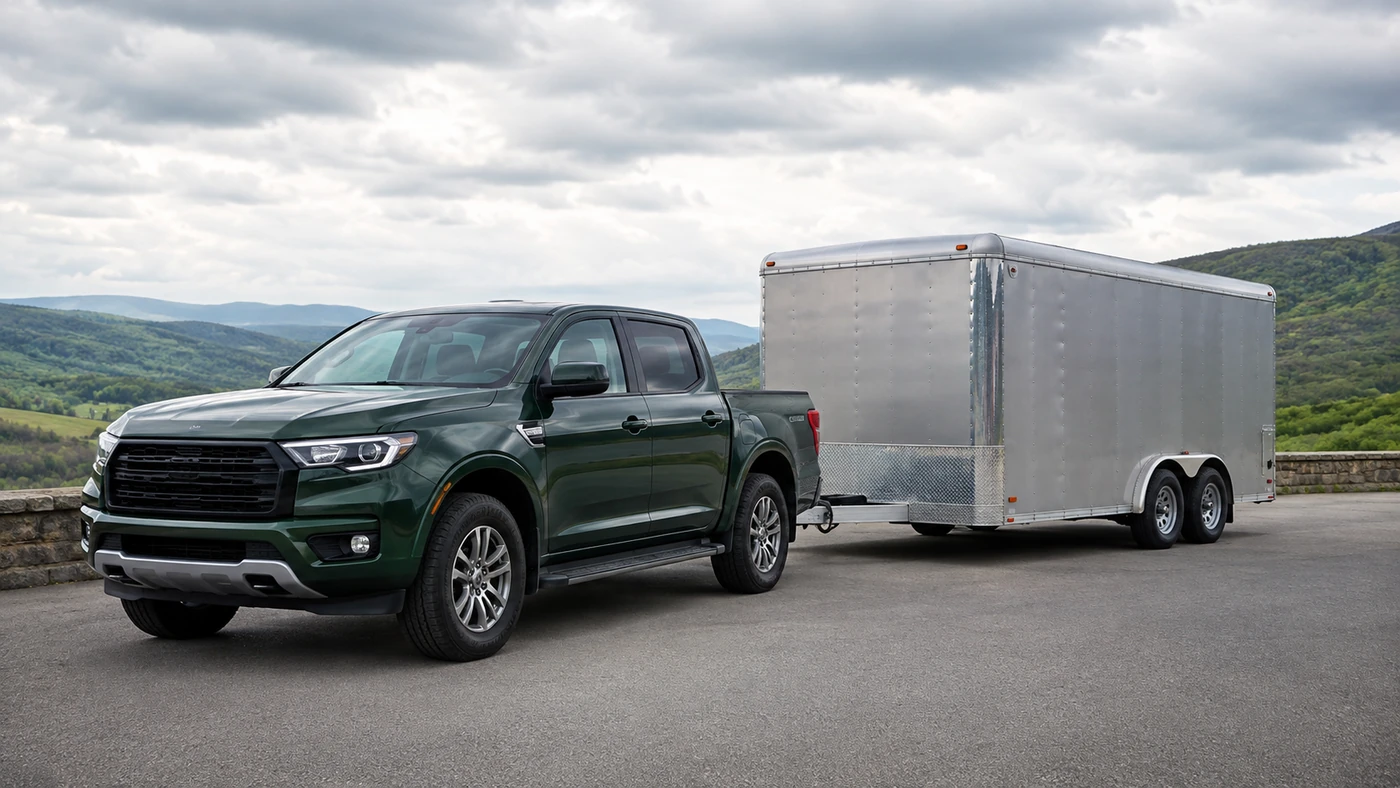
High torque at accessible RPM can make moving a loaded vehicle feel less demanding. But towing a trailer up a long hill also requires sustained power and enough cooling capacity. The engine number cannot tell us whether the complete combination is suitable.
Use the vehicle’s actual towing specification and configuration, including payload, axle limits, combined weight, hitch equipment and trailer braking requirements. Ford’s towing guide distinguishes these limits; a higher Nm figure does not override them.
Low Range Makes the Trade Especially Clear
A low-range transfer case adds another reduction, increasing wheel torque while lowering road speed for a given engine speed. Jeep describes a 4:1 low-range ratio in its Rock-Trac system for slow off-road control.
That makes sense when carefully moving over obstacles. It is not a claim that low range makes the vehicle a better high-speed acceleration machine. Follow the particular vehicle’s operating instructions: this is an explanation of the gearing, not a recommendation to engage a mode on any surface.
A Torque Increase Is Also a Load Increase
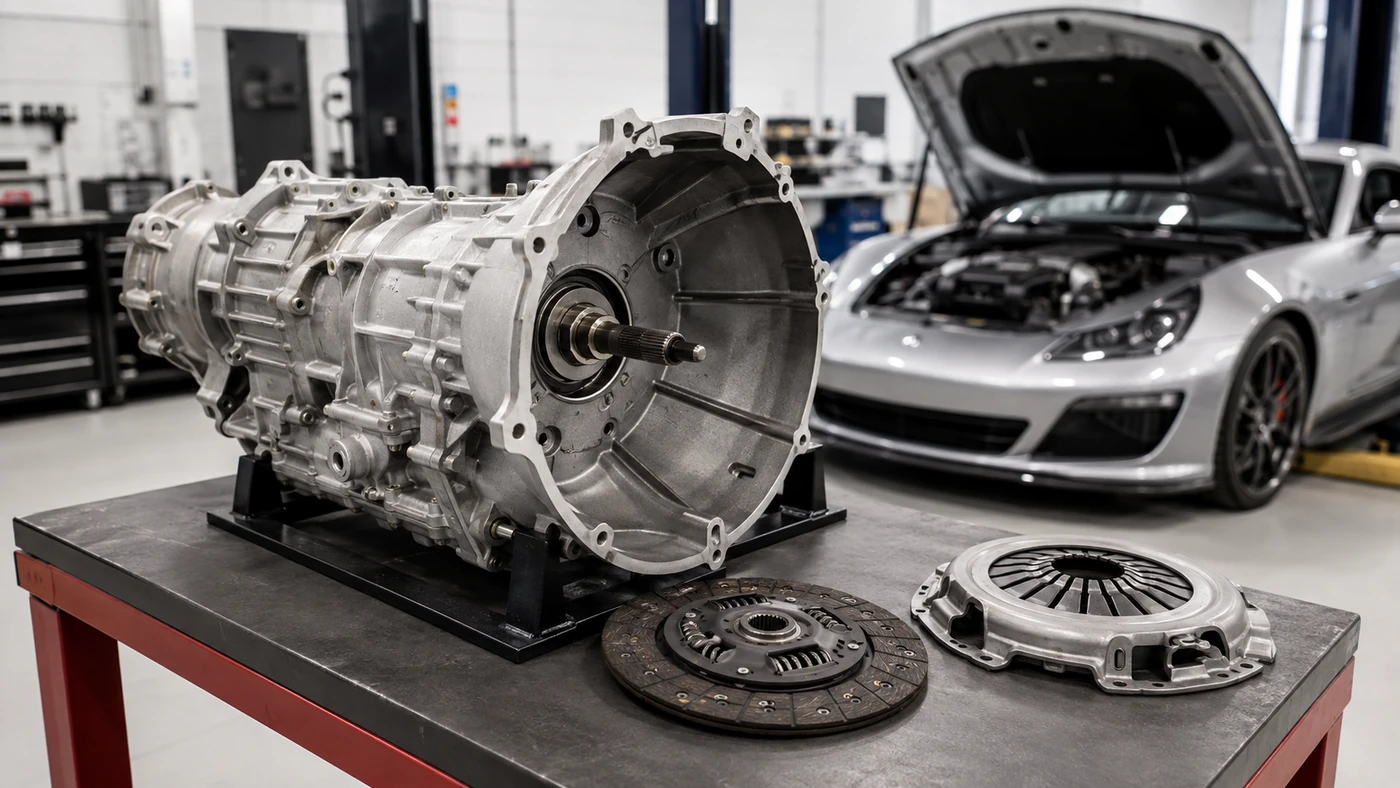
If a hypothetical tune raises engine torque from 400 to 520 Nm at a given operating point, that is a 30% increase in twisting load at that point. It is not automatically a 30% reduction in acceleration time, and it is not automatically within the hardware’s validated margins.
The clutch, transmission, differential and shafts must transmit the load. Temperatures, combustion conditions, fuel requirements and durability also need assessment. The consequences depend on the engine and calibration; there is no universal safe extra percentage.
Transmission names can hide different capacity versions. ZF describes the 8HP family as covering multiple torque ranges, rather than giving every eight-speed unit the same limit. A family name is not permission to apply its highest rating to one particular gearbox.
Manufacturers also shape delivery by gear and operating condition. Ferrari’s F8 Spider technical release describes gear-specific Variable Torque Management. Depending on the vehicle, limiting or shaping torque can serve drivability, traction or hardware protection. The headline maximum is not necessarily on offer everywhere.
7. Read Acceleration Tests, Not Just the Biggest Nm Figure
Different measurements answer different questions. A standing-start 0-100 km/h test includes the launch, grip and early shifts. An 80-120 km/h test in a fixed gear explores something different from the same interval with kickdown allowed.
Higher-speed testing places greater emphasis on sustained wheel power against rising resistance. A 100-200 km/h result may therefore tell a different story from the initial launch. Such speeds belong only in controlled testing where permitted, not a public-road experiment.
For a meaningful comparison, check vehicle version, transmission, tires, load, surface, temperature, gradient and test method. For EVs, battery condition and temperature matter too. A dramatic pedal response and a repeatably short elapsed time are worth understanding separately.
A Final Specification-Sheet Puzzle
| Fictional car | Car A | Car B |
|---|---|---|
| Maximum engine torque | 600 Nm | 400 Nm |
| Vehicle mass | 2,300 kg | 1,300 kg |
| Transmission | Eight-speed automatic | Six-speed manual |
| Driven wheels | AWD | RWD |
Which accelerates harder? There is not enough information. A might launch effectively, while B’s lower mass may help elsewhere. We still need torque curves, ratios, usable rev ranges, tire sizes, power delivery and traction, followed by comparable testing.
That is not avoiding the answer. Recognizing the missing information is the skill this article is trying to build.
Cariary Thoughts
The more we looked into this, the less useful “torque versus horsepower” became as an argument. It encourages us to choose a favorite number when the interesting part is how the whole system connects.
The biggest change in our own thinking was to stop treating the gearbox as a delivery pipe. It actively changes the torque-speed relationship. Once that clicks, a high-revving sports engine with a modest Nm figure no longer seems contradictory.
There is still something genuinely enjoyable about effortless low-RPM response. Understanding why it feels good does not diminish it. It simply lets us appreciate that character without assuming it must also win every acceleration test.
Next time a specification sheet advertises a huge torque figure, our first question will be a little different: where is that torque measured, and how does the car use it?
One-line Summary
More engine torque can help, but acceleration depends on the usable force reaching the road through the gearing, relative to the whole car’s mass and resistance.
FAQ
Does a higher Nm figure always mean faster acceleration?
No. Engine torque must pass through the gearing and become tire force. Ratios, RPM, tire radius, mass, grip and losses can change the comparison substantially.
Can a lower-torque engine produce more torque at the wheels?
Yes. Greater reduction can multiply a smaller input torque into a larger output torque. The engine must also operate at the RPM required for that ratio and road speed; gearing does not create power.
Is torque or horsepower more important?
They describe connected properties, not competing ingredients. Torque and rotational speed determine power; wheel force at a given road speed is what accelerates the vehicle against resistance. Neither peak engine number describes the entire result.
Why do diesels often feel strong without high revs?
Many turbo-diesels deliver substantial torque low in the rev range. That can provide accessible everyday response, but it does not establish superior acceleration at all speeds.
Does a flat torque curve mean instant response?
No. A torque-versus-RPM curve describes available output across engine speed. Response after pressing the accelerator unfolds over time and also depends on boost, gearbox behavior and calibration.
Do EVs have maximum torque at every speed?
No. They can produce substantial low-speed torque, but available output changes with motor speed and electrical, thermal and traction limits. Peak torque is not maintained indefinitely as speed rises.
Is wheel torque the same as engine torque?
No. Wheel-side values include the effect of reduction and, depending on how they are reported, losses and the combination of driven outputs. Check both the units and the measurement definition.
Should I change gear at peak torque?
Not as a universal rule. For maximum acceleration, compare available wheel force before and after the shift at the same road speed, accounting for shift time and the usable rev limit.
Does a high-torque engine automatically tow more?
No. Towing capability is a whole-vehicle rating involving configuration, weight limits, cooling, braking and equipment. The engine’s peak Nm figure is not a substitute for the manufacturer’s limits.
Related Thoughts
- Engine Power Basics: build the foundations of torque, power and turbocharging.
- Drivetrain Basics: follow the transmission, differential and driven wheels.
- Is AWD Really Safer in the Rain?: separate acceleration traction from braking and wet-weather safety.
References
Technical and specification reference date: September 7, 2026. Named vehicle figures refer to the stated historical releases, not every current version. Numerical teaching examples are fictional and calculated; generated illustrations are not manufacturer photographs or measured component drawings.
- OpenStax: torque and rotational work and power.
- BMW: 2020 5 Series specifications and Porsche: 2019 manual Cayman GT4 technical sheet.
- Garrett: turbocharging facts, used for the distinction between pedal input and torque response.
- Porsche: original Taycan drivetrain and GMC: 2021 HUMMER EV wheel-torque explanation.
- Honda: Civic Type R dual-axis front suspension.
- Ford: 2026 RV and Trailer Towing Guide and Jeep: four-wheel-drive systems.
- ZF: 8HP transmission family and Ferrari: F8 Spider torque-management explanation.

