
Car Structure Basics starts with a question I used to overlook: what is holding everything together? We talk about engines, gearboxes and brakes as if they work independently. Yet every one of them relies on the structure beneath the paint, and on where the car carries its weight.
A powerful engine cannot make mass disappear. Expensive suspension needs a dependable foundation. A reassuringly solid body also needs carefully planned places to deform in a crash.
This is Part 5, the final installment of our Car Basics for Enthusiasts series. Let’s connect the previous four parts through five ideas: body construction, vehicle weight, center of gravity, chassis rigidity, and crash structures with subframes.
Quick Summary
- Body-on-frame and unibody are different ways of carrying loads, not automatic rankings of toughness or quality.
- Mass affects almost everything the car does, but the location of that mass matters too.
- A lower center of gravity helps control load transfer; it does not make a heavy car light.
- A stiff structure gives suspension a more consistent foundation, without requiring an uncomfortable ride.
- Crash protection needs both controlled deformation and a strong passenger cell, not a body that refuses to bend anywhere.
Why Car Structure Basics Matters Beyond the Spec Sheet
Imagine fitting a precise door hinge to a cabinet that twists every time you move it. The hinge can be beautifully made, but its mounting points keep changing position. A car’s suspension faces a related problem if its supporting structure flexes too much.
Now imagine carrying the same suitcase at your waist and above your head. Its mass has not changed, but balancing yourself feels different. That is a useful starting point for understanding why the location of a car’s heavy components matters.
Neither analogy describes a complete vehicle. Together, however, they explain why two cars with similar power and tires can feel remarkably different. Their foundations and mass placement are part of the story.
1. Body-on-Frame vs Unibody: What Carries the Loads?
Body-on-frame: a separate supporting structure
In body-on-frame construction, a separate chassis frame provides the main foundation. A common version is the ladder frame: two long rails joined by crossmembers, rather like a ladder laid flat. The body attaches to this frame at mounting points.
The suspension and major mechanical assemblies connect to the chassis through their designed mounts and supporting structures. The body is not simply weightless decoration, but it is separate from the principal frame beneath it.
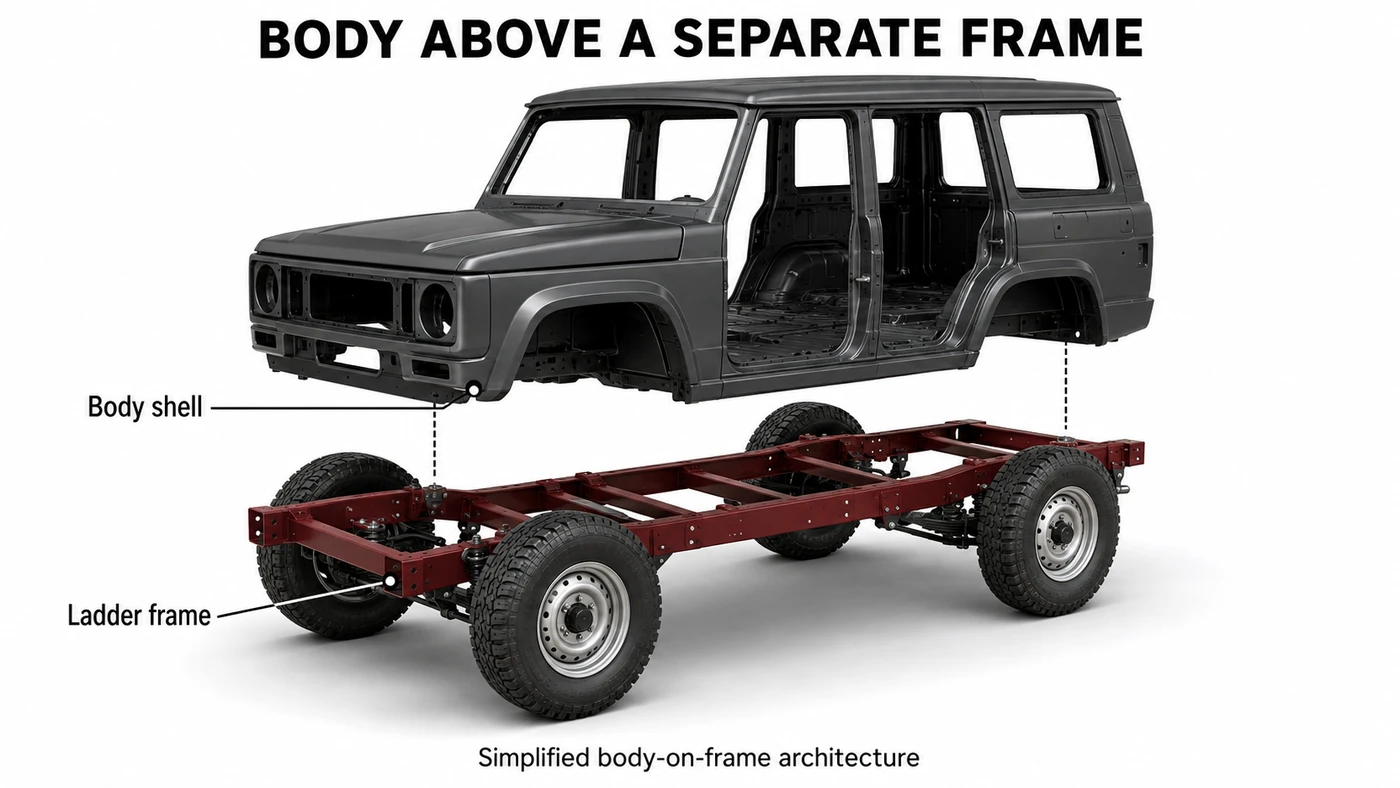
This separation suits many working vehicles. Engineers can design a durable frame around payloads, towing forces and repeated rough-road use, then fit different bodies above it. That modular approach is useful for pickups, commercial derivatives and specialized conversions.
The Toyota Land Cruiser 300, Hilux, Mercedes-Benz G-Class, Jeep Wrangler and Ford F-150 are familiar examples. Toyota’s Land Cruiser 300 technical introduction explains its frame-based GA-F architecture. These vehicles illustrate a design approach; they do not prove that every ladder-frame vehicle has the same capabilities.
There are trade-offs. A separate frame and body can add structural mass and vertical space, affecting floor height, packaging and efficiency. Body mounts also introduce another connection for engineers to tune. Modern frame vehicles can still be refined and stiff, and their actual towing limits depend on far more than the frame alone.
Repair is similarly conditional. Separate assemblies can offer useful replacement or conversion options, but a damaged frame is not automatically cheap or simple to repair. The manufacturer’s procedures and the extent of damage still decide the job.
Unibody: the body becomes part of the structure
A unibody combines the floor, sills, pillars, roof-side members and other reinforcements into an integrated load-bearing shell. Loads travel through a network rather than relying on a separate full-length ladder frame beneath the body.
Think of a well-made box. Its connected surfaces and edges work together, so the whole can resist twisting more effectively than a loose collection of flat panels. Real car bodies are considerably more sophisticated, with joints, reinforcements and carefully designed load paths.
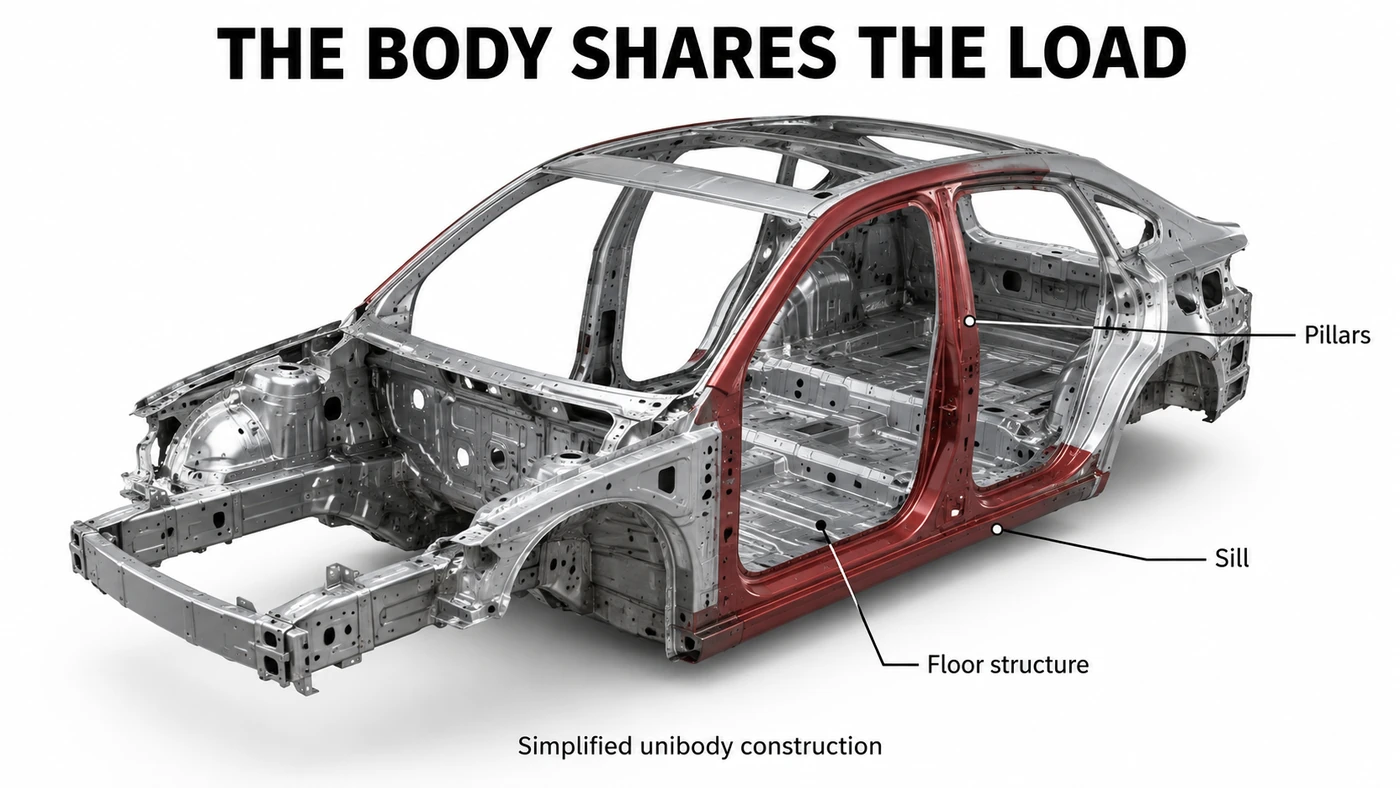
You will often hear this called monocoque. Strictly speaking, a true monocoque relies on its structural skin; most conventional car unibodies also use substantial reinforcing members. In everyday automotive writing, the terms are frequently grouped together. Neither term means every visible panel, hood or door carries the same structural responsibility.
Using the body as part of the structure can provide an efficient combination of mass, stiffness and interior packaging. That helps explain its popularity in passenger cars and crossovers. A rigid shell also gives suspension mounts a useful foundation for predictable road behavior.
It is not automatically delicate. The modern L663 Land Rover Defender uses an aluminum-intensive D7x monocoque, despite its substantial off-road ambitions. Land Rover’s launch material makes that construction clear. Architecture alone cannot tell us whether a vehicle belongs on a rough trail.
Unibody construction has its own compromises. Significant damage can affect connected structural areas, making approved repair methods and dimensional checks important. Sports cars may also use spaceframes, carbon tubs or combinations of structures rather than fitting neatly into two boxes.
Our Body-on-Frame vs Monocoque explanation explores this first distinction in more detail.
2. Vehicle Weight: Why Every Kilogram Has Consequences
In everyday car conversation, we call a figure in kilograms the car’s weight. Technically, kilograms describe mass, while weight is the force of gravity acting on it. Here, mass is the quantity that resists acceleration.
The basic relationship is force = mass x acceleration. Apply the same net forward force to two otherwise idealized vehicles, and the heavier one accelerates less. Notice the word force: this is not the same as claiming that two engines with equal peak horsepower always accelerate their cars in a fixed ratio.
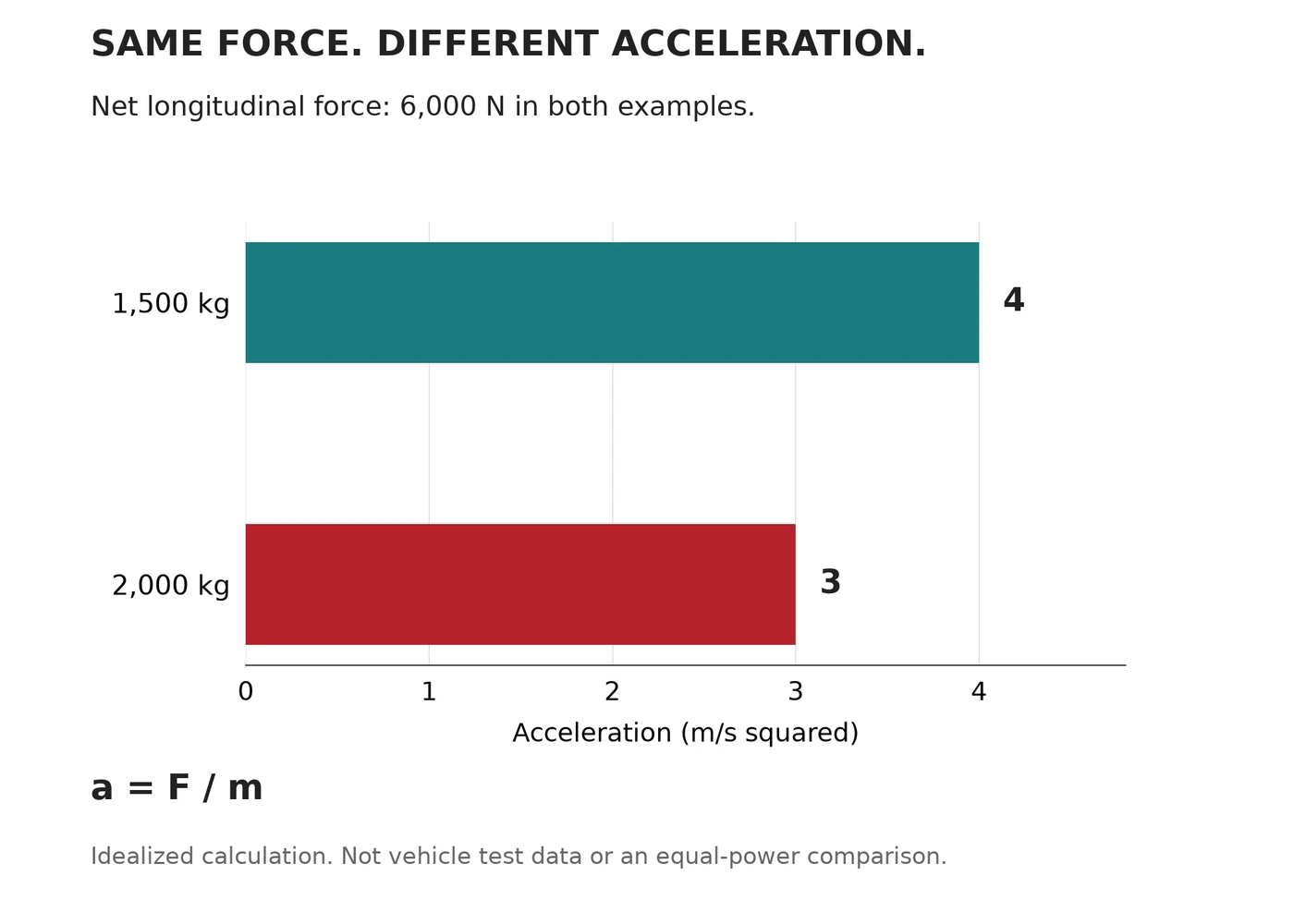
More mass also means more kinetic energy at the same speed. The brakes must help manage that energy when slowing down, alongside aerodynamic drag, rolling resistance and, where available, regenerative braking. In a turn, changing the direction of a heavier vehicle’s motion requires more lateral force at the same speed and radius.
But heavier does not automatically mean a longer single emergency stop. In a simplified friction model, both available tire force and the force needed for deceleration increase with mass. Real stopping performance then depends on tires, their response to load, temperature, brakes, control systems and conditions. Repeated heat management is a different question from one stopping-distance number.
That distinction connects directly to Part 4: Brake and Tire Basics. A bigger brake system may help cope with demanding use without changing the fundamental limits of the tire-road contact.
Why modern cars carry so much equipment
Larger bodies, crash structures, sound insulation, powered seats, comfort equipment and additional driven axles can all contribute mass. Hybrid components, larger wheels, cooling systems and active suspension can add more. Not every item makes a dramatic difference by itself; the complete package matters.
It is too simple to blame every extra kilogram on safety. Size, market expectations and equipment choices matter, while better materials and structural design can reduce mass. A newer generation does not have to become heavier than its predecessor.
Reducing mass can also have benefits elsewhere: less load to support may permit changes to other components. Conversely, a heavier vehicle may need additional structural or thermal capacity. Engineers have to manage these connected decisions rather than treat weight reduction as a single isolated part swap.
Why an EV can be heavy and still feel planted
A battery pack is a substantial part of many electric vehicles’ mass. Its enclosure, protection and mounting arrangements also matter. Comparing equivalent vehicle sizes, ranges and equipment is essential; not every EV is heavier than every combustion car.
Position changes the effect of that mass. A broad pack beneath the passenger floor places a major component relatively low, helping lower the vehicle’s overall center of gravity. Porsche’s Taycan overview discusses this underfloor arrangement.
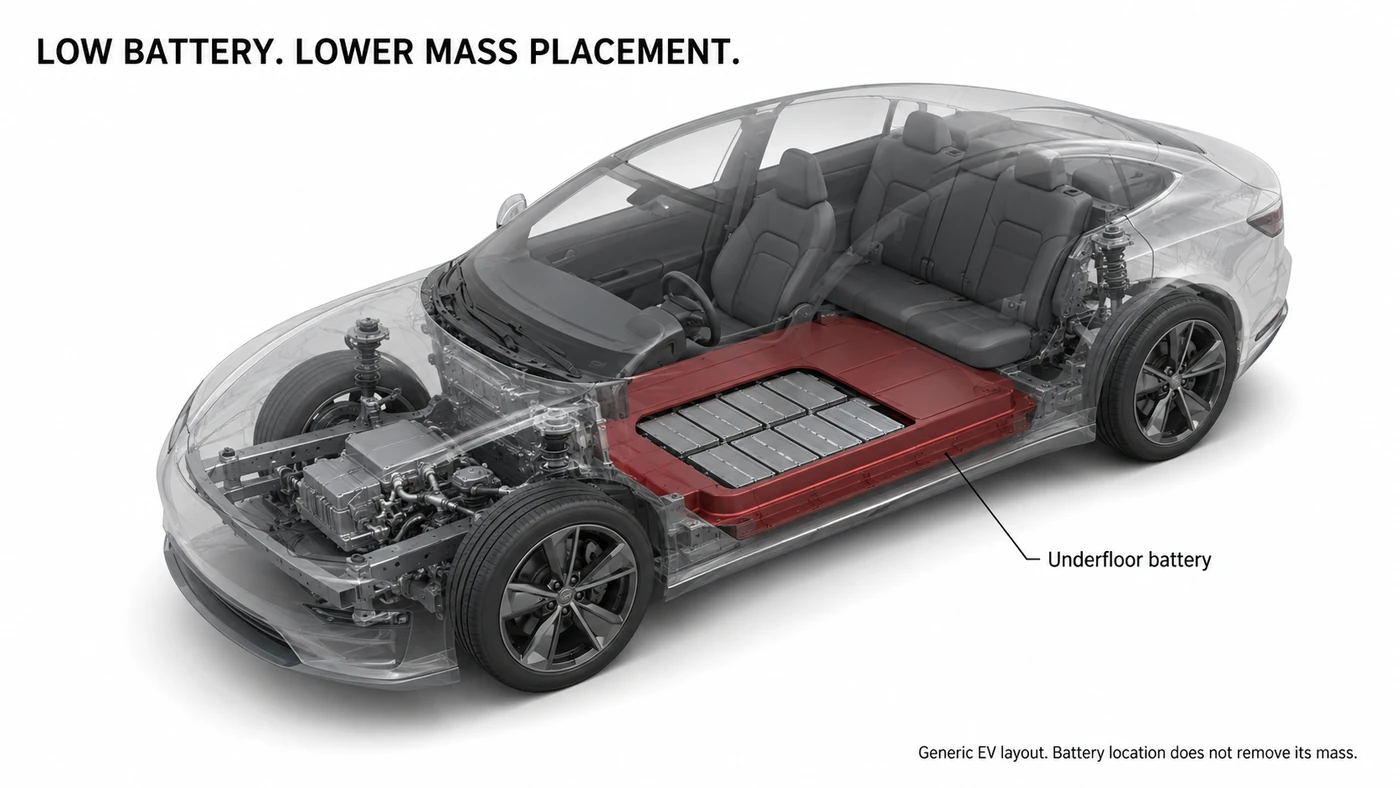
That can make a heavy car feel more settled in some situations. It does not erase the mass that must accelerate, change direction or slow down. Regeneration can recover some energy and reduce friction-brake work, but it cannot make inertia disappear.
Is lighter always better?
Lower mass is valuable, but removing sound insulation can increase noise, and expensive lightweight materials can complicate manufacture or repair. The aim is to remove unnecessary mass while preserving the functions people need.
Lightweight also does not mean unsafe. The U.S. Department of Energy’s materials overview describes reducing vehicle mass while retaining safety and performance. Structural design matters more than simply using thinner material everywhere. Cutting out braces or removing safety equipment is not a responsible shortcut to this engineering work.
3. Center of Gravity and Weight Distribution: Where Is the Mass?
The center of gravity is the point where we can treat the vehicle’s total weight as acting. It depends on the mass and position of everything in the vehicle, including passengers and cargo. It is not necessarily the visual center of the body.
Its height matters because sideways acceleration creates a tendency to redistribute vertical load between the inside and outside tires. With the same track width, mass and lateral acceleration, a higher center of gravity creates more of this lateral load transfer.
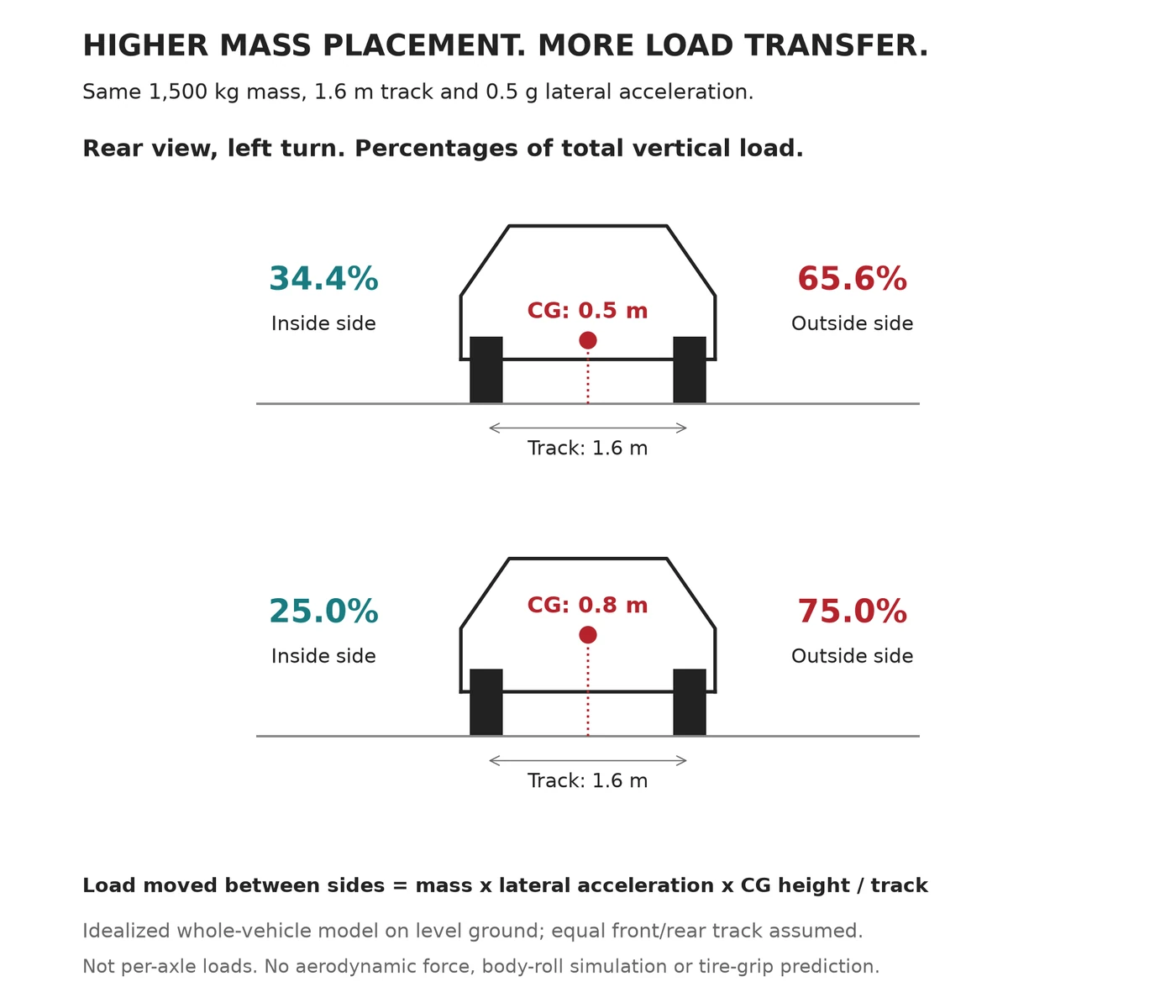
The diagram deliberately holds those comparison conditions constant. It does not simulate body roll. A vehicle can transfer load even if a very stiff or actively controlled suspension keeps its body looking almost level.
Low center of gravity does not mean no body roll
Body roll depends on more than center-of-gravity height. Suspension geometry establishes a roll axis, while springs, anti-roll bars and active systems resist roll; dampers influence how the movement develops. This is why a tall SUV with active roll control can lean less visibly than a lower car with a softer setup.
A lower center of gravity can help, but it does not guarantee that a vehicle cannot roll over. Track width, speed, tire-road interaction, sudden maneuvers and striking a curb or soft ground also matter. NHTSA’s rollover research treats rollover as a broader vehicle-safety question, not a badge awarded to low batteries.
For the suspension side of this relationship, revisit Part 3: Suspension Basics.
Is 50:50 weight distribution the perfect answer?
A 50:50 figure means the stationary vehicle places half its weight on each axle under the stated measurement conditions. It can be a useful design target, but it does not describe how every car must be arranged.
The Porsche 911 provides an important counterexample. Its rear engine places substantial mass near the driven rear wheels, supporting traction. Porsche explains the reasoning in its rear-engine layout discussion. Tire sizes, suspension, aerodynamics and control systems help the whole package work; rear bias is neither a guarantee of brilliance nor an automatic flaw.
Braking and acceleration also redistribute vertical tire loads. A static brochure percentage cannot describe every moment on the road. Engine layout and the choice of driven wheels belong in this picture, which is where Part 2: Drivetrain Basics connects.
The same balance can hide different behavior
Two cars can have the same total mass and the same front-to-rear percentage, yet arrange that mass differently. Concentrating it near the middle generally lowers yaw inertia, the resistance to rotating around the vehicle’s vertical axis, compared with placing equivalent masses farther toward the ends.
Think of turning while holding weights close to your chest, then with your arms extended. The analogy explains rotational resistance, not which complete car will corner fastest. Tires, suspension and the driver’s inputs still matter.
This gives us four separate ideas to keep apart: total mass, center-of-gravity height, axle distribution and resistance to rotation. One flattering number cannot replace the other three.
4. Chassis Rigidity: A Stable Foundation for Moving Parts
In this discussion, rigidity means how strongly the structure resists elastic deformation: temporary bending or twisting that disappears when the load is removed. Strength is different. It concerns how much loading a part can withstand before yielding or failing.
A material or structure can perform well in one respect without automatically being best in the other. High-strength steel, for example, does not simply have a proportionally higher elastic stiffness than ordinary steel. Geometry, thickness, joints and material properties all contribute.
What torsional stiffness actually measures
Torsional stiffness describes resistance to twisting. A common unit is newton-meters per degree: how much twisting torque corresponds to a degree of angular deflection under specified test conditions.
In our hypothetical example, 1,000 Nm produces one degree of twist in Structure A and half a degree in Structure B. B therefore has twice the torsional stiffness. These are teaching numbers, not measurements from production cars.
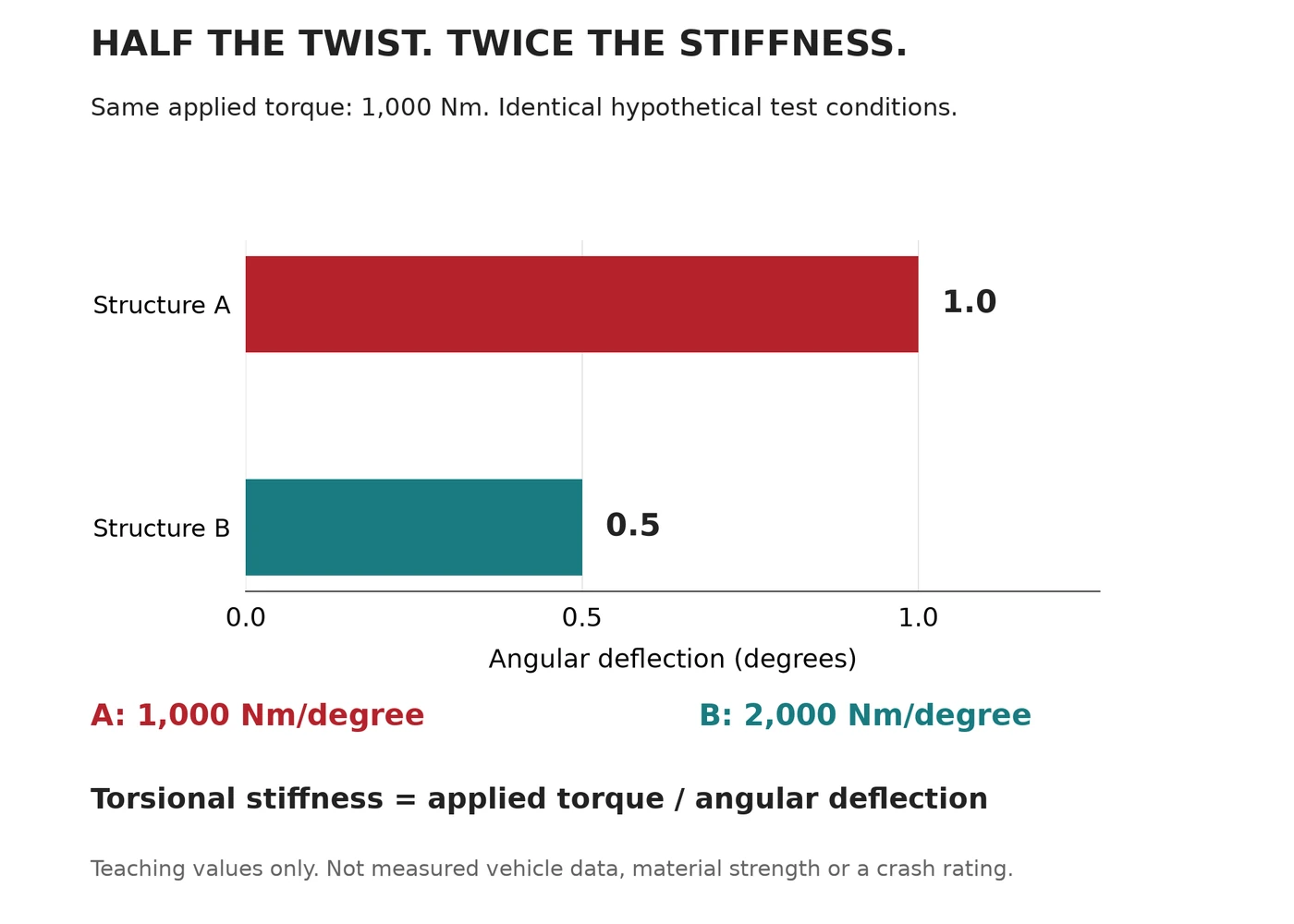
Real figures need matching test conditions. A bare shell, a complete body with bonded glass and a finished vehicle are not interchangeable test specimens. Comparing isolated marketing numbers without knowing the fixtures and included components can be misleading.
Why stiffness can help comfort as well as handling
Suspension is supposed to move in planned ways. Excessive movement of the structure supporting it can change mounting relationships and introduce unwanted motion. A stiffer foundation gives engineers more control over what the springs, dampers and bushings are doing.
That does not require a punishing ride. The body can resist twisting while tires, springs and selected mounts provide compliance. Reducing unwanted structural vibration can also support refinement, although noise and vibration depend on the complete design, not stiffness alone.
This is an important distinction: a stiff body is not the same thing as stiff suspension.
Why removing the roof changes the problem
A coupe’s roof and connected pillars can contribute to structural load paths. Removing that upper connection for a convertible changes how the remaining body must carry loads. Engineers may reinforce the sills, floor or other areas; the roof mechanism can add mass too.
It is not universal that every convertible needs large amounts of extra bracing. A structure designed around an exceptionally stiff lower tub can rely less on its roof from the beginning. The starting architecture determines the challenge.
Aluminum and carbon fiber: useful tools, not magic words
Aluminum has lower density than steel, but also a lower elastic modulus, a material’s resistance to elastic strain. An aluminum part may need a different shape or thicker section to meet the same stiffness target. It is not a one-for-one exercise in replacing every steel piece with an identical lighter copy.
Carbon-fiber-reinforced plastic can offer excellent stiffness for its mass when the fibers, layers and joints are designed for the loads. It can also be costly to manufacture, inspect and repair. A carbon-look trim panel tells us nothing about the structural material underneath.
The McLaren 750S Spider is a concrete example of a carbon-fiber Monocage structure. By contrast, a steel unibody with selected aluminum components is a different engineering solution, not necessarily an inferior attempt at the same car.
Removing mass from high in the body can be particularly useful for its location. BMW’s M3 and M4 technical introduction connects the carbon roof with reducing mass and lowering the center of gravity. The lesson is about where material is saved, not just the appearance of carbon weave.
5. Crash Structures and Subframes: Different Jobs Within the Body
Why a safe car must sometimes deform
The safest structure is not one that refuses to change shape anywhere. In a crash, the vehicle must manage motion and energy while limiting harmful loads and intrusion around its occupants.
Controlled deformation in appropriate areas provides distance over which the vehicle can slow down. Meanwhile, the passenger cell is designed to preserve survival space. Seat belts and airbags work with the structure to manage occupant motion; none of these systems can be judged properly in isolation.
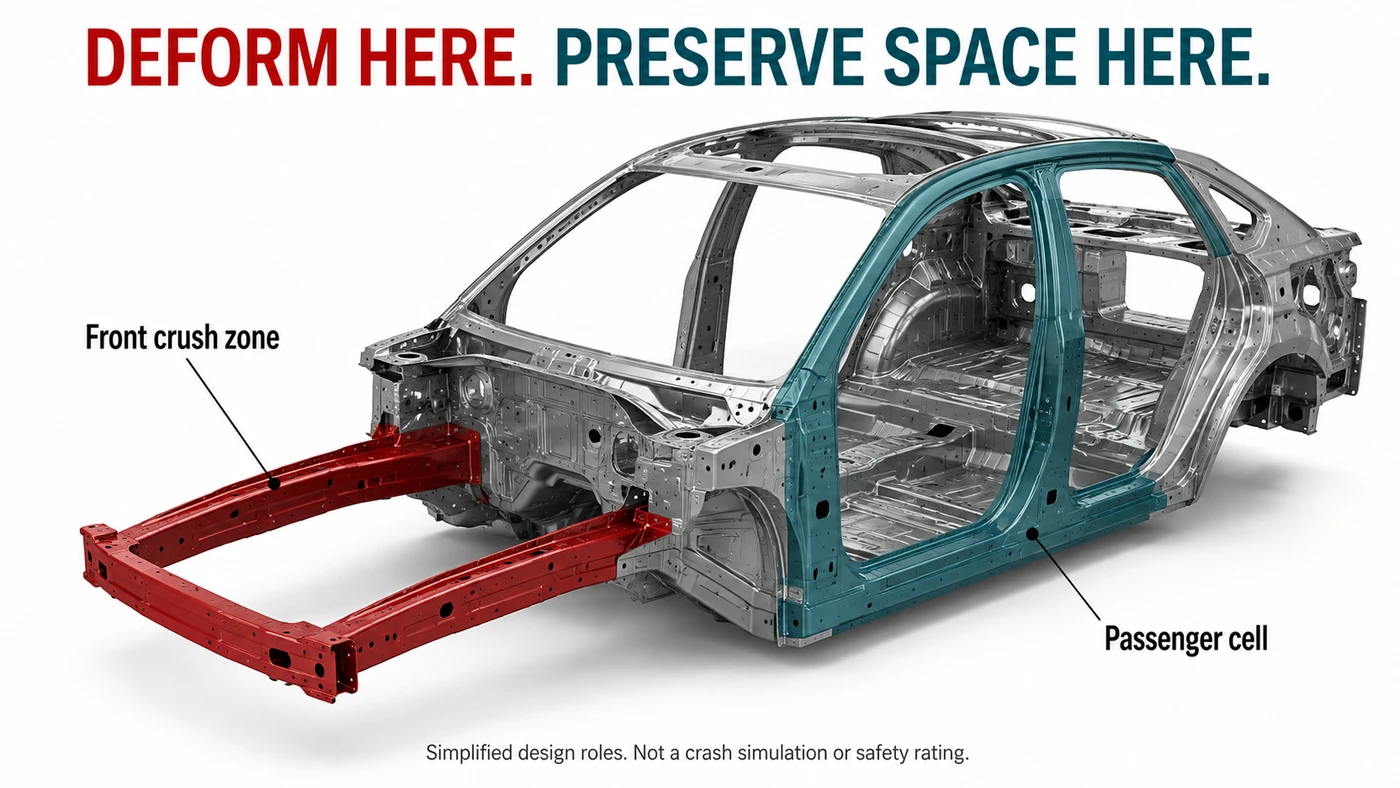
A heavily crumpled front end therefore does not, by itself, prove weak engineering. Nor does little visible exterior damage prove that occupants experienced low forces. Crash direction, overlap, speed and the object struck change what happens.
Vehicle size and mass remain relevant. All else equal, greater crush space and the dynamics of a collision with a lighter vehicle can favor occupants of the larger vehicle. That is not a reason to declare the heaviest vehicle safest for everyone: compatibility and the risk imposed on other road users matter too. The IIHS explanation of size and weight adds this necessary context.
Neither body-on-frame nor unibody wins every crash by definition. Look at the relevant crash-test results and their test conditions, along with the vehicle’s restraints and avoidance systems. A torsional-stiffness figure is not a crash rating.
What a subframe does
A subframe is a smaller structural cradle attached to the main body or chassis. Depending on the vehicle and its location, it supports suspension components, powertrain components, or a combination of them.
It collects local loads and transfers them into the main structure through its mounts. It can also allow components to be assembled as a module. Magna’s chassis systems overview shows how subframes and cradles form part of modern vehicle construction.
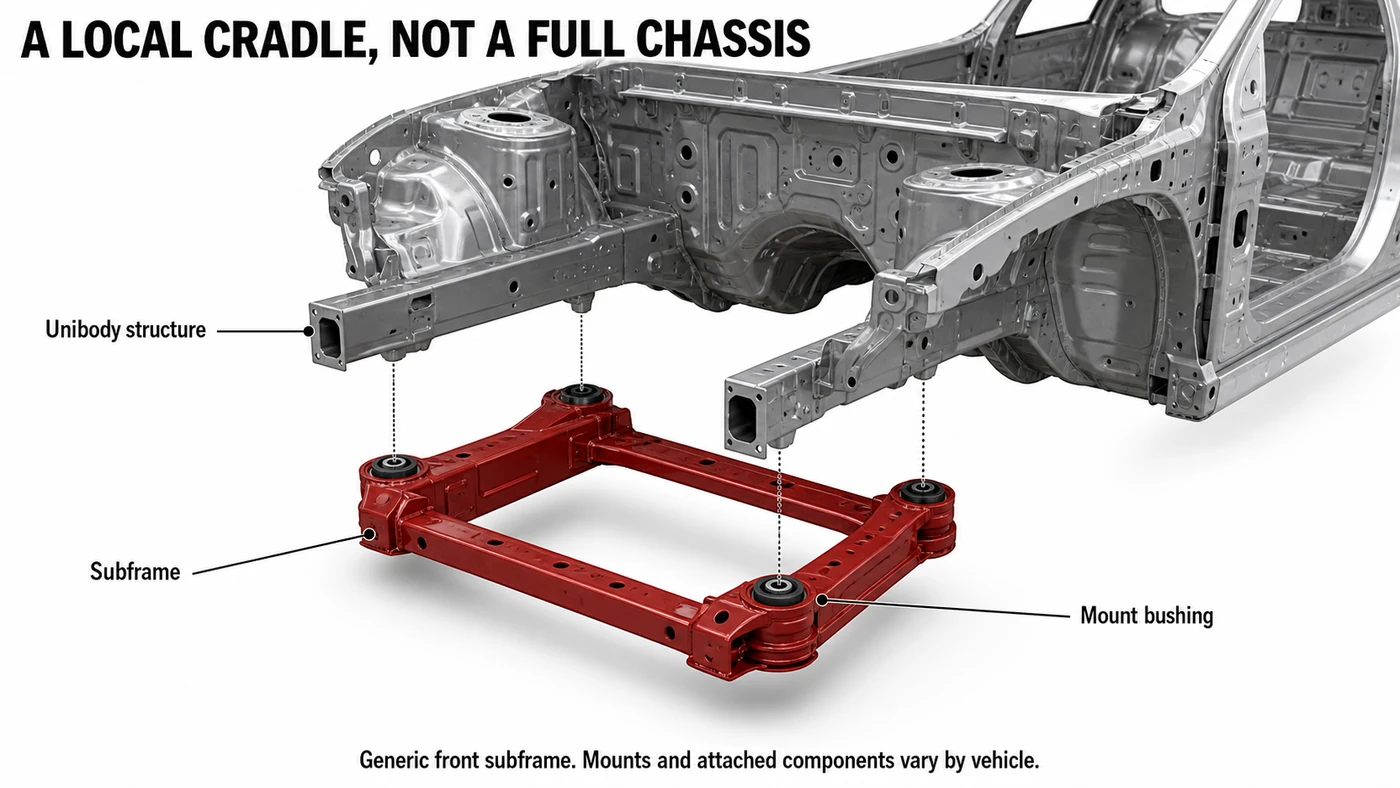
Some designs use rubber or other elastic elements in the mounts to help isolate vibration. Others use more rigid attachment where controlling movement is the priority. That is a tuning decision: too much unwanted movement can affect precision, while isolation can help keep harshness away from the cabin.
You may see this described as NVH, meaning noise, vibration and harshness. ZF’s rubber-to-metal component explanation discusses the role of elastic connections in this area.
Most importantly, a unibody with subframes is still a unibody. A local front or rear cradle does not turn it into a body-on-frame vehicle. Nor should a replaceable subframe be taken as proof that adjacent crash damage is simple: the surrounding structure and mounting points still require proper assessment.
Reading a Structure Specification Without Getting Lost
Suppose a specification describes an aluminum-intensive unibody, a front subframe, a carbon roof and a curb mass of 1,800 kg. Those details tell us about construction choices, but they do not tell us exactly how the car drives.
The useful next step is to ask what each choice is trying to achieve.
| Specification | What it can help explain | What it does not prove |
|---|---|---|
| Body-on-frame | A separate foundation suited to particular loads and body configurations | Unlimited toughness, towing capacity or crash protection |
| Aluminum-intensive unibody | An approach to structural efficiency and mass management | Lower mass than every steel-bodied car |
| Low-mounted battery | A major mass placed relatively low | Low total mass or immunity to rollover |
| 50:50 axle distribution | Static front-to-rear loading under stated conditions | Perfect handling in every maneuver |
| High torsional stiffness | Resistance to twisting in a specified test | An uncomfortable ride or a superior crash rating |
| Carbon roof | Mass reduction high in the body | A carbon-fiber passenger cell |
| Front subframe | A local mounting and load-carrying assembly | A separate full-length chassis frame |
Even curb-mass figures need comparable definitions and equipment. Fluids, fuel, optional equipment and the measurement convention can affect the reported number. A 1,500 kg car is not automatically an engineering success, and a 1,800 kg car is not automatically a failure.
We learned the same lesson with output in Part 1: Engine Power Basics. A peak number begins an explanation; it does not finish it.
Common Misconceptions
“A separate frame is always stronger.” Stronger against which load, with what mass and geometry? The architecture name alone cannot answer that.
“A low center of gravity cancels a heavy battery.” It changes where the mass acts, not how much mass must be accelerated.
“A rigid car must ride badly.” Structural stiffness and suspension compliance are different things. Engineers can combine them deliberately.
“More visible crash damage means less protection.” Controlled deformation can be doing useful work. Occupant loads and intrusion matter more than how tidy the body looks afterward.
“More carbon fiber always means better engineering.” Material choice needs a purpose, manufacturing method and repair strategy. It is not a score based on the amount of visible weave.
Cariary Thoughts
The part that changed my understanding most was the relationship between stiffness and movement. At first, it is tempting to imagine that a good car should be rigid everywhere. But the suspension needs to move, certain mounts need to isolate vibration, and crash zones need to deform.
The better question is: what should move, where, and under which load? That makes much more sense than asking whether a car is simply hard or soft, heavy or light.
It also brings this whole series together. An engine produces torque, a drivetrain delivers it, suspension manages wheel movement, and tires provide the forces that accelerate, turn and stop the vehicle. The structure connects those systems while carrying people and protecting space around them.
What I find satisfying is that understanding more does not lead to one universally perfect specification. It helps explain why a working pickup, a family EV and a lightweight sports car can arrive at different, sensible answers. Their purposes are different, so their engineering priorities should be too.
One-line Summary
Good engineering is rarely about maximizing one number. It is about balancing everything.
FAQ
What is the difference between a chassis and a body?
The body encloses the occupants and shapes the vehicle. Chassis can describe the supporting structure and running systems, although usage varies. In a unibody vehicle, the body itself is part of the load-bearing structure, so the terms do not always identify two separate assemblies.
Is monocoque construction better than body-on-frame?
It depends on the job. An integrated shell can offer useful structural and packaging efficiency, while a separate frame suits many heavy-duty and modular applications. Design quality and the vehicle’s requirements matter more than declaring one architecture universally superior.
Why do electric cars often have a low center of gravity?
Many place a substantial battery pack beneath the passenger floor. Keeping that mass low helps lower the combined center of gravity. Body height, other components, passengers and cargo still affect the final position.
Does a heavier car always take longer to stop?
No. More mass means more energy at a given speed, but a single stopping distance is also governed by tire-road forces and the complete braking system. Repeated stops can make thermal capacity increasingly important; that is not the same as a universal distance rule.
Does higher chassis rigidity improve ride comfort?
It can help engineers control unwanted structural movement and let the suspension work more consistently. Comfort still depends on tires, springs, dampers, mounts and vibration behavior. Stiffness is a foundation for tuning, not a comfort guarantee.
Does a subframe mean the car is body-on-frame?
No. A subframe is a local supporting assembly, often at the front or rear. A unibody can use both while its integrated shell remains the main vehicle structure.
Why not make the entire car as strong and rigid as possible?
Because different areas have different jobs, and additional material can add mass and cost. Crash management also requires planned deformation outside a protected occupant space. The goal is appropriate behavior under different loads, not maximum resistance everywhere.
Related Thoughts: Complete the Five-Part Series
- Part 1: Engine Power Basics connects combustion, boost, torque and power.
- Part 2: Drivetrain Basics follows the route from the power source to the road.
- Part 3: Suspension Basics explains how wheel movement becomes handling and comfort.
- Part 4: Brake and Tire Basics separates grip, heat capacity and impressive-looking hardware.
- Body-on-Frame vs Monocoque takes a closer look at two major structural approaches.
References
- Toyota: Land Cruiser 300 development and frame architecture
- Toyota: Hilux Hybrid 48V construction
- Mercedes-Benz: G-Class construction and capabilities
- Stellantis: 2024 Jeep Wrangler introduction
- Ford: 2021 F-150 technical specifications
- Land Rover: Defender D7x monocoque introduction, German-language release
- Magna: Body-in-white solutions
- U.S. Department of Energy: Lightweight and propulsion materials
- U.S. Department of Energy: Magnesium and carbon-fiber research
- Porsche: Taycan layout
- Porsche: Why the 911 engine is in the rear
- NHTSA: Rollover research
- BMW: M3 and M4 carbon-roof engineering
- McLaren: 750S Spider carbon-fiber structure
- IIHS: Vehicle size and weight
- Magna: Chassis systems and subframes
- ZF: Rubber-to-metal components and vibration isolation
Data Reference Date: September 7, 2026. Vehicle examples refer to the generations described in the linked sources. Illustrations are generic teaching aids, not manufacturer drawings; numerical diagrams use stated idealized assumptions rather than vehicle test data.

