Car myths often begin with something true. All-wheel drive can help a car accelerate on a slippery road. A larger brake can cope with more heat. A powerful engine gives engineers more performance to work with. Then a useful advantage quietly becomes a rule: more must be better, everywhere.
I have caught myself making that jump too. It is much easier to compare two horsepower figures than to understand why the supposedly slower car feels so composed. This series grew from wanting to look beyond the obvious number, without needing an engineering degree to enjoy the answer.
Here are ten familiar claims, the missing context behind each, and the full Cariary article to explore next. The point is not to dismiss good technology. It is to understand what it can do, what it cannot do, and what the rest of the car must contribute.
Quick Summary
- A specification describes an attribute, not the complete driving experience.
- Traction, braking, comfort and sustained performance are different tasks.
- Tires, temperatures, road conditions and calibration can change the answer.
- Each thumbnail below leads to the corresponding full explanation.
- The most useful question is: What problem was this technology designed to solve?
The 10 Car Myths at a Glance
| Topic | The tempting shortcut | The missing context |
|---|---|---|
| AWD | Safer in every wet-road situation | Acceleration traction is not a guarantee of braking or cornering grip. |
| Premium fuel | Higher octane adds horsepower | The engine must be able to use the extra knock resistance. |
| Warm-up | A longer idle is always kinder | Most modern cars warm efficiently through gentle driving. |
| Bigger wheels | More inches mean more performance | Tire construction, assembly weight and fitment matter. |
| Bigger brakes | More pistons mean a shorter stop | Tire grip and repeated-stop heat management are different limits. |
| Horsepower | A higher peak wins everywhere | Mass, gearing, traction and drag shape usable performance. |
| Torque | More Nm means stronger acceleration | Gearing and tire radius turn shaft torque into road force. |
| Stiff suspension | Less movement means more grip | Tires still need to follow an uneven surface. |
| Multi-link | More links guarantee a better car | Geometry and tuning determine how the potential is used. |
| Heavy cars | More mass means poor cornering | Mass placement, tires and chassis control also matter. |
1. Is AWD Really Safer in the Rain?

The myth: AWD makes a car safer in every wet-road situation.
All-wheel drive can spread propulsion across more tires, helping with a slippery launch or a wet uphill road. That is a genuine advantage. But accelerating without wheelspin and stopping for an obstacle are not the same task: ordinary FWD, RWD and AWD passenger cars already brake at all four wheels.
Stopping and turning still depend heavily on the tires and road. An AWD badge does not restore worn tread or prevent hydroplaning, when water interferes with tire contact. Speed, standing water, tire condition and the driver’s decisions remain important. A well-tired two-wheel-drive car can outperform an AWD car on unsuitable tires in particular braking or cornering conditions; the badge alone cannot settle it.
Takeaway: AWD can help you get moving. It does not give your tires unlimited grip.
Read the full article: Is AWD Really Safer in the Rain?
2. Does Premium Fuel Actually Make Your Car Faster?
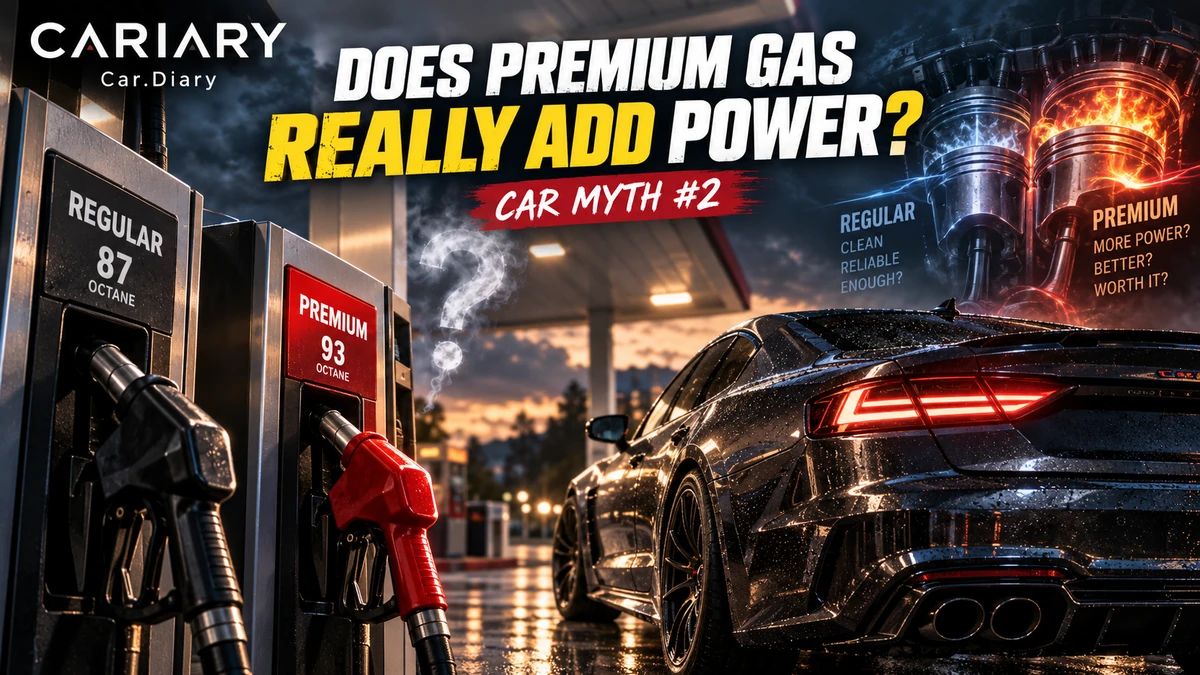
The myth: higher octane automatically creates extra horsepower.
Octane mainly describes resistance to knock, an unwanted form of combustion, not how much energy a fuel contains. An engine designed and calibrated to use higher-octane fuel may benefit through its compression, boost or ignition strategy. A higher pump number is not a universal power upgrade.
The wording in the manual matters. Required means meet that requirement. Recommended may mean the best performance depends on premium while a specified lower grade is permitted. If the engine is intended for regular fuel, premium may offer little or no normal-driving benefit. Also check the rating system: RON and North American AKI are different scales, not directly interchangeable numbers. The DOE and EPA octane guide explains the underlying distinction.
Takeaway: the correct fuel is the fuel your engine was designed to use.
Read the full article: Does Premium Fuel Actually Make Your Car Faster?
3. Do Modern Cars Still Need to Warm Up?
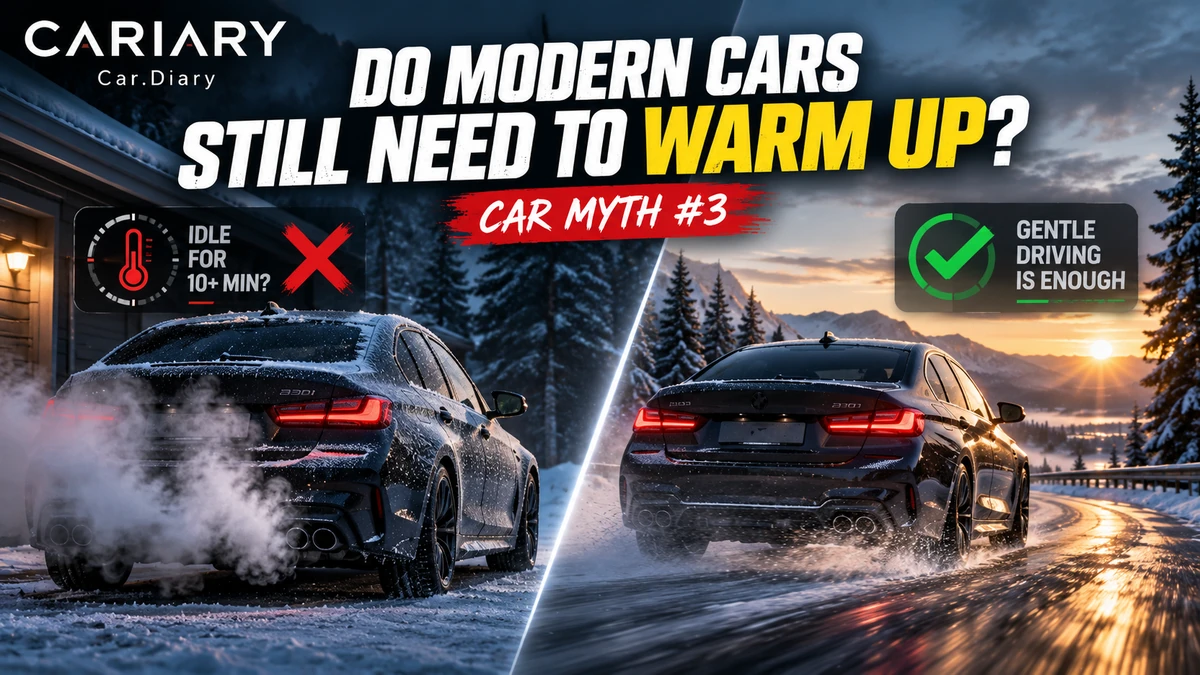
The myth: every modern engine needs five to ten minutes of idling before driving.
Warm-up still matters; prolonged stationary warm-up usually does not. For ordinary modern fuel-injected cars, a brief period to stabilize, followed by gentle driving, generally brings the vehicle toward operating temperature more efficiently. Driving also puts the transmission and other driveline components to work, rather than warming only the engine slowly at idle.
Gentle means avoiding heavy throttle, high engine speeds and demanding loads while cold, not racing away immediately. Follow the actual manual, especially in extreme cold or with a diesel, hybrid or older carbureted vehicle. Clear the windows before moving, and never run the engine in an enclosed space or attached garage. The official cold-weather fuel-economy guidance supports minimizing unnecessary idling, not skipping safe preparation.
Takeaway: modern cars need to warm up, but usually not by sitting still for a long time.
Read the full article: Do Modern Cars Still Need to Warm Up?
4. Are Bigger Wheels Actually Better?
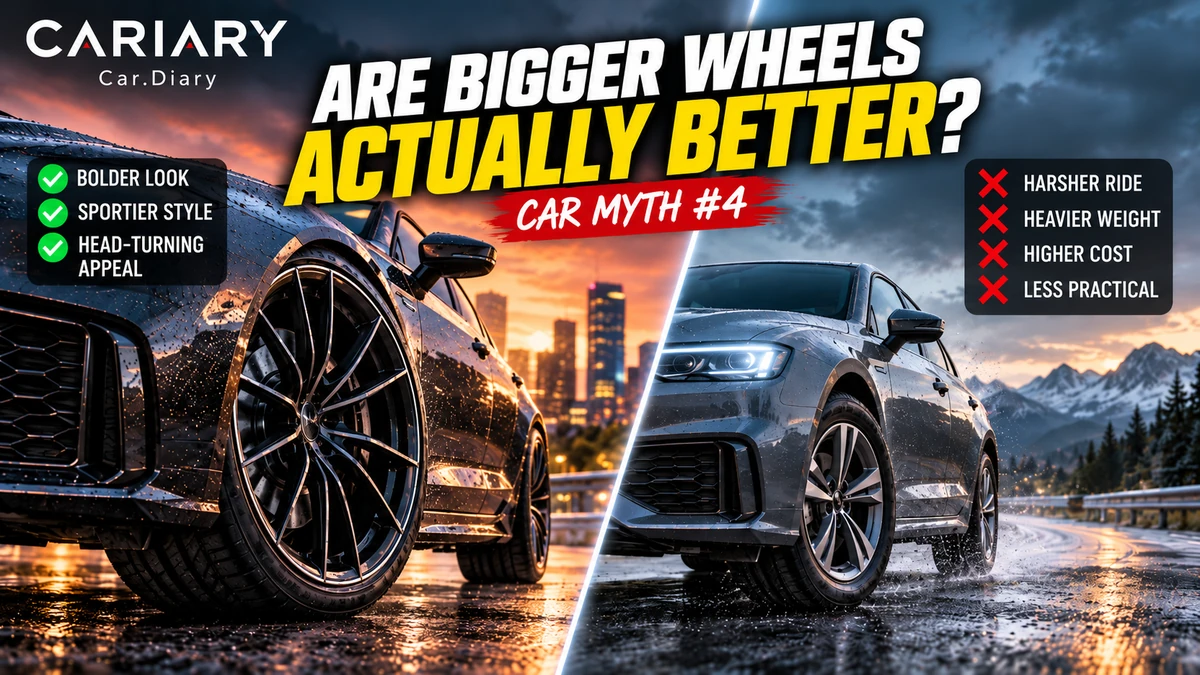
The myth: a larger wheel diameter makes the car perform better.
Larger wheels can make room for bigger brakes and, when overall tire diameter is kept similar, often come with a shorter tire sidewall. Depending on construction, that can sharpen steering response. Yet it can also reduce impact cushioning and increase pothole vulnerability, replacement cost or energy use.
The wheel-and-tire assembly is both rotating mass and part of the unsprung mass that follows road irregularities. Its actual weight and mass distribution matter, not just its diameter. A light 19-inch assembly may be preferable to a heavy 20-inch one for a particular job, but neither diameter nor the word forged proves the result. Compare compatible sizes, loads, clearances and tires, not isolated inches.
Takeaway: a bigger wheel can look faster without making the car faster.
Read the full article: Are Bigger Wheels Actually Better?
5. Do Bigger Brakes Really Stop a Car Faster?
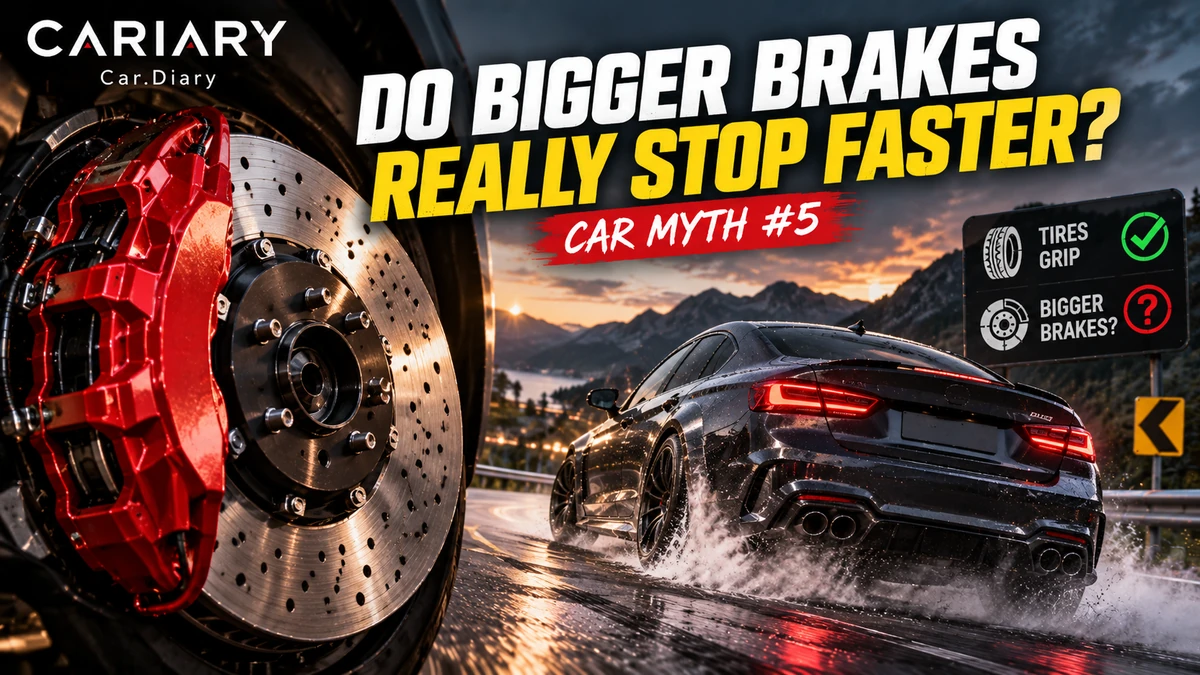
The myth: a large rotor and six-piston caliper guarantee a dramatically shorter stop.
If healthy existing brakes can already reach the available tire grip, adding brake size alone may do little for one emergency stop. That does not make an upgrade pointless. Repeated hard braking asks the system to absorb and reject heat, and this is where suitable rotors, pads, fluid, cooling and calipers can make a substantial difference.
Fade means braking performance deteriorating as components become too hot. A track session repeatedly creates this challenge, unlike a single stop with cool brakes. Piston count alone is not a thermal-capacity measurement, and no upgrade excuses poor tires or neglected maintenance. Brembo’s explanation of interacting brake-system factors is a useful reminder to consider the complete assembly.
Takeaway: good performance brakes help a car stop hard repeatedly, not just look impressive through the wheel.
Read the full article: Do Bigger Brakes Really Stop a Car Faster?
6. Does More Horsepower Always Mean a Faster Car?
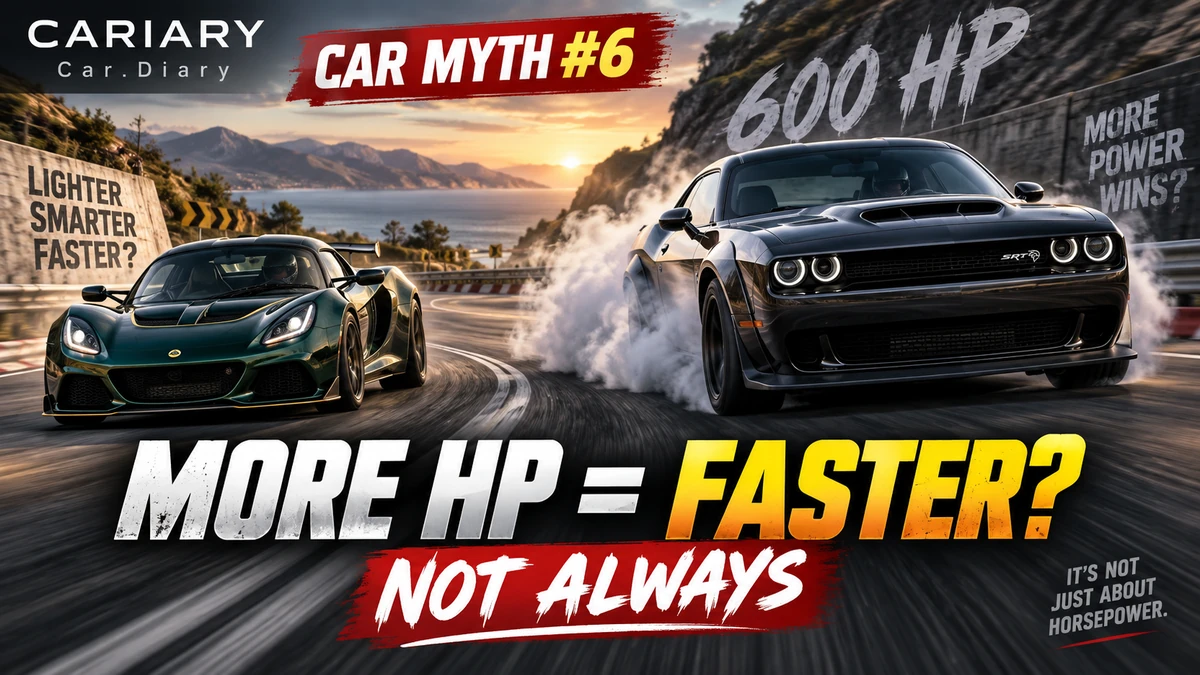
The myth: 500 hp must beat 400 hp in every situation.
Power measures the rate of doing work, but a peak engine figure is only one input. Consider two hypothetical cars: 500 hp moving 2,200 kg is about 227 hp per tonne, while 400 hp moving 1,400 kg is about 286 hp per tonne. The lower-output car has the stronger power-to-weight ratio. Those numbers are illustrative calculations, not a prediction of race results.
Traction can dominate the launch, while gearing, shifts and the usable power curve influence acceleration afterward. At higher speeds, aerodynamic drag becomes increasingly important. A rolling acceleration test, standing start and circuit lap ask different questions, so one horsepower ranking cannot answer all three. More power adds potential; delivering it is a whole-car job.
Takeaway: horsepower creates potential. The whole car decides how much becomes usable speed.
Read the full article: Does More Horsepower Always Mean a Faster Car?
7. Does More Torque Always Mean Better Acceleration?
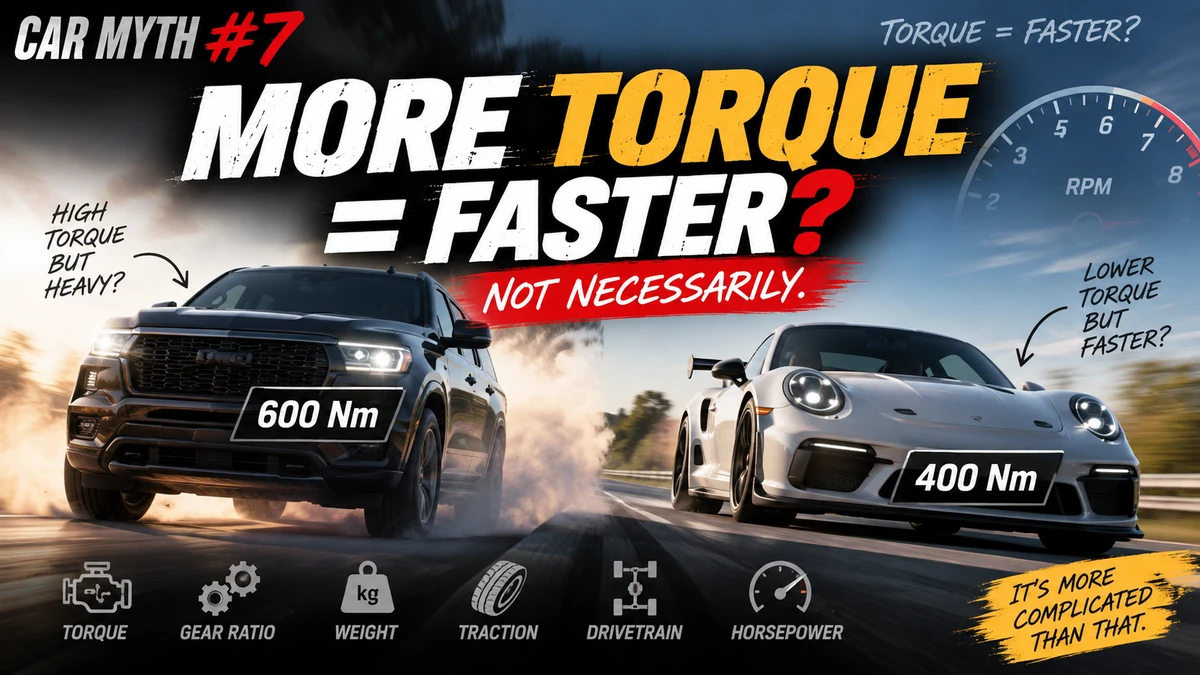
The myth: the larger Nm figure tells us which car accelerates harder.
Torque is a turning effect. Engine torque passes through the gearbox and final drive before reaching the wheels. Those reductions multiply torque while reducing rotational speed; the differential also allows the driven wheels to rotate at different speeds in a corner. A smaller engine-torque number can therefore produce substantial wheel torque with suitable gearing.
Road force depends on that wheel torque and the tire’s effective rolling radius, with losses and available grip also involved. Power relates torque to rotational speed: multiplying Nm directly by RPM needs a unit conversion before the result becomes kW or horsepower. A high-revving engine can make strong power without a huge peak torque figure. The rotational-power relationship connects the two rather than making them rivals.
Takeaway: follow the torque all the way to the tire before judging acceleration.
Read the full article: Does More Torque Always Mean Better Acceleration?
8. Does Stiffer Suspension Really Mean Better Handling?
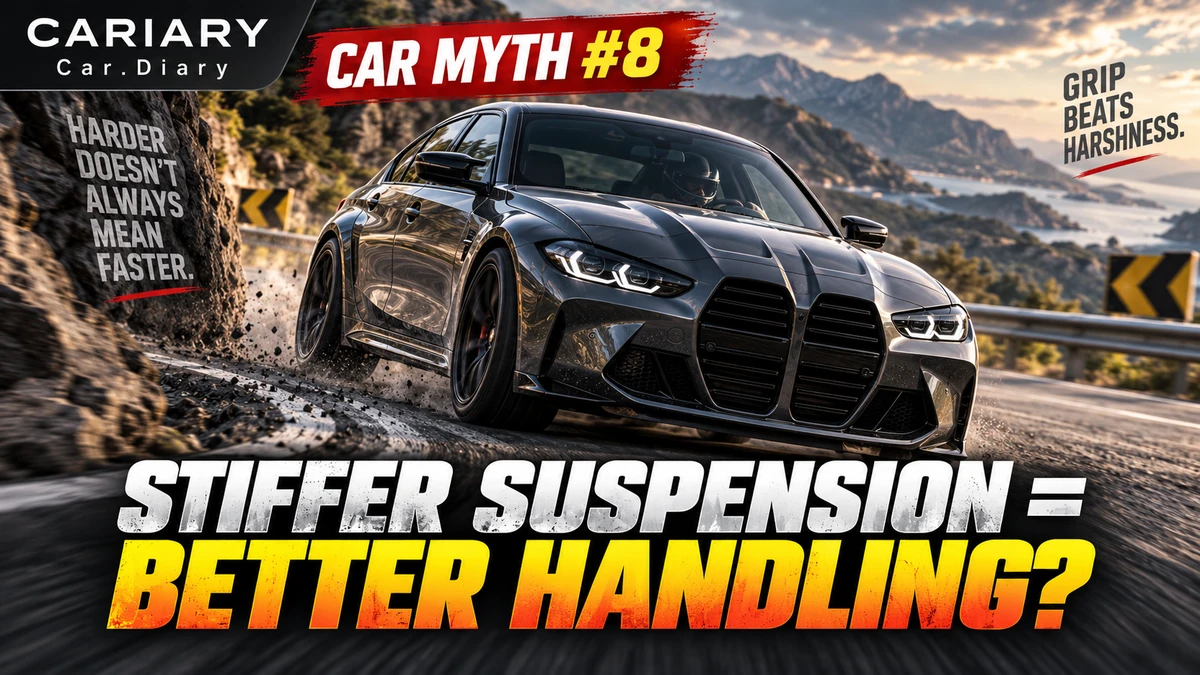
The myth: a car that moves less must corner faster.
Suspension must control the body while helping the tires follow the surface. Springs support loads; dampers control the rate of movement. Making either behavior more aggressive without considering the other can leave the car poorly matched to its road. Too much stiffness or inadequate travel can make uneven surfaces harder for the tires to follow.
A smooth circuit and a broken country road need different compromises. Rally cars make the value of travel and compliance especially visible, but simply making a road car softer is not a universal answer either. Body roll is a clue about movement, not a direct grip meter. The useful target is controlled movement with the tires still working, not the least movement possible.
Takeaway: a suspension can be too stiff for the road it needs to handle.
Read the full article: Does Stiffer Suspension Really Mean Better Handling?
9. Is Multi-Link Always Better Than a Torsion Beam?
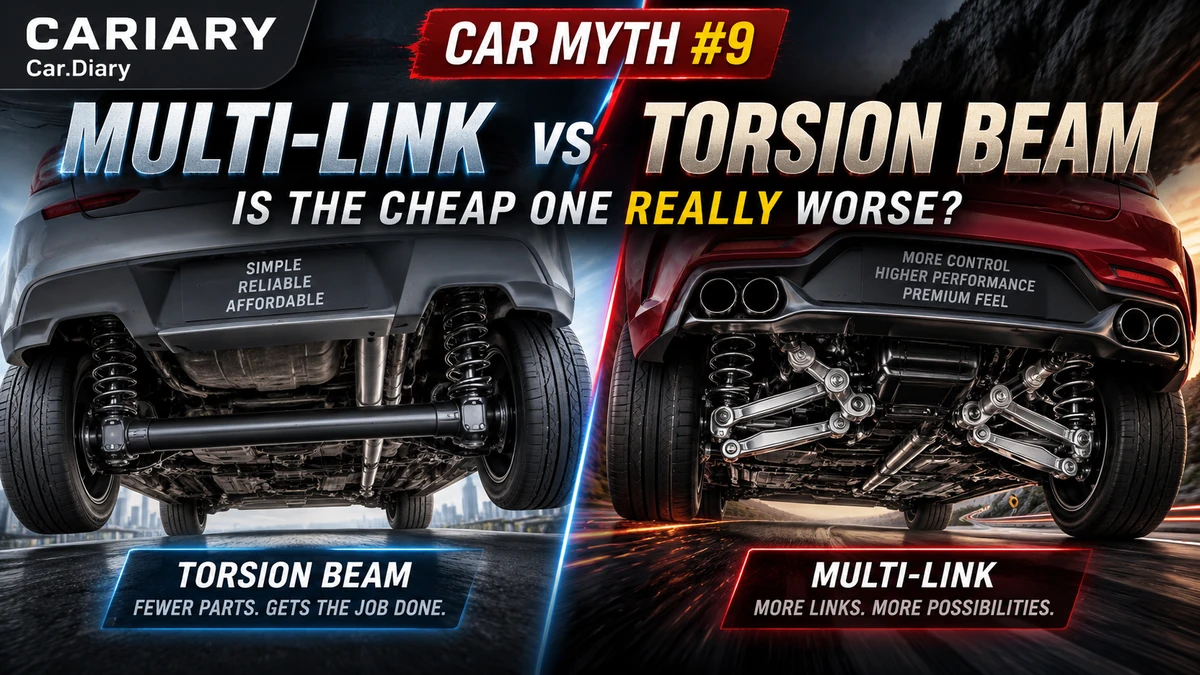
The myth: multi-link means good; torsion beam means cheap and bad.
A multi-link layout gives engineers more freedom to guide wheel movement and manage camber, the wheel’s inward or outward tilt, and toe, its direction viewed from above. That freedom can help balance ride and handling. It is an opportunity, though, not a guarantee that every implementation will use it well.
A torsion beam links the rear wheel assemblies through a crossmember that can twist. It generally offers fewer independent adjustments, but can save space, cost and complexity. Dampers, bushes, tires, geometry and the supporting body still shape the result. Volkswagen’s Golf running-gear explanation illustrates tuning within different layouts. The complete vehicle matters more than counting its links.
Takeaway: multi-link offers more tuning freedom, not an automatic promise of better tuning.
Read the full article: Is Multi-Link Always Better Than a Torsion Beam?
10. Are Heavy Cars Always Bad at Cornering?
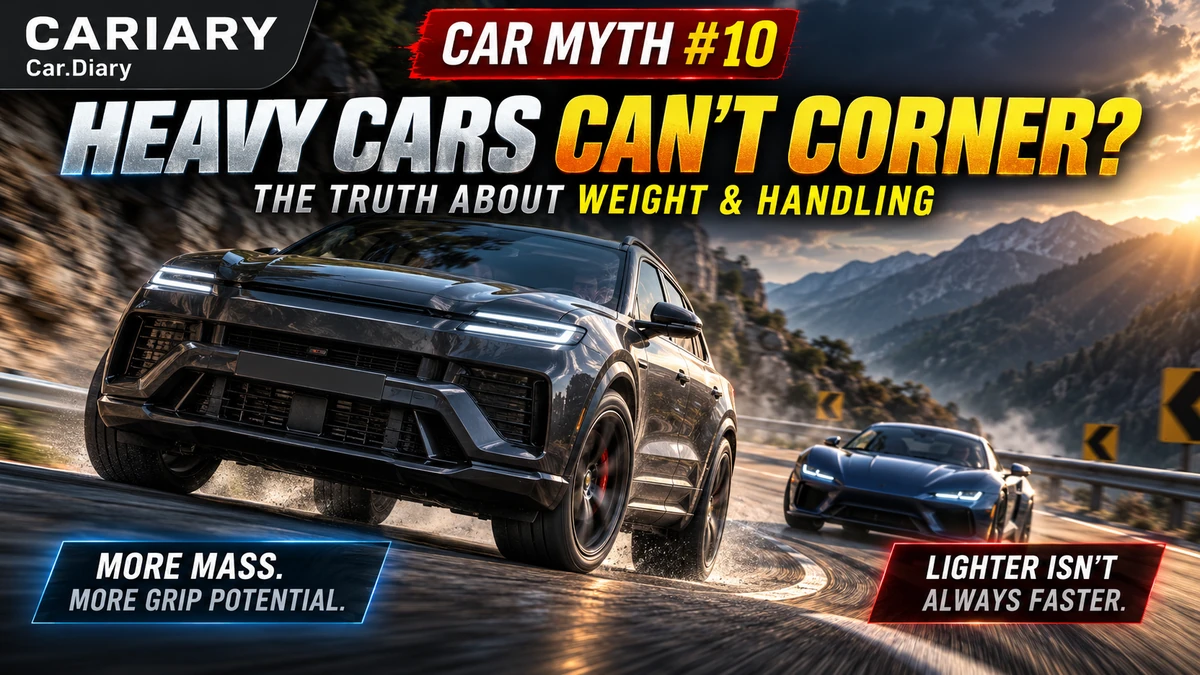
The myth: more mass automatically means poor handling.
Lightness is valuable, but mass alone does not describe where the weight sits or how the tires are controlled. A low center of gravity can reduce lateral load transfer for otherwise similar conditions. Mass concentrated nearer the car’s center can also help its response to turning, although a low battery position does not by itself prove low rotational inertia.
Suitable tires, rear-wheel steering, torque distribution and active chassis systems can make a large car impressively capable. Porsche’s original Taycan chassis explanation shows several of these tools working together. None deletes mass: more energy must be managed at a given speed, and sustained performance still faces thermal and tire demands. Wear and stopping distance cannot be predicted from weight alone either.
Takeaway: engineering can manage the effects of weight. It cannot remove the weight itself.
Read the full article: Are Heavy Cars Always Bad at Cornering?
What All These Car Myths Have in Common
A real advantage becomes an easy label, then the label gets stretched beyond its meaning. More driven wheels become total safety. More caliper pistons become shorter stops. More horsepower becomes faster everywhere. The technology is not the problem; the missing conditions are.
Specifications are useful precisely because they simplify. What they leave out may include calibration, the software and settings that coordinate a system; tire compound; suspension mounting points; or cooling under repeated load. Marketing naturally highlights a memorable number. Understanding starts when we ask what that number leaves unsaid.
The tire keeps reappearing
The engine produces power, the drivetrain delivers it, and the tires turn it into road force. Suspension helps those tires remain effective; brakes manage motion and heat. This is why tires keep returning in discussions of AWD, stopping, acceleration and cornering. Four contact patches connect those apparently separate arguments.
That does not mean tires are a magic replacement for everything else. They need appropriate loads, pressure, temperature and supporting hardware. NHTSA’s tire guidance explains the importance of condition, correct fitment and inflation. Check the vehicle’s specified cold pressures rather than treating the maximum sidewall pressure as the normal target.
Almost every advantage asks for something back
AWD can add traction along with hardware and mass. A large wheel can make room for a brake while reducing sidewall cushioning. A sophisticated suspension can offer control while consuming space and adding joints. These are not arguments against progress. They explain why different vehicles can make sensible but different choices.
The useful answer to “Is it better?” therefore starts with a more specific question: better on what surface, at what temperature, under what load, and for which task? A system optimized for repeated circuit braking does not necessarily improve a quiet commute in the same proportion.
Better Questions for Real Cars
Before comparing options or modifications, identify the problem. Is it wheelspin on a steep driveway, brake fade during properly supervised track use, or harsh impacts on the roads actually driven? A specification is meaningful only when it addresses that problem.
- Instead of “Is AWD better?” ask which traction limitation it would address and what the tires need to do.
- Instead of “Should the brakes have six pistons?” ask whether the limitation is heat, condition, control or road grip.
- Instead of “Will a bigger wheel improve handling?” compare the complete compatible wheel-and-tire package.
- Instead of “Would harder suspension feel sportier?” ask whether the current car needs better body control, more compliance or maintenance.
This is a way to understand the car, not a prescription for replacing parts. A fault, warning light or unsafe behavior needs qualified inspection; changing components around an undiagnosed problem can make the picture less clear. Public roads are not a place to test the limits described here.
From Car Basics to Car Myths
Our Car Basics for Enthusiasts: The Complete Guide asks: What is this part, and how does it work? This collection asks the next question: Why do we misunderstand what it does?
Start with the foundations when a term feels unfamiliar, then return to the myth that made you curious. Engines and gearing make the horsepower and torque articles easier to follow. Learning how springs, dampers and tires work helps connect stiffness, suspension layout and vehicle weight. There is no need to memorize every formula before the connections become useful.
Cariary Thoughts
What stayed with me while putting these ten topics together was how often the first answer was partly right. Bigger brakes can be genuinely useful. Multi-link suspension really does offer opportunities. More power is not meaningless. The mistake comes when an advantage becomes the only thing we notice.
I do not want to replace “bigger is always better” with “the simpler car is always better.” That would be the same shortcut wearing a different badge. A complex solution can be excellent when its purpose, execution and compromises make sense together.
For me, the satisfying change is learning to ask a better follow-up question. Not just “How much?” but “Where, when and why?” The specification sheet then becomes the beginning of understanding a car, rather than the end of the conversation.
One-line Summary
A specification can tell you what a car has; understanding the system tells you why it works the way it does.
FAQ
Are all ten claims completely false?
No. Most begin with a real advantage and become misleading when applied without conditions. The series separates what can be useful from what cannot be guaranteed.
Which car myths should a beginner read first?
Start with a question connected to everyday driving, such as wet-road traction, fuel choice or warm-up. Then follow horsepower into torque, or wheels into brakes and suspension. The topics connect without requiring one fixed order.
Does this mean performance specifications are useless?
Not at all. Compare equivalent measurements, then ask what the test conditions and supporting systems were. Peak power and a repeatable acceleration measurement answer different questions.
Are expensive or complicated components usually unnecessary?
Their value depends on the task. Extra cooling or more adjustable suspension geometry can solve genuine problems. Complexity is neither proof of quality nor proof of waste.
Can better tires make every car perform the same?
No. Tires are crucial, but geometry, mass, brakes, power delivery and electronic controls remain different. Suitability also depends on the weather and intended use; one tire type is not best in all conditions.
Should I change fuel or warm-up habits based only on this guide?
Use this guide to understand the reasoning, then follow your vehicle’s manual. Fuel requirements, cold-weather instructions and powertrain controls vary. General explanations do not override model-specific instructions.
Related Thoughts
Car Basics for Enthusiasts: The Complete Guide connects five foundation guides covering engines, drivetrains, suspension, brakes and tires, and vehicle structure. The ten illustrated sections above connect directly to the individual Car Myths articles.
References
Data Reference Date: September 7, 2026. The individual articles provide expanded technical sources and examples; the following primary references support the central distinctions summarized here.
- DOE and EPA: selecting the right octane fuel.
- DOE and EPA: fuel economy in cold weather.
- NHTSA: tire selection, condition and inflation.
- Brembo: interacting factors in a braking system.
- OpenStax: work and power for rotational motion.
- Volkswagen: Golf running-gear layouts and tuning.
- Porsche: original Taycan chassis systems.

